19 past-paper questions on this unit. Five of them are below. Answer on the page: each one is marked the moment you pick, the correct option is shown whether or not you found it, and the full explanation opens either way.
CIE 0620 ChemistryPaper 1 and Paper 2 MCQsFree account
Group I properties: five questions to try now
Real past-paper questions, the answer key from the mark scheme, and the explanation that goes with it. No account needed to answer them.
Question 1
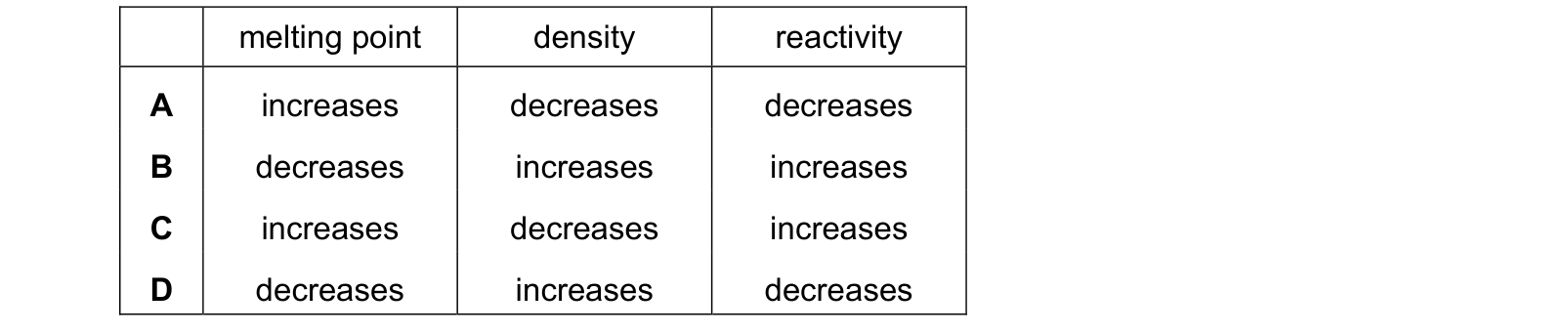
Which row shows the trend in melting point, density and reactivity as Group I is descended? Each answer gives, in order: melting point; density; reactivity.
Answer: B.
Three trends have to be recalled at once. Melting point falls as Group I is descended, from 181 °C for lithium to 28 °C for caesium, because the atoms grow larger and the metallic bonding weakens. Density rises, from lithium, which floats on water, down to caesium, which is nearly twice as dense as water. Reactivity rises as well, since the single outer electron lies further from the nucleus and is lost more easily. Decreasing, increasing, increasing is therefore the only workable row, and any row with reactivity falling contradicts the familiar demonstration that potassium reacts far more violently with water than lithium.
Question 2
Some information about element X is given. ● melting point = 64 °C ● density = 0.86 g / cm³ ● vigorous reaction with water Where in the Periodic Table is X placed?
Answer: B.
A melting point of 64 °C is remarkably low for a metal, a density of 0.86 g per cm cubed is below that of water, and a vigorous reaction with water is the signature of an alkali metal; all three fit potassium and place X in Group I. Group 0 elements are unreactive gases and would not react with water at all. Group VII elements are non metals, and the halogens dissolve in water or react with it slowly rather than fizzing vigorously. Transition metals have high melting points, high densities and react with water slowly if at all, so every clue points away from them.
Question 3
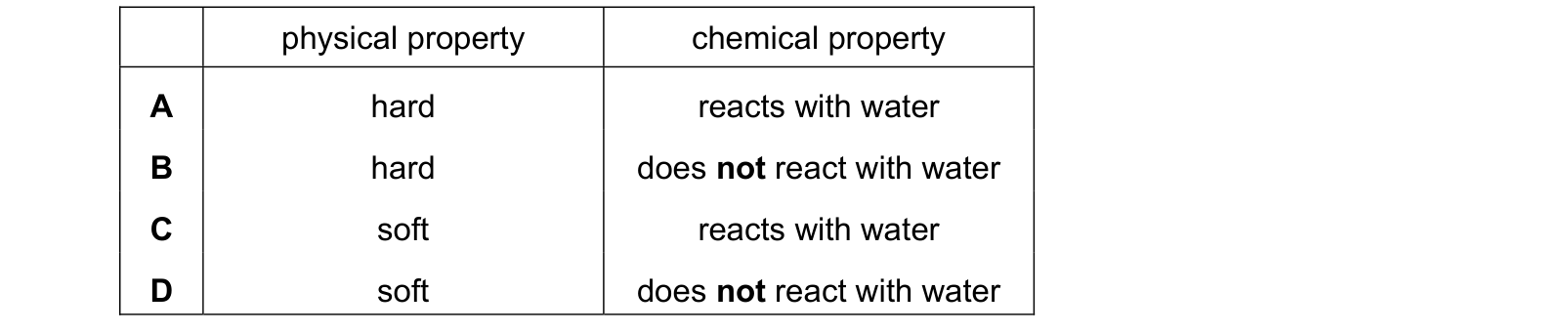
Rubidium is an element in Group I of the Periodic Table. Which row describes a physical property and a chemical property of rubidium? Each answer gives, in order: physical property; chemical property.
Answer: C.
A physical property can be observed without turning the substance into something else, and softness is exactly that: rubidium, like every Group I metal, is soft enough to cut with a knife because the metallic bonding is weak. A chemical property describes how the substance reacts, and rubidium reacts vigorously with water to give hydrogen and rubidium hydroxide. Soft with reacts with water is therefore the row. Describing rubidium as hard would place it among the transition metals, and saying it does not react with water contradicts the defining behaviour of the alkali metals.
Question 4
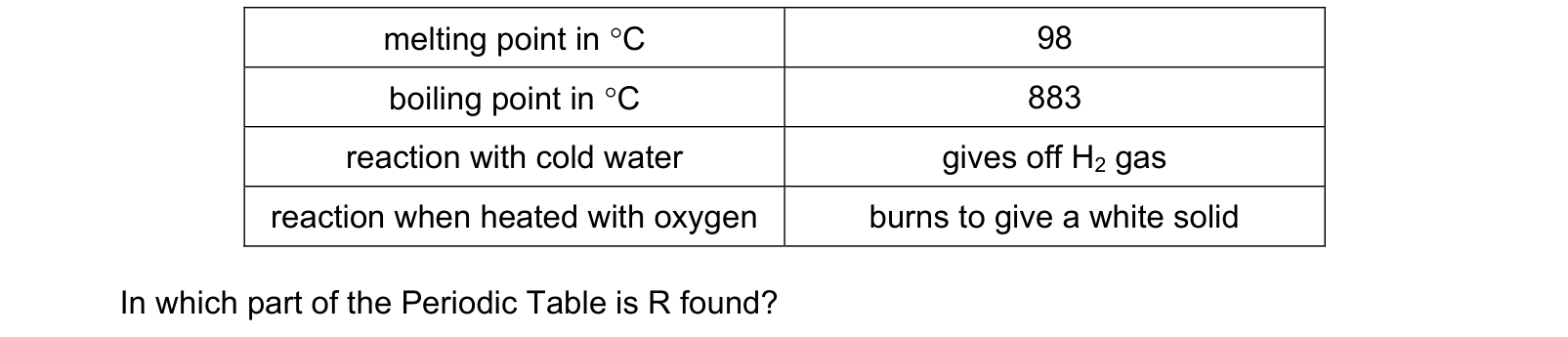
Some properties of element R are shown. melting point in °C 98 boiling point in °C 883 reaction with cold water gives off H2 gas reaction when heated with oxygen burns to give a white solid In which part of the Periodic Table is R found?
Answer: A.
Every property listed belongs to an alkali metal. A melting point of 98 °C is extremely low for a metal, and a boiling point of 883 °C beside it identifies sodium exactly. Giving off hydrogen with cold water is characteristic of Group I, since less reactive metals need steam or do not react at all. Burning in oxygen to give a white solid fits the formation of sodium oxide. Group VII and Group VIII elements are non metals and would not displace hydrogen from cold water, while transition elements have far higher melting points and react with water slowly if at all.
Question 5
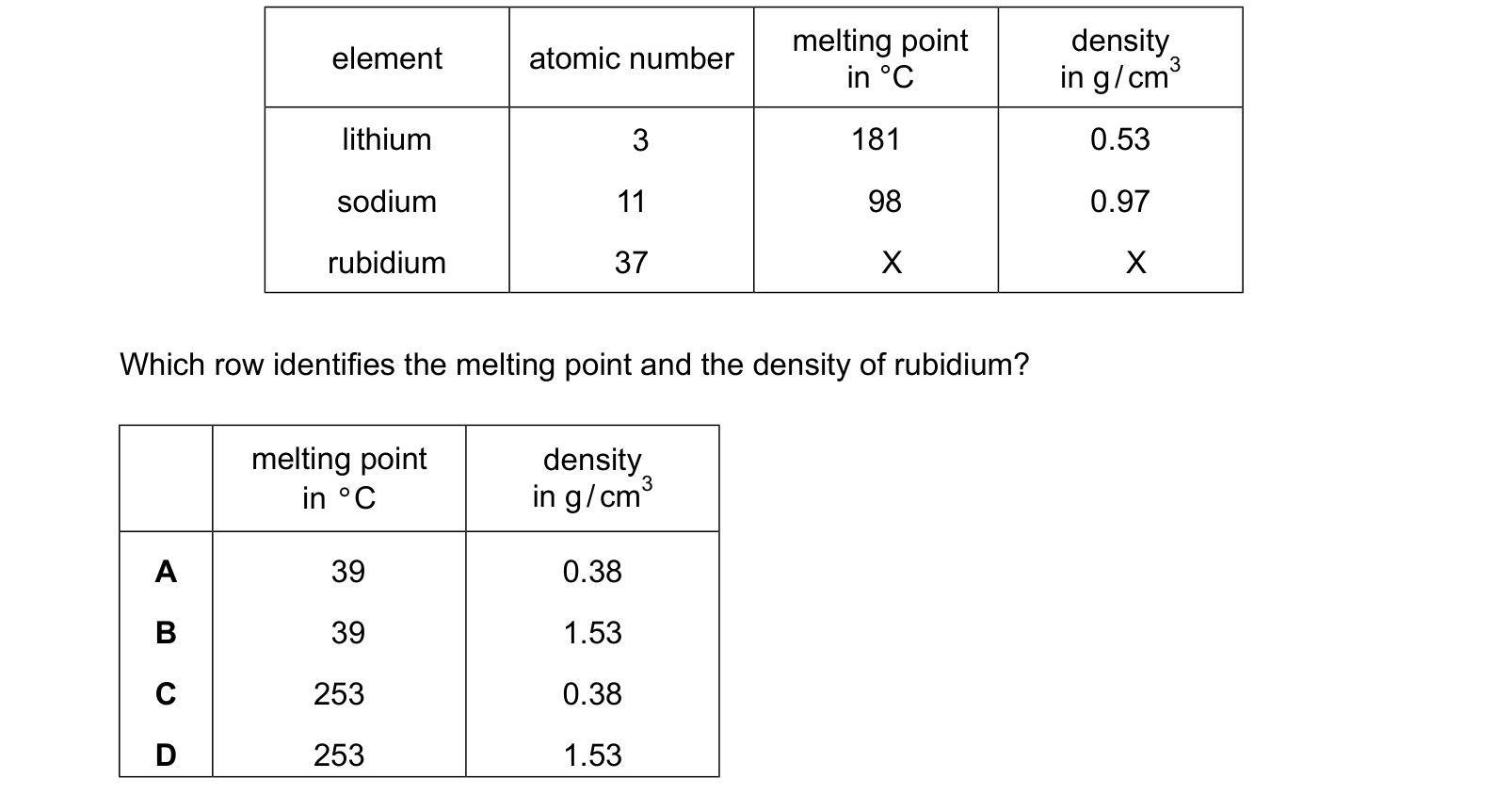
The table gives some information about three elements in Group I of the Periodic Table. Which row identifies the melting point and the density of rubidium? Each answer gives, in order: melting point in °C; density in g/cm³.
Answer: B.
The trends down Group I settle both columns, using lithium and sodium as the pattern. Melting point falls as the group is descended, from 181 °C for lithium to 98 °C for sodium, so rubidium, further down still, must melt below 98 °C, which rules out 253 °C immediately. Density rises down the group, from 0.53 to 0.97 g per cm cubed, so rubidium must be denser than 0.97, which rules out 0.38. That leaves 39 °C with 1.53 g per cm cubed. The row pairing 39 °C with 0.38 gets the melting point right and then runs the density trend backwards.
These questions are drawn from past CIE 0620 Chemistry papers and filtered to group i properties. You answer, you find out immediately whether you were right, and you get the reasoning for the correct option and for each distractor. Wrong answers go to a mistakes locker so you can come back to exactly those.
Practice is free. You need an account only so your progress and your mistakes are still there next time.
These are the errors that cost marks on group i properties, taken from our own topic notes. Read them before you practise and you will recognise the traps in the questions.
Saying the reaction with water gives an acid, when it gives an alkali.
Forgetting hydrogen as a product, and writing only the hydroxide.
Explaining increasing reactivity by "more electrons" rather than by the outer electron being further from the nucleus and shielded.
Saying the metals are stored under oil to stop them melting, rather than to keep out air and water.
Giving potassium's flame as orange and sodium's as lilac, which is the wrong way round.
Saying all alkali metals melt during the reaction, when lithium does not.
Predicting that rubidium floats, when its density is above that of water.