Preparation of salts: four questions to try now
Real past-paper questions, the answer key from the mark scheme, and the explanation that goes with it. No account needed to answer them.
Question 1
Which row describes the solubility of lead(II) chloride and lead(II) sulfate in water? Each answer gives, in order: lead(II) chloride; lead(II) sulfate.
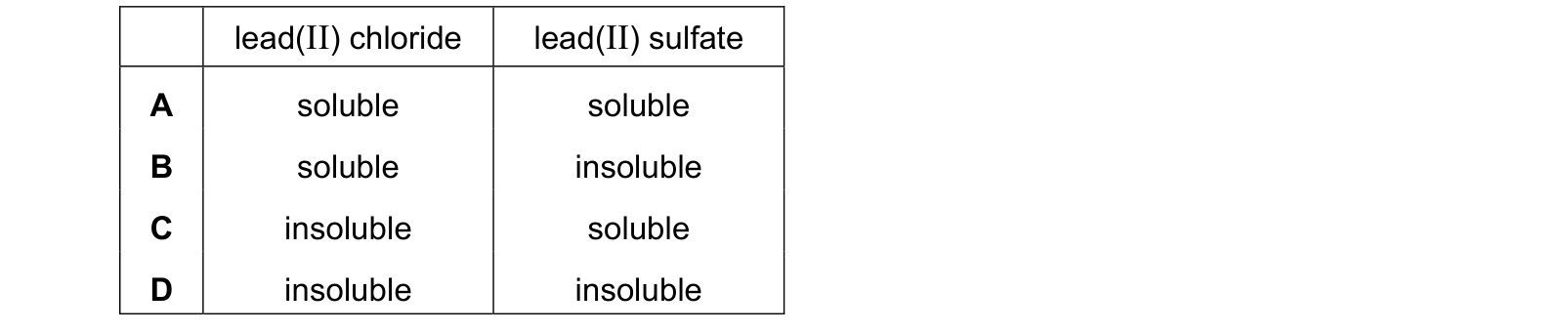
Answer: D.
Question 2
Four stages used to prepare an insoluble salt are listed. 1 drying 2 filtration 3 precipitation 4 washing In which order are the stages done?
Answer: B.
Question 3
Which methods of salt preparation are suitable for copper(II) chloride?
1 Add copper(II) carbonate to dilute hydrochloric acid.
2 Add copper to dilute hydrochloric acid.
3 Warm copper(II) oxide with dilute hydrochloric acid.
Answer: C.
Question 4
The solubility of some salts is shown.
chloride nitrate sulfate carbonate
barium soluble soluble insoluble insoluble
lead(II) insoluble soluble insoluble insoluble
potassium soluble soluble soluble soluble
zinc soluble soluble soluble insoluble
Which two aqueous solutions produce an insoluble salt when mixed together?
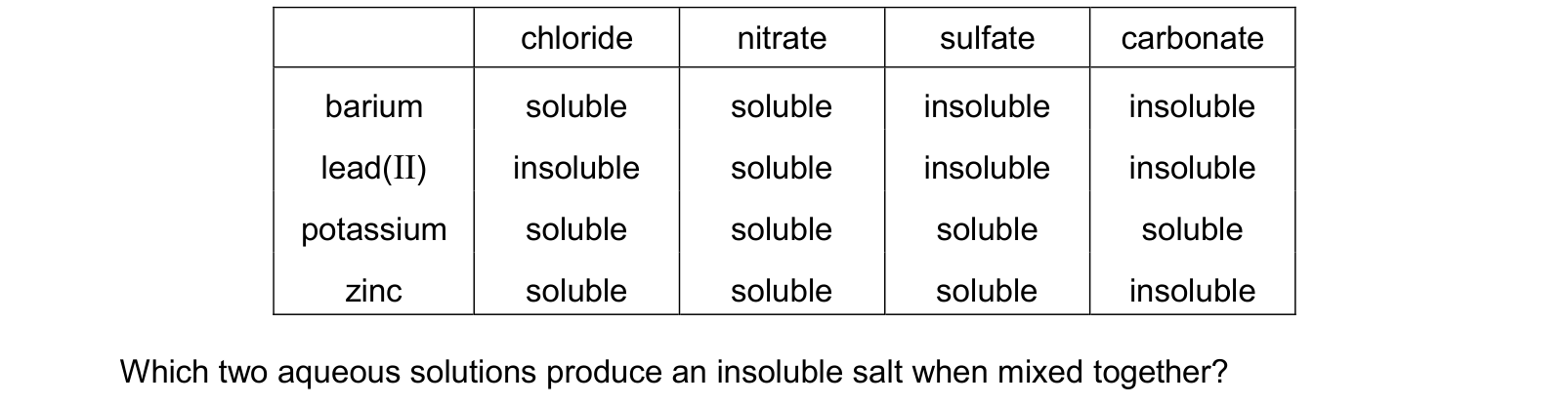
Answer: C.
What this practice covers
These questions are drawn from past CIE 0620 Chemistry papers and filtered to preparation of salts. You answer, you find out immediately whether you were right, and you get the reasoning for the correct option and for each distractor. Wrong answers go to a mistakes locker so you can come back to exactly those.
Practice is free. You need an account only so your progress and your mistakes are still there next time.
Keep going Paper 1 and Paper 2 MCQs →
What examiners see students get wrong here
These are the errors that cost marks on preparation of salts, taken from our own topic notes. Read them before you practise and you will recognise the traps in the questions.
- Using a metal to make a sodium or potassium salt, when sodium and potassium react violently with acid.
- Trying to filter off excess alkali, which is soluble.
- Leaving the indicator in during the second titration, so the crystals are coloured.
- Evaporating the solution to dryness instead of to the point of crystallisation, which spoils the crystals.
- Forgetting to wash the precipitate, leaving the soluble salt behind.
- Saying the excess solid is added so the reaction goes faster, rather than to use up all the acid.
- Choosing precipitation for a soluble salt, which would leave both salts in the same solution.
Revise it first
If any of the above is unfamiliar, work through the notes before practising: Preparation of salts revision notes.