61 past-paper questions on this unit. Five of them are below. Answer on the page: each one is marked the moment you pick, the correct option is shown whether or not you found it, and the full explanation opens either way.
CIE 0620 ChemistryPaper 1 and Paper 2 MCQsFree account
Redox: five questions to try now
Real past-paper questions, the answer key from the mark scheme, and the explanation that goes with it. No account needed to answer them.
Question 1
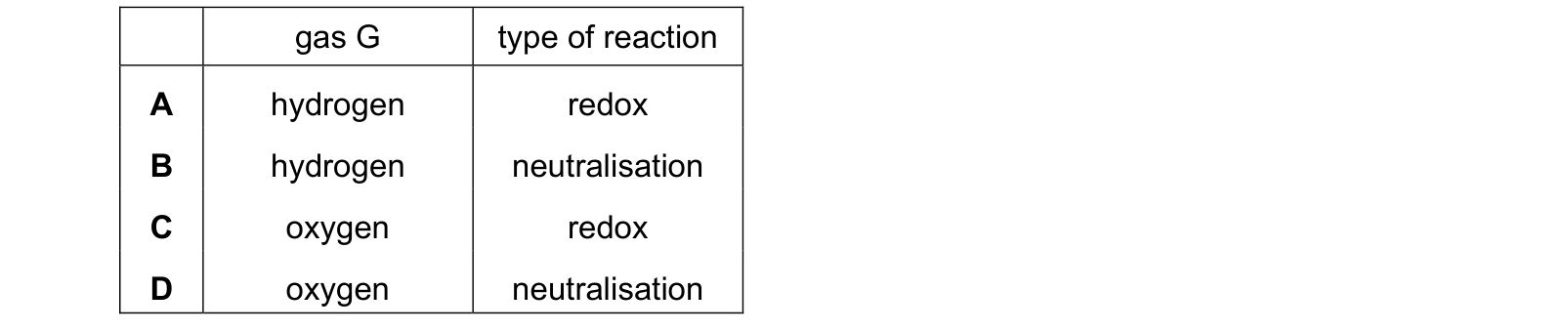
Metal M reacts with steam and produces gas G. Which row identifies gas G and the type of reaction when metal M reacts with steam? Each answer gives, in order: gas G; type of reaction.
Answer: A.
A metal reacting with steam drives hydrogen out of the water molecules, keeping the oxygen for itself, so gas G is hydrogen, exactly as it is when a metal attacks a dilute acid. That transfer is a redox change, because the metal loses electrons and is oxidised to its oxide while the hydrogen in the steam gains electrons and is reduced to hydrogen gas. Oxygen cannot be the gas released, since oxygen is what the metal holds on to; a metal that gave off oxygen would have to be taking the hydrogen instead. Neutralisation is the wrong label as well, because it needs an acid and a base to cancel one another, and steam is neither.
Question 2
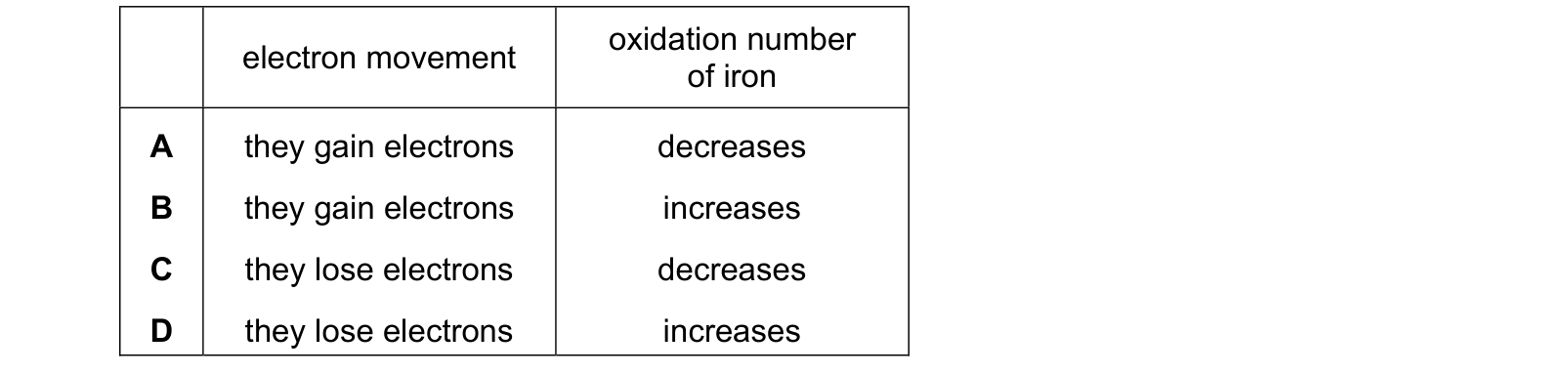
Which row describes what happens to Fe2+ ions when they are oxidised? Each answer gives, in order: electron movement; oxidation number of iron.
Answer: D.
Oxidation is a loss of electrons, so an Fe2+ ion that is oxidised must give an electron away and become Fe3+. Losing a negative charge leaves a larger positive charge, so the oxidation number climbs from +2 to +3 rather than falling. The two rows saying the ion gains electrons describe reduction instead, and gaining electrons would carry Fe2+ down towards iron metal. The row pairing a loss of electrons with a falling oxidation number is the trickiest, because it begins correctly and then assumes that losing something must make the number smaller, when the number counts charge rather than electrons.
Question 3
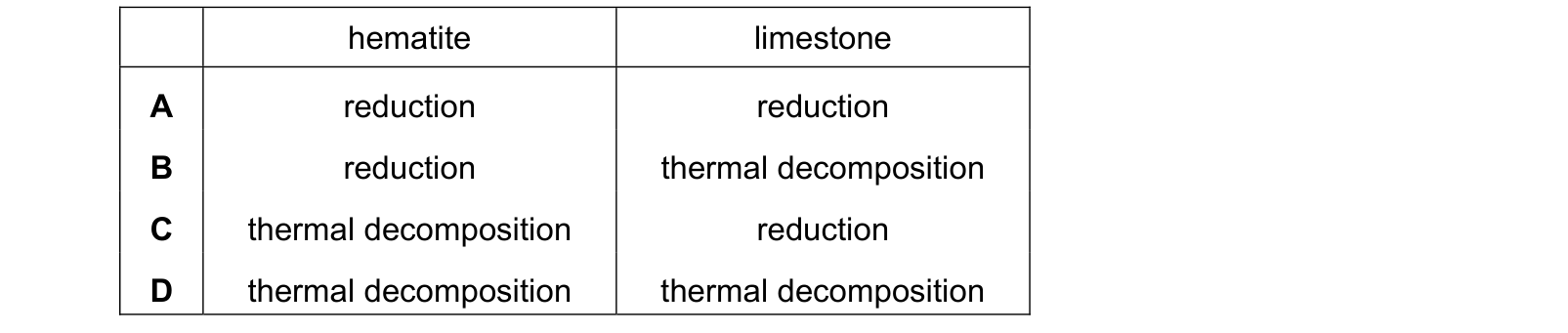
Which types of reaction do hematite and limestone undergo in the blast furnace? Each answer gives, in order: hematite; limestone.
Answer: B.
Two very different processes run side by side in the furnace. Hematite is iron(III) oxide, and the carbon monoxide rising through the charge takes its oxygen away to leave molten iron, which is a reduction. Limestone is calcium carbonate, and the intense heat splits it into calcium oxide and carbon dioxide with no element changing oxidation state, so that is thermal decomposition. Calling the limestone step a reduction is the usual error, encouraged by the feeling that everything in a blast furnace must be reduction, yet nothing takes oxygen away from the carbonate. Hematite cannot be decomposed thermally either, since heating iron(III) oxide on its own will not release the metal.
Question 4
The reaction between chlorine and bromide ions is a redox reaction. Cl2 + 2Br – → 2Cl – + Br2 What is the change in oxidation state of the reducing agent in this reaction?
Answer: B.
The reducing agent is the species that gives electrons away and is itself oxidised, and here that is the bromide ion. Each bromide carries a single negative charge, so its oxidation state is minus 1, and once it releases that electron and joins a Br2 molecule it is an uncombined element at 0. The change is therefore from minus 1 to 0, a rise, exactly as expected for something being oxidised. The reverse reading, 0 to minus 1, belongs to chlorine, which is the oxidising agent and travels down from free element to chloride. A change beginning at minus 2 has no basis here at all, since bromide never carries two negative charges.
Question 5
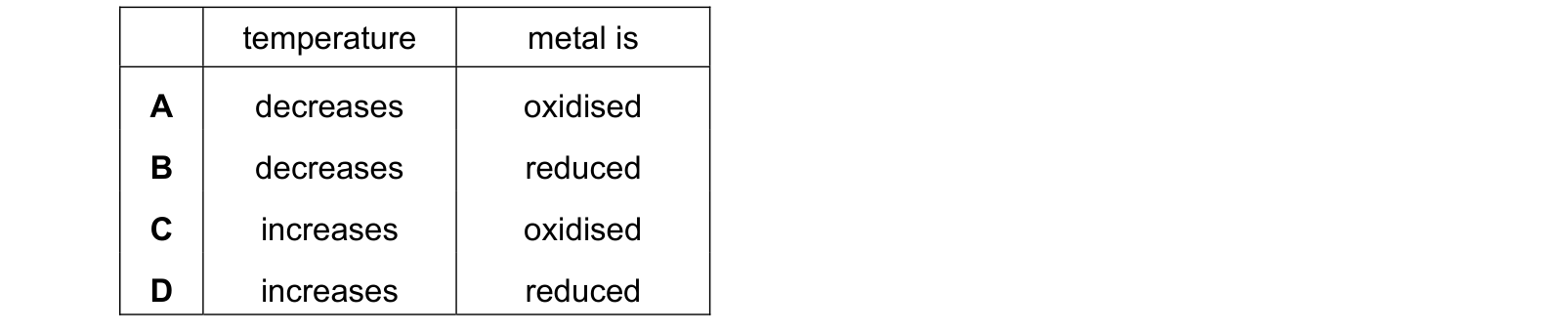
Which row describes the changes that occur when metals burn in oxygen? Each answer gives, in order: temperature; metal is.
Answer: C.
Two independent facts settle the row. A metal plus oxygen gives a metal oxide, and taking on oxygen is precisely what oxidation means, so the metal has to be described as oxidised and not reduced. Combustion also releases energy to the surroundings, which is why a burning strip of magnesium is both dazzling and hot, so the temperature climbs. Sodium lowered into a gas jar of oxygen shows both effects together: an orange flame that warms the jar and a white solid oxide left inside it. Opting for a decrease in temperature would make the reaction endothermic, and a metal that absorbed energy while burning would simply go out.
These questions are drawn from past CIE 0620 Chemistry papers and filtered to redox. You answer, you find out immediately whether you were right, and you get the reasoning for the correct option and for each distractor. Wrong answers go to a mistakes locker so you can come back to exactly those.
Practice is free. You need an account only so your progress and your mistakes are still there next time.
These are the errors that cost marks on redox, taken from our own topic notes. Read them before you practise and you will recognise the traps in the questions.
Reading the Roman numeral as the number of atoms in the formula.
Saying the oxidising agent is oxidised.
Giving only the oxygen definition on an Extended paper when the reaction involves no oxygen.
Writing oxidation as the gain of electrons.
Forgetting that a fall in oxidation number is reduction, and calling +7 to +2 an oxidation because the numbers are both positive.
Calling neutralisation a redox reaction.
Saying potassium manganate(VII) turning colourless shows an oxidising agent was added, when it shows the opposite.
Revise it first
If any of the above is unfamiliar, work through the notes before practising: Redox revision notes.