28 past-paper questions on this unit. Five of them are below. Answer on the page: each one is marked the moment you pick, the correct option is shown whether or not you found it, and the full explanation opens either way.
CIE 0620 ChemistryPaper 1 and Paper 2 MCQsFree account
Alloys and their properties: five questions to try now
Real past-paper questions, the answer key from the mark scheme, and the explanation that goes with it. No account needed to answer them.
Question 1
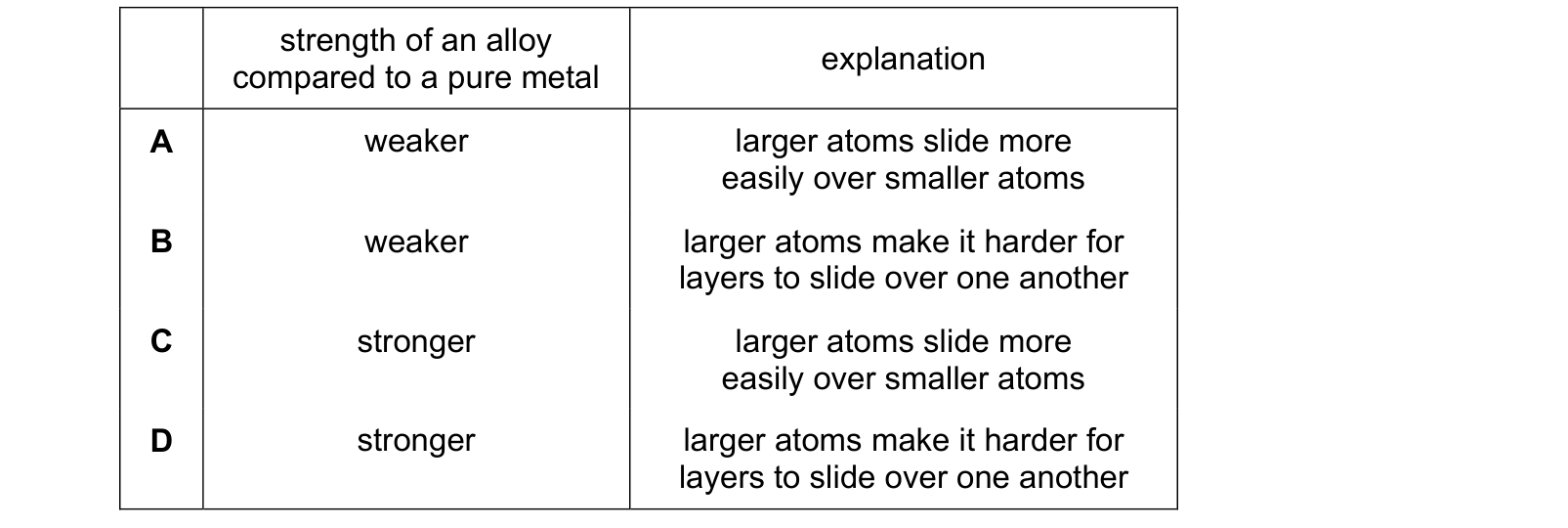
Which row compares the strength of alloys with pure metals and explains the difference in strength? Each answer gives, in order: strength of an alloy compared to a pure metal; explanation.
Answer: D.
A pure metal is comparatively soft because its identical atoms lie in regular layers that can slide over one another when a force is applied. Alloying introduces atoms of a different size into that lattice, and those misfits distort the rows so the layers no longer line up and can no longer slide easily, which makes the alloy stronger and harder. The rows calling an alloy weaker have the outcome backwards, and if alloying softened metals there would be no reason to make brass, bronze or steel at all. The row that pairs the right outcome with larger atoms sliding more easily contradicts itself, since easier sliding is precisely what makes a metal soft. Outcome and explanation have to point the same way, and harder to slide is what stronger means here.
Question 2
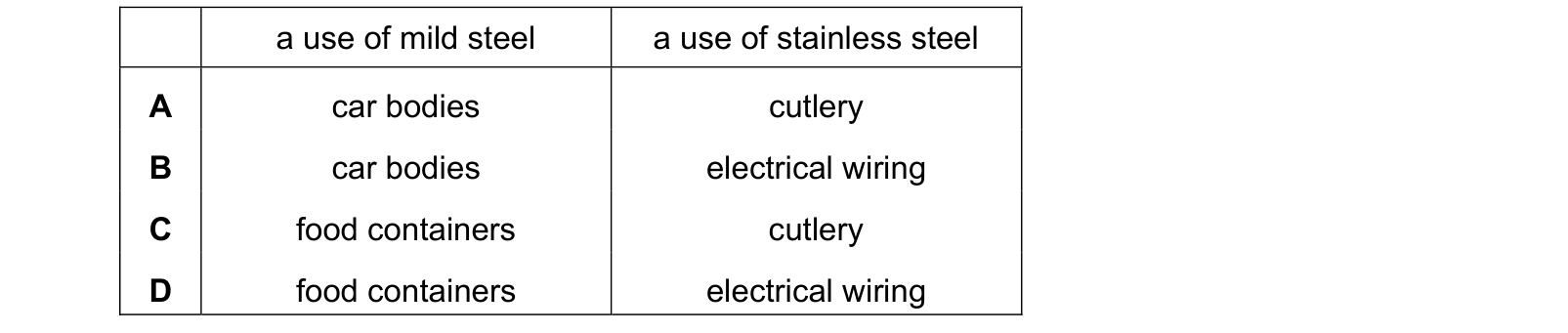
Mild steel and stainless steel are two alloys containing the element iron. Which row identifies a use of each alloy? Each answer gives, in order: a use of mild steel; a use of stainless steel.
Answer: A.
Both alloys are built on iron, but they are made for different jobs and the dividing line is corrosion resistance. Mild steel is iron with only a little carbon, strong and easily pressed into shape, which is why car bodies are made from it, although it does rust and has to be painted. Stainless steel has chromium and nickel added, which give it a surface that resists corrosion, so it suits cutlery, washed constantly and in contact with food. Putting mild steel into food containers ignores its tendency to rust, which is precisely what a food container must not do. Electrical wiring is made from copper because of its very high conductivity, and neither steel is used for it, so any row offering wiring has named the wrong metal entirely.
Question 3
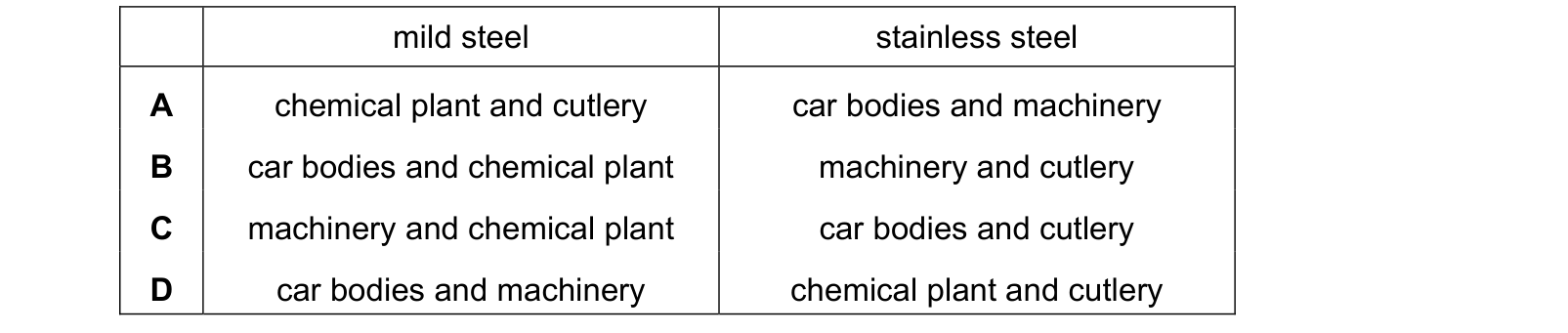
Which row identifies a use of mild steel and a use of stainless steel? Each answer gives, in order: mild steel; stainless steel.
Answer: D.
The two steels differ in what has been added to the iron, and therefore in how well they stand up to corrosion. Mild steel contains only a small amount of carbon; it is strong, cheap and easily shaped, so it goes into car bodies and machinery, and its rusting is handled by painting or greasing. Stainless steel contains chromium and nickel, which give it a corrosion resistant surface, so it is chosen where rusting cannot be allowed at all: chemical plant handling aggressive liquids, and cutlery that is washed daily and touches food. Rows that file chemical plant or cutlery under mild steel are asking a rusting alloy to do a job defined by not rusting. Rows that put car bodies under stainless steel would work technically but ignore cost, since the chromium and nickel make it far dearer than a painted mild steel panel.
Question 4
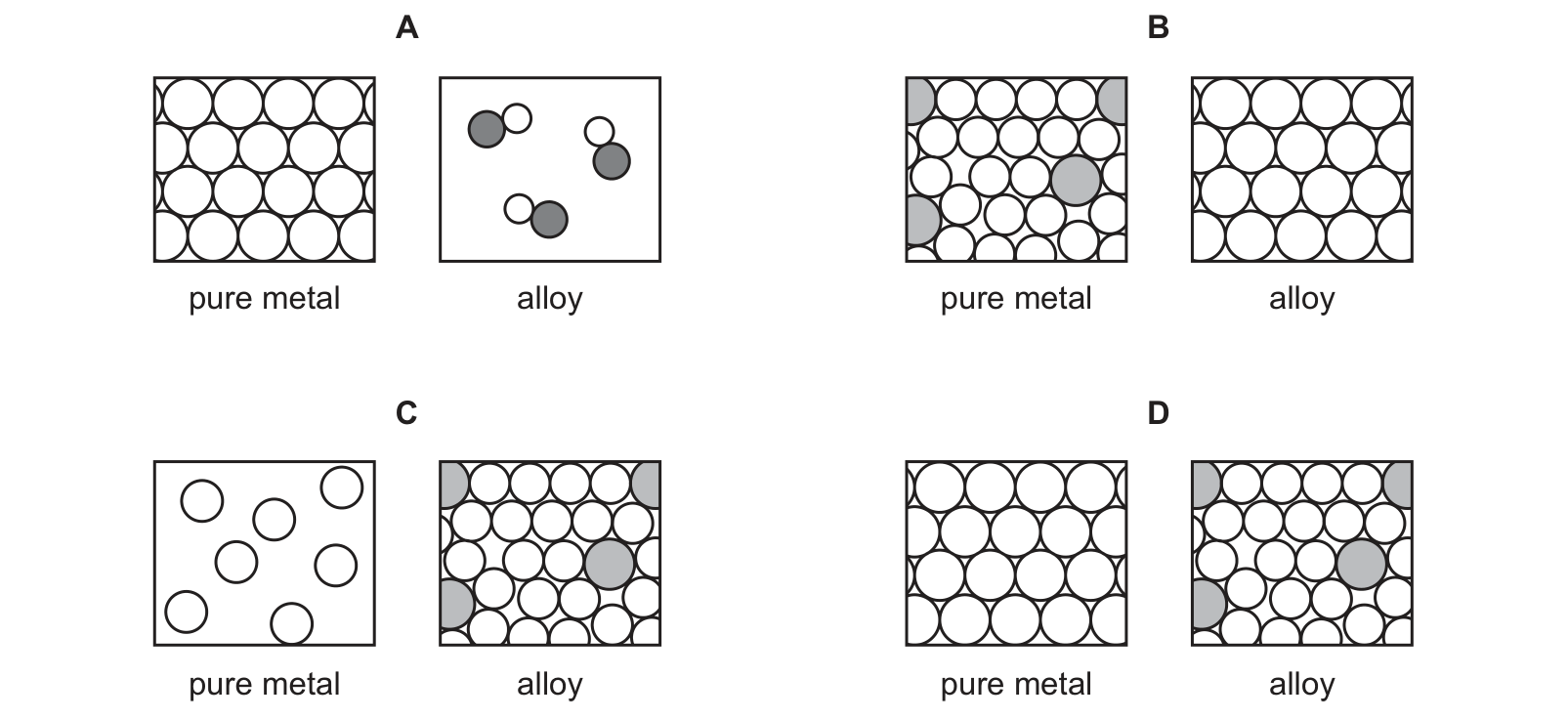
Which pair of diagrams represents both a pure metal and an alloy? Use the source image for W23 Paper 13, question 27.
Answer: D.
A pure metal is drawn as identical atoms of one size packed into regular layers, while an alloy shows atoms of a different size mixed into that lattice, breaking up the neat rows. The correct pair is therefore the one with a regularly packed block of identical circles beside a block of the same circles interrupted by larger shaded ones. One pair has the labels the wrong way round, putting the different sized atoms in the box marked pure metal and identical atoms in the box marked alloy. Another pair draws widely separated circles under the label pure metal, but scattered particles with gaps between them describe a gas rather than a solid metal. The remaining pair shows a few loose pairs of circles under the alloy label, which looks like separate molecules instead of a continuous metallic lattice.
Question 5
Which diagram represents the arrangement of atoms in an alloy? Use the source image for S22 Paper 12, question 27.
Answer: D.
An alloy is a metal with atoms of another element mixed into its lattice, so the diagram to find shows closely packed spheres of more than one size, the larger ones breaking up the neat rows. That disruption is the entire point, since layers of atoms can no longer slide cleanly over one another and the alloy comes out harder than the pure metal. The diagram of identical spheres in perfect rows is a pure metal, and its regularity is exactly why it is softer. The two diagrams with widely separated particles represent gases, one of them a gas of two-atom molecules, and neither shows a solid structure at all.
These questions are drawn from past CIE 0620 Chemistry papers and filtered to alloys and their properties. You answer, you find out immediately whether you were right, and you get the reasoning for the correct option and for each distractor. Wrong answers go to a mistakes locker so you can come back to exactly those.
Practice is free. You need an account only so your progress and your mistakes are still there next time.
These are the errors that cost marks on alloys and their properties, taken from our own topic notes. Read them before you practise and you will recognise the traps in the questions.
Describing an alloy as a compound, or giving it a chemical formula.
Saying alloys are harder because the atoms bond more strongly, rather than because the layers cannot slide.
Saying an alloy does not conduct electricity, when the delocalised electrons are still there.
Giving brass as copper and tin, which is bronze.
Saying stainless steel does not rust because it contains nickel, when the chromium oxide layer is the reason.
Explaining hardness without mentioning that the added atoms are a different size.
Saying steel is a pure metal, when it is iron alloyed with carbon.