Reversible reactions and equilibrium Exam Questions
43 past-paper questions on this unit. Five of them are below. Answer on the page: each one is marked the moment you pick, the correct option is shown whether or not you found it, and the full explanation opens either way.
CIE 0620 ChemistryPaper 1 and Paper 2 MCQsFree account
Reversible reactions and equilibrium: five questions to try now
Real past-paper questions, the answer key from the mark scheme, and the explanation that goes with it. No account needed to answer them.
Question 1
The reaction between hydrogen and nitrogen is reversible. The forward reaction is exothermic. Which change to the conditions would increase the yield of ammonia?
Answer: B.
Yield is a question about where the equilibrium sits, so only changes that move that position count. Four gas molecules, one nitrogen and three hydrogen, become two of ammonia, so raising the pressure squeezes the mixture towards the side taking up less room and more ammonia is present at equilibrium. A catalyst is the classic wrong answer, since it accelerates the forward and backward reactions by the same factor and alters only how soon equilibrium arrives. Raising the temperature makes matters worse, because the forward reaction is exothermic and heat drives an exothermic equilibrium backwards, while removing nitrogen shifts the balance away from ammonia by taking a reactant out.
Question 2
In the Haber process, an equilibrium is established. The forward reaction is exothermic. Which change to the reaction conditions will move the position of equilibrium to the left?
Answer: A.
Moving the equilibrium to the left means ending up with less ammonia, so the change must favour the reverse reaction. Four gas molecules become two in the forward direction, so lowering the pressure gives the mixture more room and pushes it back towards the four molecules of nitrogen and hydrogen. Cooling would do the opposite, since the forward reaction is exothermic and a lower temperature favours the side that gives energy out. Adding nitrogen also drives the system forwards, because an equilibrium responds to extra reactant by using some of it up. Removing the catalyst changes the position not at all, and would only make the mixture take longer to settle wherever it was heading.
Question 3
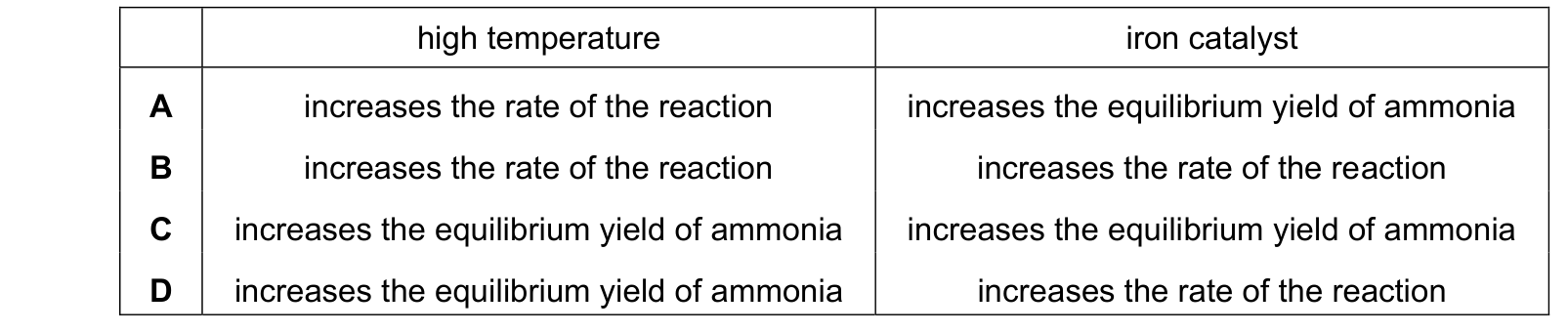
Which row explains why a high temperature and an iron catalyst are used in the manufacture of ammonia by the Haber process? Each answer gives, in order: high temperature; iron catalyst.
Answer: B.
Both conditions are there for speed rather than for yield, and separating those two ideas is the whole point of the question. A high temperature raises the rate, because the particles move faster and a larger proportion of collisions clears the activation energy, yet it actually lowers the equilibrium yield, since the forward reaction is exothermic and heating pushes the balance back towards nitrogen and hydrogen. The iron catalyst also acts purely on rate, lowering the activation energy so equilibrium arrives sooner, and because it speeds the forward and backward reactions equally it cannot move the position at all. Any row crediting either condition with a greater equilibrium yield has confused getting there quickly with getting further.
Question 4
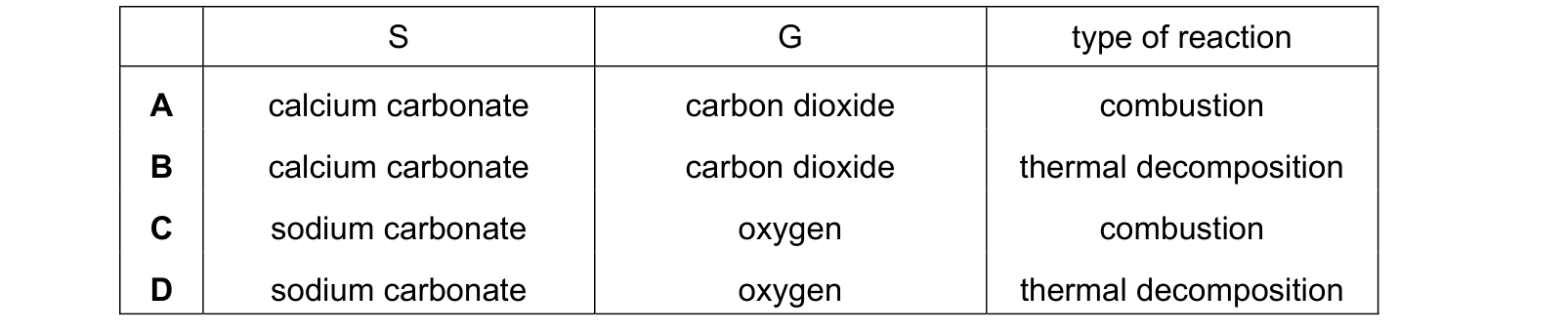
When solid S is heated strongly, it forms gas G. G turns limewater cloudy. What are S and G and which type of reaction does S undergo? Each answer gives, in order: S; G; type of reaction.
Answer: B.
Limewater turning cloudy is the standard test for carbon dioxide, so gas G is carbon dioxide and any row naming oxygen fails at the first hurdle, since oxygen relights a glowing splint and leaves limewater clear. A solid that gives off carbon dioxide when heated alone is a carbonate, and calcium carbonate is the one that breaks down at the temperatures a Bunsen or a kiln can reach. Sodium carbonate is the wrong pick because sodium is so reactive that its carbonate survives strong heating intact. Splitting a compound using heat alone is thermal decomposition, whereas combustion would require the solid to burn in oxygen, and nothing here is set alight.
Question 5
Ammonia, NH3, dissolves in water to form a dilute solution of ammonium hydroxide, NH4OH. The reaction is reversible and exists as an equilibrium mixture. Which statement about the mixture is correct?
Answer: D.
At equilibrium both reactions carry on at matching speeds, so ammonium ions form exactly as fast as ammonia molecules are rebuilt and the concentrations hold steady. That is why the statement about the molecules having stopped changing into ions fails, since nothing has stopped and a stopped mixture could not respond to dilution or to added acid. Nor have all the ammonia and water molecules turned into ions, because ammonia is a weak base and only a small fraction ionises at any moment, which is why its solution is far less alkaline than sodium hydroxide of the same concentration. Equal rates do not imply equal concentrations, so demanding that the ammonia and ammonium concentrations match adds a condition equilibrium never promises.
These questions are drawn from past CIE 0620 Chemistry papers and filtered to reversible reactions and equilibrium. You answer, you find out immediately whether you were right, and you get the reasoning for the correct option and for each distractor. Wrong answers go to a mistakes locker so you can come back to exactly those.
Practice is free. You need an account only so your progress and your mistakes are still there next time.
These are the errors that cost marks on reversible reactions and equilibrium, taken from our own topic notes. Read them before you practise and you will recognise the traps in the questions.
Saying the concentrations of reactants and products are equal at equilibrium.
Saying the reactions stop at equilibrium.
Claiming a catalyst increases the yield of ammonia.
Giving 450 °C as the condition that maximises yield, when it lowers yield and is chosen for rate.
Reversing the cobalt(II) chloride colours, which are blue when dry and pink when wet.
Saying anhydrous copper(II) sulfate turning blue proves the liquid is pure water.
Counting solids or liquids when applying the pressure rule.
Applying Le Chatelier to a reaction in an open container, which is not at equilibrium at all.