24 past-paper questions on this unit. Five of them are below. Answer on the page: each one is marked the moment you pick, the correct option is shown whether or not you found it, and the full explanation opens either way.
CIE 0620 ChemistryPaper 1 and Paper 2 MCQsFree account
Isotopes: five questions to try now
Real past-paper questions, the answer key from the mark scheme, and the explanation that goes with it. No account needed to answer them.
Question 1
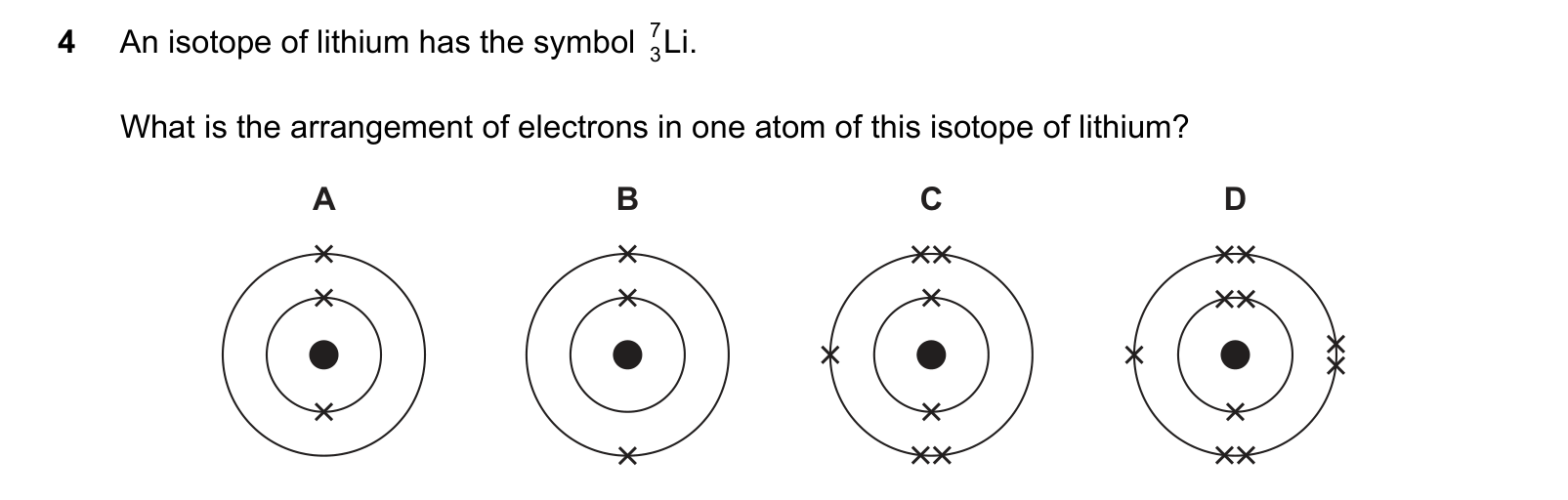
An isotope of lithium has the symbol 7 Li. 3 What is the arrangement of electrons in one atom of this isotope of lithium? Use the source image for W23 Paper 11, question 4.
Answer: A.
The subscript 3 gives the number of protons, and a neutral atom balances that with 3 electrons, so only three crosses should appear anywhere on the right picture. Shells fill from the inside out and the first holds no more than two, so 3 electrons arrange as 2,1, meaning two crosses on the inner circle and one on the outer. One picture reverses that, putting one cross inside and two outside, which starts the second shell while the first still has space. Another shows seven crosses altogether, which is the superscript from the symbol, a count of protons plus neutrons that has nothing to do with how many electrons the atom holds. The last picture packs three crosses into the inner shell, which can never hold more than two.
Question 2
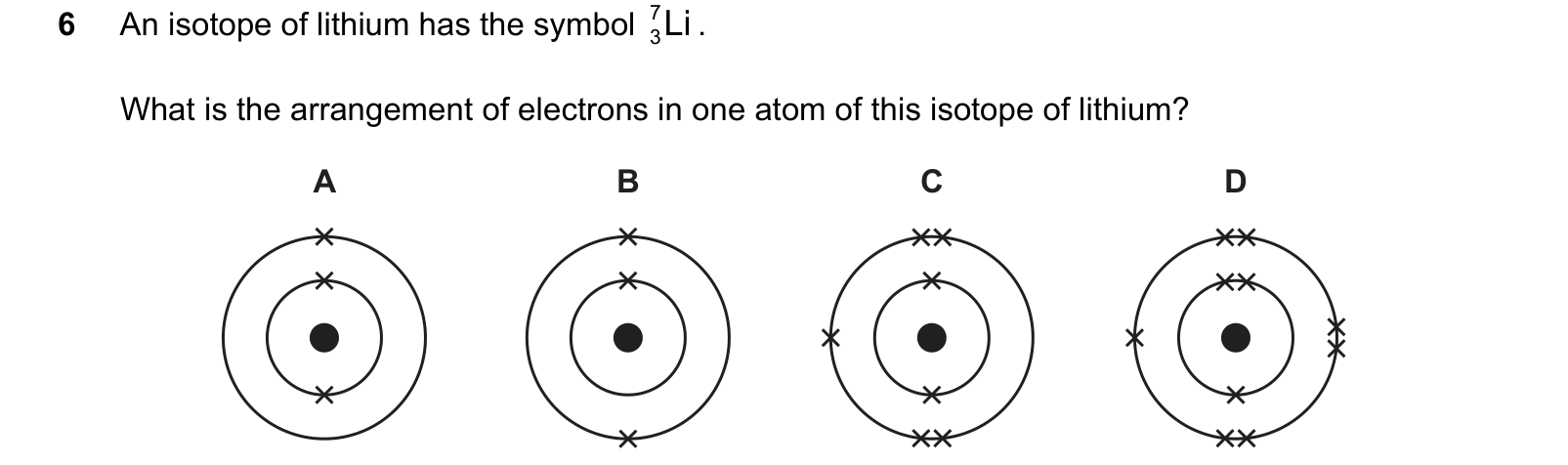
An isotope of lithium has the symbol 7 Li . 3 What is the arrangement of electrons in one atom of this isotope of lithium? Use the source image for W19 Paper 12, question 6.
Answer: A.
An atom has as many electrons as protons, and the proton number is the lower figure in the symbol, so lithium-7 carries 3 electrons rather than 7. Shells fill from the inside outwards with the first holding a maximum of two, so the arrangement is 2,1 and the right picture puts two crosses on the inner ring and one on the outer. One diagram shows two on the inner ring and five on the outer, seven in all, which is the upper figure of the symbol used as an electron count; that figure counts protons plus neutrons, and neutrons are not electrons. Another puts a single cross on the inner ring with two outside it, starting the second shell before the first is full. The remaining diagram crowds three crosses into the inner ring, which no first shell can hold.
Question 3
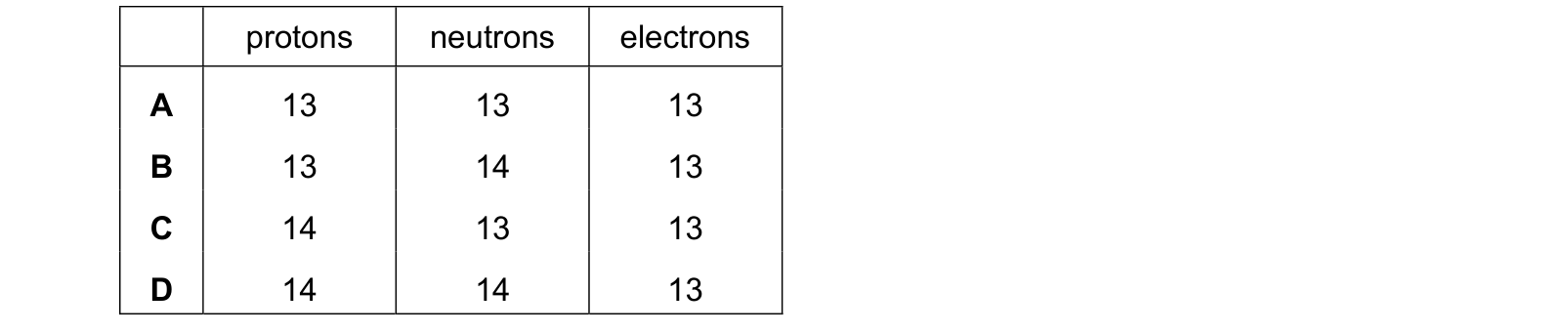
How many protons, neutrons and electrons are there in one atom of the isotope ²⁷ 13Al ? Each answer gives, in order: protons; neutrons; electrons.
Answer: B.
The lower figure in the symbol is the proton number and the upper figure is the nucleon number, so this aluminium atom has 13 protons. Neutrons are the difference between the two, 27 minus 13 = 14, and a neutral atom holds as many electrons as protons, so the electron count is 13 as well. The row giving 13 neutrons has reused the proton number instead of subtracting, which would mean the nucleon number was 26 rather than the 27 printed. Both rows offering 14 protons have moved the neutron figure into the proton column, and altering the proton number changes the element itself, since 14 protons would make the atom silicon rather than aluminium.
Question 4
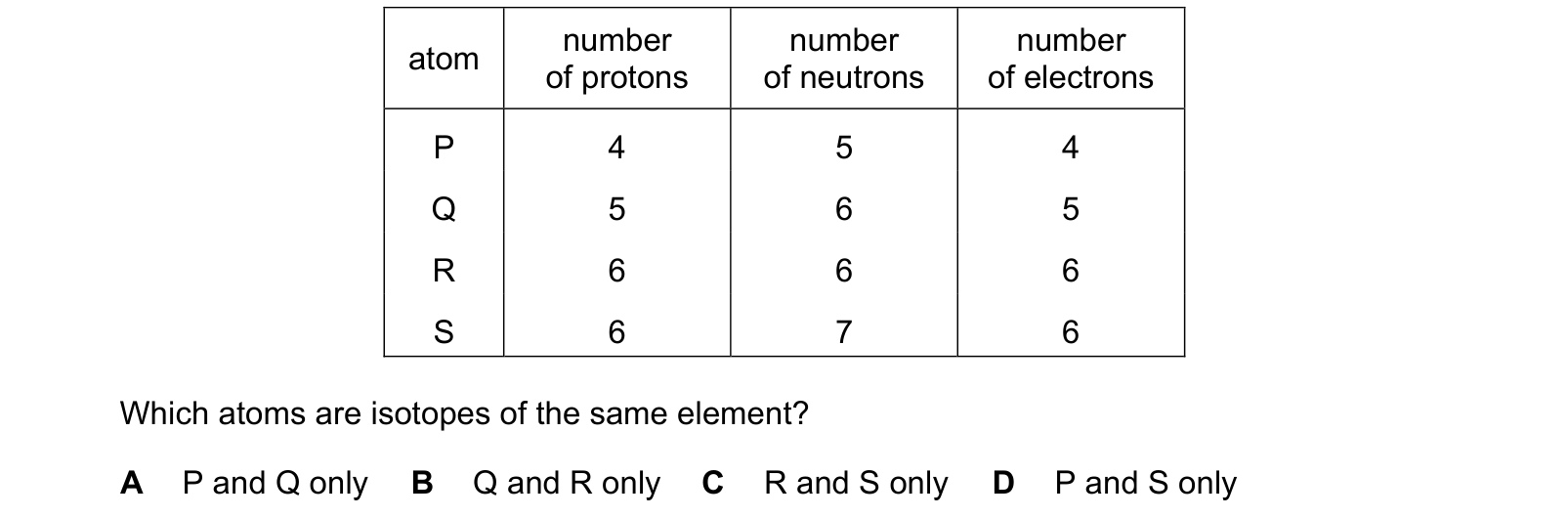
The numbers of protons, neutrons and electrons present in the atoms P, Q, R and S are shown. number number number atom of protons of neutrons of electrons Which atoms are isotopes of the same element?
Answer: C.
Isotopes share a proton number and differ in neutron number, so the proton column decides everything and the other two columns only confirm it. R and S both hold 6 protons, so they are the same element, and their neutron counts of 6 and 7 differ, which is exactly the isotope relationship. P with 4 protons and Q with 5 protons are different elements from one another and from R and S, so nothing about their neutrons can make them isotopes. Pairing Q with R looks attractive because both show 6 neutrons, but matching neutron numbers is precisely what isotopes are not required to do. Pairing P with S skips the proton column entirely, and 4 protons against 6 protons names two different elements.
Question 5
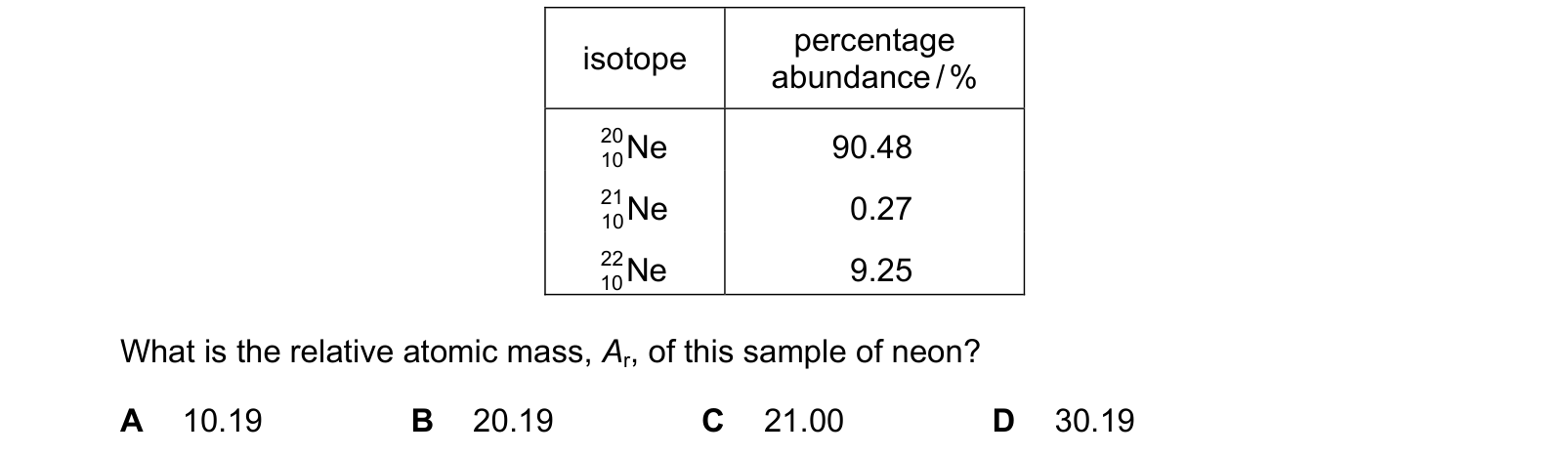
The percentage abundances of three isotopes in a sample of neon are shown. percentage isotope abundance / % 20 Ne 90.48 10 21 Ne 0.27 10 22 Ne 9.25 10 What is the relative atomic mass, Ar, of this sample of neon?
Answer: B.
Relative atomic mass is a weighted mean, so each nucleon number is multiplied by its percentage abundance and the total divided by 100. That gives (20 x 90.48) + (21 x 0.27) + (22 x 9.25) = 1809.6 + 5.67 + 203.5 = 2018.77, and 2018.77 divided by 100 is 20.19. The answer 21.00 is the plain average of 20, 21 and 22 with the abundances thrown away, which would only be right if the three isotopes were equally common, whereas neon-20 alone makes up over 90 per cent of this sample. The values 30.19 and 10.19 sit ten above and ten below the correct figure, so they come from slips in the arithmetic rather than from a different method. A quick check is that the answer must fall between 20 and 22 and lie close to 20, because the lightest isotope dominates the mixture.
These questions are drawn from past CIE 0620 Chemistry papers and filtered to isotopes. You answer, you find out immediately whether you were right, and you get the reasoning for the correct option and for each distractor. Wrong answers go to a mistakes locker so you can come back to exactly those.
Practice is free. You need an account only so your progress and your mistakes are still there next time.
These are the errors that cost marks on isotopes, taken from our own topic notes. Read them before you practise and you will recognise the traps in the questions.
Saying isotopes have different numbers of protons. Different protons means a different element.
Saying isotopes have different numbers of electrons. Neutral atoms of any isotope have the same number as protons.
Saying isotopes react differently. Their chemistry is identical because their electronic configurations are identical.
Taking a simple mean of the isotope masses when the abundances are unequal. Chlorine would come out as 36 rather than 35.5.
Forgetting to divide by 100 at the end, giving an answer in the thousands.
Quoting a relative atomic mass with a unit. It is a ratio and has none.
Rounding relative atomic mass to a whole number when the question asks for it from isotope data.
Revise it first
If any of the above is unfamiliar, work through the notes before practising: Isotopes revision notes.