13 past-paper questions on this unit. Five of them are below. Answer on the page: each one is marked the moment you pick, the correct option is shown whether or not you found it, and the full explanation opens either way.
CIE 0620 ChemistryPaper 1 and Paper 2 MCQsFree account
Formulae: five questions to try now
Real past-paper questions, the answer key from the mark scheme, and the explanation that goes with it. No account needed to answer them.
Question 1
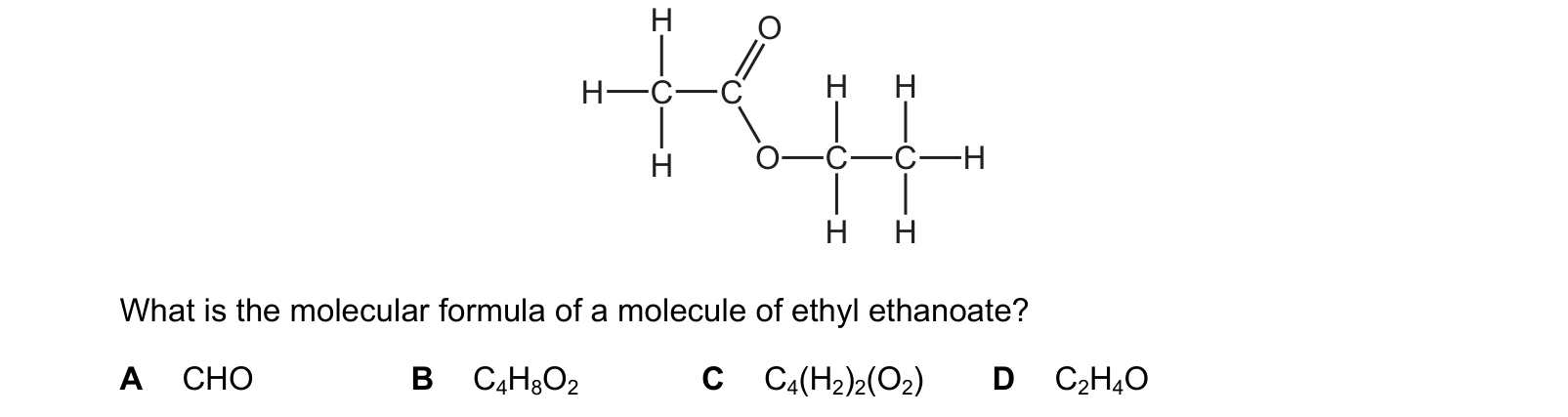
The diagram shows the structure of a molecule of ethyl ethanoate. What is the molecular formula of a molecule of ethyl ethanoate?
Answer: B.
Reading the displayed structure atom by atom gives four carbon atoms, eight hydrogen atoms and two oxygen atoms, one doubly bonded and one linking the chain, so the molecular formula is C4H8O2. The formula C2H4O is that ratio halved, which is the empirical formula rather than the molecular formula the question asks for. CHO reduces further still and does not match the ratio in the molecule at all. The bracketed version, C4(H2)2(O2), is invented notation, and multiplying its brackets out gives only four hydrogen atoms, half the number the structure actually shows.
Question 2
Silicon(IV) oxide reacts with chlorine and carbon to form liquid silicon(IV) chloride, SiCl 4, and carbon dioxide gas. If the reaction is carried out at r.t.p., which symbol equation represents this reaction?
Answer: D.
State symbols have to match the conditions the question gives. Silicon(IV) oxide is sand, a solid at room temperature and pressure, so it takes (s), and carbon is a solid too, which rules out the options writing SiO2 as a liquid or carbon as a gas. The question states that silicon(IV) chloride is a liquid, so it must carry (l), which rules out the option labelling it a gas. That leaves SiO2(s) with 2Cl2(g) and C(s) giving SiCl4(l) and CO2(g), and the atoms balance as well, with four chlorine atoms on each side and the two oxygen atoms passing from the sand into the carbon dioxide.
Question 3
Which symbol equation represents the reaction between aqueous sodium hydroxide and dilute sulfuric acid?
Answer: D.
Sodium hydroxide is NaOH and sodium sulfate is Na2SO4, because sodium forms a single positive ion while sulfate carries two negative charges. Two NaOH are therefore needed for each H2SO4, and the two hydrogen atoms of the acid combine with the two hydroxide groups to give 2H2O. The equation producing 2NaSO4 has the salt formula wrong, since NaSO4 would leave a net negative charge on every unit. The equation written Na(OH)2 treats sodium as though it formed a 2+ ion, and the one written Na2OH does the reverse, so both break the charge balance before any atom counting begins.
Question 4
Which word equation represents a reaction that occurs with ethanoic acid?
Answer: C.
Ethanoic acid is weak but it still behaves as an acid, so it reacts with metals above hydrogen in the reactivity series to give a salt and hydrogen, and magnesium sits well above hydrogen, giving magnesium ethanoate and hydrogen gas. Copper lies below hydrogen and does not react with dilute acids at all, so that row describes nothing that happens. Neutralising the acid with sodium hydroxide gives a salt and water, never oxygen. The carbonate row is the closest of the wrong answers, since that reaction does occur, but the products are a salt, carbon dioxide and water, and the water is missing from the equation as written.
Question 5
Which statement is the correct definition for molecular formula?
Answer: D.
A molecular formula states how many atoms of each element are present in one molecule, which is why ethanoic acid is written C2H4O2. A structure showing every atom and every bond is the displayed formula, a different representation that adds the bonding detail a molecular formula deliberately leaves out. An atom or group of atoms that determines the chemical properties is a functional group, such as the COOH that makes a carboxylic acid behave as it does. The description built around one gram of a compound confuses formulae with the mole, since a formula counts atoms per molecule and says nothing about mass.
These questions are drawn from past CIE 0620 Chemistry papers and filtered to formulae. You answer, you find out immediately whether you were right, and you get the reasoning for the correct option and for each distractor. Wrong answers go to a mistakes locker so you can come back to exactly those.
Practice is free. You need an account only so your progress and your mistakes are still there next time.
These are the errors that cost marks on formulae, taken from our own topic notes. Read them before you practise and you will recognise the traps in the questions.
Writing O, H or Cl instead of O₂, H₂ and Cl₂.
Balancing by changing a subscript rather than the number in front.
Losing the bracket in Ca(NO₃)₂ or Al₂(SO₄)₃.
Leaving state symbols out, especially the (s) that marks a precipitate.
Including spectator ions in an ionic equation.
Balancing the atoms but not the charge in an ionic equation.
Counting only the first molecule when a big number multiplies the whole formula.
Revise it first
If any of the above is unfamiliar, work through the notes before practising: Formulae revision notes.