The characteristic properties of acids and bases Exam Questions
244 past-paper questions on this unit. Five of them are below. Answer on the page: each one is marked the moment you pick, the correct option is shown whether or not you found it, and the full explanation opens either way.
CIE 0620 ChemistryPaper 1 and Paper 2 MCQsFree account
The characteristic properties of acids and bases: five questions to try now
Real past-paper questions, the answer key from the mark scheme, and the explanation that goes with it. No account needed to answer them.
Question 1
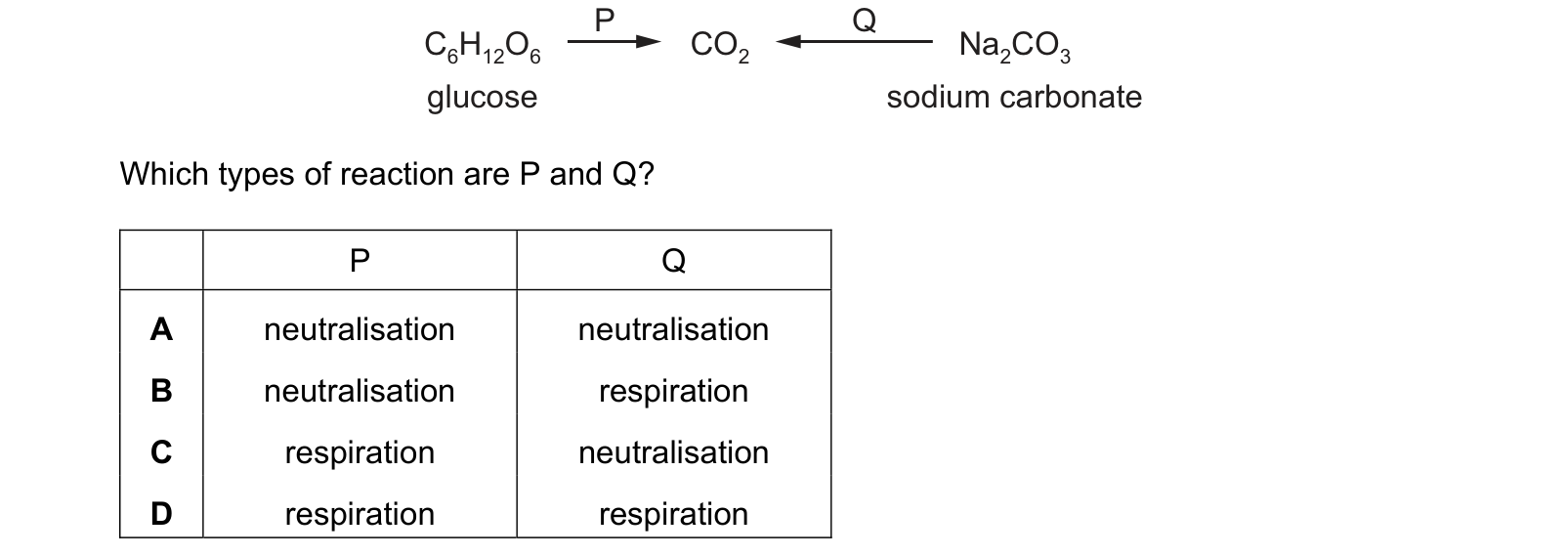
Two reactions, P and Q, produce carbon dioxide. P Q C6H12O6 CO2 Na2CO3 glucose sodium carbonate Which types of reaction are P and Q? Each answer gives, in order: P; Q.
Answer: C.
Two very different routes to the same gas are being named. Glucose broken down inside living cells to release energy, giving carbon dioxide and water, is respiration, so reaction P is respiration. Sodium carbonate gives off carbon dioxide when an acid is added, and acid reacting with a carbonate counts as neutralisation because the carbonate is behaving as a base, so reaction Q is neutralisation. Calling both reactions respiration ignores the fact that sodium carbonate is not alive and takes no part in any biological process. Calling both neutralisation is worse still, since no acid and no base appear anywhere in the breakdown of glucose.
Question 2
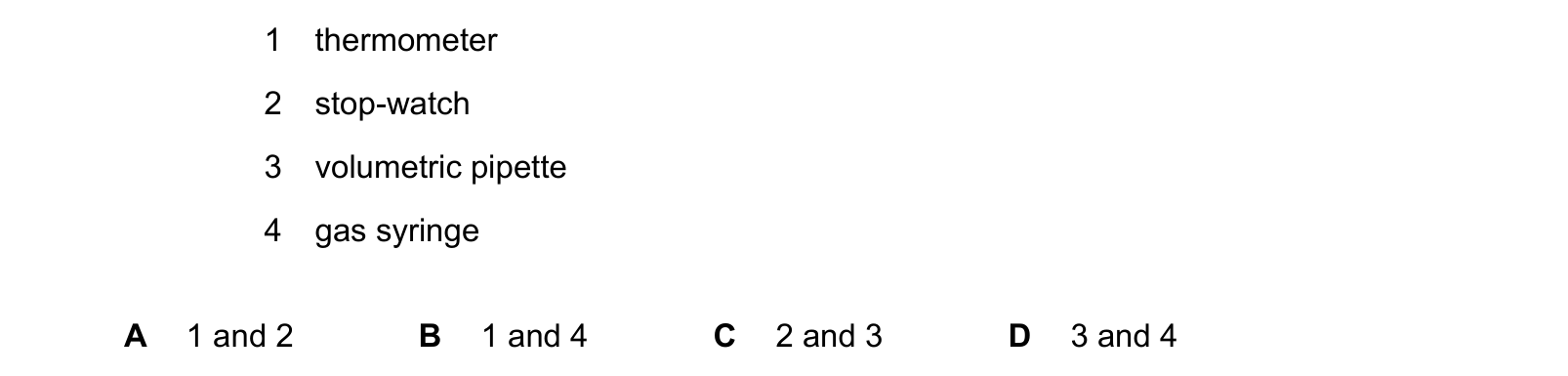
When zinc reacts with dilute sulfuric acid, hydrogen gas is produced. Which apparatus is needed to investigate the effect of temperature on the rate of this reaction?
Answer: A.
Rate is a change measured against time, so a clock cannot be dispensed with, and the factor under investigation is temperature, so a thermometer cannot be dispensed with either; those two form the essential pair. The volumetric pipette measures a fixed volume of acid accurately, which helps keep the other variables constant, but it reports neither a temperature nor a time. The gas syringe is genuinely useful for collecting the hydrogen, yet the reaction can equally be followed by timing how long the zinc takes to disappear, so it is a convenience rather than a necessity. Any pairing that drops the thermometer leaves the experiment unable to record the very variable being changed, which is exactly why combining the stop-watch with the volumetric pipette fails.
Question 3
Which colours are seen when litmus and methyl orange are added to separate samples of aqueous sodium hydroxide? Each answer gives, in order: litmus; methyl orange.
Answer: B.
Sodium hydroxide solution is an alkali, so both indicators have to be showing their alkaline colours. Litmus in alkali is blue, whereas purple is what litmus looks like in a neutral solution, so the two rows offering purple are describing water rather than an alkali. Methyl orange in alkali is yellow, and orange is only the intermediate shade it passes through near its changeover point around pH 4, which lies on the acid side of neutral. The row pairing blue litmus with orange methyl orange gets the first indicator right and then halts the second one halfway through its colour change, which is the commonest form of this error.
Question 4
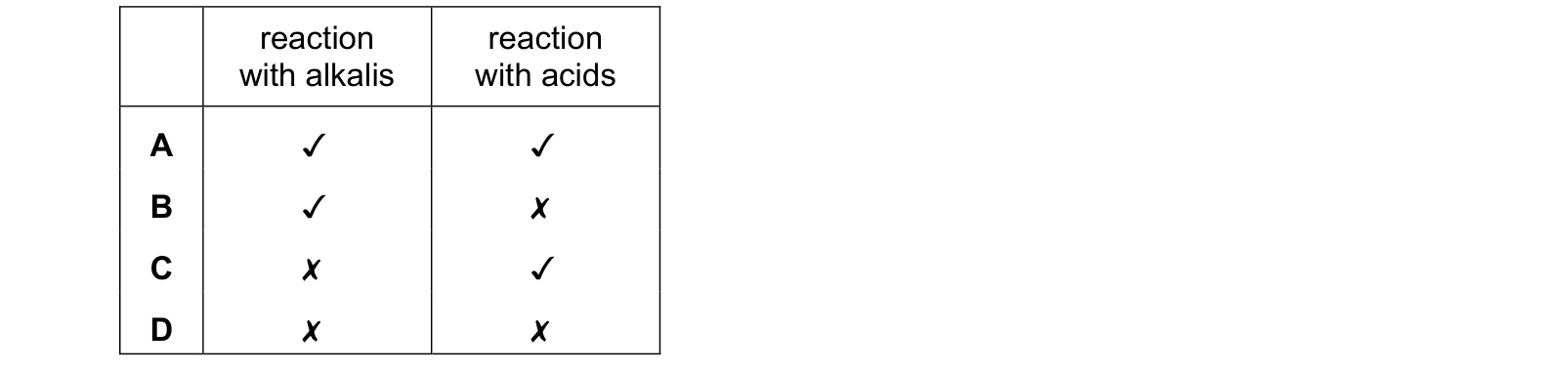
Zinc oxide is an amphoteric oxide. Which row describes the reactions of zinc oxide? reaction reaction with alkalis with acids Use the source image for W20 Paper 21, question 23.
Answer: A.
Amphoteric is defined by reacting with both acids and bases, so the correct row carries a tick in each column. Zinc oxide neutralises dilute hydrochloric acid to give zinc chloride and water, which is the basic side of its character, and it also dissolves in hot concentrated sodium hydroxide to give sodium zincate, which is the acidic side. The row ticking acids only would describe an ordinary metal oxide such as magnesium oxide, and it is the answer most students reach for because zinc is a metal. The row ticking alkalis only describes a non-metal oxide such as carbon dioxide, while the row crossing both columns would make zinc oxide a neutral oxide like carbon monoxide, leaving the word amphoteric in the question with nothing to do.
Question 5
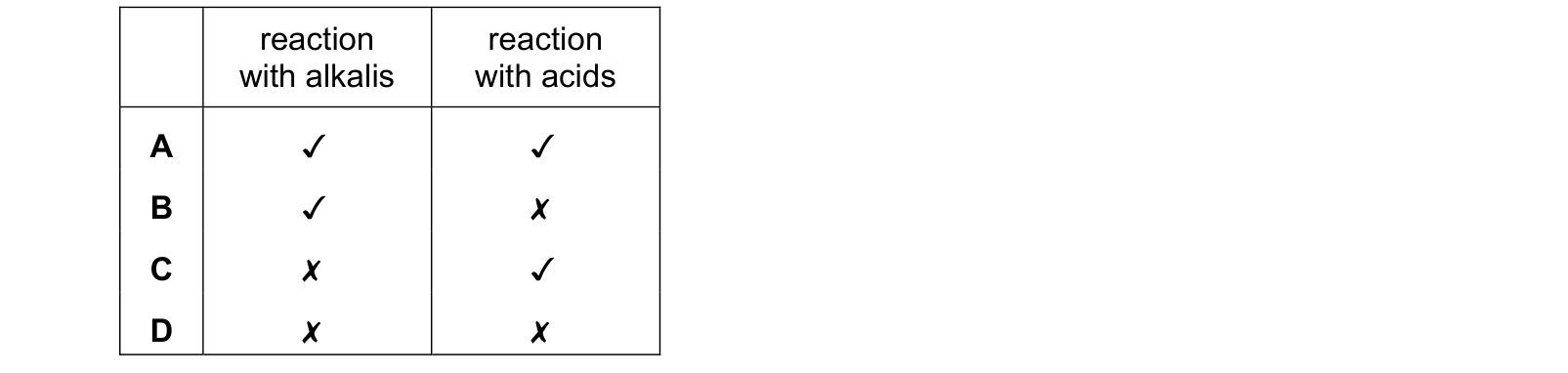
Zinc oxide is an amphoteric oxide. Which row describes the reactions of zinc oxide? reaction reaction with alkalis with acids Use the source image for W20 Paper 22, question 23.
Answer: A.
The question hands you the classification, so the work is in knowing what it implies. An amphoteric oxide behaves as a base towards an acid and as an acid towards an alkali, so both columns must be ticked: zinc oxide gives zinc chloride and water with hydrochloric acid, and sodium zincate with hot concentrated sodium hydroxide. Ticking only the acid column would demote zinc oxide to a plain basic oxide, which is what magnesium oxide is, and that ignores the very term the stem provides. Ticking only the alkali column would make it acidic, the behaviour of a non-metal oxide such as sulfur dioxide, and crossing both columns would describe a neutral oxide that neutralises nothing whatever.
These questions are drawn from past CIE 0620 Chemistry papers and filtered to the characteristic properties of acids and bases. You answer, you find out immediately whether you were right, and you get the reasoning for the correct option and for each distractor. Wrong answers go to a mistakes locker so you can come back to exactly those.
Practice is free. You need an account only so your progress and your mistakes are still there next time.
These are the errors that cost marks on the characteristic properties of acids and bases, taken from our own topic notes. Read them before you practise and you will recognise the traps in the questions.
Calling every base an alkali, when only the soluble ones are.
Writing acid plus carbonate as giving hydrogen instead of carbon dioxide.
Giving thymolphthalein as pink in alkali, which is phenolphthalein, not on this syllabus.
Saying pH 3 is three times as acidic as pH 4, rather than ten times.
Using "strong" to mean "concentrated".
Saying a weak acid needs less alkali to neutralise it.
Forgetting that the ionic equation for every neutralisation is H<sup>+</sup> + OH<sup>−</sup> → H<sub>2</sub>O.
Testing for ammonia with dry litmus paper rather than damp.