13 past-paper questions on this unit. Five of them are below. Answer on the page: each one is marked the moment you pick, the correct option is shown whether or not you found it, and the full explanation opens either way.
CIE 0620 ChemistryPaper 1 and Paper 2 MCQsFree account
Noble gases: five questions to try now
Real past-paper questions, the answer key from the mark scheme, and the explanation that goes with it. No account needed to answer them.
Question 1
Three properties of element X are listed. ● It contains atoms with a full outer shell of electrons. ● It is monoatomic. ● It is unreactive. In which part of the Periodic Table is the element placed?
Answer: C.
A full outer shell means an atom has no tendency to gain, lose or share electrons, which explains both the lack of reactivity and the existence of the element as single atoms rather than molecules. That combination belongs to the noble gases in Group VIII. Group I elements have one outer electron and are among the most reactive metals known. Group VII elements need one more electron and react readily, and they exist as diatomic molecules rather than single atoms. Transition elements have partly filled shells, variable oxidation states and a rich chemistry, which is the opposite of unreactive.
Question 2
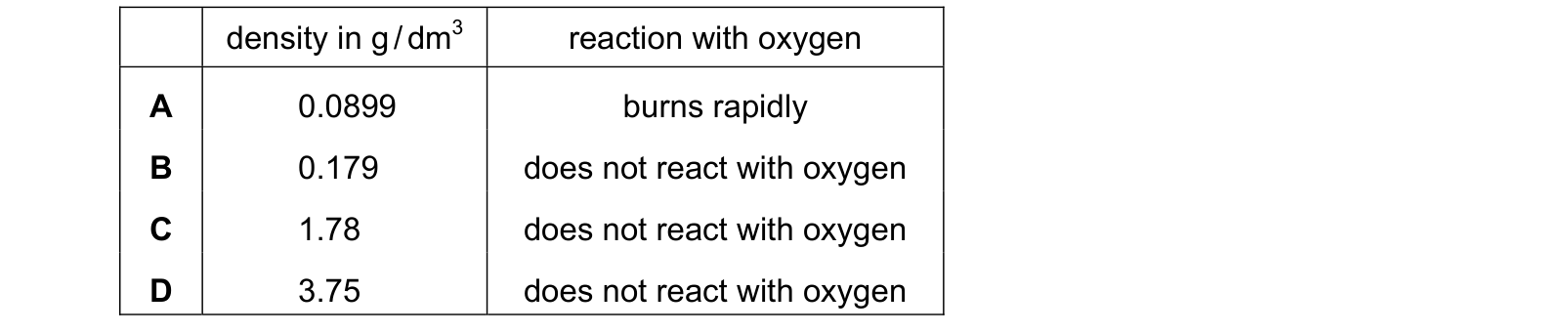
A balloon is filled with helium. Helium is a noble gas and makes the balloon rise up in the air. The density of air is 1.23 g / dm³. Which gas is helium? Each answer gives, in order: density in g / dm³; reaction with oxygen.
Answer: B.
A balloon rises when the gas inside it is less dense than the air around it, and the air here has a density of 1.23 g per dm cubed, so the helium must be well below that. Both 1.78 and 3.75 are denser than air and would make the balloon sink. Helium is a noble gas with a full outer shell, so it does not react with oxygen, which rules out the row describing a gas that burns rapidly; that row also quotes the density of hydrogen, the other very light gas, whose flammability is exactly why helium replaced it. A density of 0.179 g per dm cubed with no reaction with oxygen is the row that fits.
Question 3
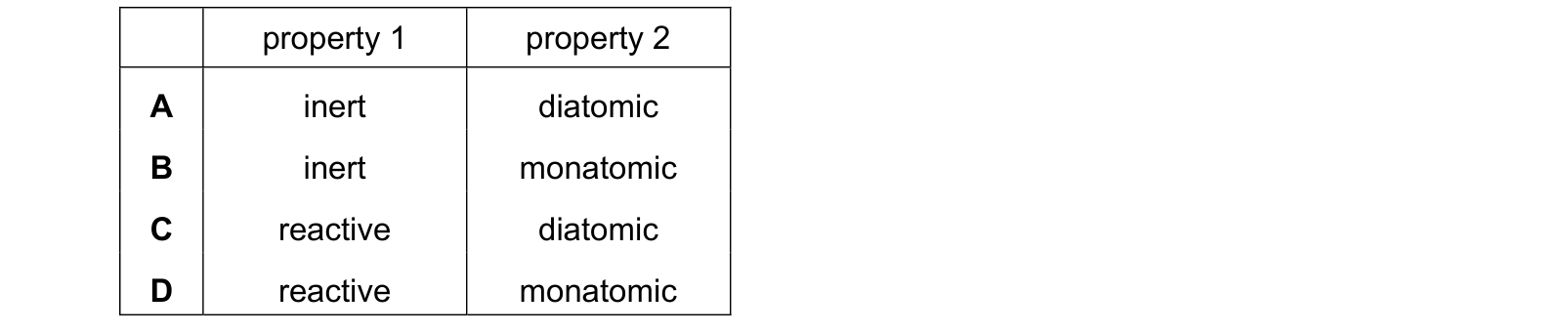
Which row describes the properties of argon? Each answer gives, in order: property 1; property 2.
Answer: B.
Argon is a noble gas with a full outer shell of eight electrons, so it has no tendency to react and is described as inert, which is why it fills light bulbs and shields welding arcs. That same full shell means it has no reason to bond to a second argon atom, so argon exists as single atoms and is monatomic rather than diatomic. Both halves of the row follow from one electronic structure. Rows describing argon as reactive contradict the whole basis of Group VIII, and the rows calling it diatomic borrow a property of chlorine or oxygen, elements that do need to share electrons.
Question 4
Helium and neon exist as monoatomic gases at room temperature and pressure. statement 1 Helium and neon have eight electrons in their outer shell. statement 2 Helium and neon are unreactive. Which option is correct?
Answer: D.
Statement 2 is correct, since helium and neon are both unreactive, which is why they exist as single atoms and take part in almost no chemistry. Statement 1 is not correct, because helium has only two electrons in total and its outer shell is already full with those two; only neon and the noble gases below it carry eight. What is needed is therefore a false first statement paired with a true second one. Options treating statement 1 as correct have applied the eight electron rule to an element whose first shell holds a maximum of two, which is precisely the exception this question exists to test.
Question 5
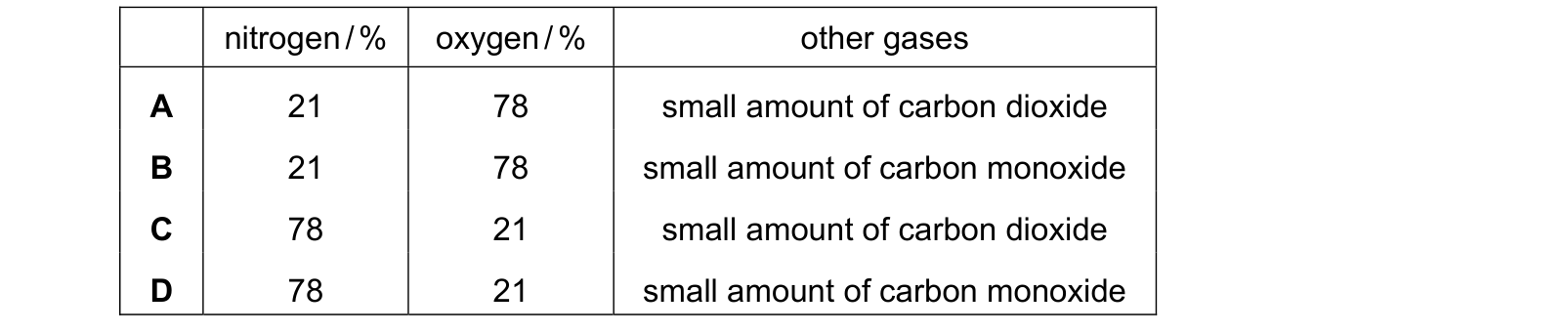
Clean, dry air contains nitrogen, oxygen and small amounts of other gases. The noble gases have been left out of the table. Which row shows the composition of clean, dry air? nitrogen / % oxygen / % other gases Use the source image for W19 Paper 13, question 29.
Answer: C.
Air that has not been polluted is about 78% nitrogen and 21% oxygen by volume, so nitrogen has to be the larger of the two percentages; the rows offering 21% nitrogen with 78% oxygen have the two main gases in the wrong columns. What remains is roughly 1% argon together with about 0.04% carbon dioxide, so carbon dioxide is a legitimate component of clean air. Carbon monoxide is not, since it is produced by incomplete combustion in engines and heaters and appears only in polluted air. That leaves 78% nitrogen, 21% oxygen and a small amount of carbon dioxide as the only description of a clean, dry sample.
These questions are drawn from past CIE 0620 Chemistry papers and filtered to noble gases. You answer, you find out immediately whether you were right, and you get the reasoning for the correct option and for each distractor. Wrong answers go to a mistakes locker so you can come back to exactly those.
Practice is free. You need an account only so your progress and your mistakes are still there next time.
These are the errors that cost marks on noble gases, taken from our own topic notes. Read them before you practise and you will recognise the traps in the questions.
Writing the noble gases as diatomic molecules such as Ne<sub>2</sub>.
Saying they are unreactive because they have eight outer electrons, and then being caught by helium, which has two.
Saying helium is used in balloons only because it is light, without mentioning that it does not burn.
Saying argon is used in lamps because it glows, which is neon's use.
Claiming the noble gases become more reactive down the group.
Explaining unreactivity as "they are stable" without linking it to losing, gaining or sharing electrons.
Revise it first
If any of the above is unfamiliar, work through the notes before practising: Noble gases revision notes.