17 past-paper questions on this unit. Five of them are below. Answer on the page: each one is marked the moment you pick, the correct option is shown whether or not you found it, and the full explanation opens either way.
CIE 0620 ChemistryPaper 1 and Paper 2 MCQsFree account
Carboxylic acids: five questions to try now
Real past-paper questions, the answer key from the mark scheme, and the explanation that goes with it. No account needed to answer them.
Question 1
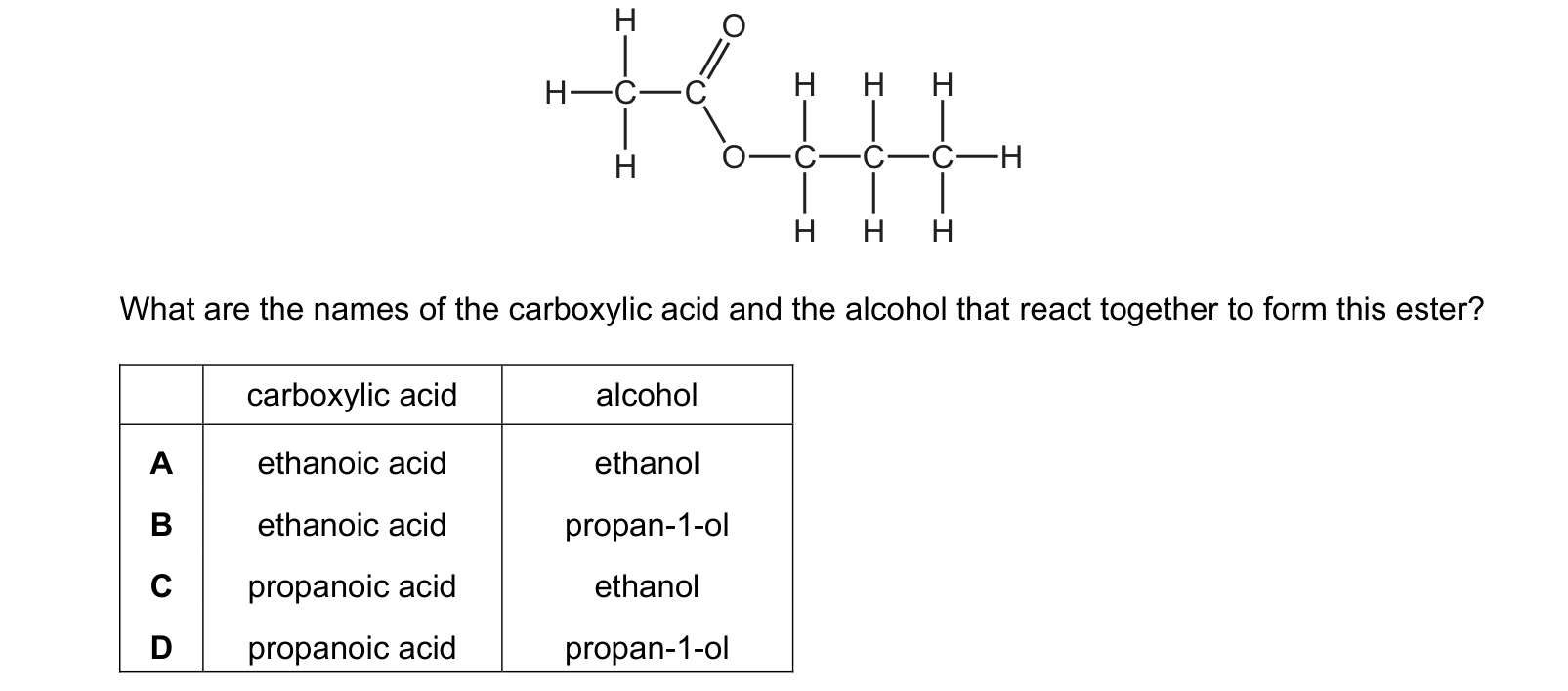
The structure of an ester is shown. What are the names of the carboxylic acid and the alcohol that react together to form this ester? Each answer gives, in order: carboxylic acid; alcohol.
Answer: B.
Every ester breaks at the COO group into an acid part and an alcohol part, and the carbon of the C=O belongs to the acid. Counting from the left of the structure gives a CH3 group and then the carbonyl carbon, two carbon atoms in all, so the acid is ethanoic acid. To the right of the single-bonded oxygen there are three carbon atoms in a row finishing in CH3, so the alcohol is propan-1-ol. Answering ethanoic acid with ethanol counts only two carbon atoms on the right-hand side, and the two rows offering propanoic acid have handed the carbonyl carbon to the wrong half of the molecule, finding three carbon atoms on the left where there are two.
Question 2
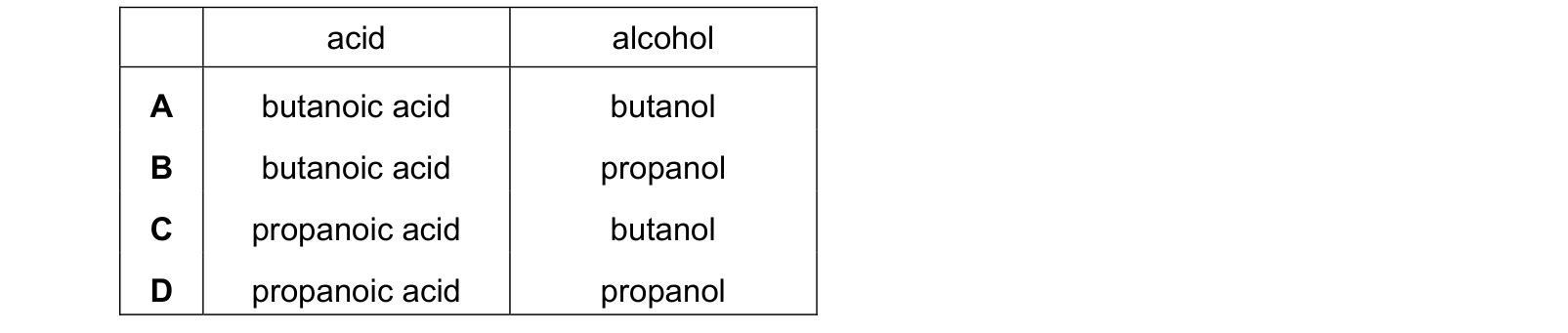
The formula of an ester is CH3CH2CH2COOCH2CH2CH3. Which acid and alcohol react together to make the ester? Each answer gives, in order: acid; alcohol.
Answer: B.
In the name of an ester the alcohol supplies the first word and the acid the second, but in a formula written as RCOOR the acid part sits to the left of the COO group. Split CH3CH2CH2COOCH2CH2CH3 at that group and count carefully. On the left is CH3CH2CH2CO, which is four carbon atoms once the carbonyl carbon is included, so the acid is butanoic acid; on the right is OCH2CH2CH3, three carbon atoms, so the alcohol is propanol. Pairing butanoic acid with butanol makes both parts four carbons long, which happens when the carbonyl carbon is counted twice, and the rows built on propanoic acid have stopped counting at the three carbons before the carbonyl group and given that carbon away to the alcohol.
Question 3
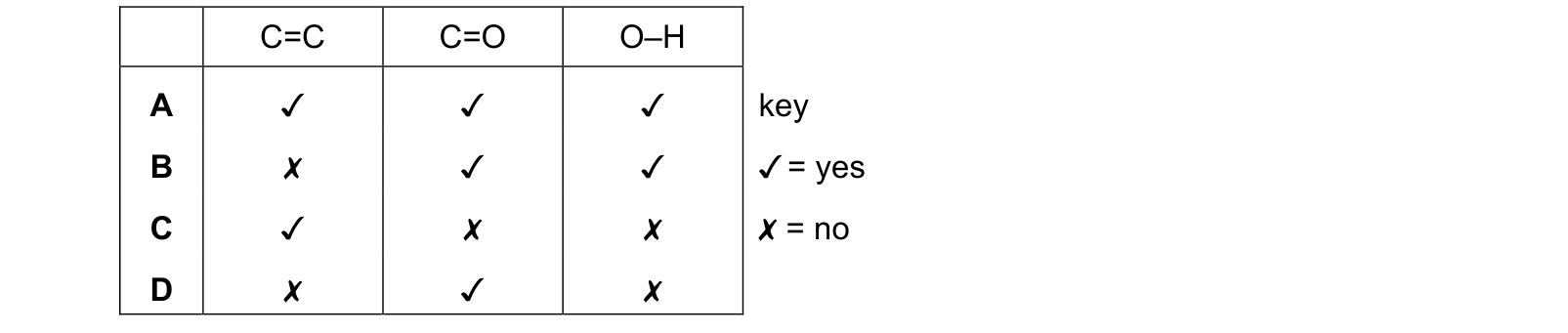
Compound J is an unsaturated carboxylic acid. Which bonds are present in a molecule of J? C=C C=O O–H Use the source image for S22 Paper 12, question 32.
Answer: A.
Read the description as two separate requirements. Carboxylic acid means the COOH group, in which one carbon is double bonded to an oxygen and single bonded to an OH, so C=O and O-H both have to be ticked. Unsaturated means a carbon to carbon double bond somewhere in the molecule, so C=C is ticked too and every column is yes. The row denying C=C describes a saturated acid such as ethanoic acid, the row ticking C=C alone describes a plain alkene with no acid group, and the row with C=O but no O-H would leave every oxygen double bonded, which no carboxylic acid can be.
Question 4
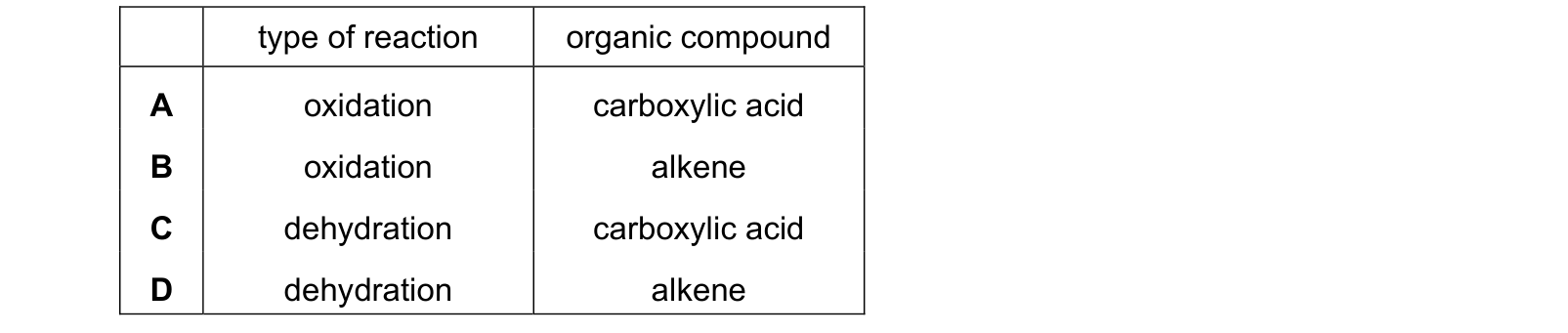
Ethanol is reacted with acidified potassium manganate(VII). Which row describes the type of reaction and the type of organic compound formed? Each answer gives, in order: type of reaction; organic compound.
Answer: A.
Acidified potassium manganate(VII) is an oxidising agent, and its purple colour draining away is the sign that it has handed oxygen to something. Ethanol is what it oxidises here, the OH group at the end of the chain becoming COOH, so the product is ethanoic acid, a carboxylic acid, and the reaction is an oxidation. Dehydration means taking water out, which is what hot concentrated sulfuric acid does to ethanol, and that reaction gives ethene, so rows naming dehydration have brought in a different reagent altogether. An alkene cannot come from this oxidation, since adding oxygen at the end of the chain is the opposite of stripping a water molecule out of the middle of it.
Question 5
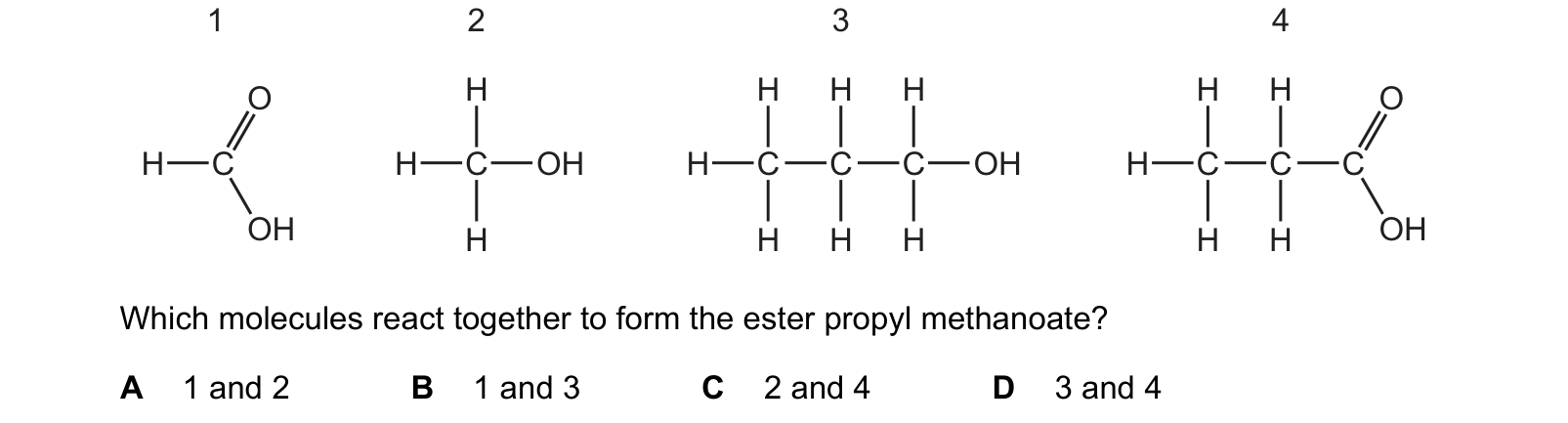
The structures of four molecules are shown. Which molecules react together to form the ester propyl methanoate?
Answer: B.
Propyl methanoate is named with the alcohol first and the acid second, so it needs an alcohol of three carbon atoms and an acid of one. Molecule 3 is a three-carbon chain ending in OH, which is propan-1-ol, and molecule 1 is HCOOH, the acid whose carbonyl carbon carries a hydrogen atom instead of a carbon chain, which is methanoic acid. Molecules 2 and 4 fill the same two roles the other way round, methanol with one carbon atom and propanoic acid with three, and warming those together would give methyl propanoate. That is the popular wrong answer, because the carbon atoms look right in total until you check which half of the name each molecule has to supply.
These questions are drawn from past CIE 0620 Chemistry papers and filtered to carboxylic acids. You answer, you find out immediately whether you were right, and you get the reasoning for the correct option and for each distractor. Wrong answers go to a mistakes locker so you can come back to exactly those.
Practice is free. You need an account only so your progress and your mistakes are still there next time.
These are the errors that cost marks on carboxylic acids, taken from our own topic notes. Read them before you practise and you will recognise the traps in the questions.
Drawing -COOH with two O-H bonds, or with no double bond at all.
Counting the carboxyl carbon twice, so CH₃CH₂COOH is called butanoic acid.
Naming the salt of ethanoic acid an ethanate or an ethanoate acid. It is an ethanoate.
Expecting a gas from the reaction with a base. Only metals and carbonates give one.
Saying a weak acid is a dilute acid.
Reversing the ester name, so ethanoic acid plus ethanol is called ethanoyl ethanoate or ethanoic ethyl.
Leaving water out of the esterification equation.
Writing the sulfuric acid catalyst in as a reactant.