62 past-paper questions on this unit. Five of them are below. Answer on the page: each one is marked the moment you pick, the correct option is shown whether or not you found it, and the full explanation opens either way.
CIE 0620 ChemistryPaper 1 and Paper 2 MCQsFree account
Polymers: five questions to try now
Real past-paper questions, the answer key from the mark scheme, and the explanation that goes with it. No account needed to answer them.
Question 1
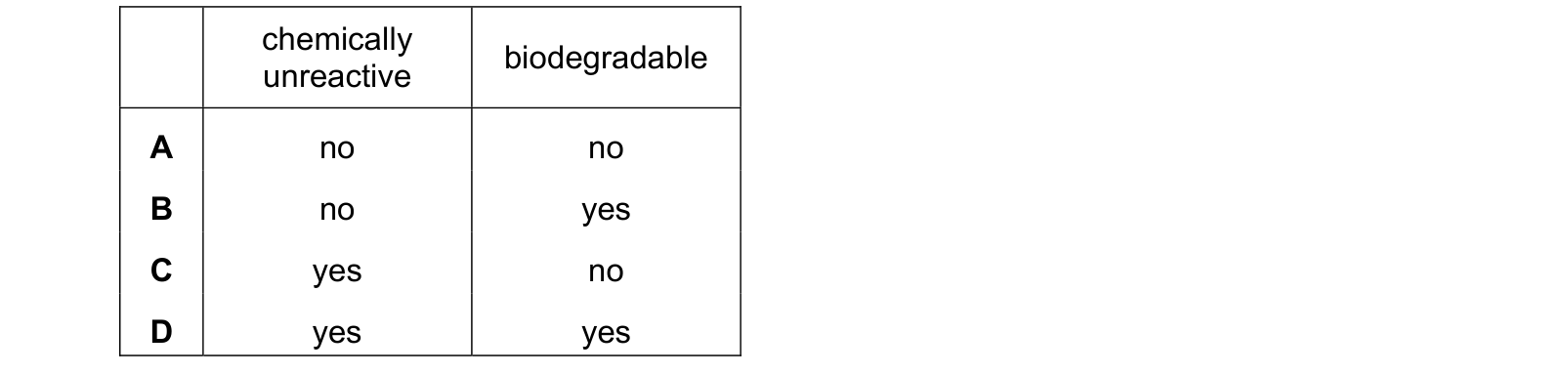
Most objects made from synthetic polymers last for many years. Why do these polymers last for so long? Each answer gives, in order: chemically unreactive; biodegradable.
Answer: C.
Synthetic addition polymers like poly(ethene) consist of long chains of strong, chemically inert carbon-carbon single bonds without reactive functional groups, making them chemically unreactive to acids, alkalis, and atmospheric oxidation. Furthermore, because they are synthetic materials that micro-organisms lack the enzymes to break down, they are non-biodegradable and persist in the environment for decades. Row C (yes / no) correctly pairs high chemical unreactivity with non-biodegradability. A and B are incorrect because polymers are chemically unreactive, and B and D falsely claim synthetic polymers are biodegradable.
Question 2
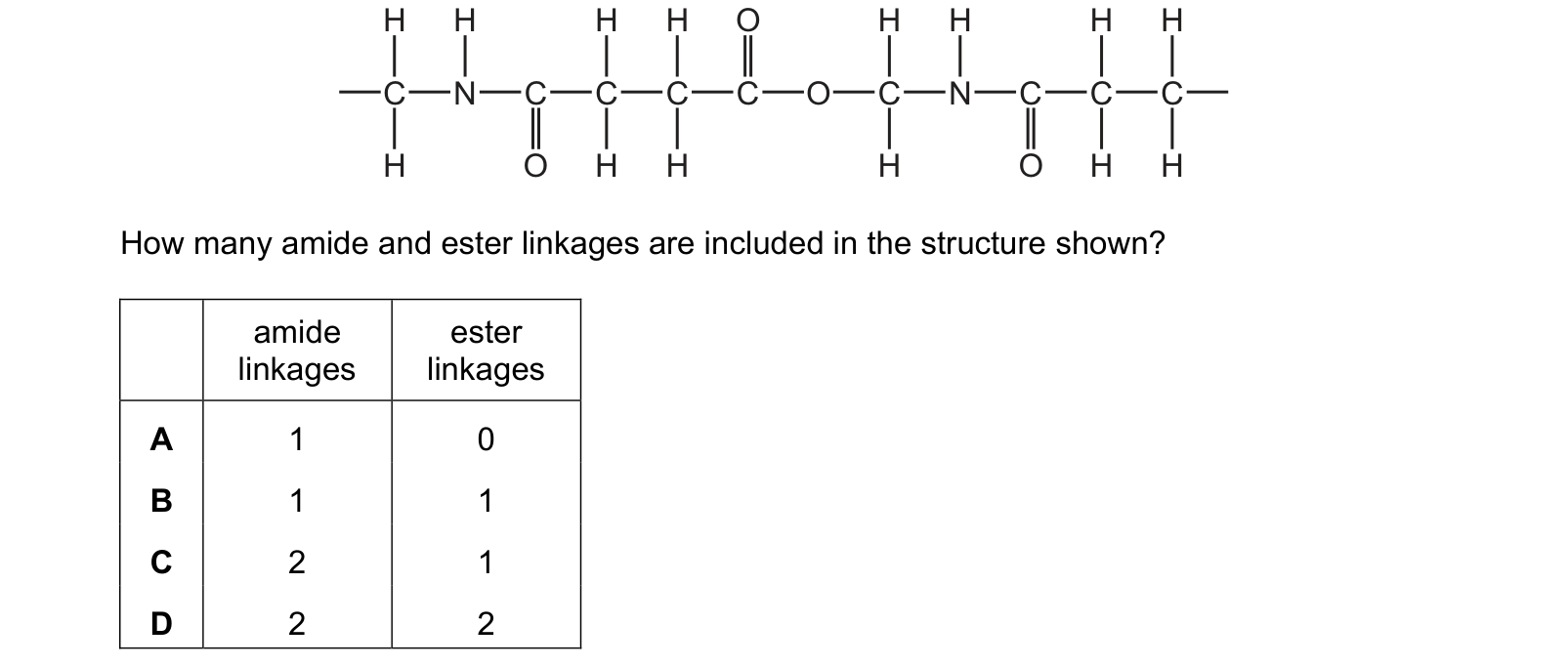
The structure of part of a polymer is shown. How many amide and ester linkages are included in the structure shown? Each answer gives, in order: amide linkages; ester linkages.
Answer: C.
The two kinds of link are told apart by what sits beside the carbon that carries the double bonded oxygen. An amide link has that carbon joined to a nitrogen bearing a hydrogen, while an ester link has it joined to a plain oxygen with no nitrogen involved. Reading along the chain there are two places where a C=O group is attached to an NH group, giving 2 amide linkages, and one place where a C=O group is attached to an O, giving 1 ester linkage. The rows answering one amide have counted only the first nitrogen link and stopped there. The row answering two esters has most likely counted the doubly bonded oxygen of an amide as though it belonged to an ester; the nitrogen is the deciding atom, and it appears in exactly two of the three link positions.
Question 3
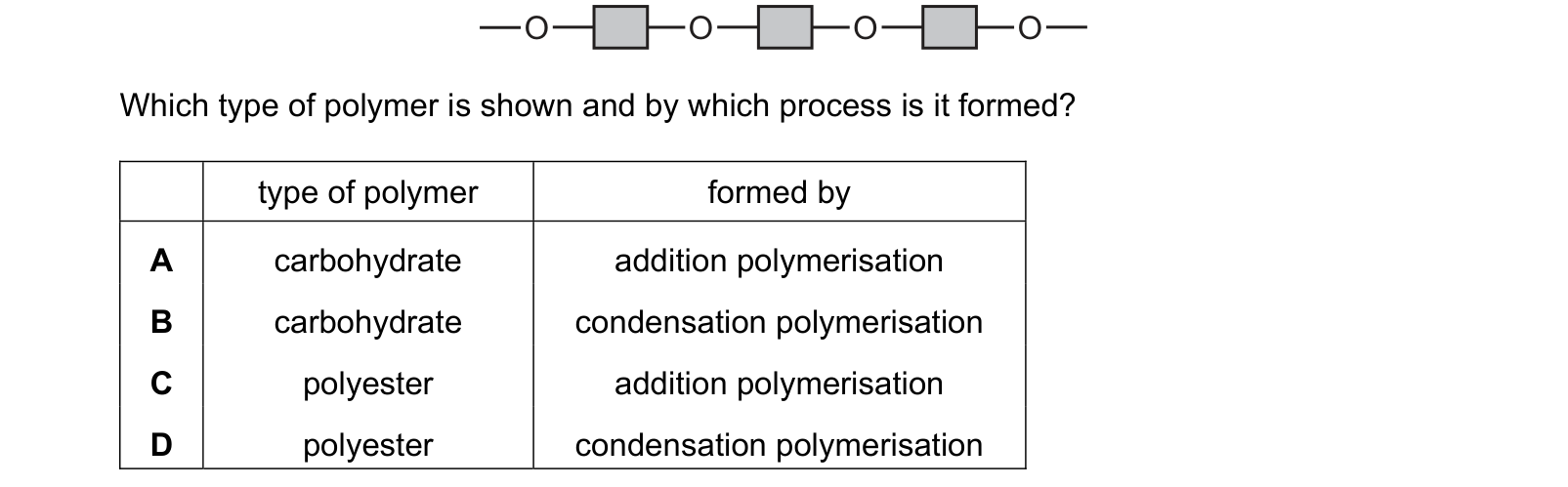
The structure of a polymer is shown. Which type of polymer is shown and by which process is it formed? Each answer gives, in order: type of polymer; formed by.
Answer: B.
The links in this chain are single oxygen atoms between the blocks, with no C=O anywhere along it. An ester linkage always places a carbonyl group next to the oxygen, so a polyester would show a C=O at every junction, and a chain bridged by lone oxygen atoms is a carbohydrate such as starch, where glucose rings join in exactly that way. Each bridge was made by removing a molecule of water from two OH groups, which makes the process condensation polymerisation. Addition polymerisation fails for a second reason as well, because it needs monomers containing a C=C double bond and yields a backbone of carbon atoms only, with no oxygen in it.
Question 4
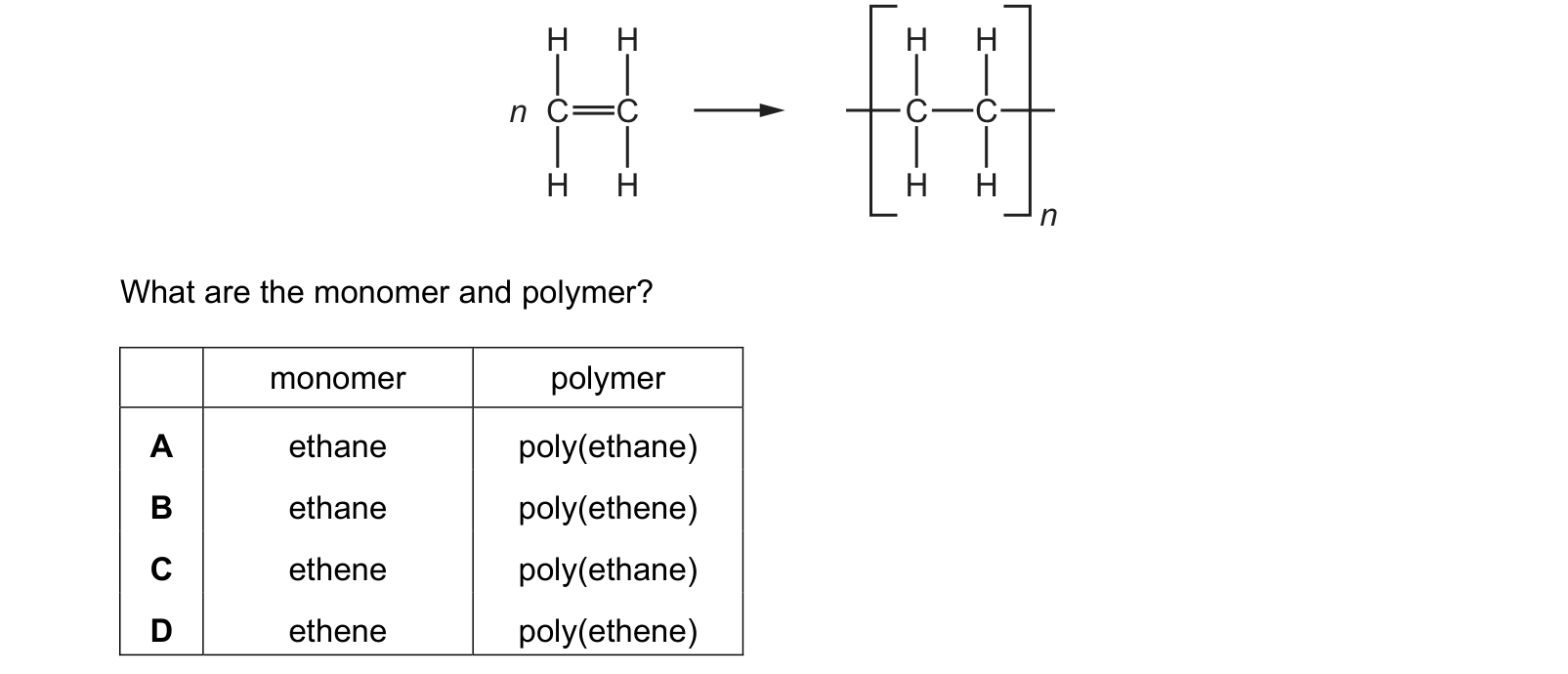
The diagram shows the structure of a monomer and of the polymer made from it. What are the monomer and polymer? Each answer gives, in order: monomer; polymer.
Answer: D.
The starting molecule has two carbon atoms joined by a double bond with two hydrogen atoms on each, which is ethene, C2H4, and the ending ene is what signals that double bond. In the product the double bond has become a single bond and the unit is enclosed in brackets to show that it repeats, so the polymer is poly(ethene). Calling the monomer ethane would require six hydrogen atoms and no double bond, which is not what is drawn and could not polymerise in any case. Poly(ethane) is not a name in use, because an addition polymer keeps the name of the alkene it was built from, however saturated the finished chain may be.
Question 5
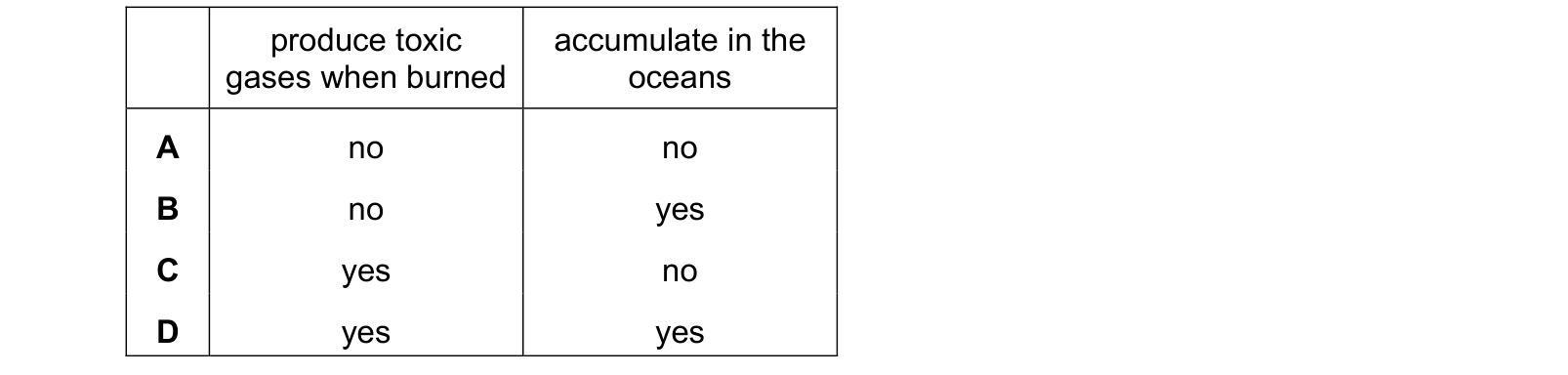
Which row explains why plastics such as poly(ethene) cause pollution? Each answer gives, in order: produce toxic gases when burned; accumulate in the oceans.
Answer: D.
Both columns here deserve a yes, for reasons that have nothing to do with each other. Burning plastic does release toxic gases, since incomplete combustion gives carbon monoxide and a chlorine-containing plastic such as PVC gives off hydrogen chloride as well. Separately, poly(ethene) and its relatives are non-biodegradable, because the carbon chain is unreactive and no microbe has an enzyme that can break it, so discarded plastic drifts into the sea and stays there as accumulating fragments. Answering no in the second column is the usual error, made by assuming that anything left outdoors eventually rots, when it is precisely that resistance to attack which makes plastics useful and also makes them a lasting pollutant.
These questions are drawn from past CIE 0620 Chemistry papers and filtered to polymers. You answer, you find out immediately whether you were right, and you get the reasoning for the correct option and for each distractor. Wrong answers go to a mistakes locker so you can come back to exactly those.
Practice is free. You need an account only so your progress and your mistakes are still there next time.
These are the errors that cost marks on polymers, taken from our own topic notes. Read them before you practise and you will recognise the traps in the questions.
Drawing a repeat unit with the double bond still in place.
Leaving off the bonds that extend through the brackets.
Saying water is lost in addition polymerisation. Nothing is lost; the polymer is the only product.
Giving one monomer for nylon or PET. Each needs two, or a monomer with two different groups.
Confusing the linkages: -COO- is the ester linkage, -CONH- is the amide linkage.
Saying plastics are burnt to make them biodegradable, rather than naming the toxic gases produced.
Calling a protein a polyester. It is a natural polyamide.
Revise it first
If any of the above is unfamiliar, work through the notes before practising: Polymers revision notes.