20 past-paper questions on this unit. Five of them are below. Answer on the page: each one is marked the moment you pick, the correct option is shown whether or not you found it, and the full explanation opens either way.
CIE 0620 ChemistryPaper 1 and Paper 2 MCQsFree account
Identification of ions and gases: five questions to try now
Real past-paper questions, the answer key from the mark scheme, and the explanation that goes with it. No account needed to answer them.
Question 1
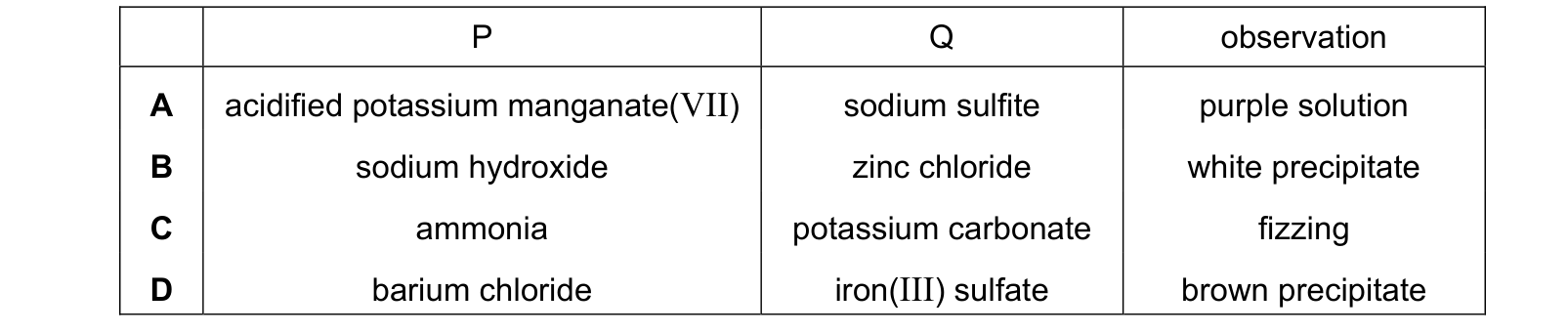
Which row shows the observation when a few drops of aqueous P is added to concentrated aqueous Q? Each answer gives, in order: P; Q; observation.
Answer: B.
Sodium hydroxide added to a zinc salt precipitates zinc hydroxide, which is white, and only a few drops are added so the alkali is not yet in excess and the precipitate stays; that row matches its stated observation. Acidified potassium manganate(VII) with sodium sulfite is a redox test in which the sulfite reduces the manganate(VII), so the purple colour disappears rather than remaining, which is the opposite of what that row claims. Ammonia added to potassium carbonate produces no fizzing at all, because carbon dioxide is released from a carbonate by an acid and ammonia is an alkali. Barium chloride with iron(III) sulfate does give a precipitate, but it is white barium sulfate; a brown precipitate would point to iron(III) hydroxide, which needs an alkali rather than barium chloride to form.
Question 2
An aqueous cation reacts with aqueous sodium hydroxide to form a white precipitate. The precipitate is insoluble in excess sodium hydroxide. What is the aqueous cation?
Answer: B.
Sodium hydroxide added to a metal ion in solution precipitates the metal hydroxide, and the colour together with the behaviour in excess alkali identifies the metal. Calcium hydroxide is white and stays as a precipitate no matter how much extra sodium hydroxide is added, so calcium satisfies both halves of the description. Aluminium and zinc also give white precipitates, which is what makes them tempting, but both are amphoteric and their hydroxides redissolve in excess sodium hydroxide to leave a colourless solution, so they fail the second half. Chromium fails on colour before that, since chromium(III) hydroxide is a green precipitate, and it too dissolves in excess. The phrase insoluble in excess is what separates calcium from the other white precipitates.
Question 3
The results of two tests on an aqueous solution of X are shown. test observation aqueous sodium hydroxide added green precipitate formed acidified aqueous silver nitrate added yellow precipitate formed What is X?
Answer: D.
Two tests, two ions. A green precipitate with aqueous sodium hydroxide is the standard result for iron(II), since iron(III) gives red brown and copper(II) gives light blue, which rules out both copper compounds at once. A yellow precipitate with acidified silver nitrate identifies iodide, because chloride gives white and bromide gives cream. Putting the two together gives iron(II) iodide. The row naming iron(II) chloride gets the metal right and then ignores the colour of the halide precipitate, which is the only thing separating it from the answer.
Question 4
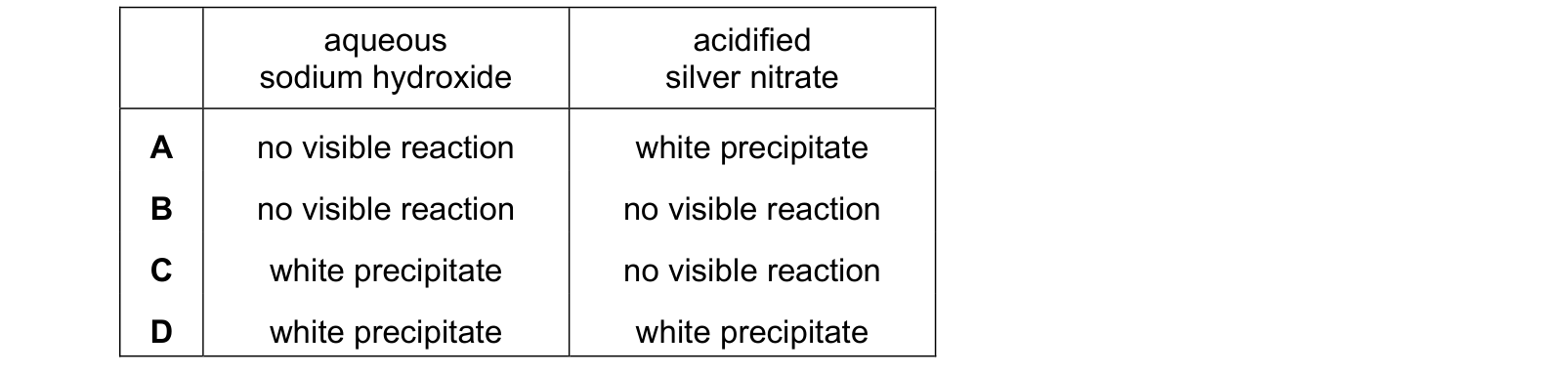
Four different colourless solutions are each tested separately with aqueous sodium hydroxide and with acidified silver nitrate. Which solution is sodium chloride? Each answer gives, in order: aqueous sodium hydroxide; acidified silver nitrate.
Answer: A.
The two tests target different parts of the compound. Aqueous sodium hydroxide tests for the metal ion, and sodium ions give no precipitate at all, since sodium hydroxide is itself soluble, so the first column reads no visible reaction. Acidified silver nitrate tests for the halide, and chloride gives a white precipitate of silver chloride, so the second column shows a white precipitate. Any row with a white precipitate in the first column describes a metal such as calcium, zinc or aluminium, and the row with no reaction in both columns would fit a sodium salt containing no halide, such as sodium nitrate.
Question 5
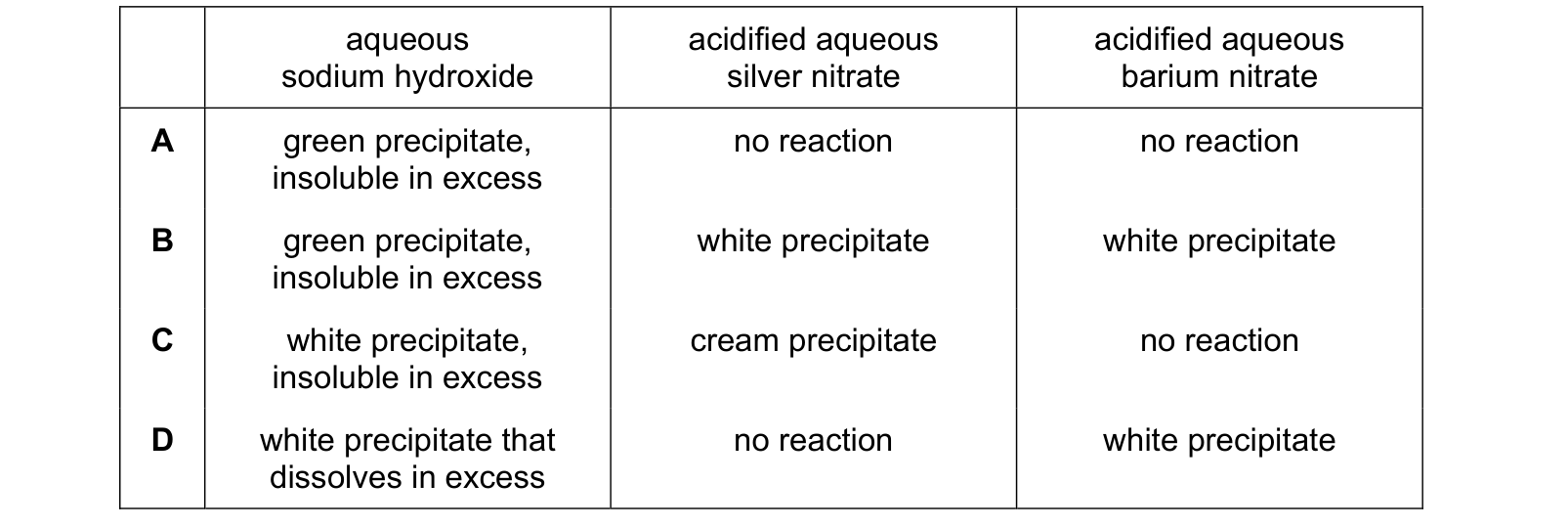
A substance is tested with three different reagents. Which row shows the results obtained with aqueous iron(II) nitrate? Each answer gives, in order: aqueous sodium hydroxide; acidified aqueous silver nitrate; acidified aqueous barium nitrate.
Answer: A.
Three tests each ask a different question. Aqueous sodium hydroxide identifies the cation, and iron(II) gives a green precipitate that stays put in excess alkali, so the first column reads green and insoluble in excess. Acidified silver nitrate tests for halide ions, and iron(II) nitrate contains no halide, so nothing happens. Acidified barium nitrate tests for sulfate, and there is no sulfate either, so again nothing happens. The row with white precipitates in the second and third columns describes a compound containing both a halide and a sulfate, which iron(II) nitrate is not.
These questions are drawn from past CIE 0620 Chemistry papers and filtered to identification of ions and gases. You answer, you find out immediately whether you were right, and you get the reasoning for the correct option and for each distractor. Wrong answers go to a mistakes locker so you can come back to exactly those.
Practice is free. You need an account only so your progress and your mistakes are still there next time.
These are the errors that cost marks on identification of ions and gases, taken from our own topic notes. Read them before you practise and you will recognise the traps in the questions.
Reporting only what a few drops of sodium hydroxide do, without adding excess.
Saying calcium gives a white precipitate that dissolves in excess. It does not.
Missing the dark blue solution that copper(II) gives with excess ammonia.
Using hydrochloric acid to acidify before adding silver nitrate.
Using sulfuric acid to acidify before adding barium nitrate.
Giving "white" for the silver bromide precipitate, which is cream.
Using dry litmus paper for ammonia or chlorine.
Swapping the two splints, or saying the limewater turns white rather than milky.