28 past-paper questions on this unit. Five of them are below. Answer on the page: each one is marked the moment you pick, the correct option is shown whether or not you found it, and the full explanation opens either way.
CIE 0620 ChemistryPaper 1 and Paper 2 MCQsFree account
Arrangement of elements: five questions to try now
Real past-paper questions, the answer key from the mark scheme, and the explanation that goes with it. No account needed to answer them.
Question 1
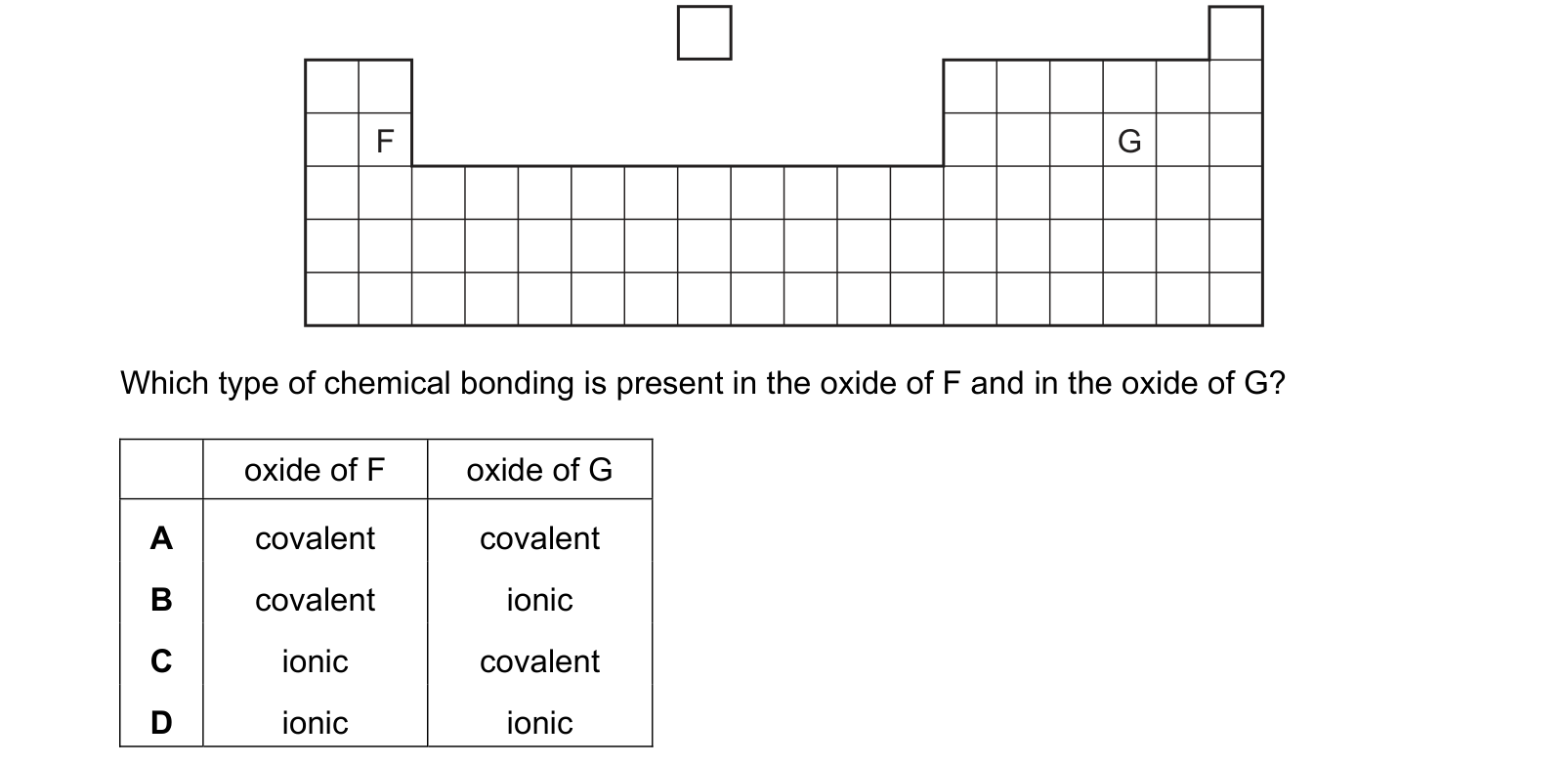
Part of the Periodic Table is shown. Which type of chemical bonding is present in the oxide of F and in the oxide of G? Each answer gives, in order: oxide of F; oxide of G.
Answer: C.
F sits in the second column of the left hand block, so it is a Group II metal, and metal oxides are ionic, built from metal cations and oxide anions held together by electrostatic attraction. G sits in the block on the right, four columns in, which makes it a Group VI non metal, and the oxide of a non metal is a molecular covalent compound with shared pairs of electrons. So the oxide of F is ionic while the oxide of G is covalent. The rows making both oxides the same type ignore that the two elements lie on opposite sides of the metal to non metal divide, and the reversed row treats the left of the table as non metallic.
Question 2
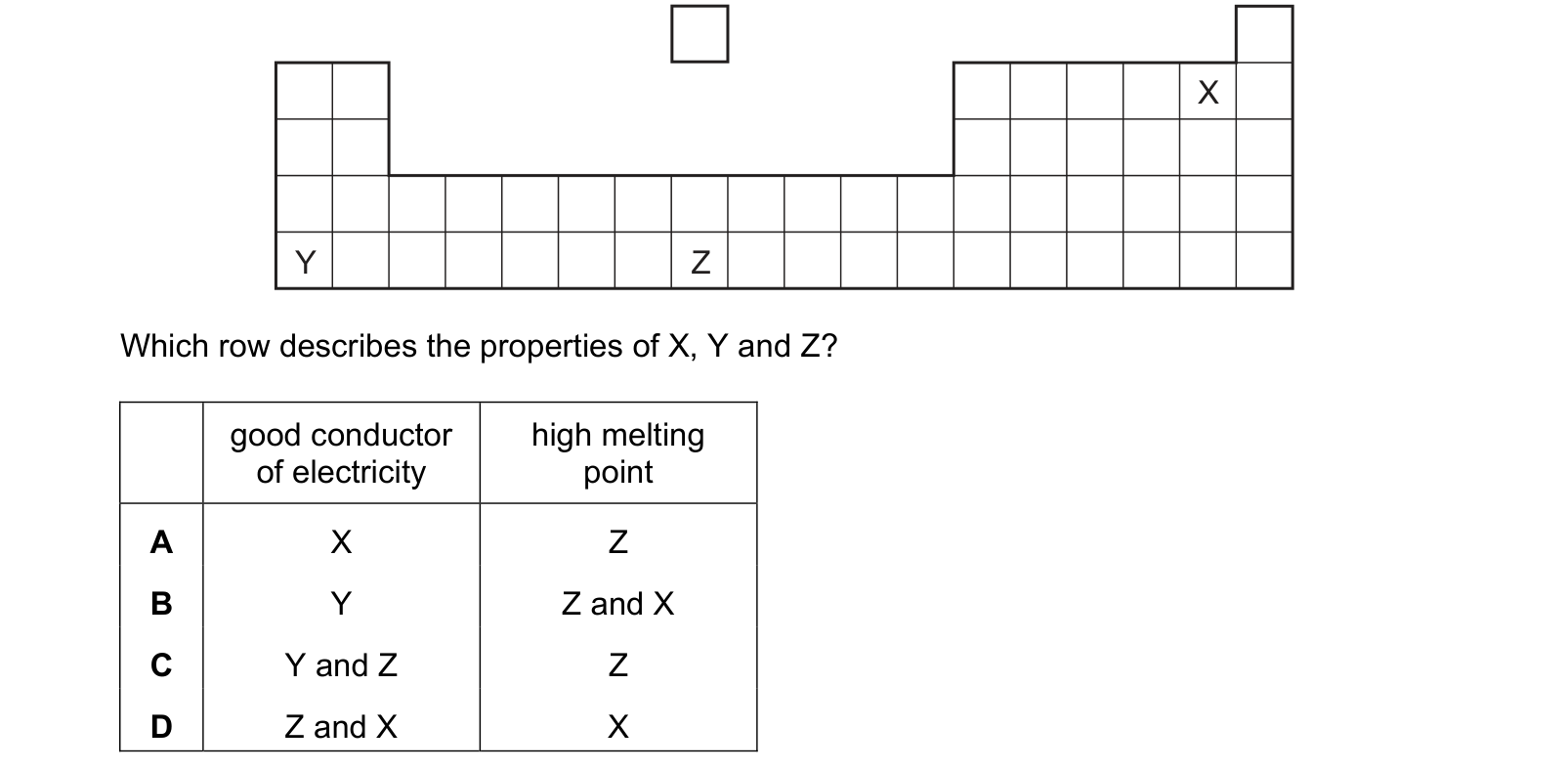
Part of the Periodic Table is shown. Which row describes the properties of X, Y and Z? Each answer gives, in order: good conductor of electricity; high melting point.
Answer: C.
The three letters sit in different regions of the table. Y is in the first column on the left, so it is a Group I metal, and Z is in the central block, so it is a transition metal; both are metals, and metals conduct electricity well because of their delocalised electrons. X is in the block on the right near the top, so it is a non metal and a poor conductor. On melting point, Group I metals are famously soft and low melting while transition metals have strong metallic bonding and very high melting points, so only Z melts high. Good conductors Y and Z, with a high melting point for Z alone, is the row that fits.
Question 3
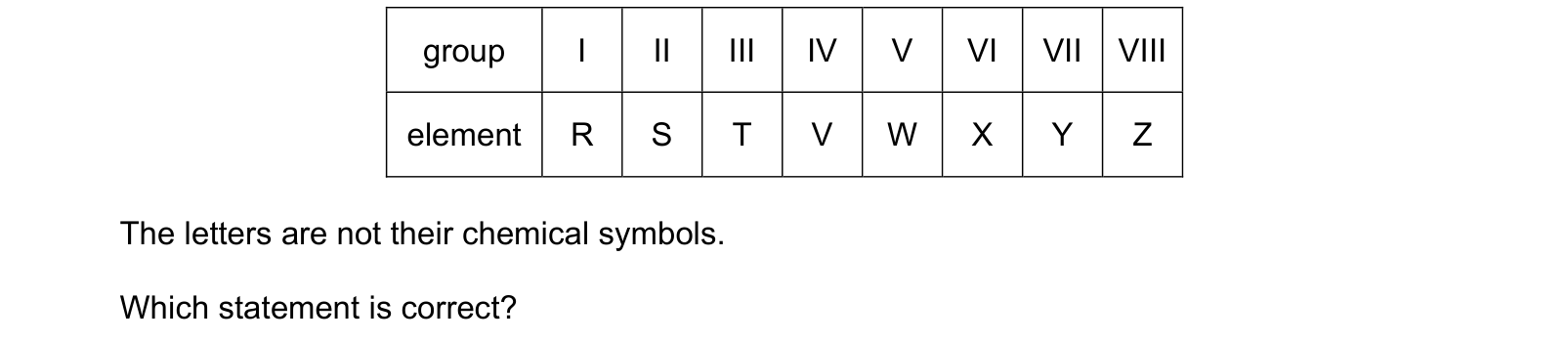
A period of the Periodic Table is shown. group I II III IV V VI VII VIII element The letters are not their chemical symbols. Which statement is correct?
Answer: B.
R is in Group I and Y is in Group VII, so R is a reactive metal that loses an electron while Y is a reactive non metal that gains one; transferring that electron from R to Y makes an ionic compound, and that is the correct statement. R is a metal, so it conducts electricity, which disposes of the first statement. Z is in Group VIII, a noble gas with a full outer shell, so it exists as single atoms rather than diatomic molecules and reacts with neither T nor anything else. Both statements about Z credit a noble gas with chemistry it does not do.
Question 4
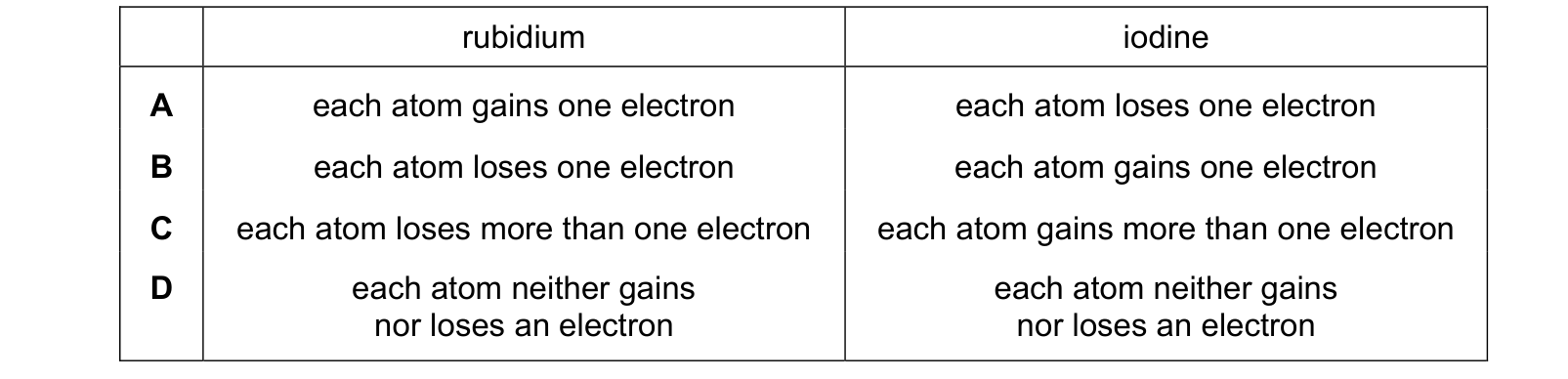
Rubidium is in Group I and iodine is in Group VII of the Periodic Table. Which row describes what happens when rubidium and iodine react together to form rubidium iodide? Each answer gives, in order: rubidium; iodine.
Answer: B.
Rubidium is in Group I with one outer electron, and losing that single electron leaves a full shell beneath, so each rubidium atom loses one. Iodine is in Group VII with seven outer electrons and needs just one more, so each iodine atom gains one. The numbers match exactly, which is why the compound has the formula RbI. The row reversing them has the metal gaining and the non metal losing, which would take both atoms further from a full shell. The row with more than one electron each would suit a Group II metal with a Group VI non metal, and the row with no transfer describes covalent bonding rather than an ionic compound.
Question 5
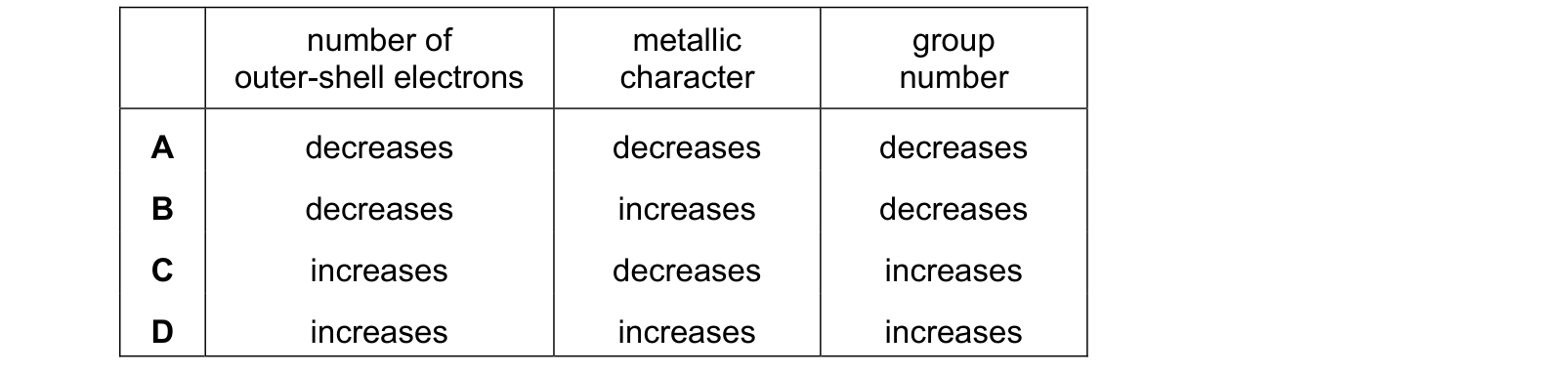
The elements sodium to argon form Period 3 of the Periodic Table. Which row describes the trend across Period 3 from left to right? Each answer gives, in order: number of outer-shell electrons; metallic character; group number.
Answer: C.
Two of the three columns move together because they measure the same thing: the group number simply reports how many outer shell electrons an atom has, and crossing Period 3 from sodium to argon that count climbs from one to eight. Any row in which one of those columns rises while the other falls is self contradictory before the chemistry is even considered. Metallic character behaves in the opposite way, since sodium and magnesium give up electrons easily while sulfur and chlorine hold onto theirs and gain more, so the elements become less metallic from left to right. Increasing, decreasing, increasing survives both checks.
These questions are drawn from past CIE 0620 Chemistry papers and filtered to arrangement of elements. You answer, you find out immediately whether you were right, and you get the reasoning for the correct option and for each distractor. Wrong answers go to a mistakes locker so you can come back to exactly those.
Practice is free. You need an account only so your progress and your mistakes are still there next time.
These are the errors that cost marks on arrangement of elements, taken from our own topic notes. Read them before you practise and you will recognise the traps in the questions.
Saying the elements are arranged in order of relative atomic mass.
Confusing periods with groups, so quoting the period number as the number of outer electrons.
Giving a Group VI ion a 6+ charge instead of 2−.
Explaining similar chemistry within a group by similar mass rather than by outer shell electrons.
Expecting carbon to form C<sup>4+</sup> ions rather than covalent bonds.
Saying metallic character increases across a period.
Predicting a value beyond a data table without checking whether the steps are getting bigger or smaller.