Atomic structure and the Periodic Table Exam Questions
70 past-paper questions on this unit. Five of them are below. Answer on the page: each one is marked the moment you pick, the correct option is shown whether or not you found it, and the full explanation opens either way.
CIE 0620 ChemistryPaper 1 and Paper 2 MCQsFree account
Atomic structure and the Periodic Table: five questions to try now
Real past-paper questions, the answer key from the mark scheme, and the explanation that goes with it. No account needed to answer them.
Question 1
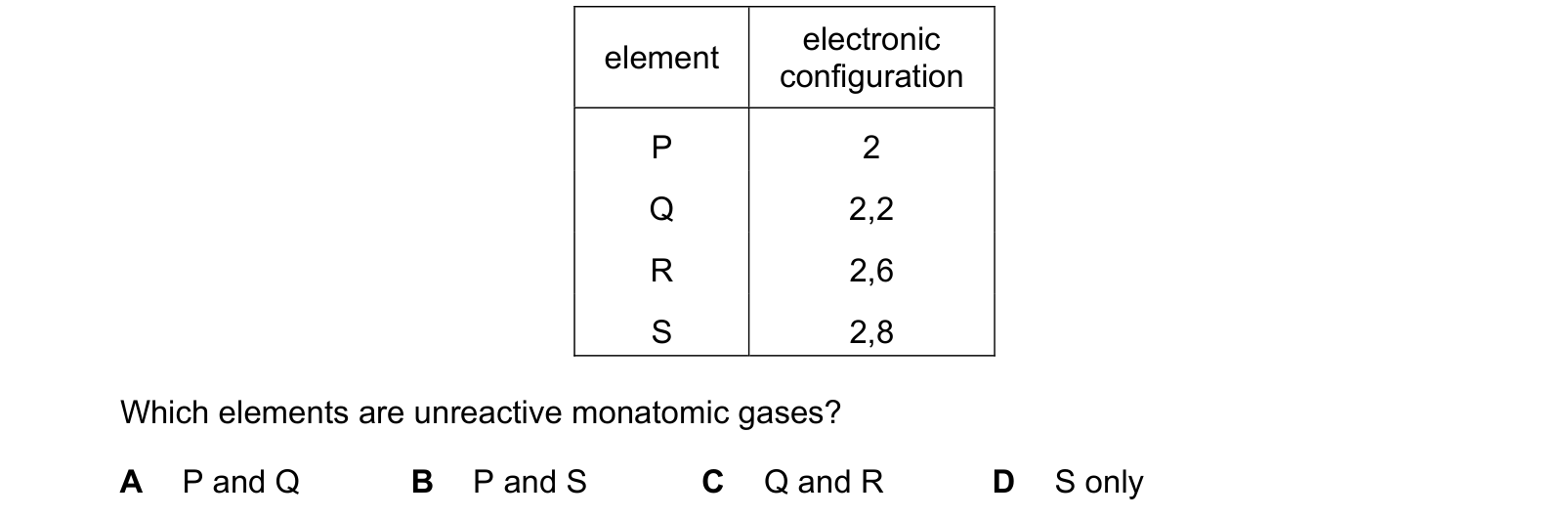
The electronic configurations of four elements, P, Q, R and S, are shown. electronic element configuration P 2 Q 2,2 R 2,6 S 2,8 Which elements are unreactive monatomic gases?
Answer: B.
Unreactive monatomic gases are the noble gases, and what identifies a noble gas is a complete outer shell that leaves nothing to gain, lose or share. P is written 2, a full first shell, and S is written 2,8, a full second shell, so those two are helium and neon. Q at 2,2 has two outer electrons and is a group II metal that reacts readily by losing them, so it is neither unreactive nor a gas. R at 2,6 has six outer electrons and is a group VI non metal that reacts by gaining two; it may be a gas but it is far from unreactive. Picking S on its own forgets that the first shell is complete at 2 rather than at 8, which is precisely why helium belongs with the noble gases despite holding only two electrons.
Question 2
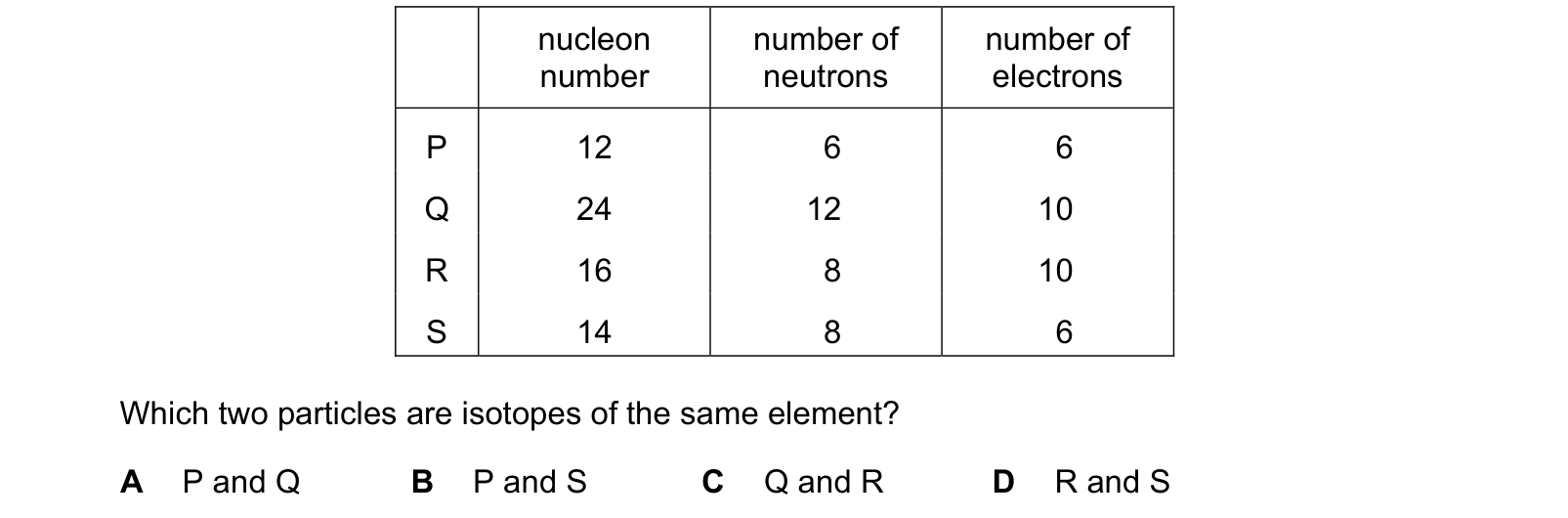
Some information about particles P, Q, R and S is shown. nucleon number of number of number neutrons electrons Which two particles are isotopes of the same element?
Answer: B.
Isotopes share a proton number, and here the proton number has to be worked out as the nucleon number take away the neutrons. P gives 12 less 6, which is 6 protons, and S gives 14 less 8, which is 6 as well, so both are carbon and differ only in neutrons. Q gives 24 less 12, which is 12 protons and therefore magnesium, and R gives 16 less 8, which is 8 protons and therefore oxygen, so those two are different elements. Q and R are the trap, because both show 10 electrons and look alike in that column, but an equal electron count makes them isoelectronic ions rather than isotopes, and R and S sharing a neutron count of 8 is beside the point in the same way.
Question 3
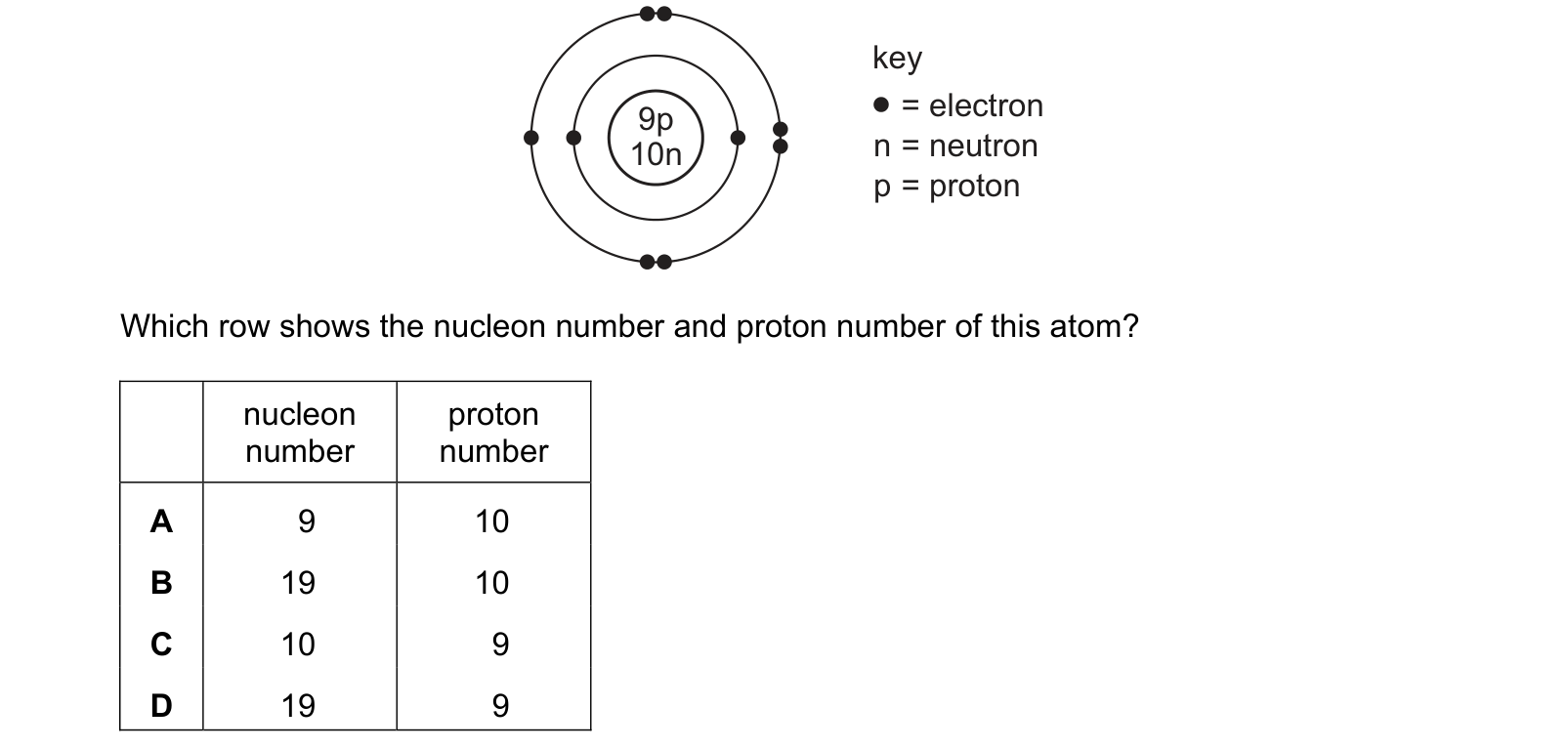
The structure of an atom is shown. Which row shows the nucleon number and proton number of this atom? Each answer gives, in order: nucleon number; proton number.
Answer: D.
Nucleon number counts protons and neutrons together, while proton number counts the protons alone. The nucleus in the diagram is labelled 9p and 10n, so the proton number is 9 and the nucleon number is 9 + 10 = 19, which agrees with the 2,7 electron arrangement drawn around it. The row giving 10 as the proton number has lifted the neutron count instead, and 10 protons would make this neon rather than fluorine. The row reading 10 then 9 puts the neutron count where the nucleon number belongs, forgetting to add the protons to it. The row reading 9 then 10 has both entries in the wrong columns, quoting the proton number as a nucleon number and the neutron number as a proton number.
Question 4
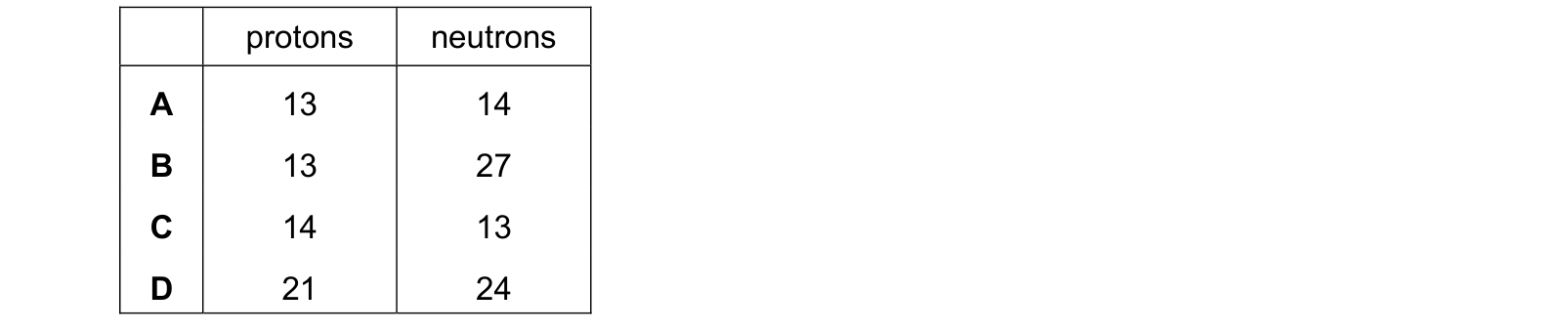
An atom has three electron shells. There are three electrons in the outer shell. How many protons and how many neutrons are in this atom? Each answer gives, in order: protons; neutrons.
Answer: A.
Three occupied shells with three electrons in the outer one gives the arrangement 2,8,3, so the atom holds 2 + 8 + 3 = 13 electrons and therefore 13 protons. Thirteen protons identifies aluminium, whose nucleon number is 27, so the neutrons come to 27 minus 13 = 14. The row giving 27 neutrons has copied the nucleon number straight into the neutron column, forgetting to take the protons out of it first. The row reading 14 protons with 13 neutrons has the two figures swapped, and 14 protons would make this silicon, whose outer shell holds four electrons rather than three. The row offering 21 protons fails on the shell count, since 21 electrons would need a fourth shell and the question specifies three.
Question 5
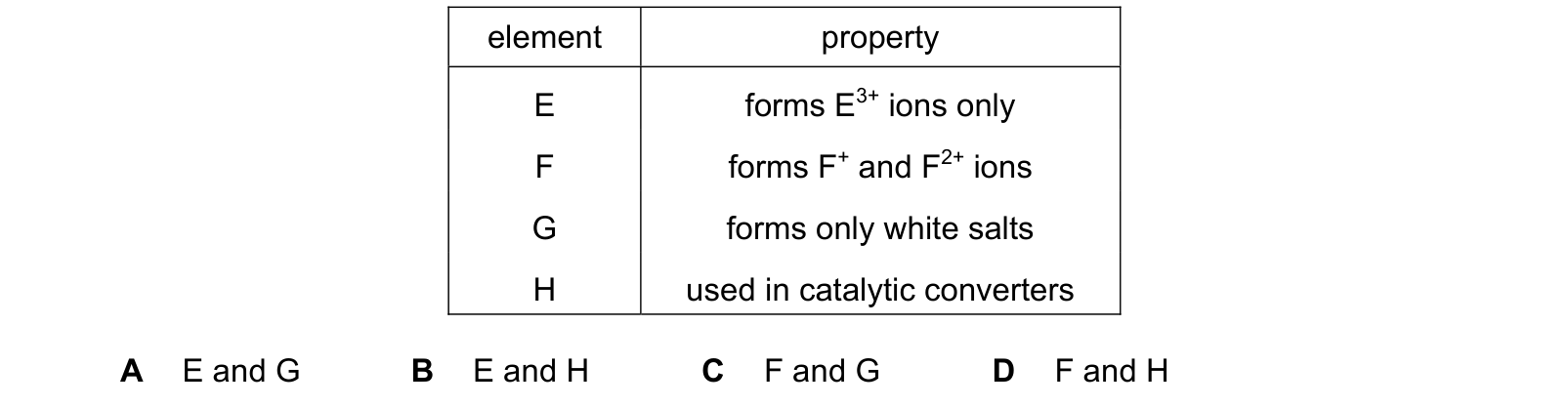
Which elements in the table are transition elements? element property E forms E3+ ions only F forms F+ and F2+ ions G forms only white salts H used in catalytic converters
Answer: D.
Two transition metal properties are being tested, variable oxidation state and catalytic activity. F forms two different ions, which is variable oxidation state, and H is used in catalytic converters, which is catalysis, so both belong to the block. E is the sharpest distractor, because a 3 plus charge looks impressive, but forming only one kind of ion is exactly what a main group metal such as aluminium does. G forms only white salts, and coloured compounds are a transition metal hallmark, so a metal without any is almost certainly from Group I or Group II.
These questions are drawn from past CIE 0620 Chemistry papers and filtered to atomic structure and the periodic table. You answer, you find out immediately whether you were right, and you get the reasoning for the correct option and for each distractor. Wrong answers go to a mistakes locker so you can come back to exactly those.
Practice is free. You need an account only so your progress and your mistakes are still there next time.
These are the errors that cost marks on atomic structure and the periodic table, taken from our own topic notes. Read them before you practise and you will recognise the traps in the questions.
Giving an electron a relative mass of 1 rather than treating it as negligible.
Using the nucleon number as the number of neutrons instead of subtracting the proton number.
Changing the number of protons when writing the configuration of an ion. Only the electrons change.
Putting more than 8 electrons in the third shell for an element up to calcium.
Writing a configuration whose digits do not add up to the proton number.
Reading the period number from the outer shell electrons, or the group number from the number of shells. It is the other way round.
Saying the noble gases have no outer shell electrons. They have a full one.