16 past-paper questions on this unit. Five of them are below. Answer on the page: each one is marked the moment you pick, the correct option is shown whether or not you found it, and the full explanation opens either way.
CIE 0620 ChemistryPaper 1 and Paper 2 MCQsFree account
Diffusion: five questions to try now
Real past-paper questions, the answer key from the mark scheme, and the explanation that goes with it. No account needed to answer them.
Question 1
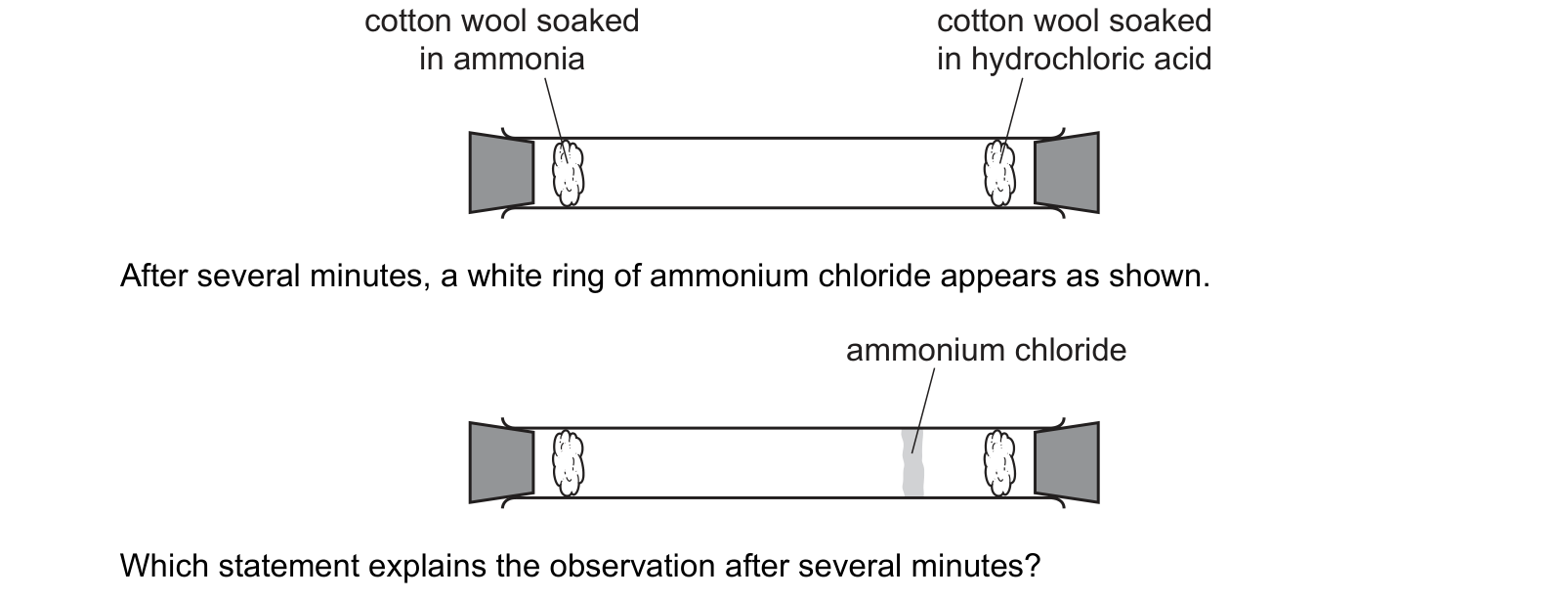
An experiment is set up as shown. cotton wool soaked cotton wool soaked After several minutes, a white ring of ammonium chloride appears as shown. Which statement explains the observation after several minutes?
Answer: A.
The white ring forms much nearer the hydrochloric acid end of the tube, which means the ammonia molecules covered the greater distance in the same time and so diffused faster. The reason is mass: ammonia has a relative molecular mass of 17 while hydrogen chloride has 36.5, and lighter molecules travel faster at a given temperature. The correct statement joins that observation to that reason. Saying ammonia is faster because it is heavier reports the observation correctly but inverts the rule linking mass to speed. Both statements claiming ammonia diffuses more slowly contradict where the ring actually formed, since the slower gas is the one that meets the other closer to its own end.
Question 2
The rate of diffusion of three gases, ammonia, carbon dioxide and methane, is measured. What is the order of the rate of diffusion of the gases from slowest to fastest?
Answer: A.
The order of diffusion follows the order of molecular mass, with the heaviest molecule slowest, so the masses have to be worked out first: carbon dioxide is 44, ammonia is 17 and methane is 16. Running from slowest to fastest that gives carbon dioxide, then ammonia, then methane. The sequence starting with methane and ending with carbon dioxide is that same list reversed, which is what happens when the question is read as fastest to slowest. Ammonia and methane are separated by a single mass unit, so the pair is easy to swap, and the order placing methane before ammonia has them the wrong way round even though it correctly leaves carbon dioxide at the slow end.
Question 3
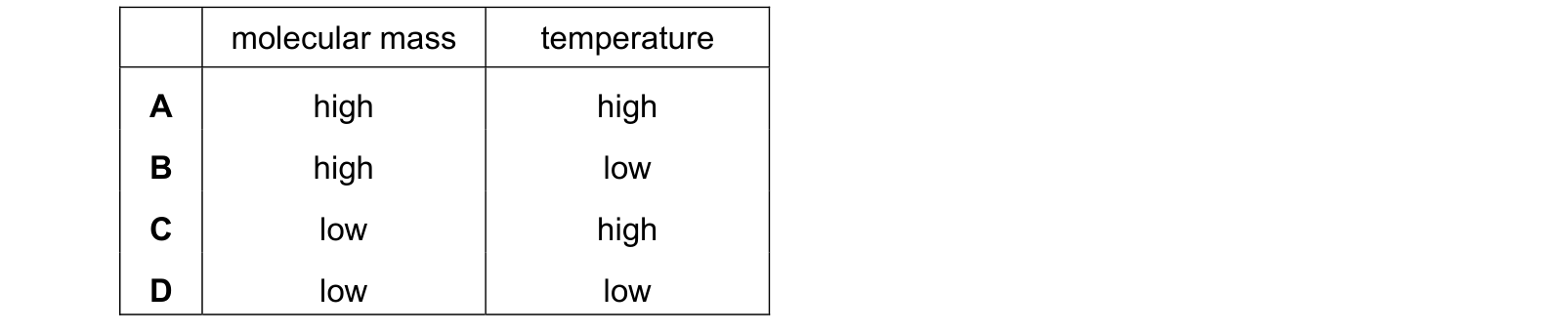
The rate of diffusion of a gas depends on its molecular mass and the temperature. Which combination of molecular mass and temperature gives the slowest rate of diffusion? Each answer gives, in order: molecular mass; temperature.
Answer: B.
Diffusion is slowest when the molecules move slowest, and molecular speed falls as mass rises and as temperature falls, so the slowest combination puts both factors at their least helpful: high molecular mass together with low temperature. Choosing high mass with high temperature keeps the heavy molecules but warms them up, which partly compensates and speeds the diffusion. Low mass with high temperature is the fastest combination available, the exact opposite of what is asked. Low mass with low temperature is the trap for anyone who reads slow as meaning small, because a light molecule is still quick even when it is cold.
Question 4
‘The movement of a substance very slowly from an area of high concentration to an area of low concentration.’ Which process is being described?
Answer: C.
Movement from high concentration to low concentration is the definition of diffusion, which rules out both changes of state on offer, since freezing a liquid and melting a solid involve no concentration gradient at all. That leaves diffusion through a liquid and diffusion through air, and the deciding word in the description is slowly. In a liquid the particles are touching, so a diffusing particle is constantly blocked and deflected by its neighbours and progress is sluggish, which is why a drop of dye needs many minutes to colour a beaker of still water. In air the particles are far apart and fast moving, so diffusion there is comparatively quick, and that is the option to reject.
Question 5
Samples of four gases are released in a room at the same time. The gases are carbon dioxide, CO2, hydrogen chloride, HCl, hydrogen sulfide, H2S, and nitrogen dioxide, NO2. Which gas diffuses fastest?
Answer: C.
All four gases are at the same temperature, so the one with the smallest relative molecular mass has the highest average speed and diffuses fastest. The masses work out as 44 for carbon dioxide, 36.5 for hydrogen chloride, 34 for hydrogen sulfide and 46 for nitrogen dioxide, so hydrogen sulfide is the lightest and wins. Hydrogen chloride is the near miss at 36.5, only slightly heavier, and it is the usual choice of students who narrow the field to the two hydrogen containing gases and then guess. Nitrogen dioxide is in fact the heaviest of the four and would be the slowest to spread through the room.
These questions are drawn from past CIE 0620 Chemistry papers and filtered to diffusion. You answer, you find out immediately whether you were right, and you get the reasoning for the correct option and for each distractor. Wrong answers go to a mistakes locker so you can come back to exactly those.
Practice is free. You need an account only so your progress and your mistakes are still there next time.
These are the errors that cost marks on diffusion, taken from our own topic notes. Read them before you practise and you will recognise the traps in the questions.
Saying particles move from high to low concentration because they "want more space". They move at random.
Saying diffusion occurs in solids.
Saying the white ring forms in the middle of the tube, or nearer the ammonia end.
Saying the heavier gas diffuses faster because it has more energy. At a given temperature the energies are equal, so the heavier particle is the slower one.
Explaining the bromine jar by saying bromine is denser and sinks, when the whole design of the experiment is that the bromine moves upwards.
Stirring or warming the water in the potassium manganate(VII) experiment, which replaces diffusion with convection.
Revise it first
If any of the above is unfamiliar, work through the notes before practising: Diffusion revision notes.