17 past-paper questions on this unit. Five of them are below. Answer on the page: each one is marked the moment you pick, the correct option is shown whether or not you found it, and the full explanation opens either way.
CIE 0620 ChemistryPaper 1 and Paper 2 MCQsFree account
Uses of metals: five questions to try now
Real past-paper questions, the answer key from the mark scheme, and the explanation that goes with it. No account needed to answer them.
Question 1
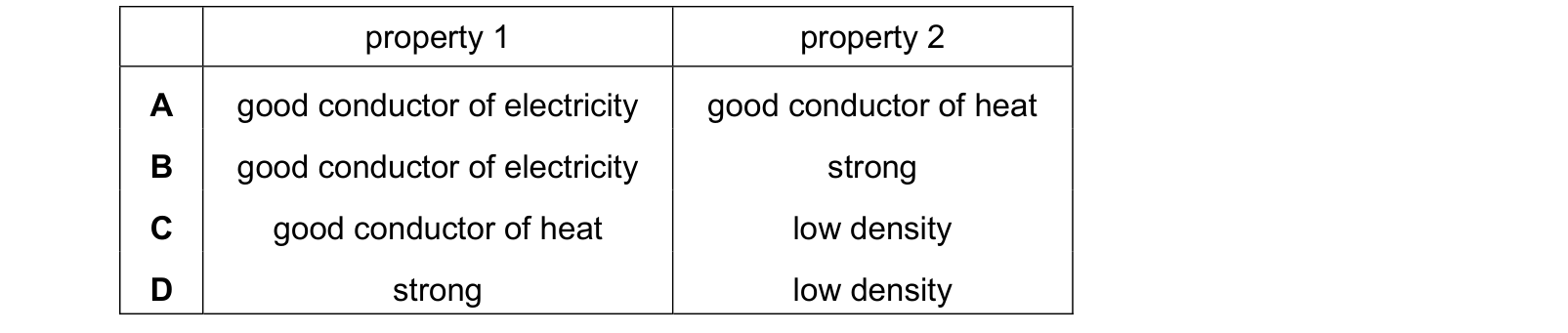
The bodies of aircraft are often made using aluminium. Which two properties of aluminium make it suitable for this use? Each answer gives, in order: property 1; property 2.
Answer: D.
An aircraft body has to carry heavy loads without itself being heavy, so the two properties that matter are strength and low density. Aluminium alloys supply both, which is why they replaced wood and fabric, and why steel, stronger though it is, is far too dense for a whole airframe. Conducting electricity is a genuine property of aluminium and earns it a place in overhead power cables, but it is not why a fuselage is made from it. Conducting heat is equally genuine and equally beside the point here, belonging to saucepans and heat exchangers rather than to aircraft skins. Every wrong row keeps at least one conduction property, and conduction is exactly what an aircraft body has no need of.
Question 2
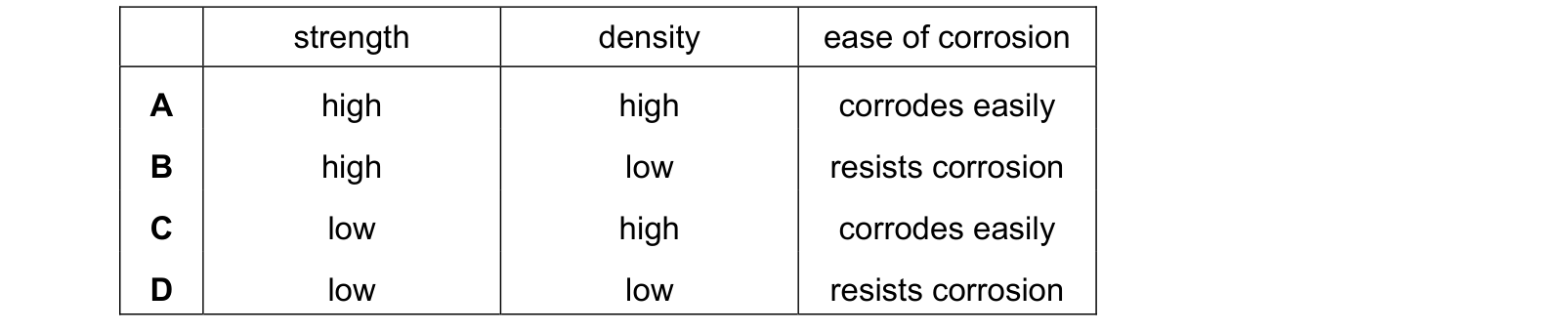
Which row describes the properties of a metal that can be used in the manufacture of aircraft? Each answer gives, in order: strength; density; ease of corrosion.
Answer: B.
An aircraft has to lift its own weight, carry structural loads and survive years of weather, so three demands are being made of the metal at once. High strength is needed because the airframe carries the load, and low density is needed because every kilogram of metal is a kilogram that has to be flown, which is why aluminium alloys are used rather than steel. Resistance to corrosion matters because the skin meets rain and damp air at altitude, and a metal that corroded readily would need constant replacement. Rows offering high density fail on fuel alone, since a heavier aircraft costs more to fly for every hour of its life. Rows offering low strength fail the structural test outright, and any row accepting easy corrosion accepts an airframe that weakens in service.
Question 3
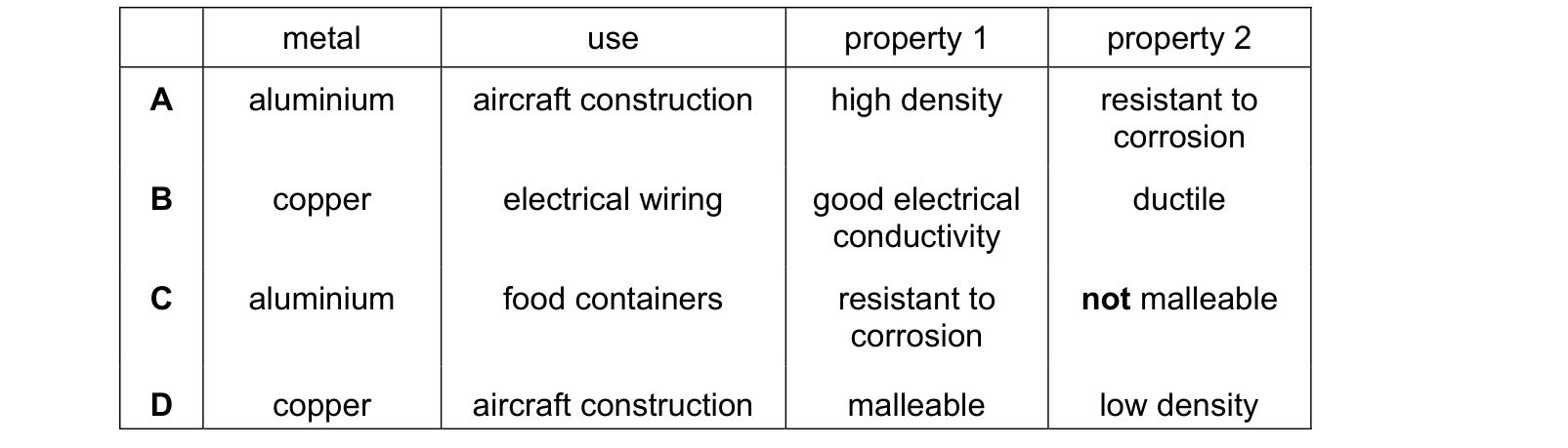
Which row gives a use for the named metal and two properties which both explain this use? Each answer gives, in order: metal; use; property 1; property 2.
Answer: B.
A correct row needs a use together with two properties that both genuinely explain it. Copper is used for electrical wiring because it conducts electricity extremely well and because it is ductile, so it can be drawn out into long thin wires; both properties bear directly on the job. The aircraft row for aluminium offers resistance to corrosion, which is fair enough, but pairs it with high density, when aluminium is chosen for aircraft precisely because its density is low. The food container row starts well with resistance to corrosion and then claims aluminium is not malleable, whereas aluminium is extremely malleable, which is how foil and cans are shaped in the first place. The last row puts copper into aircraft construction and calls it low density, but copper is about three times as dense as aluminium, so the property is false and the use belongs to another metal.
Question 4
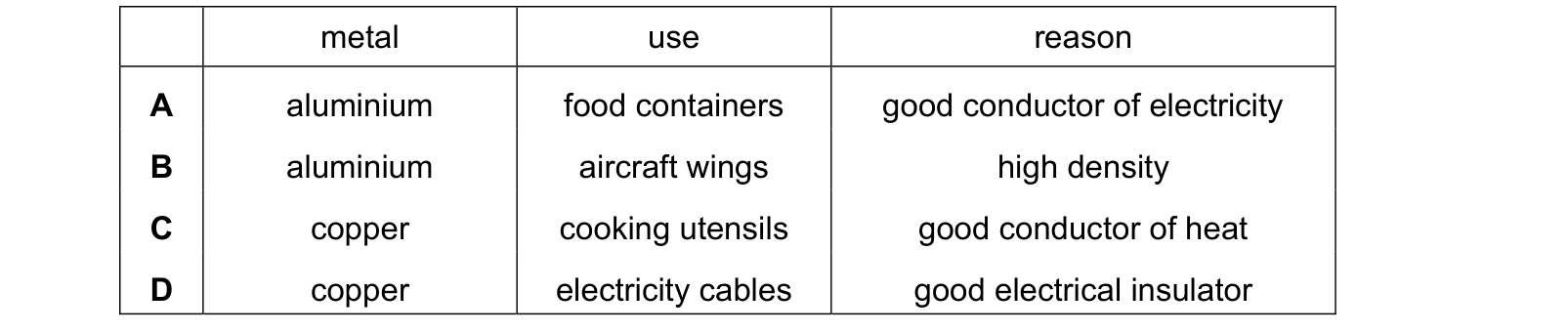
Which row describes a use of the metal and explains why it is used? Each answer gives, in order: metal; use; reason.
Answer: C.
Each row makes three claims and all three have to hang together. Copper is used for cooking utensils because it conducts heat quickly and evenly so the pan warms without hot spots, and that reason genuinely explains that use. Naming copper for cables and then calling it a good electrical insulator contradicts itself, since copper is chosen for wiring exactly because it conducts. Aluminium in food containers is a real use, but the reason should be resistance to corrosion rather than electrical conductivity, and aircraft wings depend on aluminium having a low density, so calling it high density reverses the very property that matters.
Question 5
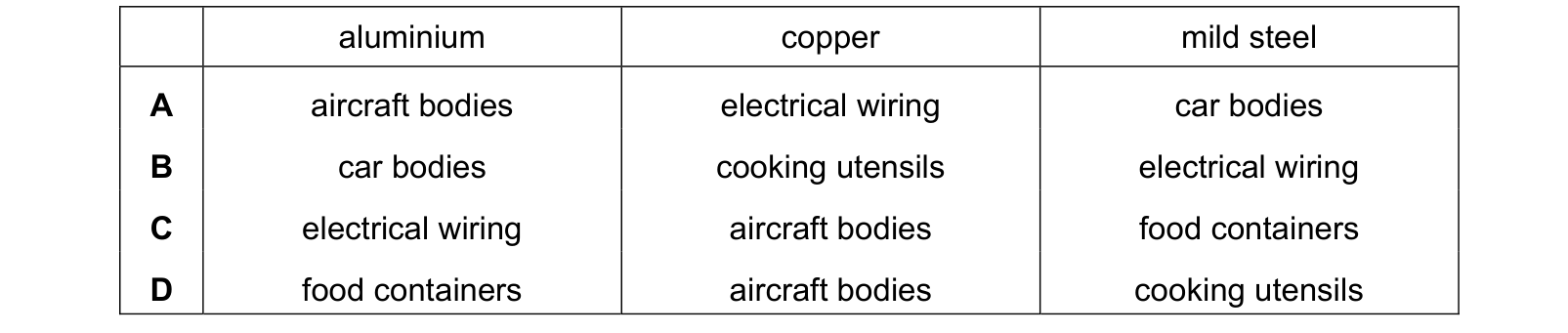
Which row describes the uses of aluminium, copper and mild steel? Each answer gives, in order: aluminium; copper; mild steel.
Answer: A.
Three metals have to be matched to three uses, and each match rests on a different property. Aluminium goes into aircraft bodies because its density is about a third that of iron. Copper goes into electrical wiring because it conducts electricity well and is ductile enough to be drawn into fine wire. Mild steel goes into car bodies because it is strong and cheap enough to use by the tonne, so any row putting aluminium into wiring or copper into an aircraft has swapped a good conductor for a light metal, two properties belonging to quite different jobs.
These questions are drawn from past CIE 0620 Chemistry papers and filtered to uses of metals. You answer, you find out immediately whether you were right, and you get the reasoning for the correct option and for each distractor. Wrong answers go to a mistakes locker so you can come back to exactly those.
Practice is free. You need an account only so your progress and your mistakes are still there next time.
These are the errors that cost marks on uses of metals, taken from our own topic notes. Read them before you practise and you will recognise the traps in the questions.
Saying aluminium is used in aircraft because it does not corrode, when the mark is for low density.
Saying aluminium is used in cans because it is light, when the mark is for corrosion resistance.
Saying aluminium is unreactive, rather than that its oxide layer makes it appear unreactive.
Giving copper for overhead cables because it conducts best, ignoring its density.
Saying copper is used for wiring because it is malleable, when the word for making wire is ductile.
Naming a use without naming the property, which is where the mark is.
Placing aluminium below iron in the reactivity series because it corrodes less.