301 past-paper questions on this unit. Five of them are below. Answer on the page: each one is marked the moment you pick, the correct option is shown whether or not you found it, and the full explanation opens either way.
CIE 0620 ChemistryPaper 1 and Paper 2 MCQsFree account
Elements, compounds and mixtures: five questions to try now
Real past-paper questions, the answer key from the mark scheme, and the explanation that goes with it. No account needed to answer them.
Question 1
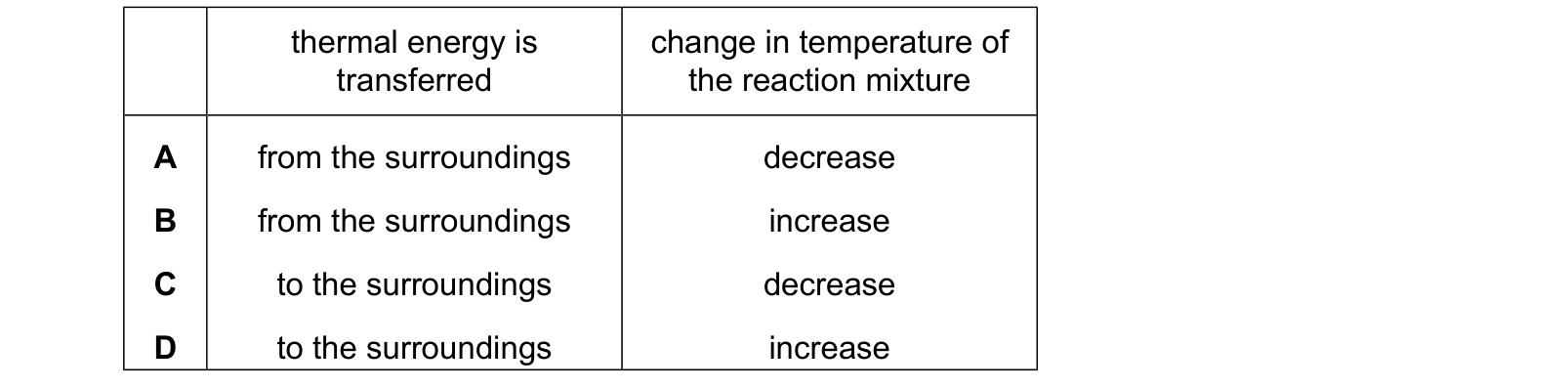
Which row describes what happens during an endothermic reaction? Each answer gives, in order: thermal energy is transferred; change in temperature of the reaction mixture.
Answer: A.
Endothermic means energy is taken in, so thermal energy travels from the surroundings into the reaction mixture, the opposite of what happens in an exothermic change. Because that energy is drawn out of the surroundings and used to break bonds rather than to warm anything, a thermometer in the mixture records a fall and the flask feels cold. Rows C and D reverse the direction of the transfer and describe an exothermic reaction such as combustion or neutralisation. Row B is the sharp trap, taking the direction correctly and then having the temperature rise, which contradicts the very definition it has just applied.
Question 2
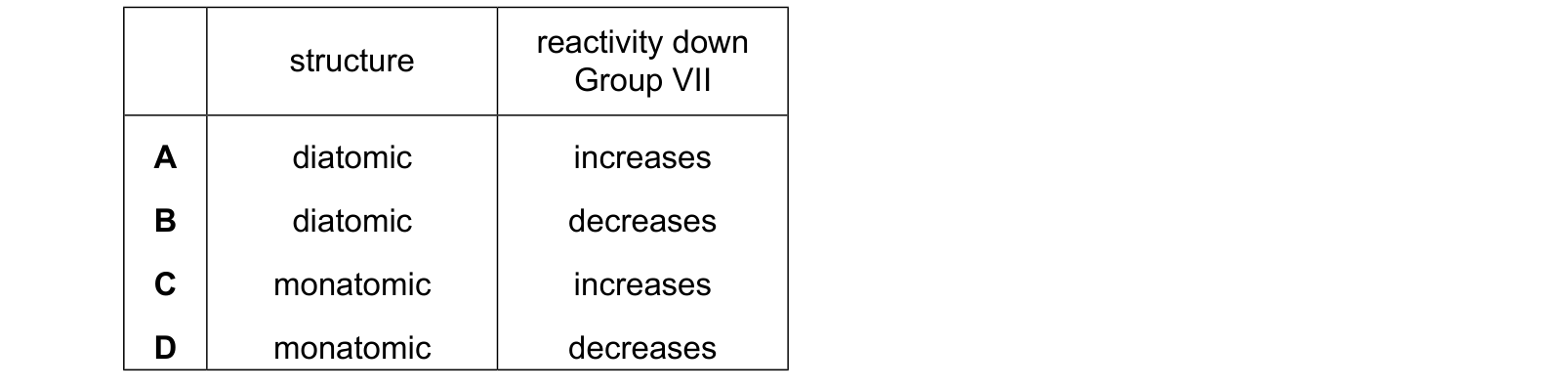
Which row describes the structure of Group VII elements and the trend in their reactivity down the group? Each answer gives, in order: structure; reactivity down Group VII.
Answer: B.
Halogen atoms are one electron short of a full outer shell, so a pair of them share electrons and the free elements exist as the diatomic molecules Cl2, Br2 and I2. Monatomic describes group VIII, the noble gases, whose atoms already have full shells and need bond to nothing, so both monatomic rows misplace that property. Reactivity in group VII depends on how strongly an atom can attract one more electron, and moving down the group the outer shell lies further from the nucleus with more inner shells screening the charge, so that pull weakens and reactivity decreases from fluorine towards iodine. The row that pairs diatomic with increasing reactivity has the structure right but has carried across the group I trend, where losing an electron does get easier further down, and that borrowed trend is exactly what the question tests.
Question 3
Part of the Periodic Table is shown. Which element has a high density, a high melting point and forms a brown oxide? Use the source image for W22 Paper 12, question 22.
Answer: B.
High density, a high melting point and a coloured oxide together point at the central block of transition elements, and brown in particular points at iron, whose iron(III) oxide is the familiar colour of rust. The labelled box in the middle of period 4 is iron, so it satisfies all three clues at once. The box in group I of period 2 is lithium, a soft metal of density 0.53 g per cm cubed that melts at 181 degrees C and gives a white oxide, so it fails every clue. The box lower down group II is another reactive light metal with a white oxide, and the box in group III of period 3 is aluminium, whose oxide is white and whose density of about 2.7 is well under that of any transition metal. Only the central block puts all three properties in one element.
Question 4
Part of the Periodic Table is shown. Which element has a high density, a high melting point and forms a brown oxide? Use the source image for W22 Paper 22, question 23.
Answer: B.
One element has to satisfy three clues at once, and only the middle block of the table can. Transition metals have giant metallic structures that push their melting points high, closely packed heavy atoms that make them dense, and compounds that are coloured rather than white. The word brown then narrows the field to iron, whose iron(III) oxide is the brown solid familiar as rust, and the labelled box inside the transition block of period 4 is iron. The labelled box in group I of period 2 is lithium, light enough to float on water and giving a white oxide, and the box further down group II is another reactive light metal whose oxide is white. The box in group III of period 3 is aluminium, whose oxide is white as well; the coloured compound is the clue that no main group metal can supply.
Question 5
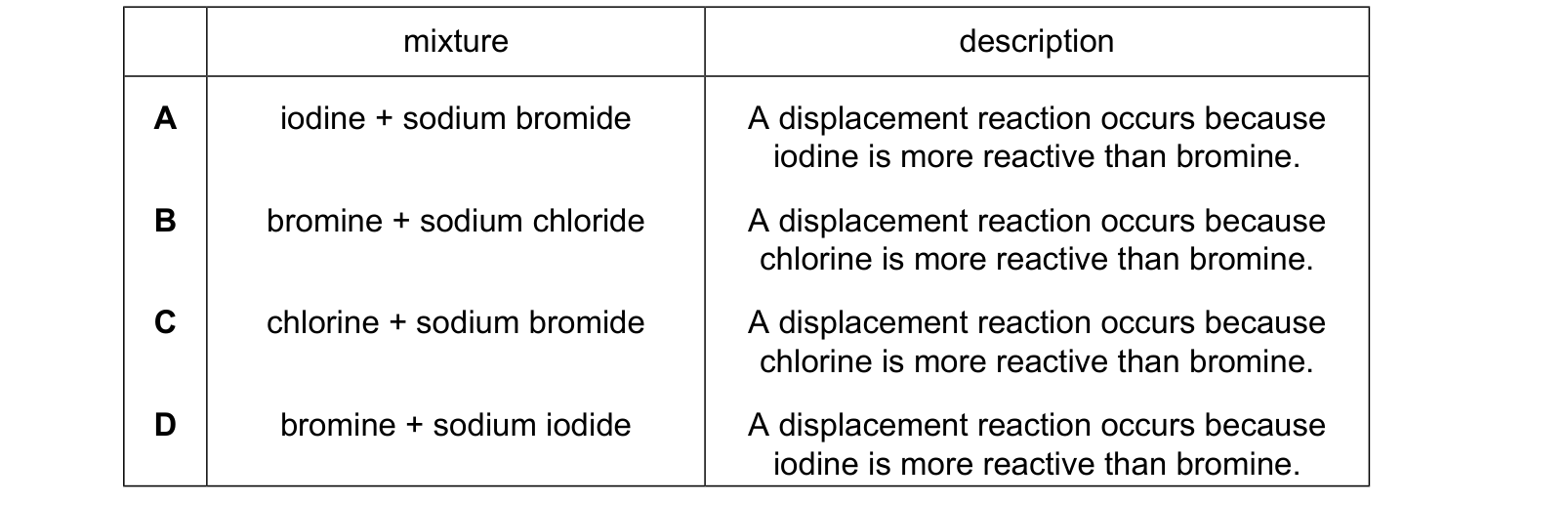
Four mixtures each contain a halogen and an aqueous sodium halide. Which row describes what happens in the mixtures shown? Each answer gives, in order: mixture; description.
Answer: C.
One halogen displaces another from its salt only when the added halogen is the more reactive of the pair, and reactivity falls down group 7 from chlorine through bromine to iodine. Chlorine added to aqueous sodium bromide sits above bromine in the group, so it does displace bromine and the reason offered for it is the right way round. The two rows in which iodine is said to displace bromine invert the trend, since iodine lies below bromine and is the weaker oxidising agent of the two. Bromine with sodium chloride quotes a true statement about chlorine being more reactive, but that is precisely why bromine cannot attack chloride, so nothing happens in that mixture at all. Fixing the positions in the group before reading the reason settles this in one step.
These questions are drawn from past CIE 0620 Chemistry papers and filtered to elements, compounds and mixtures. You answer, you find out immediately whether you were right, and you get the reasoning for the correct option and for each distractor. Wrong answers go to a mistakes locker so you can come back to exactly those.
Practice is free. You need an account only so your progress and your mistakes are still there next time.
These are the errors that cost marks on elements, compounds and mixtures, taken from our own topic notes. Read them before you practise and you will recognise the traps in the questions.
Calling air a compound. Its gases are not chemically combined and its composition varies.
Saying a mixture of two elements is a compound because it contains two elements. Combination, not company, makes a compound.
Saying a compound can be separated by filtering or distilling.
Saying an element cannot be a molecule. O₂, N₂, Cl₂ and S₈ are all elements made of molecules.
Expecting a mixture to have a sharp melting point.
Saying iron(II) sulfide is magnetic because it contains iron. The iron is bonded and no longer behaves as iron.