25 past-paper questions on this unit. Five of them are below. Answer on the page: each one is marked the moment you pick, the correct option is shown whether or not you found it, and the full explanation opens either way.
CIE 0620 ChemistryPaper 1 and Paper 2 MCQsFree account
Fertilisers: five questions to try now
Real past-paper questions, the answer key from the mark scheme, and the explanation that goes with it. No account needed to answer them.
Question 1
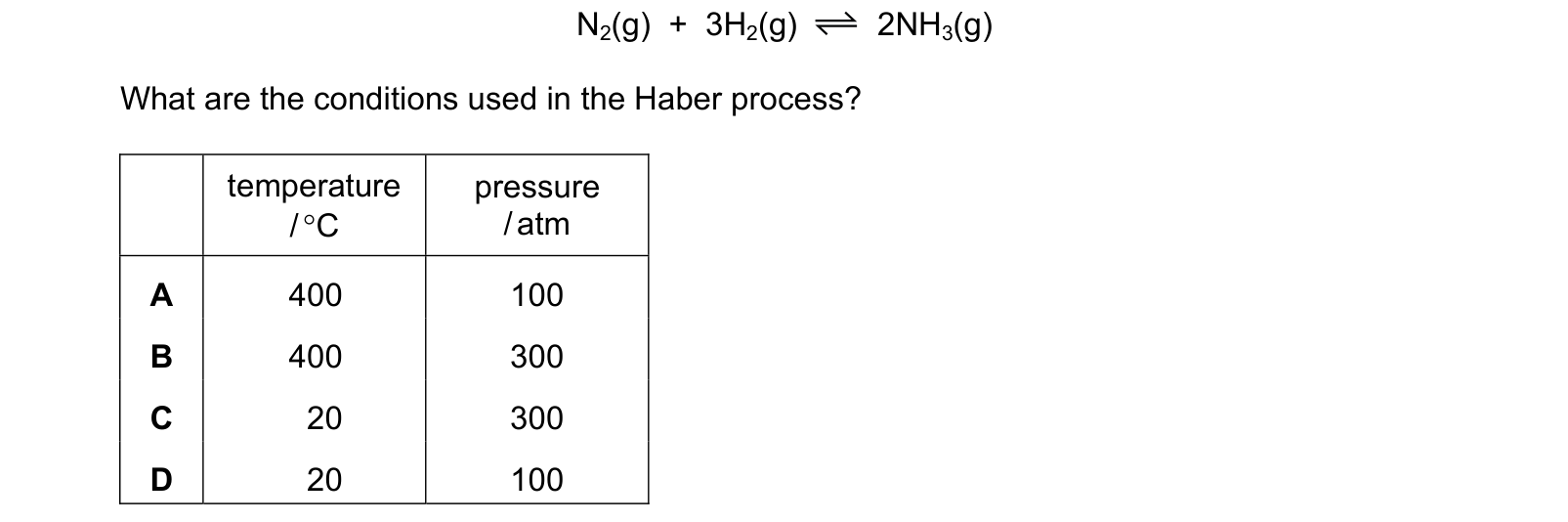
Ammonia is manufactured by the Haber process. What are the conditions used in the Haber process? Each answer gives, in order: temperature / °C; pressure / atm.
Answer: B.
Two decisions are needed and each is a compromise. A temperature of 20 °C would give an excellent equilibrium yield, since the forward reaction is exothermic, but nitrogen is so unreactive that almost no ammonia would appear in any useful time, so the plant runs hot at around 400 °C and accepts a smaller yield for a workable rate. Pressure pulls the other way, because four gas molecules become two, so compressing the mixture genuinely raises the proportion converted and the higher of the two pressures offered is the one worth paying for. Rows built on room temperature are the clearest failures, since a reaction that never gets going yields nothing at any pressure.
Question 2
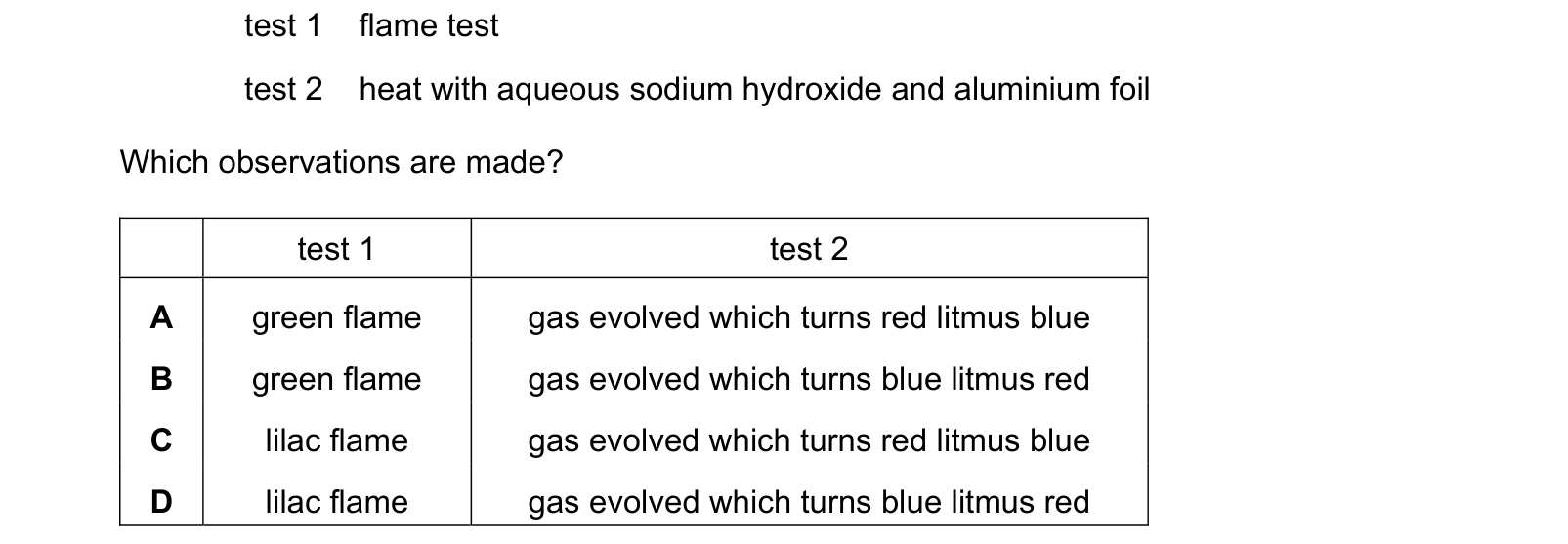
Two tests are done on an NPK fertiliser. test 1 flame test test 2 heat with aqueous sodium hydroxide and aluminium foil Which observations are made? Each answer gives, in order: test 1; test 2.
Answer: C.
An NPK fertiliser contains potassium, and the flame test for potassium gives a lilac flame, so any row offering green has named copper or barium instead. The second test is the standard test for a nitrate, since warming the sample with sodium hydroxide and aluminium foil reduces the nitrate ion to ammonia. Ammonia is an alkaline gas, so it turns damp red litmus blue, which is the observation to expect. A row predicting that the gas turns blue litmus red would be describing an acidic gas such as carbon dioxide or sulfur dioxide, and neither of those is produced by this test.
Question 3
A farmer knows his soil needs phosphorus and potassium. He has a choice of four fertilisers. 1 NH4NO3 2 (NH4)3PO4 3 KNO3 4 (NH2)2CO Which fertilisers should he use?
Answer: C.
The soil needs phosphorus and potassium, so the pair chosen must supply both, and the formulas can be read straight off. Ammonium phosphate, (NH4)3PO4, carries phosphorus in its phosphate ion, and potassium nitrate, KNO3, carries potassium, so together they meet both requirements and add nitrogen as a bonus. Ammonium nitrate offers only nitrogen, since both of its ions are nitrogen-based, so it addresses neither stated need. Urea, (NH2)2CO, is nitrogen-based too, containing only nitrogen, hydrogen, carbon and oxygen, so any pairing built around those two leaves the soil short of exactly what it was lacking.
Question 4
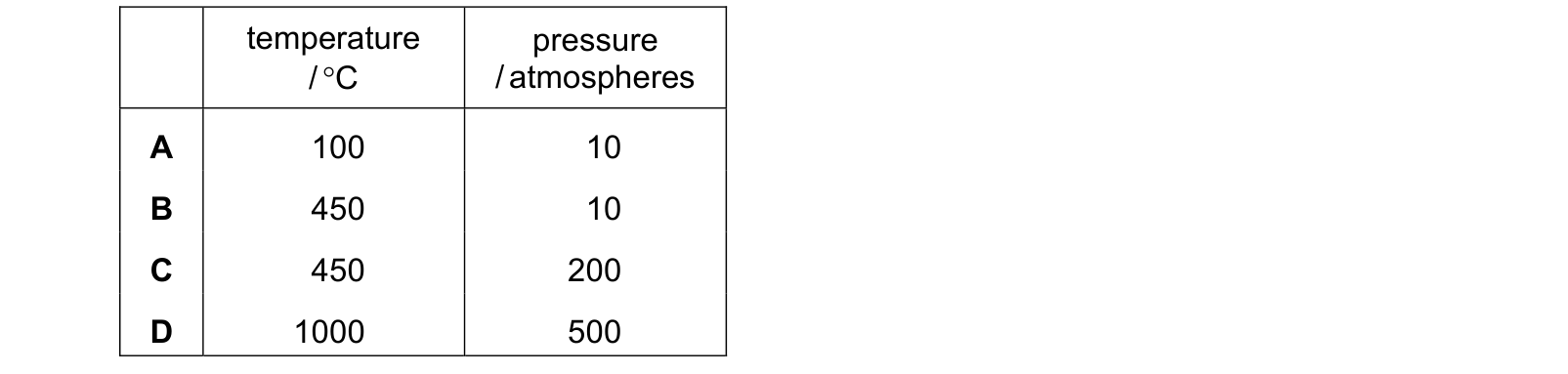
Which conditions are used in the Haber process? Each answer gives, in order: temperature / °C; pressure / atmospheres.
Answer: C.
Two figures are wanted and each is chosen for a different reason. The temperature is about 450 °C, a balance between the larger yield a cooler mixture would give an exothermic reaction and the crawling rate that would come with it, so 100 °C would leave the nitrogen almost untouched while 1000 °C would break ammonia down about as fast as it formed. The pressure is around 200 atm, high because four gas molecules become two and compressing the mixture therefore raises the yield. Ten atmospheres throws that advantage away, and 500 atm would demand far stronger and costlier plant than the extra yield could justify.
Question 5
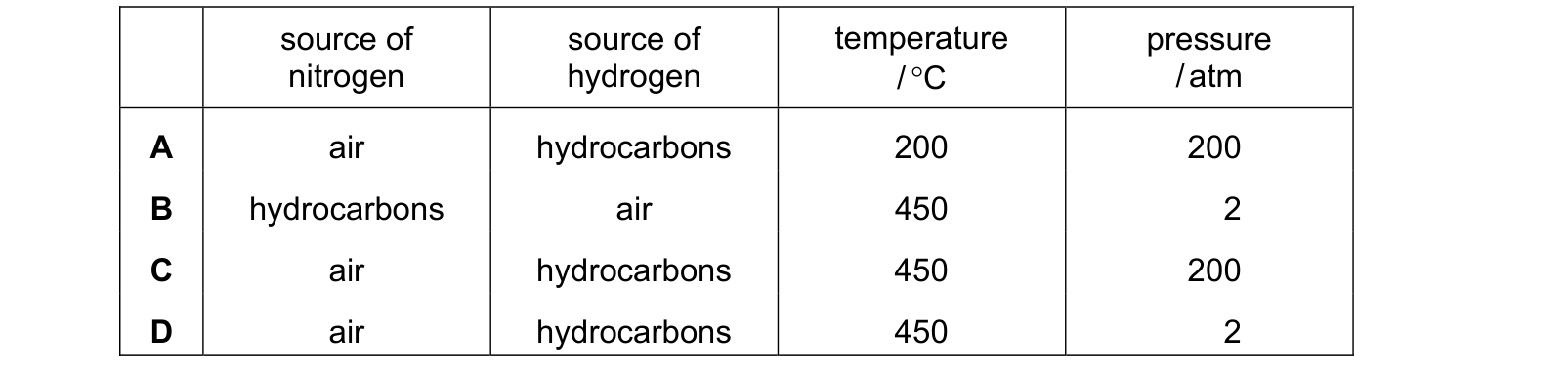
Ammonia is produced using the Haber process. Which row shows the source of the raw materials and the reaction conditions? Each answer gives, in order: source of nitrogen; source of hydrogen; temperature / °C; pressure / atm.
Answer: C.
Four pieces of information have to be correct at once. Nitrogen is taken from the air by fractional distillation of liquid air while hydrogen comes from hydrocarbons, usually methane reacted with steam, so the row reversing those two sources falls at the first step. The temperature is around 450 °C, a compromise between the better yield that cool conditions would give an exothermic reaction and a rate quick enough to be useful, which makes 200 °C too low. The pressure is about 200 atm, worth its expense because four gas molecules become two, so a row quoting 2 atm has borrowed the pressure of the Contact process, where no such forcing is needed.
These questions are drawn from past CIE 0620 Chemistry papers and filtered to fertilisers. You answer, you find out immediately whether you were right, and you get the reasoning for the correct option and for each distractor. Wrong answers go to a mistakes locker so you can come back to exactly those.
Practice is free. You need an account only so your progress and your mistakes are still there next time.
These are the errors that cost marks on fertilisers, taken from our own topic notes. Read them before you practise and you will recognise the traps in the questions.
Saying plants take nitrogen from the air. Almost none can; the nitrogen must arrive as NH₄⁺ or NO₃⁻ in solution.
Swapping the jobs of phosphorus and potassium. Phosphorus is for roots, potassium is for flowers, fruit and disease resistance.
Writing ammonium as NH₃⁺ or NH₄. The ion is NH₄⁺.
Saying the fertiliser itself poisons the fish, instead of tracing the algae, light, bacteria and oxygen chain.
Naming the base in fertiliser manufacture as a hydroxide when the salt is an ammonium salt. The base is ammonia.
Counting only one nitrogen atom in NH₄NO₃. There are two, one in each half of the formula.
Revise it first
If any of the above is unfamiliar, work through the notes before practising: Fertilisers revision notes.