81 past-paper questions on this unit. Five of them are below. Answer on the page: each one is marked the moment you pick, the correct option is shown whether or not you found it, and the full explanation opens either way.
CIE 0620 ChemistryPaper 1 and Paper 2 MCQsFree account
Air quality and climate: five questions to try now
Real past-paper questions, the answer key from the mark scheme, and the explanation that goes with it. No account needed to answer them.
Question 1
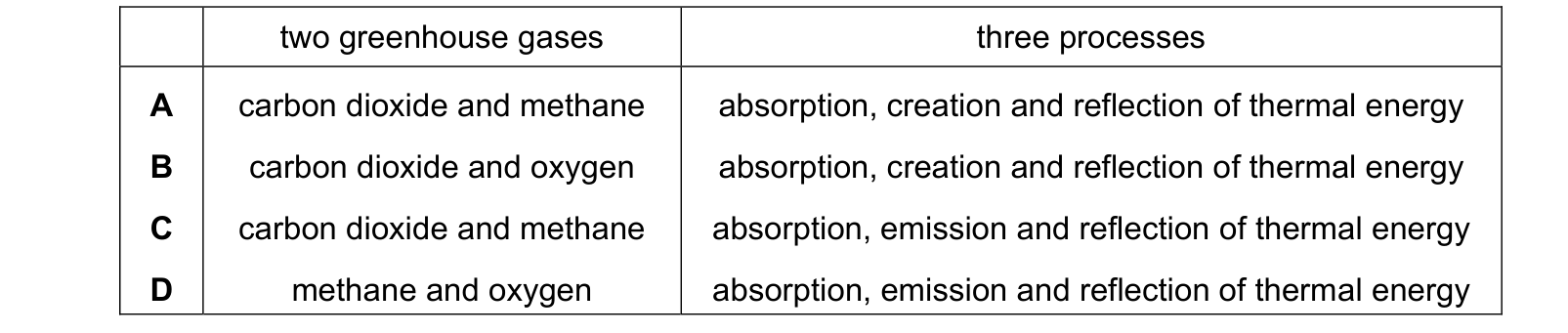
Which row identifies two greenhouse gases and three processes by which they contribute to global warming? Each answer gives, in order: two greenhouse gases; three processes.
Answer: C.
Two things have to be right at once, the gases and the mechanism. Carbon dioxide and methane are greenhouse gases because their bonds absorb infrared, whereas oxygen is a molecule of two identical atoms and cannot absorb it, so any row naming oxygen fails at once. The three processes are absorption of the thermal energy leaving the Earth, re-emission of that energy in all directions, and reflection of part of it back towards the surface. Creation is the word that gives the other row away, since a greenhouse gas makes no energy at all; it intercepts and redirects energy the Earth has already radiated.
Question 2
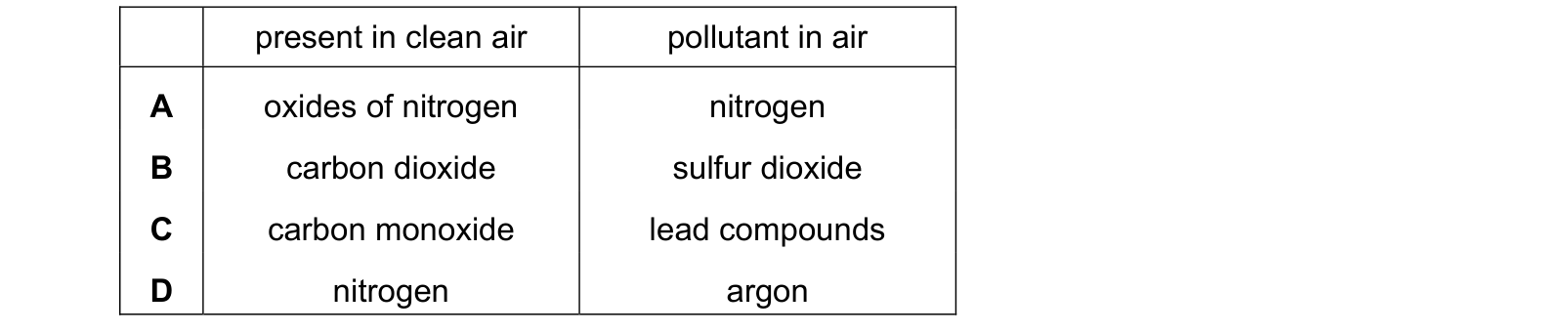
Which row identifies a substance present in clean air and a substance that is a pollutant in air? Each answer gives, in order: present in clean air; pollutant in air.
Answer: B.
Clean air is nitrogen, oxygen, argon, water vapour and a small proportion of carbon dioxide, so carbon dioxide belongs in the first column even though it is a greenhouse gas. Sulfur dioxide is no part of clean air, being produced when fuels containing sulfur are burnt, so it is a genuine pollutant. The row offering oxides of nitrogen as a clean air component reverses the situation, since those form only in engines, furnaces and lightning strikes, and nitrogen itself is the most abundant gas in the atmosphere rather than a pollutant. Argon is likewise natural, so calling it a pollutant mistakes unreactive scarcity for contamination, and carbon monoxide has no place in clean air either.
Question 3
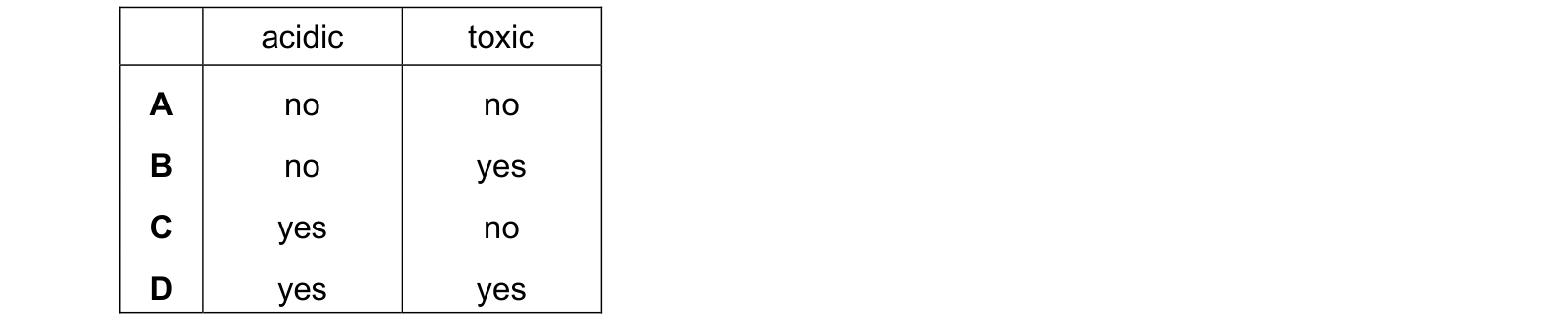
Oxides of nitrogen are given out from car exhausts. Which row best shows why oxides of nitrogen are unwanted in the atmosphere? Each answer gives, in order: acidic; toxic.
Answer: D.
Oxides of nitrogen are unwelcome for two separate reasons, so both columns should read yes. They are acidic oxides, dissolving in rain to give nitric acid that attacks limestone buildings and acidifies lakes and soils. They are also directly toxic, irritating the lungs and airways and worsening asthma, which is why roadside air quality is monitored for them. Any row answering no in either column keeps only half the story, since choosing acidic without toxic ignores the health effects while choosing toxic without acidic forgets that non-metal oxides are acidic by nature.
Question 4
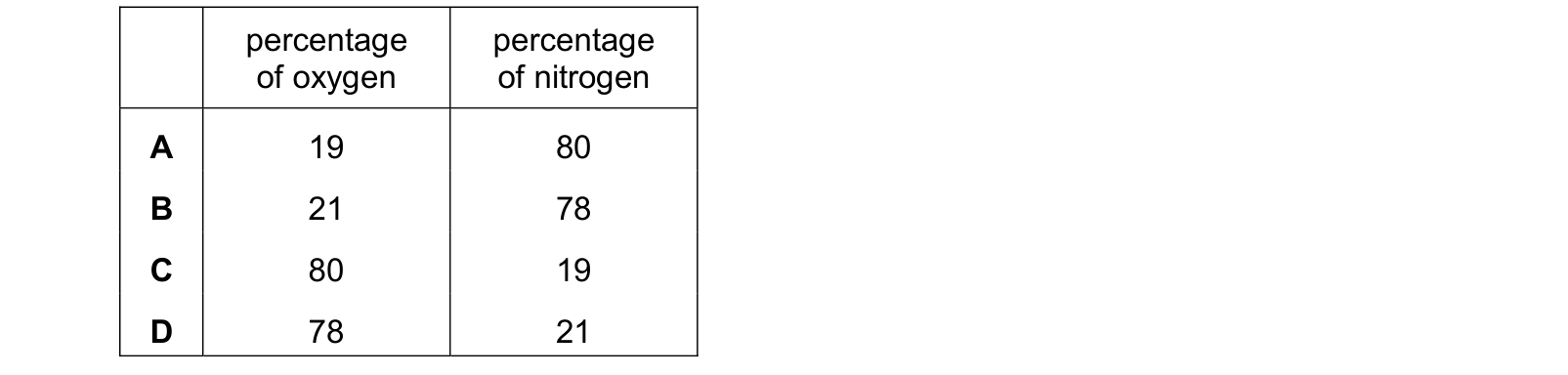
What are the approximate percentages of oxygen and nitrogen in clean, dry air? Each answer gives, in order: percentage of oxygen; percentage of nitrogen.
Answer: B.
Clean dry air is about 78 per cent nitrogen and about 21 per cent oxygen, with argon and carbon dioxide accounting for nearly all of the remaining one per cent. Nitrogen is the more abundant by a wide margin, so any row giving oxygen the larger share has the two gases swapped, and the row reading 78 for oxygen against 21 for nitrogen does exactly that. The row offering 80 per cent oxygen is a still bolder version of the same reversal. The pair 19 and 80 has roughly the right shape but neither figure matches the accepted value, and the two together with argon should come to about 100 per cent.
Question 5
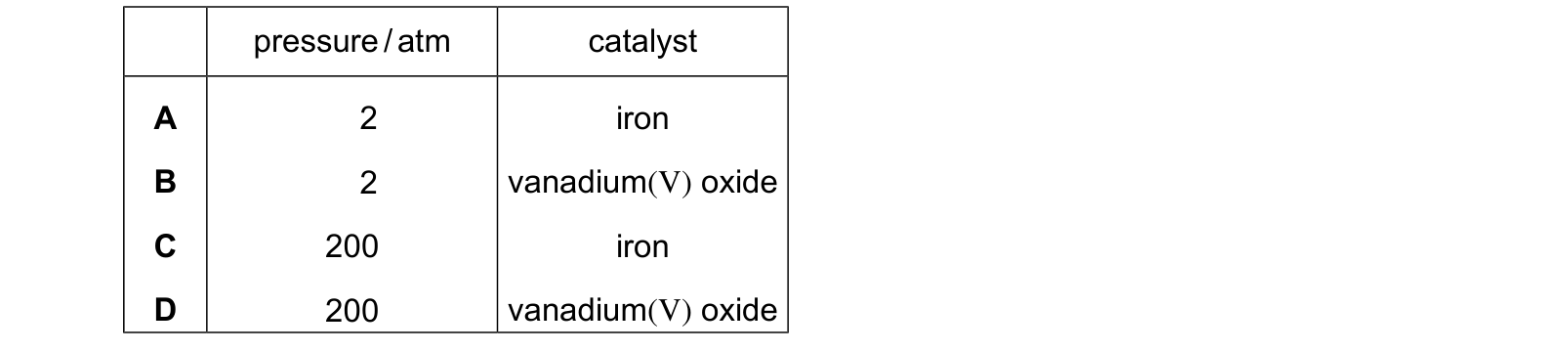
Which row identifies the pressure and the catalyst used for the conversion of sulfur dioxide to sulfur trioxide in the Contact process? Each answer gives, in order: pressure/atm; catalyst.
Answer: B.
Two facts are asked for here and they belong to different parts of the plant design. Vanadium(V) oxide is the catalyst, needed because sulfur dioxide and oxygen react far too slowly without it, while iron belongs to the Haber process for ammonia. The pressure is about 2 atm, which surprises many students because the equation does have fewer molecules on the right and higher pressure would in principle raise the yield; the reason is that the yield already reaches about 96 per cent at low pressure, so compression buys almost nothing for its cost. That is why 200 atm, the Haber figure, is the wrong number to attach to this reaction.
These questions are drawn from past CIE 0620 Chemistry papers and filtered to air quality and climate. You answer, you find out immediately whether you were right, and you get the reasoning for the correct option and for each distractor. Wrong answers go to a mistakes locker so you can come back to exactly those.
Practice is free. You need an account only so your progress and your mistakes are still there next time.
These are the errors that cost marks on air quality and climate, taken from our own topic notes. Read them before you practise and you will recognise the traps in the questions.
Quoting the composition of air as 79% nitrogen and 20% oxygen. The figures wanted are 78% and 21%.
Giving carbon dioxide as a product of incomplete combustion. Incomplete combustion gives carbon monoxide and particulates.
Saying oxides of nitrogen come from nitrogen in the fuel. They come from the nitrogen in the air, forced to react by the heat of the engine.
Naming carbon dioxide as a cause of acid rain. Acid rain is caused by sulfur dioxide and oxides of nitrogen.
Saying carbon monoxide causes acid rain, or that sulfur dioxide is a greenhouse gas.
Writing that greenhouse gases stop the Sun's radiation getting in. They absorb the outgoing thermal radiation from the surface.
Claiming a catalytic converter removes carbon dioxide.