50 past-paper questions on this unit. Five of them are below. Answer on the page: each one is marked the moment you pick, the correct option is shown whether or not you found it, and the full explanation opens either way.
CIE 0620 ChemistryPaper 1 and Paper 2 MCQsFree account
Solids, liquids and gases: five questions to try now
Real past-paper questions, the answer key from the mark scheme, and the explanation that goes with it. No account needed to answer them.
Question 1
Element X is in Group II of the Periodic Table. Which statements about X are correct? 1 X is a metal. 2 X has two electrons in its outer shell. 3 X is a liquid at room temperature.
Answer: A.
Group number in the Periodic Table gives the number of outer shell electrons, so an element in Group II has two of them, and Group II lies on the left of the table among the metals, which makes statements 1 and 2 both secure. Statement 3 claims X is a liquid at room temperature, but every Group II element from beryllium to barium is a solid, with magnesium melting at about 650 °C. The only elements that are liquid at room temperature are mercury and bromine, and neither sits in Group II. Every option retaining statement 3 therefore fails, including the one that accepts all three statements together.
Question 2
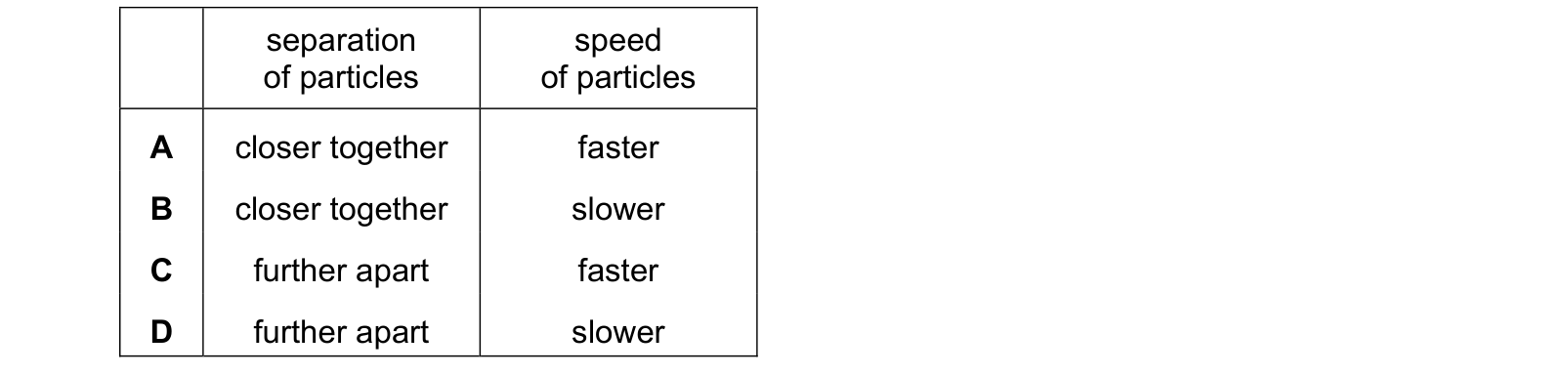
Which row describes what happens to the particles in solid iodine when it is heated and turned into a gas? Each answer gives, in order: separation of particles; speed of particles.
Answer: C.
Turning solid iodine into iodine gas means moving from a lattice where the molecules touch to a state where they are far apart, so the separation increases. Heating also raises the kinetic energy of the molecules, so they move faster, and both changes happen together, which is why further apart with faster movement is the only consistent row. The two rows that bring the particles closer together describe the reverse process, a gas depositing back to a solid. The row pairing greater separation with slower particles is the more thoughtful mistake, since students reason that spreading out must cost energy and so slow the molecules, but the heat supplied both separates them and speeds them up.
Question 3
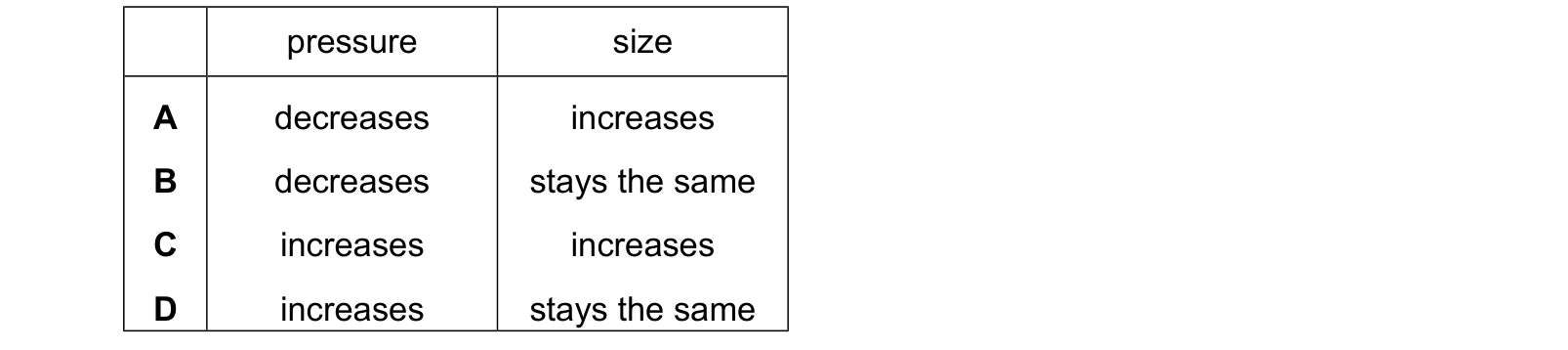
A sample of argon gas is heated in a closed container. Which row describes what happens to the pressure and the size of the argon atoms? Each answer gives, in order: pressure; size.
Answer: D.
Heating a gas in a sealed container makes the atoms move faster, so they strike the walls harder and more often and the pressure rises. What heating never does is change the atoms themselves: an argon atom keeps the same nucleus and the same electron cloud at every temperature, so its size stays fixed and only the spacing between atoms can respond. Increased pressure with unchanged size is therefore the correct row. The rows saying the pressure decreases have the effect of heating backwards. The row in which both the pressure and the atom size increase carries the widespread misconception that particles swell when heated, when it is the volume of the sample, not the volume of each particle, that changes.
Question 4
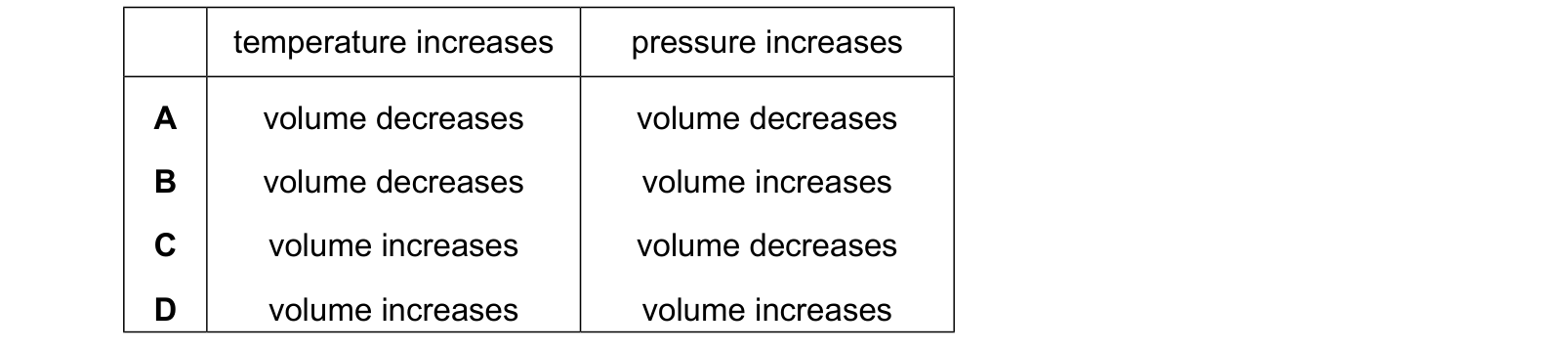
Which row describes how the volume of a gas changes when the temperature increases, or when the pressure increases? Each answer gives, in order: temperature increases; pressure increases.
Answer: C.
Raising the temperature gives the particles more kinetic energy, so they push harder on their surroundings and the gas expands, meaning the volume increases. Raising the pressure squeezes the particles into a smaller space, so the volume decreases, which is the inverse relationship between pressure and volume. Only the row combining an increase with a decrease matches both. The row in which both changes increase the volume treats pressure as though it behaved like temperature, and the row in which both decrease it makes the opposite error with temperature. Reversing the pair, so that volume falls on heating and rises on compression, gets both relationships wrong at once.
Question 5
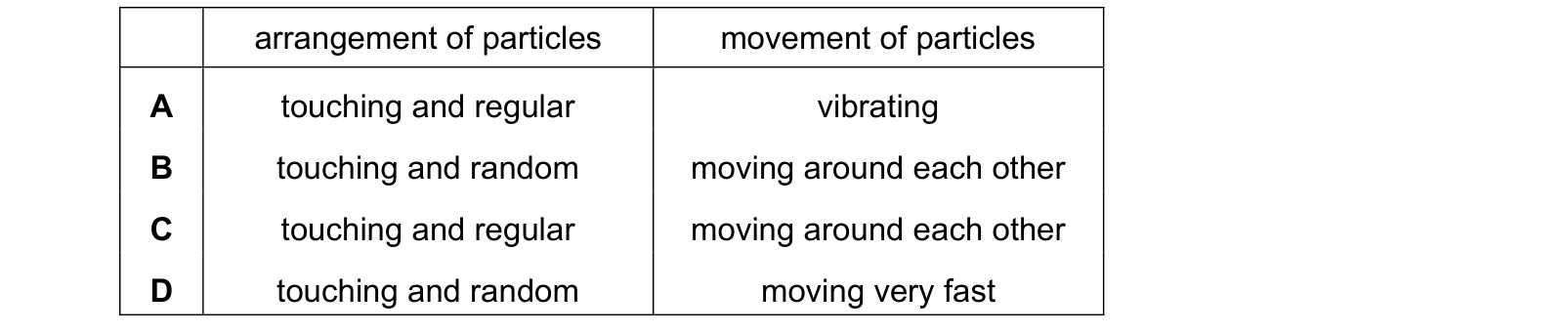
Which row describes the arrangement and movement of particles in a liquid? Each answer gives, in order: arrangement of particles; movement of particles.
Answer: B.
Liquid particles are still in contact, so a liquid has a definite volume, but the ordered lattice has broken down, so the arrangement is random and the particles slide around one another. Touching and random, moving around each other, states both of those. Vibrating on the spot is what particles do in a solid, so the row giving a regular touching arrangement with vibration describes the solid state. Keeping a regular arrangement while letting particles move around each other is self contradictory, because that movement is what destroys the regularity. The last row gets the arrangement right but has the particles moving very fast, which belongs to a gas rather than to a liquid still held together by substantial attractions.
These questions are drawn from past CIE 0620 Chemistry papers and filtered to solids, liquids and gases. You answer, you find out immediately whether you were right, and you get the reasoning for the correct option and for each distractor. Wrong answers go to a mistakes locker so you can come back to exactly those.
Practice is free. You need an account only so your progress and your mistakes are still there next time.
These are the errors that cost marks on solids, liquids and gases, taken from our own topic notes. Read them before you practise and you will recognise the traps in the questions.
Saying particles in a solid do not move. They vibrate about fixed positions.
Saying the temperature rises while a substance is melting or boiling.
Saying that the particles themselves expand when a gas is heated.
Treating evaporation and boiling as the same thing.
Reading the top of a heating curve as the melting point instead of reading the flat sections.
Saying a gas is compressible because its particles are soft, rather than because there is space between them.
Forgetting that freezing point and melting point are the same temperature.