60 past-paper questions on this unit. Five of them are below. Answer on the page: each one is marked the moment you pick, the correct option is shown whether or not you found it, and the full explanation opens either way.
CIE 0620 ChemistryPaper 1 and Paper 2 MCQsFree account
Alcohols: five questions to try now
Real past-paper questions, the answer key from the mark scheme, and the explanation that goes with it. No account needed to answer them.
Question 1
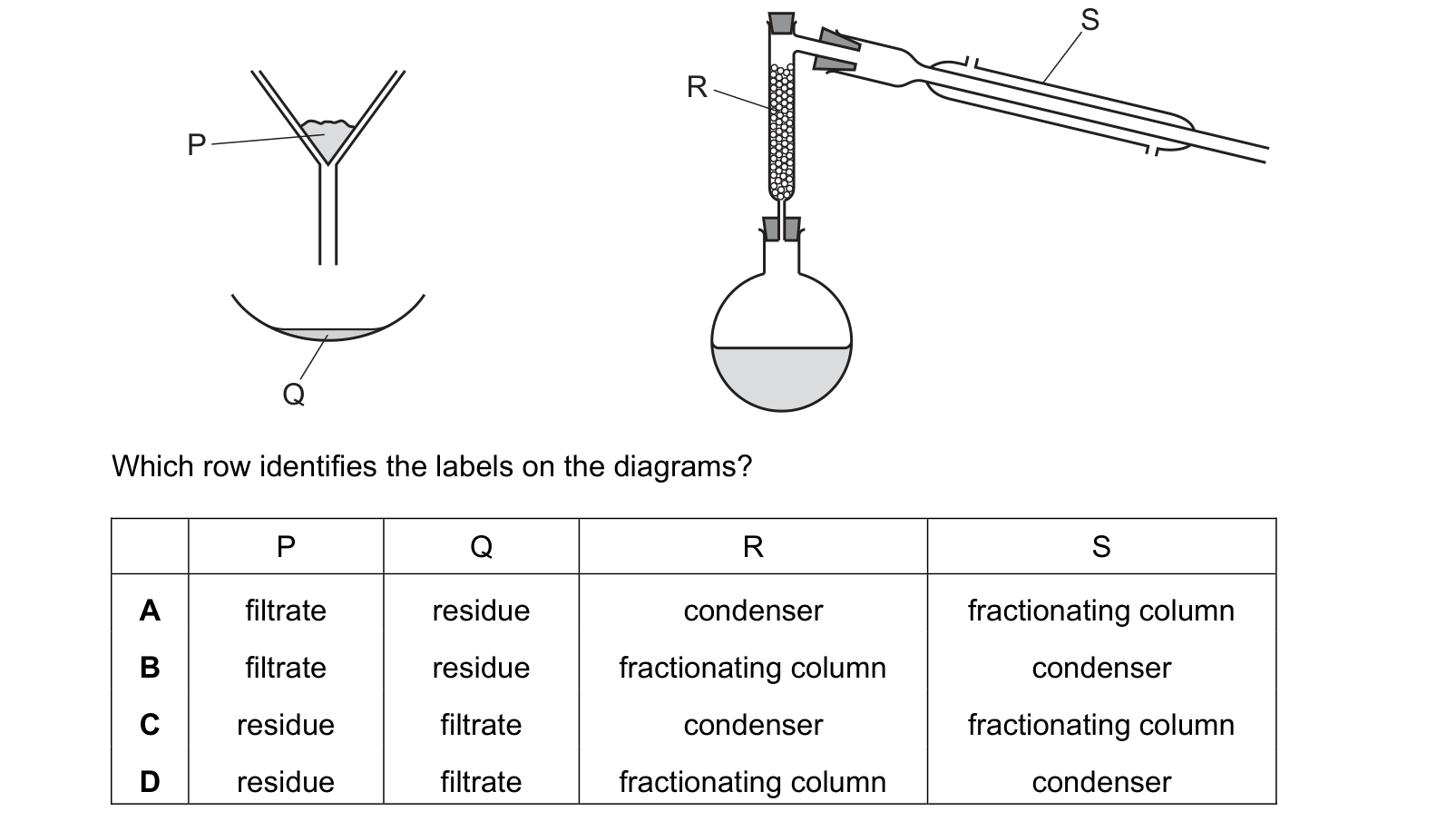
The apparatus used to separate a mixture of sand, methanol and ethanol is shown. P Which row identifies the labels on the diagrams? Each answer gives, in order: P; Q; R; S.
Answer: D.
Filtration separates an insoluble solid from a liquid, and the names matter: the solid held back by the filter paper is the residue, while the liquid passing through is the filtrate. P is inside the cone of paper, so P is the sand residue, and Q is the liquid gathering in the basin below, so Q is the filtrate. R is the vertical packed tube standing on the flask, where vapour condenses and evaporates over and over so that the more volatile methanol, boiling at 65 degrees Celsius, reaches the top ahead of ethanol; that is the fractionating column. S is the sloping tube inside a water jacket, whose job is to cool vapour back to liquid, so S is the condenser. The two rows that call P the filtrate put a liquid up in the funnel where only the trapped solid can be.
Question 2
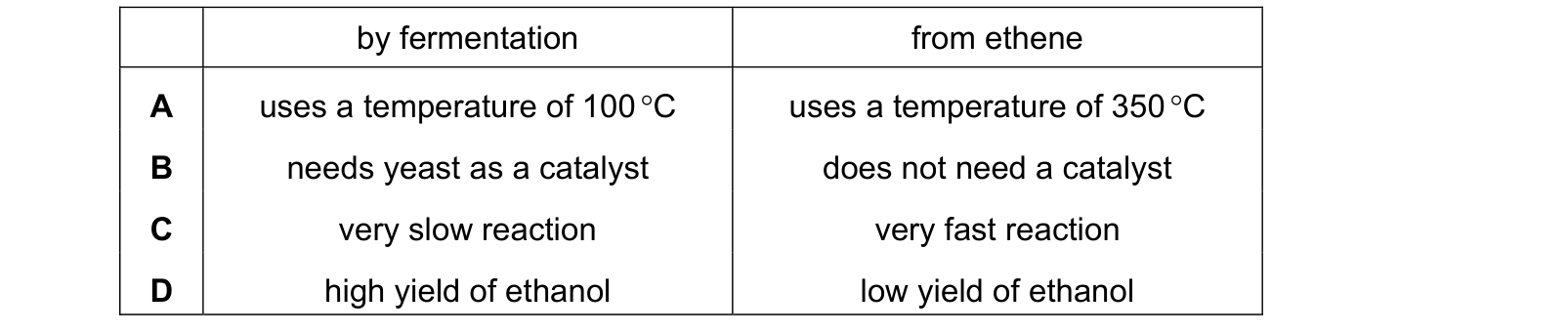
Ethanol is produced by fermentation or by the reaction of ethene with steam. Which row is correct? Each answer gives, in order: by fermentation; from ethene.
Answer: C.
Rate is the honest contrast between these two routes, since fermentation takes days while yeast enzymes work at about 30 degrees Celsius, and ethene with steam reacts in moments over a hot catalyst. The temperatures offered elsewhere are wrong for fermentation, because 100 degrees Celsius would kill the yeast outright and denature its enzymes. The claim that the ethene route needs no catalyst is wrong too, as phosphoric acid is what makes that addition run at a workable rate. The yields are the wrong way round as well, since the catalytic route converts ethene almost completely once unreacted gas is recycled, while fermentation stops when the alcohol it has made begins to poison the yeast.
Question 3
Which method is used to separate a mixture of the following liquids? liquid boiling point / °C methanol 64.5 ethanol 78.5 propan-1-ol 97.2 butan-1-ol 117.0
Answer: D.
Every substance in the table is a liquid, and these four alcohols mix freely with one another, so there is no solid to filter out and nothing to crystallise. What separates them is boiling point, and the values run from 64.5 to 117.0 degrees Celsius, close enough that a single evaporation would carry over a mixture of vapours rather than one pure liquid. A fractionating column deals with that, because the vapour condenses and evaporates many times on its way up and each cycle enriches it in the liquid with the lowest boiling point, so methanol comes over first and the others follow in order. Evaporation is the tempting wrong answer, but it would keep only the least volatile liquid and lose the rest into the air instead of collecting them.
Question 4
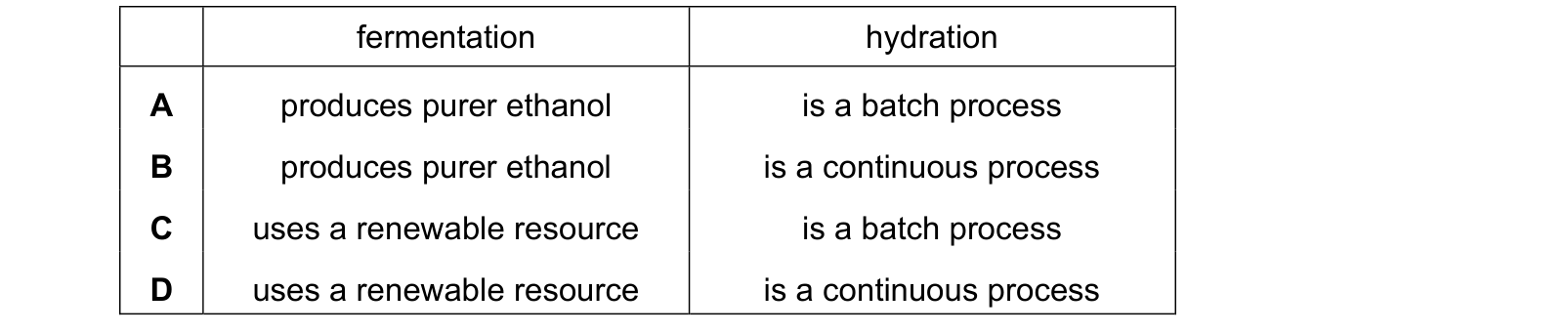
Ethanol is manufactured by fermentation of sugars or by catalytic hydration of ethene. Which row states an advantage of each method? Each answer gives, in order: fermentation; hydration.
Answer: D.
Both halves of the row have to be a real advantage of the method named beside them. Fermentation's advantage is its raw material, sugar from crops that regrow every season, set against ethene cracked from finite crude oil. The hydration route's advantage is that it runs continuously, gases flowing over the catalyst and product drawn off without a break, whereas fermentation must be loaded, left for days and emptied. Calling fermentation the source of purer ethanol reverses the truth, since what leaves the vessel is mostly water, and offering a batch process as hydration's advantage misdescribes it, because hydration is the continuous one.
Question 5
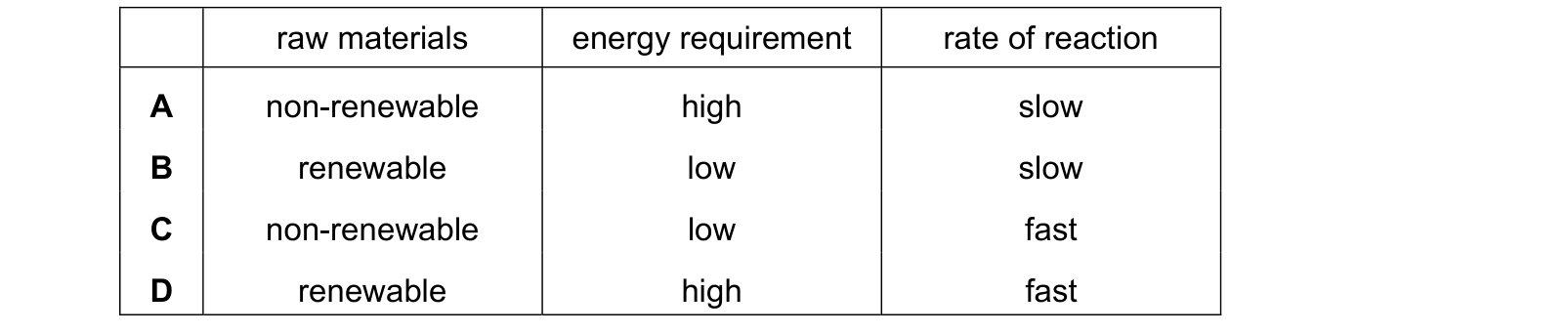
Which row about the production of ethanol by fermentation is correct? Each answer gives, in order: raw materials; energy requirement; rate of reaction.
Answer: B.
Fermentation begins with sugar or starch grown in fields, so its raw material is renewable and the two rows calling it non-renewable can go. It runs at about 30 degrees Celsius and ordinary pressure, with enzymes in the yeast doing the work, so its energy requirement is low. The gentleness has a price, because the reaction takes days rather than minutes, which makes the rate slow. Any row describing fermentation as fast has borrowed a property of the ethene and steam route, which flows continuously at high temperature and pressure and is quick precisely because so much energy is fed into it.
These questions are drawn from past CIE 0620 Chemistry papers and filtered to alcohols. You answer, you find out immediately whether you were right, and you get the reasoning for the correct option and for each distractor. Wrong answers go to a mistakes locker so you can come back to exactly those.
Practice is free. You need an account only so your progress and your mistakes are still there next time.
These are the errors that cost marks on alcohols, taken from our own topic notes. Read them before you practise and you will recognise the traps in the questions.
Calling ethanol a hydrocarbon.
Forgetting the oxygen atom in the alcohol when balancing a combustion equation.
Giving the fermentation temperature as 60 °C or "warm". Above about 40 °C the yeast enzymes are denatured.
Saying fermentation needs oxygen. It needs the absence of oxygen.
Writing the fermentation equation without the carbon dioxide.
Answering "suitable conditions" for the hydration of ethene instead of 300 °C, 60 atmospheres and phosphoric acid.
Saying acidified potassium manganate(VII) goes from purple to clear. The change is purple to colourless.
Claiming fermentation gives pure ethanol. It gives a dilute aqueous solution that must be distilled.
Revise it first
If any of the above is unfamiliar, work through the notes before practising: Alcohols revision notes.