98 past-paper questions on this unit. Five of them are below. Answer on the page: each one is marked the moment you pick, the correct option is shown whether or not you found it, and the full explanation opens either way.
CIE 0620 ChemistryPaper 1 and Paper 2 MCQsFree account
Ions and ionic bonds: five questions to try now
Real past-paper questions, the answer key from the mark scheme, and the explanation that goes with it. No account needed to answer them.
Question 1
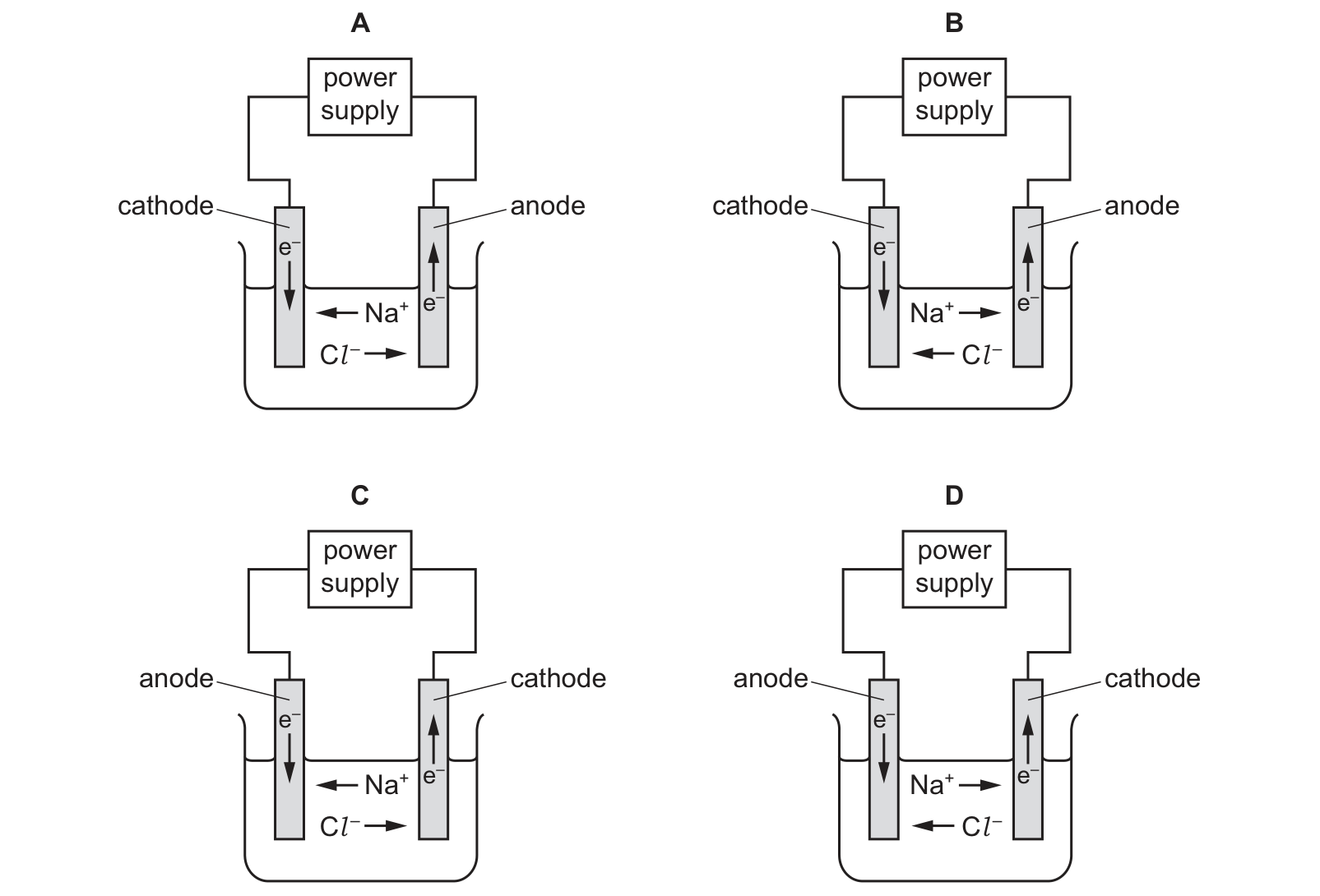
Which diagram shows the direction of movement of ions and electrons during the electrolysis of molten sodium chloride? Use the source image for M22 Paper 22, question 11.
Answer: A.
Two things have to be right together, where the ions travel and which way the electrons go. Sodium ions are positive and are drawn to the negative electrode, the cathode, while chloride ions are negative and move to the anode, so the Na plus arrow must point at the cathode and the Cl minus arrow at the anode. Electrons arrive from the power supply into the cathode, where sodium ions collect them, and leave the anode once chloride ions have surrendered them, so the arrow runs down into the cathode and up out of the anode. Diagram D is the sharp trap, since it sends both ions to the correct electrodes and then runs the electrons backwards, pushing them into the anode and drawing them out of the cathode, which no external circuit does.
Question 2
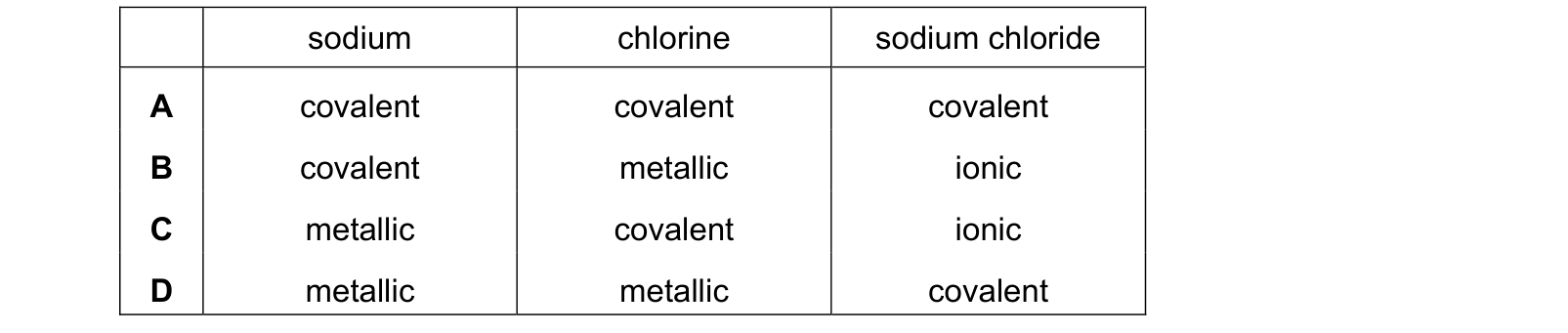
Sodium reacts with chlorine to form sodium chloride. Which row describes the bonding in the three substances? Each answer gives, in order: sodium; chlorine; sodium chloride.
Answer: C.
Three different pairings of atoms produce three different kinds of bonding, so each substance has to be judged on what it contains. Sodium alone is a metal, so positive ions sit in a lattice surrounded by delocalised electrons, which is metallic bonding. Chlorine alone is a reactive non metal existing as Cl2, and two non metal atoms share a pair of electrons, so the bonding there is covalent. When the two react, the metal hands an electron to the non metal and the oppositely charged ions attract each other, which is ionic bonding in sodium chloride. Describing chlorine as metallic misreads a green gas from the right hand edge of the table as a metal, and calling sodium chloride covalent throws away the electron transfer between a group I metal and a group VII non metal on which the whole reaction rests.
Question 3
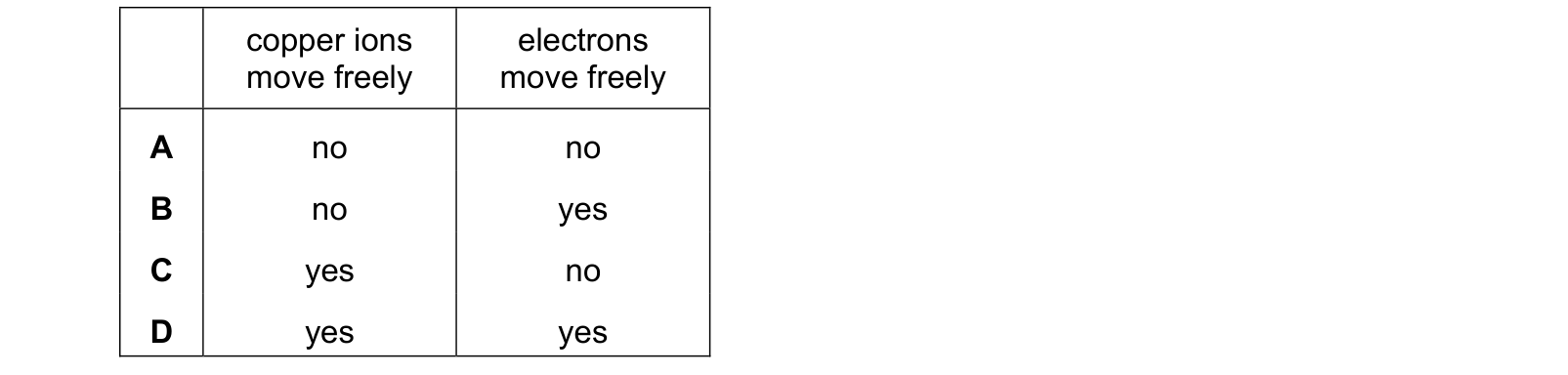
Which row explains why copper is a good conductor of electricity at room temperature? Each answer gives, in order: copper ions move freely; electrons move freely.
Answer: B.
In a solid metal the positive ions sit at fixed points in the lattice and only vibrate, so they carry no charge from one end of a wire to the other, and the first column must be no. The electrons released when the lattice formed are delocalised and free to drift through the whole structure, and that drift is the current, so the second column must be yes. Row D allows both to move, which would describe a molten ionic compound rather than a solid metal. Row A denies both, which leaves nothing at all to carry charge and contradicts the very fact the question begins with, that copper conducts well.
Question 4
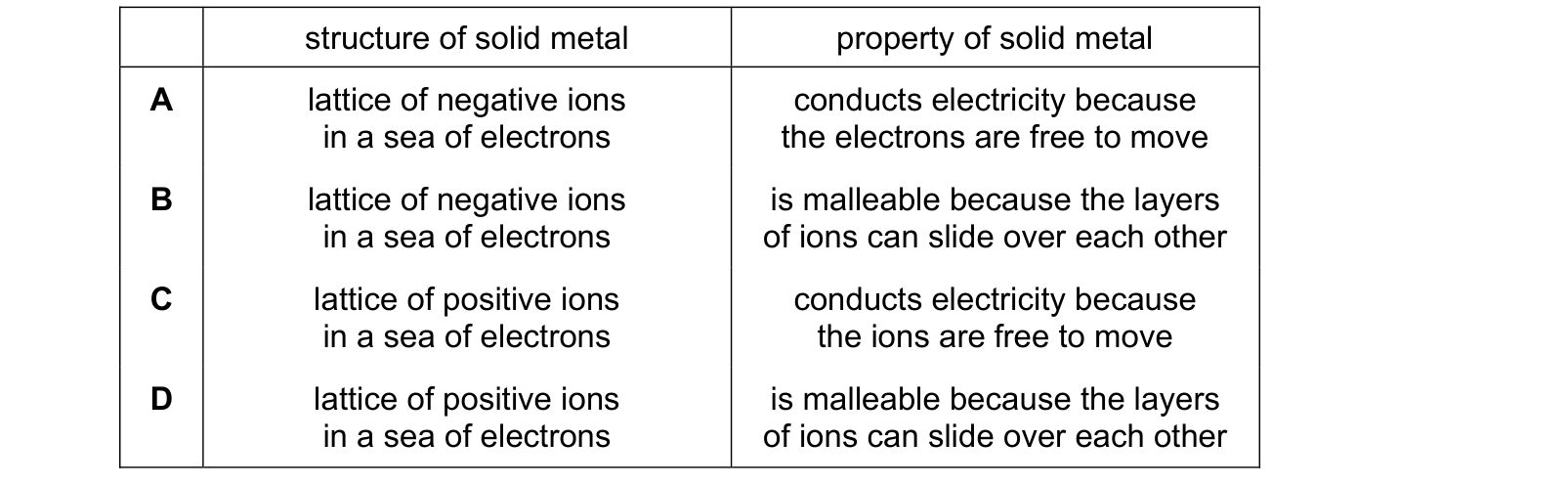
Which row describes the structure of a solid metal and explains the property? Each answer gives, in order: structure of solid metal; property of solid metal.
Answer: D.
The description has to be right before the explanation can be judged at all. A metal is a lattice of positive ions in a sea of delocalised electrons, since the atoms have given their outer electrons up, so the two rows offering negative ions fail immediately. Of the two remaining, one says the metal conducts because its ions are free to move, and that is false, because the ions are fixed in the lattice and it is the electrons that travel. The other says the metal is malleable because layers of ions slide over one another, which is exactly right, with the electron sea moving along with them so the structure holds together while the shape changes.
Question 5
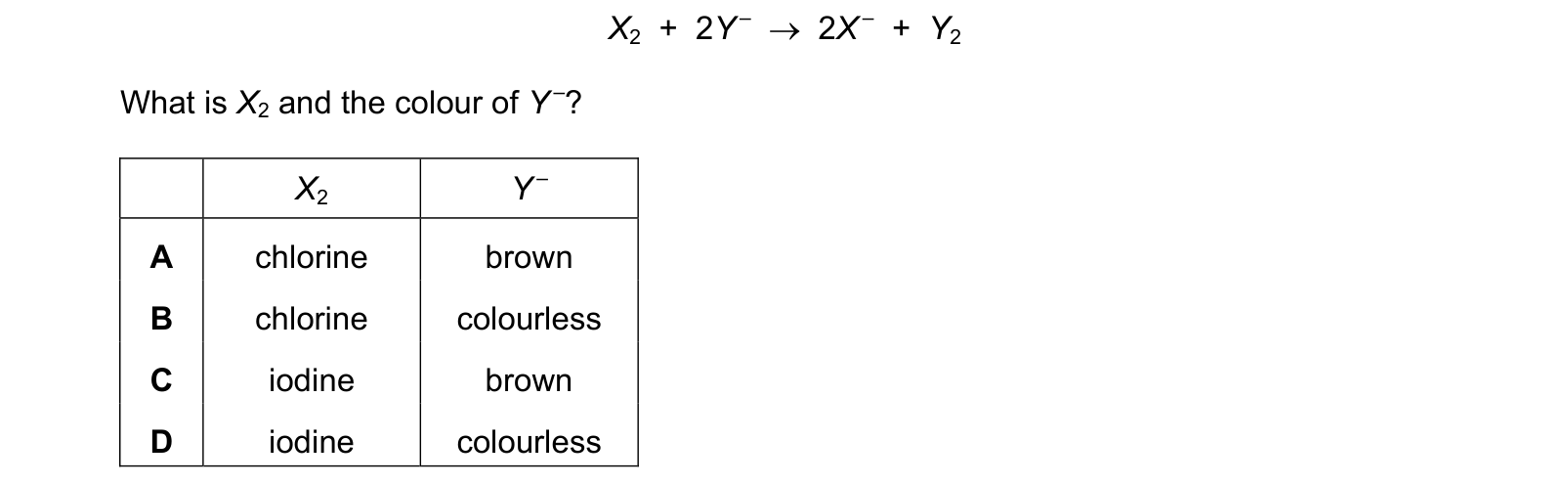
The equation shows the reaction between a halogen and the aqueous ions of another halogen. X2 + 2Y – → 2X – + Y2 What is X2 and the colour of Y –? Each answer gives, in order: X2; Y –.
Answer: B.
The equation shows X2 taking electrons from Y minus ions, so X is the more reactive halogen and must lie above Y in group VII. Iodine sits at the bottom of the group and cannot displace anything above it, so X2 has to be chlorine, with Y minus being bromide or iodide. Halide ions in solution are colourless; the colour in these reactions comes from the free halogen released, bromine giving an orange to brown solution and iodine a brown one, which is precisely what makes a displacement visible. The rows offering brown have taken the colour of the halogen Y2 formed at the end and attached it to the ion present at the start. Reactivity settles the first column, and the difference between an ion and an element settles the second.
These questions are drawn from past CIE 0620 Chemistry papers and filtered to ions and ionic bonds. You answer, you find out immediately whether you were right, and you get the reasoning for the correct option and for each distractor. Wrong answers go to a mistakes locker so you can come back to exactly those.
Practice is free. You need an account only so your progress and your mistakes are still there next time.
These are the errors that cost marks on ions and ionic bonds, taken from our own topic notes. Read them before you practise and you will recognise the traps in the questions.
Saying an ionic bond is the sharing of electrons. That is covalent bonding.
Drawing a dot-and-cross diagram without brackets or without charges.
Showing the sodium ion still holding its outer electron.
Saying ionic compounds conduct because of delocalised electrons. They conduct because ions move.
Saying solid sodium chloride conducts. It does not; the ions cannot move.
Writing MgCl or AlO instead of balancing the charges to MgCl₂ and Al₂O₃.
Calling an ionic compound a molecule, or using relative molecular mass for it.