25 past-paper questions on this unit. Five of them are below. Answer on the page: each one is marked the moment you pick, the correct option is shown whether or not you found it, and the full explanation opens either way.
CIE 0620 ChemistryPaper 1 and Paper 2 MCQsFree account
Hydrogen-oxygen fuel cells: five questions to try now
Real past-paper questions, the answer key from the mark scheme, and the explanation that goes with it. No account needed to answer them.
Question 1
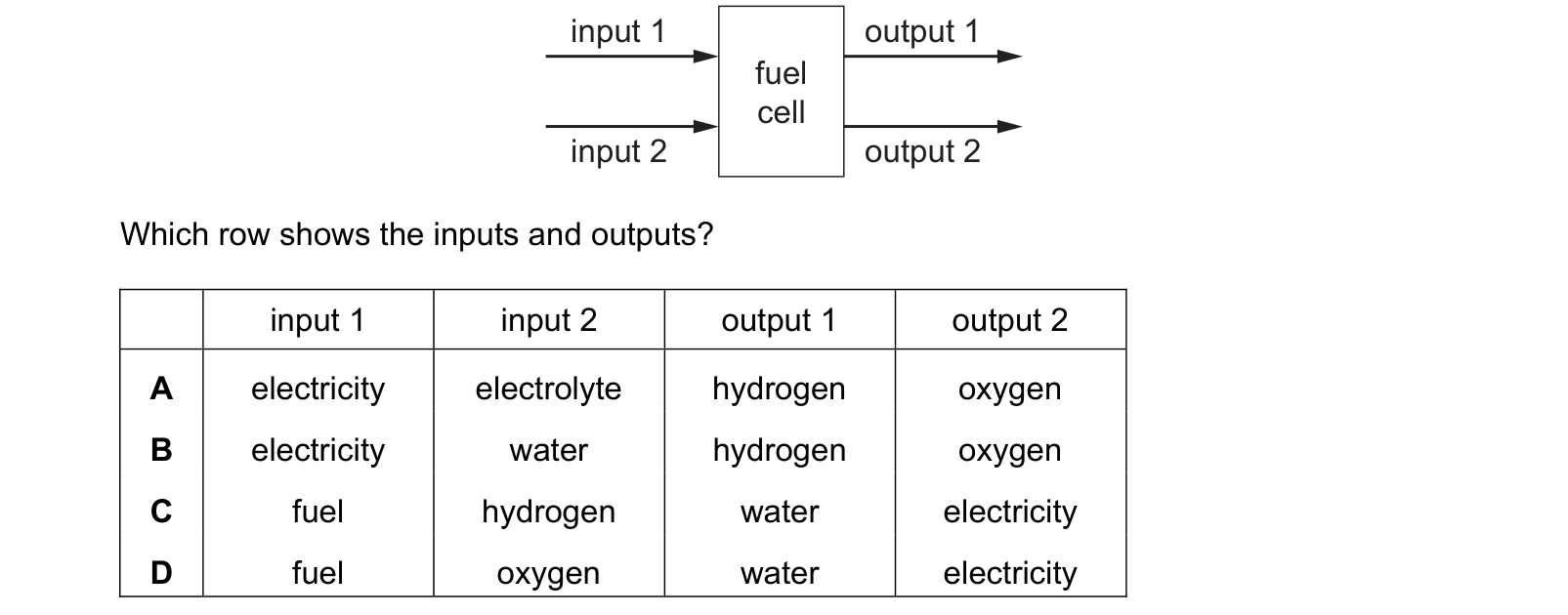
The flow diagram represents a hydrogen–oxygen fuel cell. Which row shows the inputs and outputs? Each answer gives, in order: input 1; input 2; output 1; output 2.
Answer: D.
A fuel cell consumes reactants and delivers energy, so the inputs must both be chemicals while the outputs include the electricity the cell exists to produce. The reactants are the fuel, hydrogen, together with oxygen, and the products are water and an electric current, which fixes the row as fuel and oxygen going in with water and electricity coming out. The row listing fuel with hydrogen as the two inputs names the same substance twice and leaves no oxidant. The rows with electricity as an input describe the electrolysis of water, the reverse process, which produces hydrogen and oxygen rather than consuming them.
Question 2
Fuel cells are used as energy sources in cars. Which row gives a fuel used in a fuel cell and the products formed? Each answer gives, in order: fuel in a fuel cell; products formed.
Answer: B.
A hydrogen fuel cell is supplied with hydrogen and oxygen, and since no carbon enters the cell, no carbon dioxide can leave it, so the sole product is water. The row pairing hydrogen with carbon dioxide and water invents a carbon containing product out of a carbon free reaction. Petrol is a fuel, but it is burned in an engine rather than used in this type of cell, and burning petrol produces carbon dioxide as well as water, so the row offering petrol with water only is wrong about the products as well as about the fuel.
Question 3
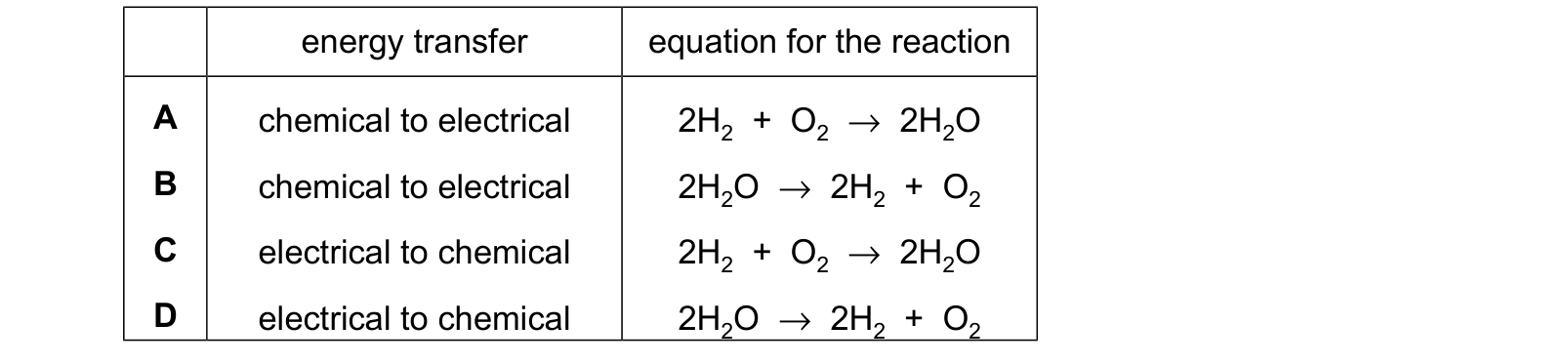
Which row about a hydrogen–oxygen fuel cell is correct? Each answer gives, in order: energy transfer; equation for the reaction.
Answer: A.
A fuel cell exists to turn chemical energy into electrical energy, so that column is fixed by what the device does; any row describing electrical to chemical is describing electrolysis instead. The reaction is hydrogen combining with oxygen to form water, which balances as 2H2 + O2 → 2H2O. The equation written the other way round, 2H2O → 2H2 + O2, is the electrolysis of water and consumes electricity rather than producing it. The row that pairs that equation with a chemical to electrical energy change combines the right energy transfer with the wrong reaction.
Question 4
Hydrogen–oxygen fuel cells can be used to power vehicles. What is produced by the fuel cells?
Answer: D.
A hydrogen fuel cell reacts hydrogen with oxygen, so the useful output is electricity and the only chemical product is water, which makes statements 2 and 3 both correct. Carbon dioxide is not produced, because no carbon enters the cell at any stage, and that is the main environmental argument for fuel cell vehicles over petrol engines. Any option including carbon dioxide has imported the products of burning a hydrocarbon into a reaction that contains none. Leaving water out is the other way to go wrong, since the water formed is a genuine product rather than a trace.
Question 5
Which statement describes an advantage of using a hydrogen–oxygen fuel cell in a car compared to a gasoline engine?
Answer: D.
An advantage has to be something the fuel cell does better than the engine it replaces. Water as the only chemical product is exactly that, since a gasoline engine emits carbon dioxide along with carbon monoxide and oxides of nitrogen. Hydrogen being difficult to store is a genuine problem rather than a benefit, and its flammability is a safety concern rather than a selling point. Making the hydrogen from hydrocarbons is a real criticism of the technology, because carbon dioxide is released during that manufacture, so it counts against the fuel cell rather than for it.
These questions are drawn from past CIE 0620 Chemistry papers and filtered to hydrogen-oxygen fuel cells. You answer, you find out immediately whether you were right, and you get the reasoning for the correct option and for each distractor. Wrong answers go to a mistakes locker so you can come back to exactly those.
Practice is free. You need an account only so your progress and your mistakes are still there next time.
These are the errors that cost marks on hydrogen-oxygen fuel cells, taken from our own topic notes. Read them before you practise and you will recognise the traps in the questions.
Saying the fuel cell produces no products at all. It produces water.
Saying hydrogen is burned in the cell. It reacts electrochemically and the energy is released as electricity.
Calling a fuel cell a battery that needs recharging. It runs as long as it is fed.
Claiming a fuel cell vehicle causes no pollution anywhere, without mentioning how the hydrogen was made.
Saying hydrogen is easy to store because it is light. Its low density is exactly why storing it is difficult.
Giving "it is cleaner" as the whole answer instead of naming water as the only product.