Infectious diseases: five questions to try now
Real past-paper questions, the answer key from the mark scheme, and the explanation that goes with it. No account needed to answer them.
Question 1
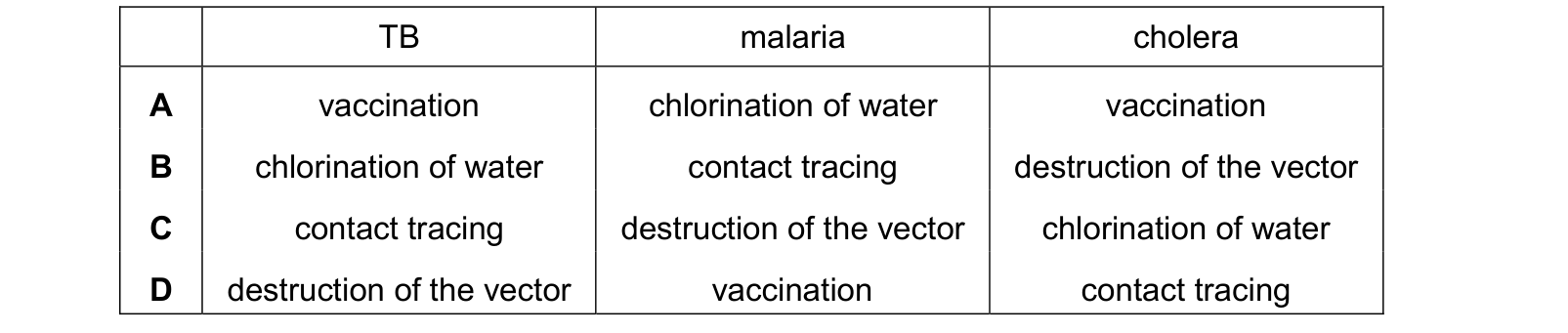
Which row is correct for the control or prevention methods for each disease? Each answer gives, in order: TB; malaria; cholera.
Answer: C.
TB spreads through the air from person to person, so contact tracing finds and tests the people an infected person has been close to.
Malaria is carried by the Anopheles mosquito, so destroying the vector by draining standing water, spraying and using treated nets breaks the cycle.
Cholera is water-borne, so chlorinating the water removes the route entirely.
Every wrong row pairs a measure with a disease whose transmission it does not touch. Chlorinating water does nothing for an airborne infection, and contact tracing does nothing for a disease caught from water rather than from a person.
Question 2
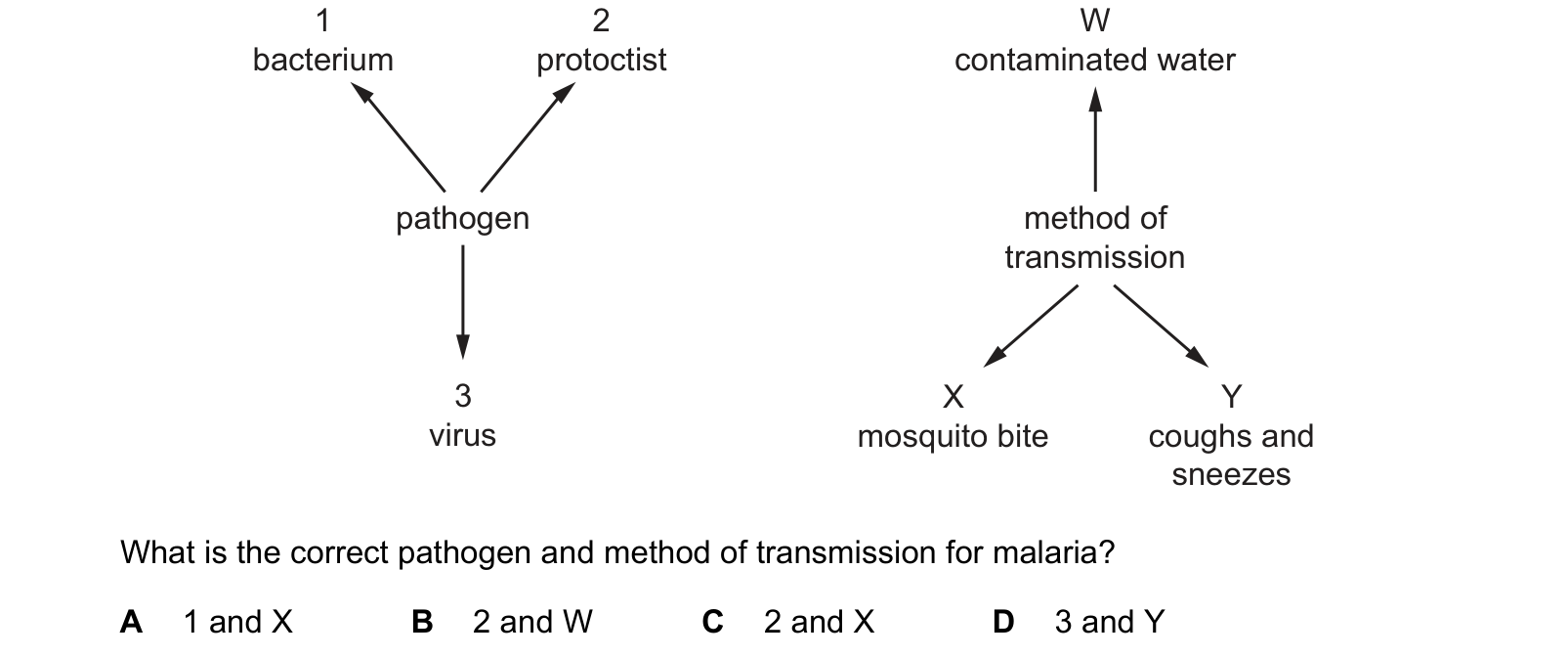
The diagram shows some of the pathogens that cause disease in humans and some of the ways they are transmitted.
1 2 W virus mosquito bite coughs and sneezes
What is the correct pathogen and method of transmission for malaria?
Answer: C.
It is transmitted by the bite of an infected female Anopheles mosquito, which is X on the right. The mosquito is a vector: it carries the parasite from an infected person to an uninfected one, so it spreads the disease without being the cause of it.
2 and X, which is C.
The other two transmission routes belong to diseases worth knowing alongside this one. Contaminated water (W) is how cholera spreads, caused by the bacterium Vibrio cholerae. Coughs and sneezes (Y) carry droplets containing the bacterium that causes TB and the virus that causes measles.
Question 3
Repeated infections with malaria result in more effective immunity to malaria.
Which type of immunity is responsible for the more effective immunity?
Answer: C.
Natural because it came from catching the disease rather than from a vaccine or an injection. Active because the person's own immune system made the response, so their own B lymphocytes produced antibodies and left memory cells behind.
Artificial would mean medical intervention: a vaccine for artificial active, an injection of ready-made antibodies for artificial passive.
Passive would mean receiving antibodies someone else made, as a baby does across the placenta. Those give immediate protection and leave no memory cells, so they could never build up over repeated exposures the way the question describes.
Question 4
A hurricane destroys a large town on an island. People move away from the town and set up tents, where sanitation is poor.
Which disease is most likely to spread within a week of the change in living conditions?
Answer: A.
Cholera is spread by water and food contaminated with faeces, so it appears wherever sanitation breaks down, and its incubation period is a matter of hours to a few days. A camp with no sewage treatment is the classic setting for an outbreak, which is A.
Malaria needs the Anopheles mosquito to be present and breeding, so it depends on the local vector rather than on sanitation. TB spreads in crowded air but develops slowly and can stay latent for years. HIV is transmitted sexually or through blood and would not produce an outbreak in a week.
The timescale is what settles it.
Question 5
Which statements correctly identify why it is difficult to eliminate TB?
1 Humans have limited access to clean water.
2 Humans can be infected but the pathogen can be inactive.
3 A number of drug-resistant strains of the pathogen have evolved.
Answer: D.
Mycobacterium tuberculosis can stay latent in the body for years, walled off in the lungs and causing no symptoms, then become active if the immune system weakens. A reservoir of infected people who do not know they are infected cannot be treated: statement 2.
Drug-resistant strains have evolved, largely because the treatment course runs for months and is so often stopped early: statement 3.
Statement 1 belongs to cholera. Access to clean water is the central issue for a water-borne disease, and TB is spread by airborne droplets, so clean water does not affect its transmission.
What this practice covers
These questions are drawn from past CIE 9700 Biology papers and filtered to infectious diseases. You answer, you find out immediately whether you were right, and you get the reasoning for the correct option and for each distractor. Wrong answers go to a mistakes locker so you can come back to exactly those.
Practice is free. You need an account only so your progress and your mistakes are still there next time.
What examiners see students get wrong here
These are the errors that cost marks on infectious diseases, taken from our own topic notes. Read them before you practise and you will recognise the traps in the questions.
- Saying malaria is caused by a mosquito. It is caused by Plasmodium; the mosquito is the vector.
- Saying HIV and AIDS are the same thing. HIV is the virus; AIDS is the condition that follows.
- Saying cholera kills through the bacterium spreading round the body. It stays in the gut; the killer is dehydration from the toxin.
- Saying TB is treated with a single antibiotic for a week. It needs a combination, for months.
- Naming only biological control measures when the question asks about prevention. The social and economic factors carry as many marks.
Revise it first
If any of the above is unfamiliar, work through the notes before practising: Infectious diseases revision notes.