Antibiotics
Contents: 8 sections
What an antibiotic is
An antibiotic is a substance produced by a living organism, usually a fungus or a bacterium, that kills or inhibits the growth of bacteria.
- Bactericidal antibiotics kill bacteria. Penicillin is one.
- Bacteriostatic antibiotics stop them reproducing, leaving the immune system to clear the infection.
Antibiotics work by attacking structures or processes that bacteria have and human cells do not, which is what makes them safe to take. That principle explains both how penicillin works and why antibiotics are useless against viruses.
How penicillin works
Bacteria have a cell wall made of peptidoglycan, a mesh of polysaccharide chains cross-linked by short peptides. The wall is what stops the cell bursting, because bacterial cytoplasm has a much lower water potential than its surroundings and water is constantly entering by osmosis.
Penicillin inhibits the enzymes that form the cross-links in the peptidoglycan wall.
The consequence follows in steps:
- A growing bacterium is continually making new wall.
- With penicillin present, the new wall is made without cross-links, so it is weak.
- Water continues to enter by osmosis, since the cytoplasm still has a lower water potential.
- The weakened wall cannot resist the pressure, and the cell bursts, which is lysis.
Two things follow from this that are regularly examined.
Penicillin only affects bacteria that are actively growing. A dormant bacterium is not making new wall, so there is nothing for penicillin to disrupt. This is one reason tuberculosis is hard to treat.
Penicillin does not harm human cells, because human cells have no cell wall at all, so there is nothing for it to act on.
Why antibiotics do not work on viruses
A virus is not a cell. It has no cell wall, no ribosomes of its own, no cell surface membrane of the bacterial kind, and no metabolism.
Once inside a host cell, a virus uses the host's own enzymes and ribosomes to make copies of itself. There is no separate viral machinery for an antibiotic to target, and anything that did attack the machinery in use would damage the host cell too.
This is why prescribing antibiotics for a cold or influenza does nothing for the patient, and why doing so anyway is one of the main drivers of resistance.
How resistance arises
This is the part where the reasoning has to be exactly right, because a plausible-sounding wrong version is very common.
- A bacterial population contains natural genetic variation, arising from random mutation. Mutations happen whether or not an antibiotic is present.
- By chance, some mutations give resistance. A bacterium might produce an enzyme such as penicillinase that breaks the antibiotic down, or have an altered membrane protein that stops it entering, or an altered target site the antibiotic no longer fits.
- When the antibiotic is used, it acts as a selection pressure. Non-resistant bacteria are killed.
- The resistant bacteria survive and reproduce, passing the allele to their offspring. Bacteria reproduce very quickly, so this happens in days rather than generations of years.
- Over time the frequency of the resistance allele in the population rises, and eventually the antibiotic is ineffective.
The mutation is not caused by the antibiotic. This is the point that separates a correct answer from an incorrect one. The antibiotic does not make bacteria become resistant; it selects the ones that already were. Saying that bacteria "become immune" or "adapt to" the antibiotic describes the wrong mechanism.
This is natural selection, complete and observable, which is why it is such a common exam context.
Horizontal transfer
Resistance also spreads sideways, not just by inheritance. Bacteria carry small circular DNA molecules called plasmids, and a plasmid carrying a resistance gene can be passed from one bacterium to another during conjugation, even between different species.
This is why resistance can appear in a species that has never itself been exposed to a particular antibiotic, and it is what makes multiple resistance in a single organism possible.
Why resistance matters
- Infections that were routine become difficult or impossible to treat, and people die of them.
- Surgery, transplants and chemotherapy all depend on being able to prevent or treat infection, so they become far more dangerous.
- MRSA, methicillin-resistant Staphylococcus aureus, spreads in hospitals where many vulnerable people are close together and antibiotic use is heavy.
- Multi-drug resistant tuberculosis requires far longer, more toxic and more expensive treatment, with a lower chance of cure.
- Developing a new antibiotic takes many years and a great deal of money, and resistance to it can emerge within a few years of release.
Reducing resistance
Each measure is aimed at reducing the selection pressure or at limiting spread.
- Prescribe antibiotics only when they are needed, and never for viral infections.
- Complete the course. Stopping early leaves the more resistant survivors alive and free to multiply. This is why DOTS exists for tuberculosis.
- Use narrow-spectrum antibiotics where the organism is known, so fewer species are exposed.
- Rotate the antibiotics used in a hospital, so no single one is under constant selection.
- Use a combination of antibiotics, since a bacterium resistant to one is usually still killed by the other, and the chance of a single organism being resistant to both is very small.
- Hospital hygiene: handwashing, isolating infected patients, and thorough cleaning, all of which limit spread rather than resistance itself.
- Restrict agricultural use. Antibiotics used routinely in livestock as growth promoters expose enormous bacterial populations to a constant low dose, which is close to ideal conditions for selecting resistance.
Common mistakes
- Saying the antibiotic causes the mutation. Mutation is random and prior; the antibiotic selects.
- Saying bacteria "become immune". Immunity is something a host has against a pathogen, not something a bacterium has against a drug.
- Saying penicillin dissolves or destroys the cell wall. It prevents new wall being cross-linked, so it only affects growing cells.
- Saying antibiotics do not affect viruses because viruses are too small. It is because they have no cellular machinery of their own to target.
- Explaining "finish the course" as making sure you feel better. It is about not leaving the most resistant survivors behind.
Check you have it
Question 1
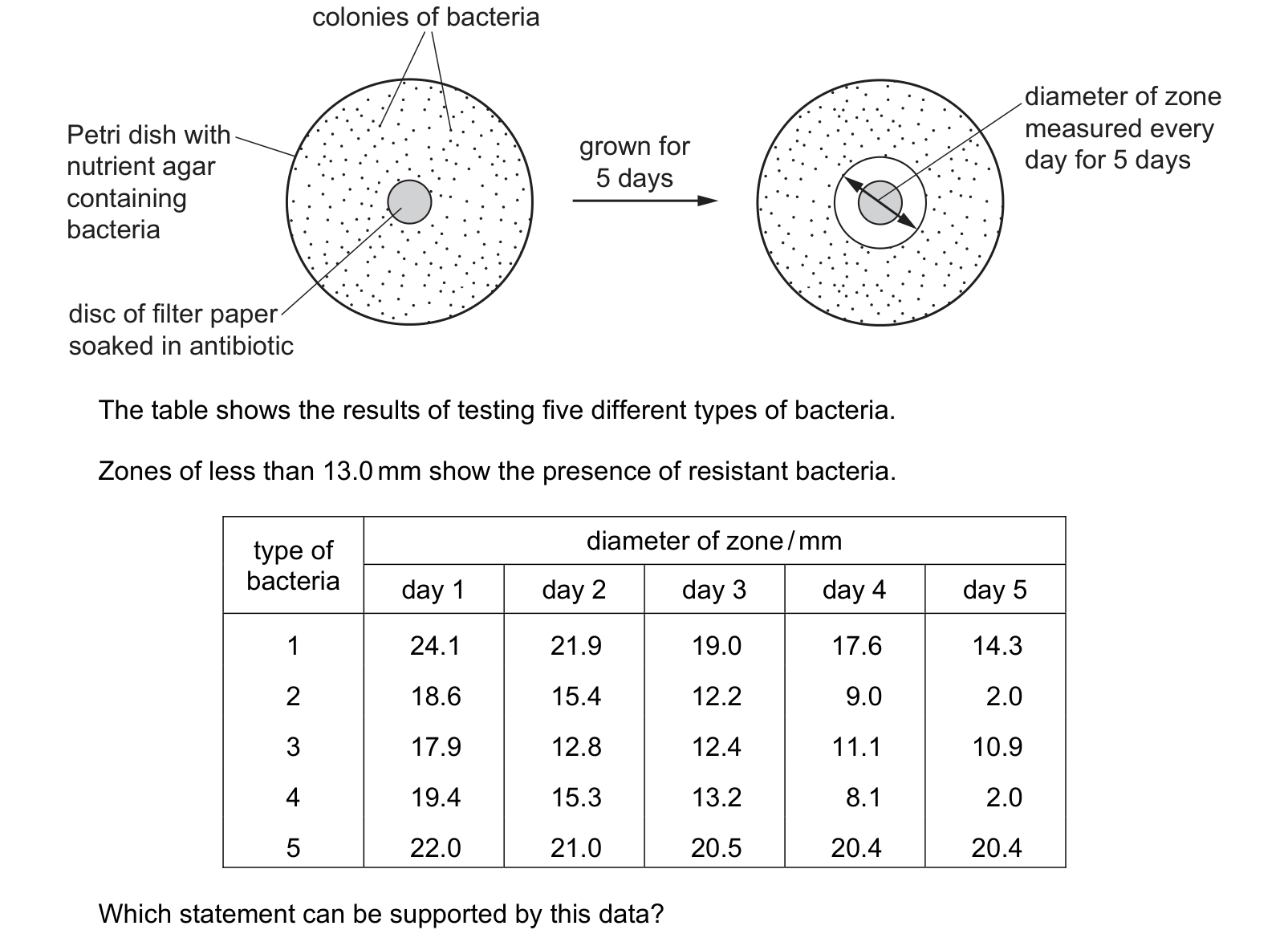
The diagram shows one way of testing the effect of an antibiotic on bacteria. Petri dish with measured every nutrient agar day for 5 days containing bacteria
disc of filter paper soaked in antibiotic
The table shows the results of testing five different types of bacteria.
Zones of less than 13.0 mm show the presence of resistant bacteria. Which statement can be supported by this data?
Answer: B.
Read down the day 5 column. Type 1 finishes at 14.3 mm, type 2 at 2.0, type 3 at 10.9, type 4 at 2.0 and type 5 at 20.4. Three of them are under 13.0 mm: types 2, 3 and 4. That is B.
A overstates it. Types 1 and 5 never drop below the cut-off. Type 1's zone does shrink from 24.1 to 14.3, and type 5 barely moves at all, so "all the types" is contradicted by the very last row.
C gets it backwards. Type 3 finishes at 10.9 mm, so it is one of the resistant ones and the antibiotic is a poor choice against it. Type 5 keeps a 20.4 mm zone, so it is the one the antibiotic works best on and it is missing from that option entirely.
D claims something no experiment can show. Five days of data cannot rule out resistance appearing later. Resistance arises by chance mutation and then spreads because the antibiotic kills everything else, so "never" is not a conclusion any set of results supports.
Question 2
Bacteria may be classified according to differences in cell wall structure. The differences are shown by using the Gram stain.
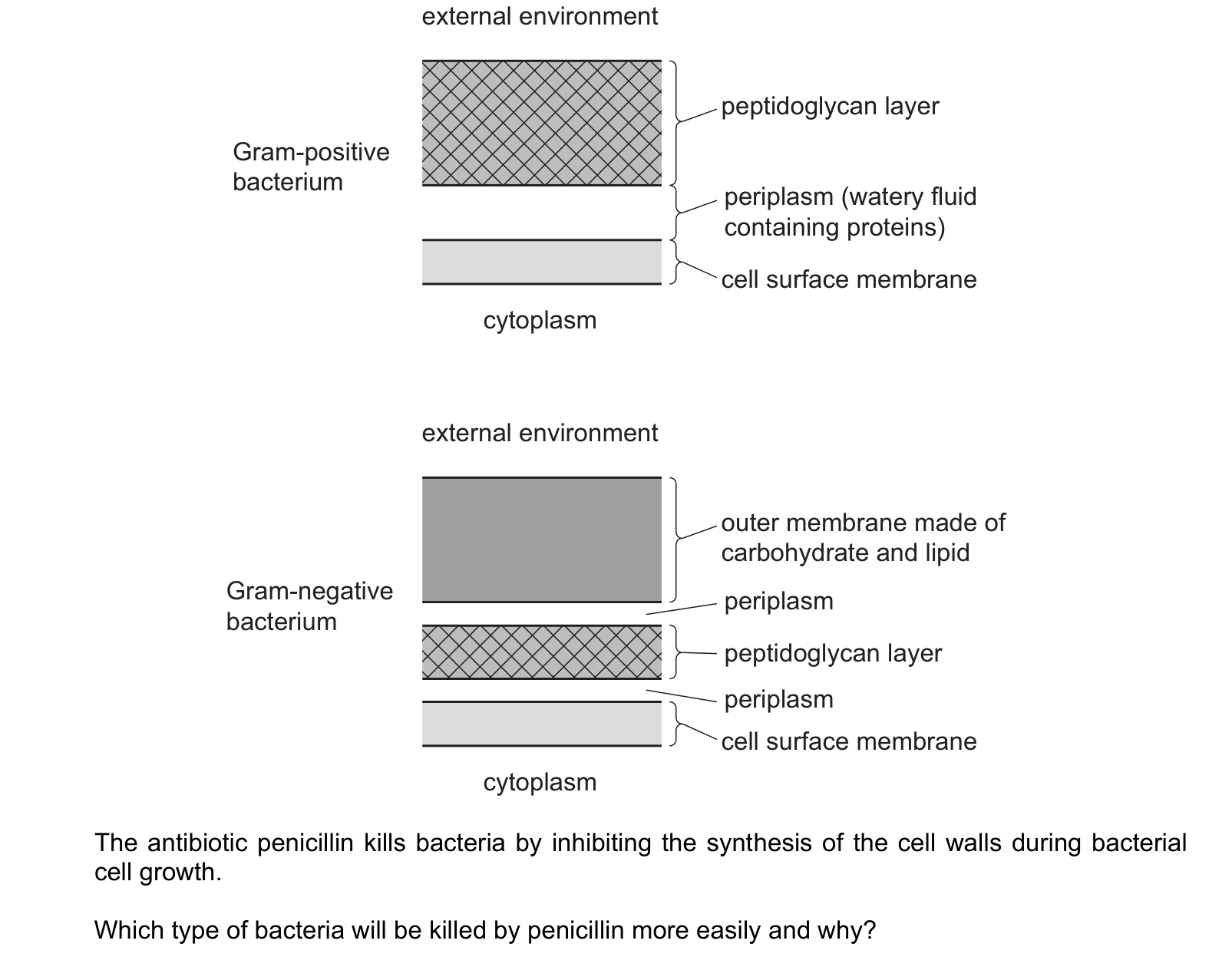
The diagram shows part of a Gram-positive bacterium and part of a Gram-negative bacterium, drawn to the same scale.
external environment The antibiotic penicillin kills bacteria by inhibiting the synthesis of the cell walls during bacterial cell growth.
Which type of bacteria will be killed by penicillin more easily and why?
Answer: A.
In the Gram-positive bacterium the peptidoglycan is the outermost layer. It faces the external environment directly, so penicillin arriving from outside meets it straight away. That is A.
In the Gram-negative bacterium the diagram shows an outer membrane of carbohydrate and lipid covering everything, with the thin peptidoglycan layer buried underneath it. Penicillin has to get through that outer membrane first, and that extra barrier is what makes Gram-negative bacteria harder to kill with it.
B is wrong although it picks the right bacterium. Gram-positive has the thicker peptidoglycan layer, not a thinner one, and thickness is not the point anyway. C is wrong on the same fact from the other side: the Gram-negative peptidoglycan is thin, but being thin does not help when the drug cannot get to it. D is wrong because periplasm is a watery fluid holding proteins, and having more of it says nothing about how strong the wall is.
Notice the timing in the stem too. Penicillin inhibits synthesis of walls during growth, so it kills bacteria that are dividing and leaves dormant ones alone.
Question 3
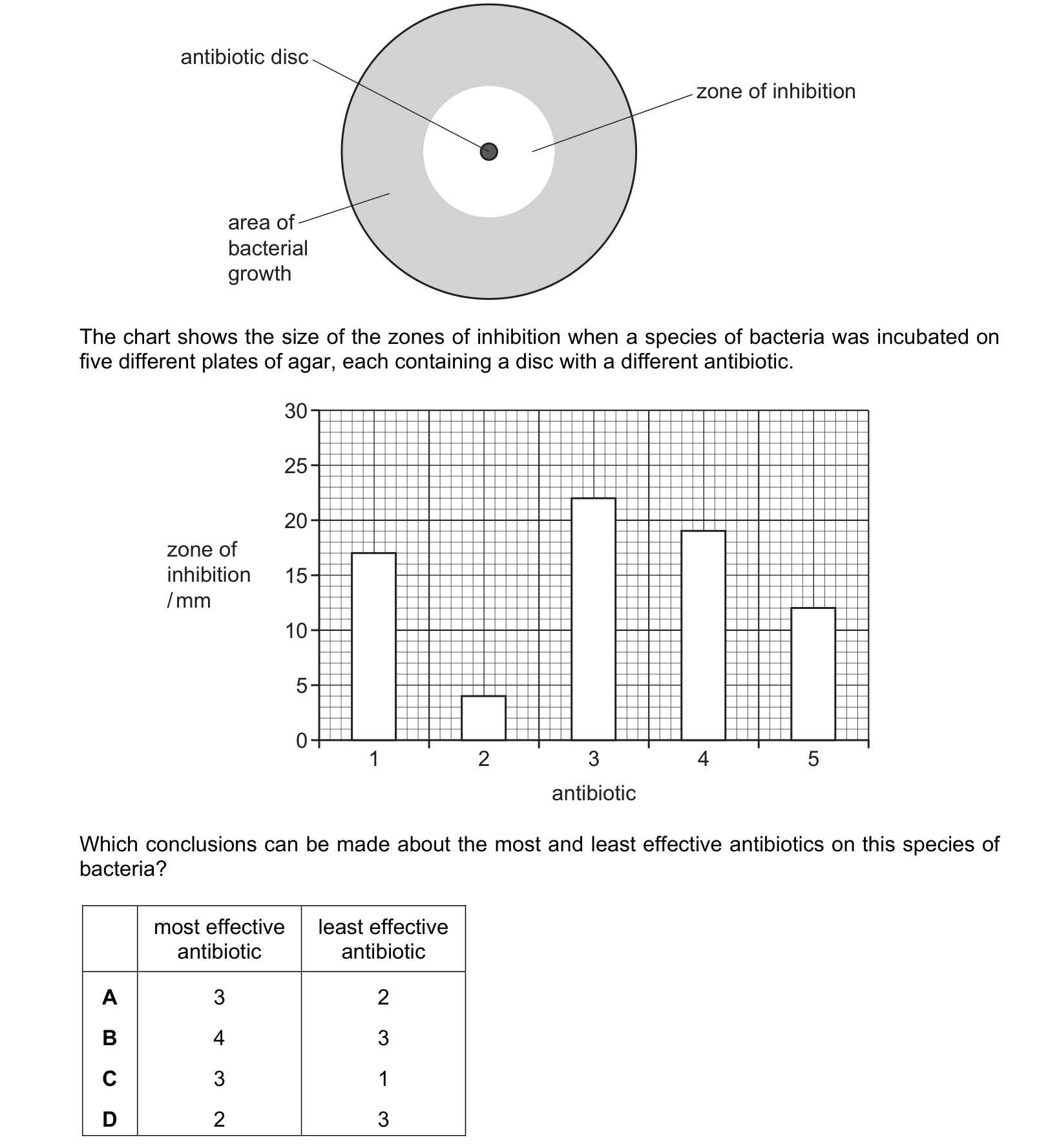
When bacteria are grown in a Petri dish containing discs with antibiotics, there will be zones of inhibition of bacterial growth.
The chart shows the size of the zones of inhibition when a species of bacteria was incubated on five different plates of agar, each containing a disc with a different antibiotic. Which conclusions can be made about the most and least effective antibiotics on this species of bacteria? Each answer gives, in order: most effective antibiotic; least effective antibiotic.
Answer: A.
Antibiotic 3 gives the largest zone at 22 mm, so it is the most effective. Antibiotic 2 gives the smallest at 4 mm, so it is the least effective. Most effective 3, least effective 2, which is A.
The other rows each get one of the two wrong. B picks 4, which is second at 19 mm, not the largest. C has the most effective right but calls antibiotic 1 the least when its zone is 17 mm, one of the bigger ones. D has the two swapped entirely.
One thing this experiment cannot tell you: a large zone in a Petri dish does not guarantee the antibiotic will work in a patient. It has to reach the site of infection in the body at a high enough concentration, which is a separate question from whether it kills the bacteria on agar.
What the syllabus asks for on this topicSyllabus points
Syllabus points
- Outline how penicillin acts on bacteria and why antibiotics do not affect viruses.
- Explain how bacteria become resistant to antibiotics, with reference to mutation and selection.
- Discuss the consequences of antibiotic resistance and the measures needed to reduce it.
Related CIE 9700 Biology topics
Not the topic you were looking for? Describe what you are stuck on in your own words and we will take you to the notes that answer it.