Mode of action of enzymes
Contents: 9 sections
What an enzyme is
An enzyme is a globular protein that acts as a biological catalyst. It speeds up a reaction and is not used up, so one molecule can work again and again.
Because it is a globular protein, everything from topic 2.3 applies: the tertiary structure comes from interactions between R groups, and if those interactions break, the shape is lost and so is the function.
The active site
The active site is a small depression on the surface of the enzyme, made of a handful of amino acids brought close together by the way the chain folds. Those amino acids may be far apart in the primary structure and adjacent in the finished molecule.
The active site has a shape complementary to the substrate. That word is worth using precisely: the site is not the same shape as the substrate, it is the shape that fits it, the way a mould fits a casting.
Activation energy
Every reaction needs an initial input of energy to get started, called the activation energy. It is the energy needed to break existing bonds and reach the transition state.
An enzyme lowers the activation energy. It does not add energy, and it does not change how much energy the reaction releases overall. It provides an alternative route with a lower barrier, so a larger proportion of molecules have enough energy to react at any given temperature, and the reaction goes faster.
Two things follow that questions test directly:
- An enzyme cannot make a reaction happen that would not happen anyway. It only changes the rate.
- An enzyme does not change the equilibrium position, because it lowers the barrier in both directions equally.
The lock and key hypothesis
The original model. The active site is a rigid shape, and only a substrate with exactly the right shape fits, as a key fits a lock.
The sequence is:
- Substrate collides with the active site in the correct orientation.
- An enzyme-substrate complex forms.
- The reaction happens, and an enzyme-product complex forms briefly.
- Products leave, and the active site is free again.
The model explains specificity well. Its weakness is that it treats the enzyme as rigid, and enzymes are not rigid.
The induced fit hypothesis
The current model, and the one to give if a question asks for the better explanation.
The active site is not an exact fit at the start. When the substrate begins to bind, the active site changes shape slightly to mould around it, and that change is what puts strain on the bonds in the substrate.
That strain is the mechanism. Distorted bonds are weaker, so they break more easily, which is the same thing as saying the activation energy has fallen. Lock and key describes what happens; induced fit explains why it works.
Induced fit also explains things lock and key cannot: why some enzymes act on a small range of similar substrates rather than one, and how a molecule binding somewhere else on the enzyme can change the active site, which is what non-competitive inhibition does.
Specificity
An enzyme is specific because the shape of its active site is determined by its tertiary structure, which is determined by its primary structure, which is determined by the gene that codes for it.
A substrate whose shape is not complementary cannot form an enzyme-substrate complex, so no reaction is catalysed. This chain, gene to primary structure to tertiary structure to active site to specificity, is worth being able to state in one sentence, because a great many questions are asking for exactly it.
It also explains why denaturation destroys activity. Heat or extreme pH breaks the hydrogen and ionic bonds holding the tertiary structure. The chain unfolds, the active site loses its shape, and the substrate no longer fits. The primary structure is unaffected, because peptide bonds are covalent and survive.
Intracellular and extracellular enzymes
Intracellular enzymes work inside the cell that made them. Most enzymes are of this kind.
- Catalase breaks hydrogen peroxide, a toxic by-product of metabolism, into water and oxygen. It is one of the fastest enzymes known, which matters because hydrogen peroxide damages cells quickly.
- The enzymes of respiration and photosynthesis are intracellular, held in the mitochondria and chloroplasts.
Extracellular enzymes are made inside a cell, packaged and secreted, and work outside it.
- Amylase, made in the salivary glands and pancreas, hydrolyses starch to maltose in the gut.
- Trypsin, made in the pancreas, hydrolyses proteins to peptides in the small intestine.
The reason organisms secrete enzymes is straightforward: large molecules such as starch and protein cannot cross the cell surface membrane, so they must be broken down outside the cell into molecules small enough to be absorbed.
Fungi and many bacteria feed entirely this way, releasing enzymes onto their food and absorbing the products.
The route out of the cell
An extracellular enzyme is made on ribosomes on the rough endoplasmic reticulum, moves through the RER in a vesicle to the Golgi body, is modified there, and leaves in a vesicle that fuses with the cell surface membrane and releases it by exocytosis.
That pathway links straight back to topic 1.2, and questions about organelle function often use a secreted enzyme as the example.
Common mistakes
- Saying the active site is "the same shape as" the substrate. It is complementary to it.
- Saying an enzyme "lowers the energy needed for the reaction". It lowers the activation energy, not the overall energy change.
- Saying denaturation "breaks the enzyme down" or "breaks the peptide bonds". Peptide bonds are unaffected; the bonds holding the tertiary structure break.
- Saying enzymes are used up. They are not, which is why a small quantity catalyses a large amount of reaction.
- Treating lock and key as simply wrong. It is an accurate description of specificity that induced fit refines.
Check you have it
Question 1
HIV-1 protease is an enzyme produced by the HIV virus.
Two identical chains of 99 amino acids form the enzyme. In each chain, amino acids 25, 26 and 27 in the sequence form part of the active site.
Which orders of protein structure control the shape of the active site?
Answer: A.
The primary structure sets which amino acids are present and in what order, and amino acids 25, 26 and 27 are named as part of the active site. The secondary and tertiary levels fold the chain so that those residues are brought into the right position in three dimensions.
The detail that decides this question is that the enzyme is made of two identical chains. A protein of more than one polypeptide has quaternary structure, and the two chains sit together to complete the active site.
B is the answer for a single-chain enzyme, which this is not.
Question 2
Which functions are performed by glycoproteins on the surface of a cell surface membrane?
1 to act as enzymes catalysing reactions in the membrane
2 to have a specific site where chemicals can bind
3 to secrete specific chemicals used for cell signalling
Answer: C.
Glycoproteins on the outer surface act as receptors: the carbohydrate chain gives a site with a specific shape that a hormone or signalling molecule binds to, which is cell signalling and cell recognition.
Statement 1 confuses two different membrane proteins. Membranes do hold enzymes, but that is not the job of the surface glycoproteins.
Statement 3 gets the direction backwards. A receptor receives a signalling molecule. It does not secrete one, and secretion happens by exocytosis from inside the cell.
Question 3
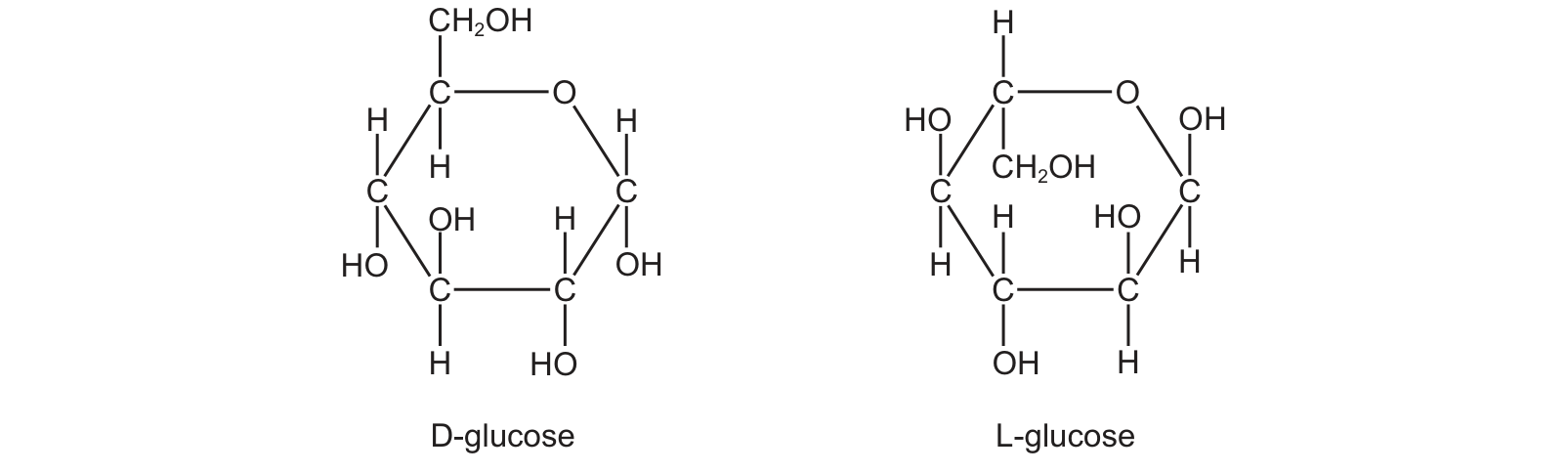
The diagram shows naturally occurring D-glucose and a form of glucose that can be synthesised in the laboratory, known as L-glucose.
CH2OH H
D-glucose L-glucose
The enzyme glucose oxidase catalyses the oxidation of D-glucose. The enzyme cannot catalyse the oxidation of L-glucose.
Which statement about L-glucose explains this?
Answer: A.
Enzyme specificity is about shape. The active site of glucose oxidase is complementary to D-glucose in three dimensions, and a mirror image does not fit a three-dimensional shape any more than a left hand fits a right glove. No enzyme-substrate complex forms, so no reaction. That is A.
D is a true statement that does not answer the question. Being a mirror image is the reason the shape is wrong, but on its own it says nothing about the enzyme, and mirror images are not automatically unusable by every enzyme. The question asks what explains the failure to catalyse, and that has to be about the active site.
B is false as written. The structural formula, which atom is bonded to which, is the same for both. Only the spatial arrangement differs, which is why they are called stereoisomers rather than structural isomers.
C is irrelevant. Enzymes have no way of knowing where a molecule came from. Plenty of laboratory-made compounds are perfectly good substrates, and plenty of natural ones are not.
What the syllabus asks for on this topicSyllabus points
Syllabus points
- Explain enzyme action in terms of the active site, enzyme-substrate complex and lowering of activation energy.
- Explain the lock and key and induced fit hypotheses.
- Explain why enzymes are specific.
- Distinguish between intracellular and extracellular enzymes.
Related CIE 9700 Biology topics
Not the topic you were looking for? Describe what you are stuck on in your own words and we will take you to the notes that answer it.