Factors that affect enzyme action
Contents: 9 sections
Reading a rate graph
Almost every question here is a graph question, so a habit that pays: before deciding what a curve means, ask what limits the rate at each end of it. A curve that rises then levels is telling you that one factor was limiting at the start and a different one is limiting at the end.
Temperature
The curve rises to a peak and then falls steeply. Those two halves have completely different explanations, and a full answer needs both.
Below the optimum. Raising the temperature gives molecules more kinetic energy. Enzyme and substrate move faster, so there are more successful collisions per second, more enzyme-substrate complexes form, and the rate rises. Around a 10 °C rise roughly doubles the rate, which is the Q₁₀ of about 2.
Above the optimum. The extra energy makes the enzyme molecule vibrate enough to break the hydrogen and ionic bonds holding the tertiary structure. The chain unfolds, the active site loses its complementary shape, the substrate no longer fits, and the rate falls. The enzyme is denatured, and this is permanent.
The fall is steeper than the rise, because denaturation removes enzyme molecules from the reaction entirely rather than merely slowing them.
The word "optimum" needs care. It is the temperature at which the rate is highest, which is not the same as the temperature an enzyme is happiest at over a long period. Many enzymes have an optimum a little above the temperature they normally work at, because at the optimum they are already denaturing slowly.
pH
A narrow curve with a peak at the optimum pH, falling away on both sides.
Changing pH changes the concentration of hydrogen ions, which interferes with the ionic bonds and hydrogen bonds between R groups. Charged R groups gain or lose hydrogen ions and stop attracting one another. The tertiary structure changes, the active site changes shape, and activity falls.
Small changes in pH may be reversible. Large ones denature the enzyme permanently.
Optima vary with where the enzyme works: pepsin in the stomach has an optimum near pH 2, while trypsin in the small intestine works near pH 8.
Enzyme concentration
With substrate in excess, the rate is directly proportional to enzyme concentration, so the graph is a straight line through the origin. Doubling the enzyme doubles the number of active sites available, so twice as many enzyme-substrate complexes form per second.
The line only stays straight while substrate remains in excess. If substrate runs short, the graph levels off, and now substrate is the limiting factor.
Substrate concentration
The curve rises steeply, then bends, then levels off at a plateau.
At low substrate concentration the active sites are not all occupied. Adding more substrate means more collisions with free active sites, so the rate rises. Substrate concentration is the limiting factor.
At the plateau every active site is occupied as soon as it becomes free. Adding more substrate makes no difference because there is nothing free for it to bind to. The rate is now limited by enzyme concentration and by how quickly each enzyme can process its substrate.
The rate at the plateau is Vmax, the maximum rate for that enzyme concentration.
Km
Km, the Michaelis-Menten constant, is the substrate concentration at which the rate is half of Vmax.
It is a measure of affinity, and the relationship runs the opposite way to the intuition:
- a low Km means half maximum rate is reached at a low substrate concentration, so the enzyme binds its substrate readily. High affinity.
- a high Km means a lot of substrate is needed to reach half maximum rate. Low affinity.
So the enzyme with the lower Km has the higher affinity. Reading it the other way round is the single most common error in this topic.
Km is a property of the enzyme and substrate together, and does not change with enzyme concentration. Vmax does.
Inhibitors
Competitive inhibition
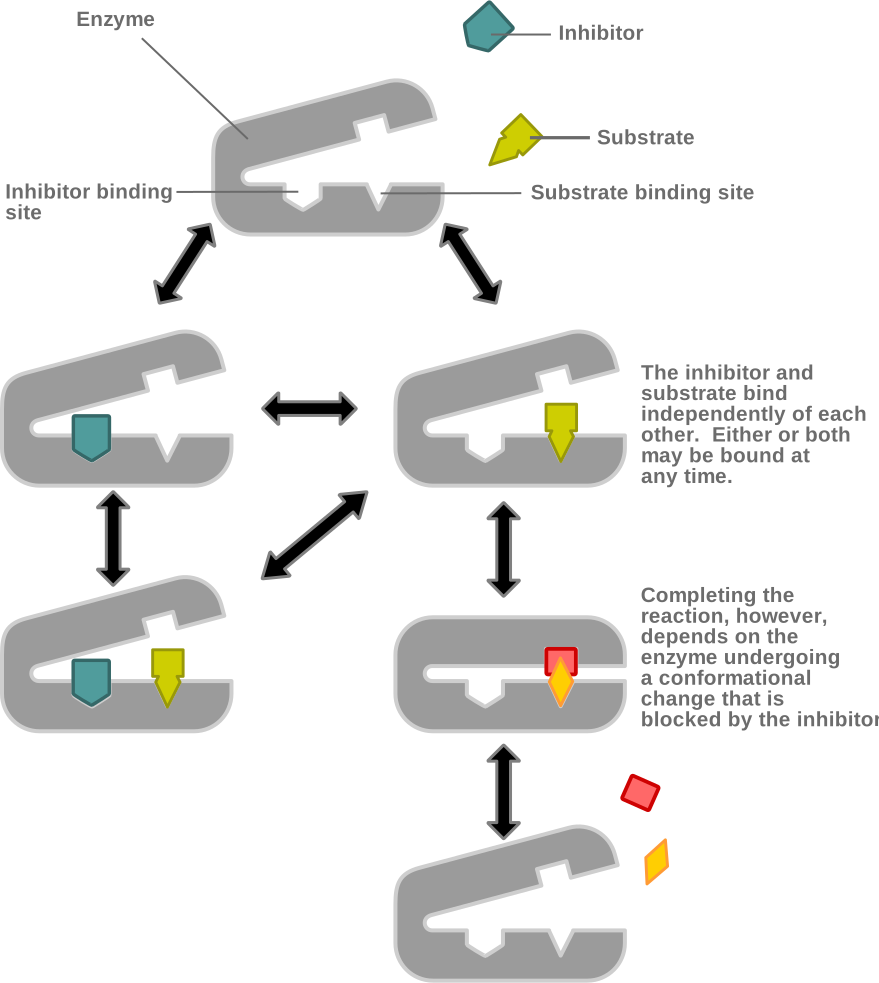
The inhibitor has a shape similar to the substrate, so it binds to the active site and blocks it. While it is there the substrate cannot bind.
The effect depends on the ratio of inhibitor to substrate, so:
- at low substrate concentration the rate is reduced
- at high substrate concentration substrate outcompetes the inhibitor, and Vmax is still reached, just at a higher substrate concentration
- Km increases, since more substrate is needed to reach half Vmax
On a graph, the curve rises more slowly but arrives at the same plateau.
Non-competitive inhibition
The inhibitor binds somewhere other than the active site, at an allosteric site. That changes the tertiary structure of the enzyme, which changes the shape of the active site, so the substrate no longer fits.
Adding more substrate does not help, because the substrate and the inhibitor are not competing for the same place. So:
- the rate is reduced at all substrate concentrations
- Vmax is lowered
- Km is unchanged, because the enzyme molecules still working have the same affinity as before
On a graph, the curve levels off at a lower plateau.
The comparison
| Competitive | Non-competitive | |
|---|---|---|
| Binds to | active site | elsewhere on the enzyme |
| Shape | similar to substrate | unrelated to substrate |
| Effect of more substrate | overcomes it | no effect |
| Vmax | unchanged | lowered |
| Km | raised | unchanged |
Immobilised enzymes
An immobilised enzyme is held on or in an inert support, such as being trapped in alginate beads, so it cannot mix freely with the substrate solution.
Advantages:
- the product is not contaminated by the enzyme, which matters in food and medicine
- the enzyme is recovered and reused, which is cheaper for an expensive enzyme
- the enzyme is more stable, tolerating higher temperatures and a wider pH range, because the support holds the tertiary structure in place
- the reaction is easily stopped and started by moving the beads
The cost is that the substrate has to diffuse to the enzyme, so the reaction is often slower than it would be in free solution.
Common mistakes
- Explaining the temperature curve with kinetic energy alone, and never mentioning denaturation.
- Saying high temperature "kills" the enzyme. An enzyme is not alive; it is denatured.
- Getting Km backwards. Low Km means high affinity.
- Saying a competitive inhibitor lowers Vmax. It does not, given enough substrate.
- Saying a non-competitive inhibitor "changes the shape of the substrate". It changes the shape of the active site.
Check you have it
Question 1
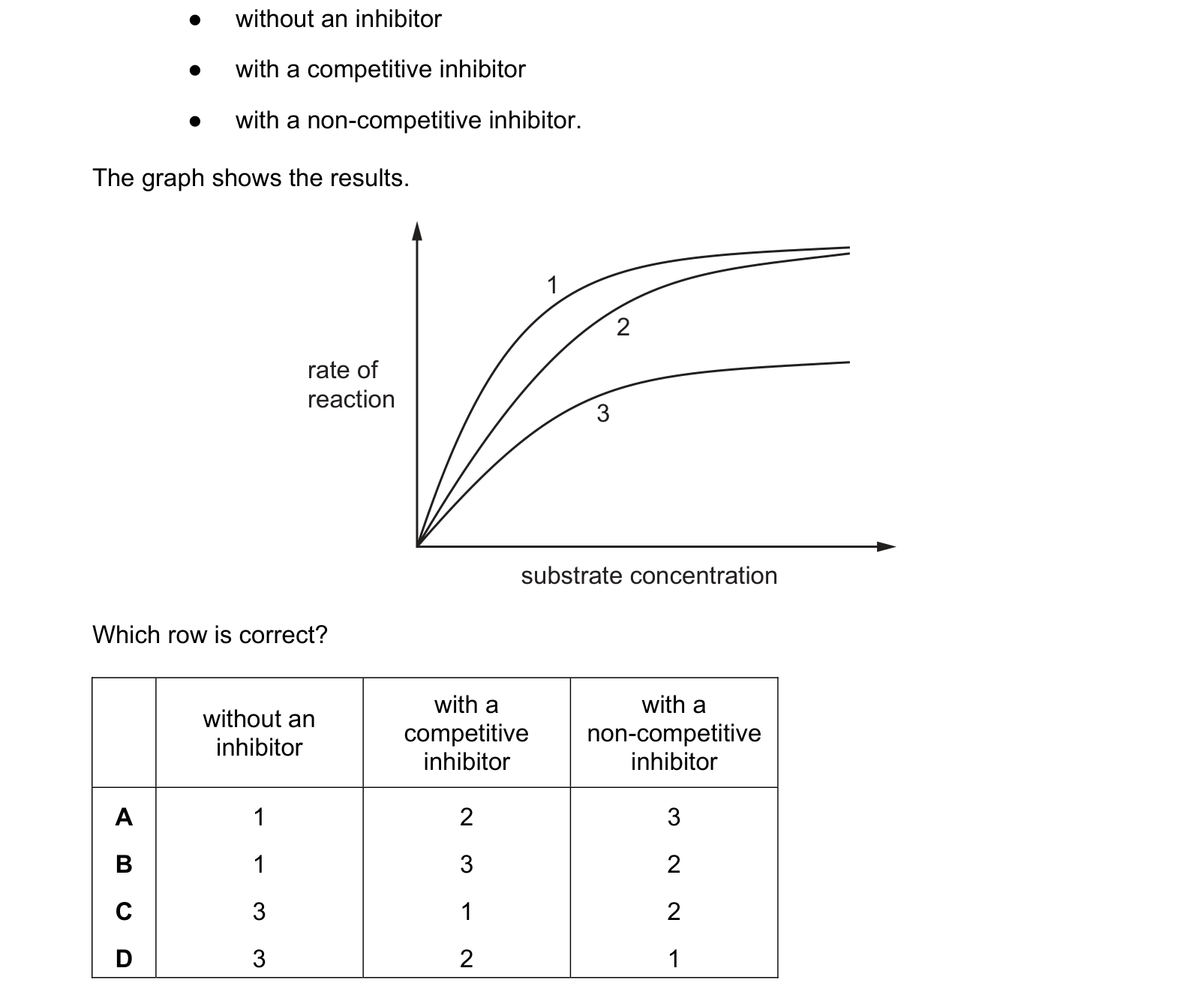
The effect of substrate concentration on an enzyme-catalysed reaction was measured in three different conditions: ● without an inhibitor ● with a competitive inhibitor ● with a non-competitive inhibitor. The graph shows the results. Which row is correct? Each answer gives, in order: without an inhibitor; with a competitive inhibitor; with a non-competitive inhibitor.
Answer: A.
Where does each curve level off? Curves 1 and 2 flatten at the same high rate. Curve 3 flattens at a much lower rate, so 3 has a reduced maximum. Only a non-competitive inhibitor does that: it binds away from the active site, distorts it, and no amount of extra substrate can displace it. That fixes 3.
Which of the remaining two is faster? Curve 1 is above curve 2 at every substrate concentration. The uninhibited enzyme has to be the fastest, so 1 is without an inhibitor and 2 is with the competitive inhibitor.
Curve 2's shape confirms it: depressed at low substrate concentrations, where inhibitor and substrate are competing for the same active sites, but climbing to the same maximum as curve 1 once there is enough substrate to outcompete the inhibitor.
1, 2, 3 in that order, which is A.
The distinction is worth committing to memory as a pair of statements. Competitive inhibition raises the substrate concentration needed to reach Vmax but leaves Vmax alone. Non-competitive inhibition lowers Vmax and cannot be reversed by adding substrate.
Question 2
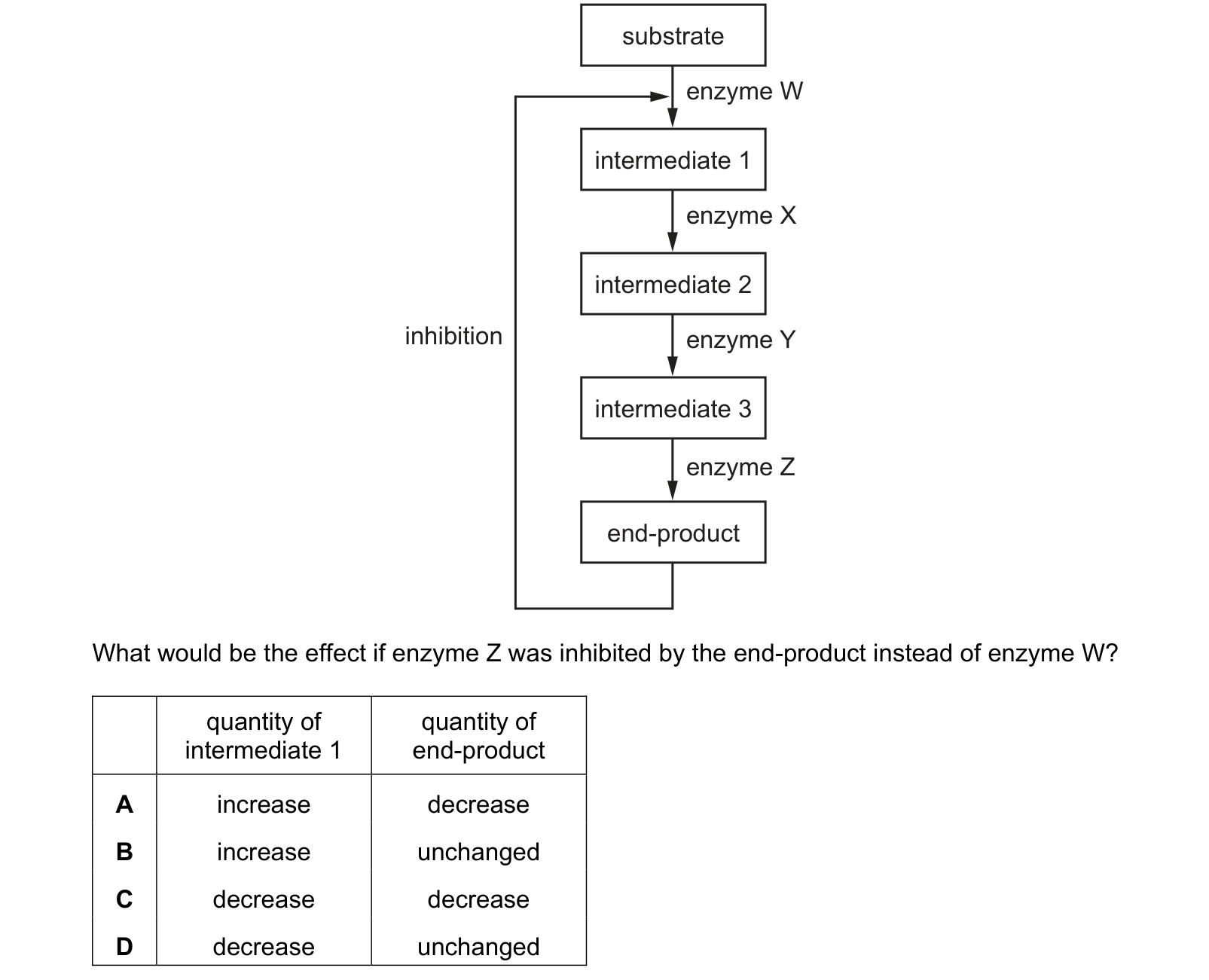
The end-product of a metabolic pathway can act as a competitive inhibitor. This is called end-product inhibition and allows a cell to control a metabolic pathway.
The diagram shows a metabolic pathway where the end-product could act as an inhibitor of enzyme W. What would be the effect if enzyme Z was inhibited by the end-product instead of enzyme W? Each answer gives, in order: quantity of intermediate 1; quantity of end-product.
Answer: A.
Normally the end-product inhibits W, the first step, which shuts the whole line down before anything piles up. That is why end-product inhibition usually acts on the first enzyme.
Move the inhibition to Z, the last step, and W, X and Y keep working. Substrate keeps being converted, so the intermediates have nowhere to go and accumulate: intermediate 1 increases. Meanwhile the final conversion is blocked, so the end-product decreases.
That is A. The general point is worth keeping: inhibit early and nothing builds up, inhibit late and everything upstream does.
Question 3
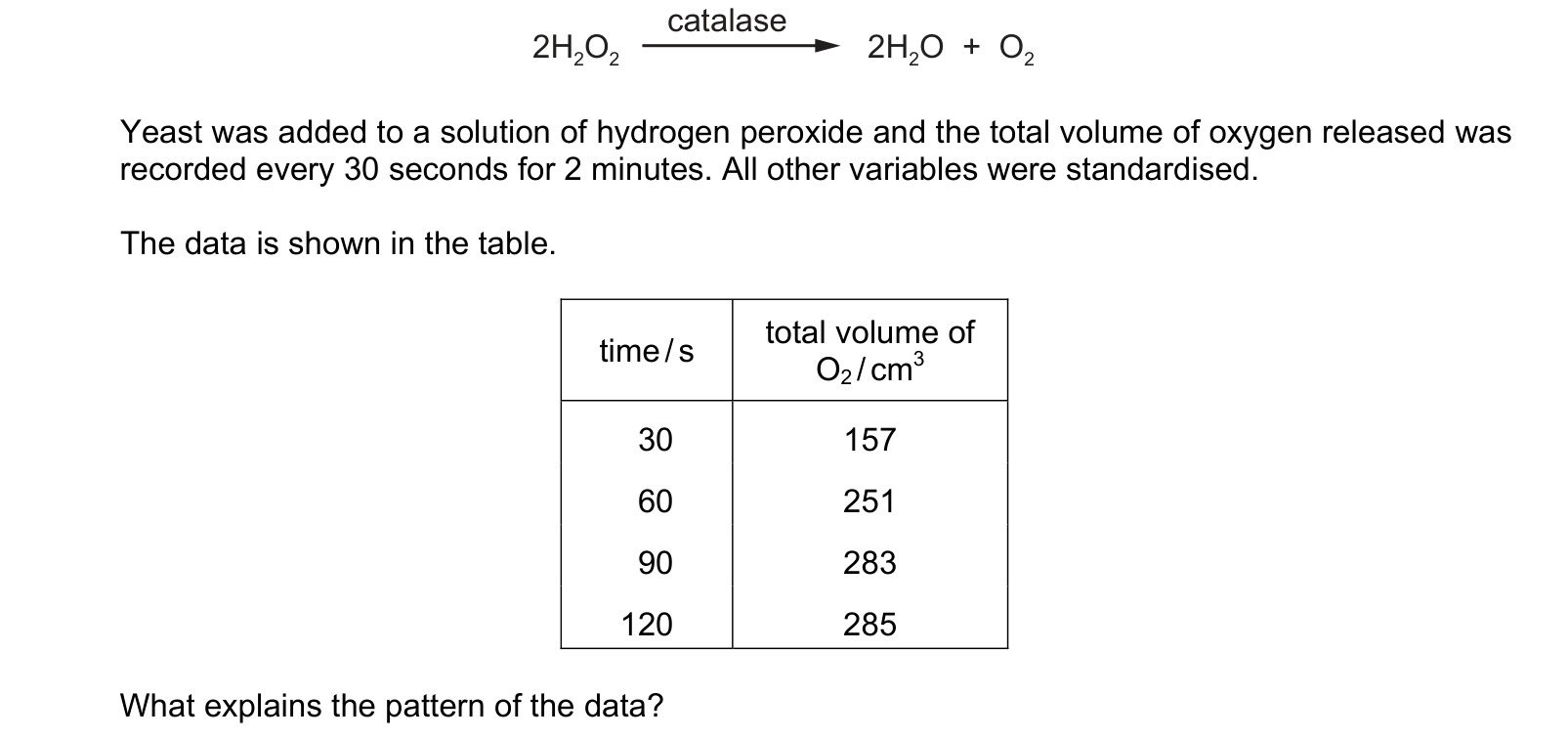
Yeast contains the enzyme catalase which catalyses the breakdown of hydrogen peroxide (H2O2) as shown. catalase 2H2O2 2H2O + O2 Yeast was added to a solution of hydrogen peroxide and the total volume of oxygen released was recorded every 30 seconds for 2 minutes. All other variables were standardised. The data is shown in the table. total volume of time / s O2 / cm³ 30 157 60 251 90 283 120 285 What explains the pattern of the data?
Answer: D.
In each successive 30 seconds the extra oxygen collected is 157, then 94, then 32, then 2 cm³. The reaction is slowing down and has essentially stopped by two minutes. That is D: less and less oxygen is released in each interval because the substrate is being used up. With fewer hydrogen peroxide molecules left in the solution, collisions with active sites become rarer and rarer.
A and B both say the rate increases, and it plainly does not. B also misuses Vmax: the maximum velocity is reached when substrate is plentiful, at the start of a reaction like this, not at the end.
C blames denaturation, and nothing in the method supports it. The stem says all other variables were standardised, so the temperature and pH did not change, and there is no reason for the catalase to denature. Falling rate at constant conditions means the substrate is running out.
A useful habit with any total-volume table: work out the differences down the column before reading the options. A total that keeps rising can hide a rate that is collapsing.
What the syllabus asks for on this topicSyllabus points
Syllabus points
- Investigate and explain the effects of temperature, pH, enzyme concentration and substrate concentration on the rate of enzyme-catalysed reactions.
- Explain the effect of competitive and non-competitive inhibitors.
- Explain the term Vmax and the Michaelis-Menten constant Km as a measure of affinity.
- Describe the advantages of immobilised enzymes.
Related CIE 9700 Biology topics
Not the topic you were looking for? Describe what you are stuck on in your own words and we will take you to the notes that answer it.