Movement into and out of cells
Contents: 9 sections
Diffusion
The net movement of molecules or ions from a region of higher concentration to a region of lower concentration, down a concentration gradient, until evenly distributed.
It is passive: no ATP is used. The energy comes from the kinetic energy the particles already have.
The word net matters. Particles move in all directions all the time; diffusion is the overall result, and at equilibrium movement continues in both directions at equal rates.
Rate depends on:
- the steepness of the concentration gradient
- the temperature, since more kinetic energy means faster movement
- the surface area across which diffusion happens
- the thickness of the surface, since a shorter distance is faster
- the size of the molecule, since small molecules diffuse faster
- whether the molecule is lipid-soluble, since those cross the bilayer directly
The first four are Fick's law: rate is proportional to surface area multiplied by concentration difference, divided by thickness.
Facilitated diffusion
Still passive, still down the gradient, but through a protein, because the molecule cannot cross the hydrophobic core unaided.
- Channel proteins form water-filled pores. Each is specific to one ion or a small group, and many are gated.
- Carrier proteins bind the molecule, change shape, and release it on the other side. Glucose enters most cells this way.
Facilitated diffusion has a maximum rate, unlike simple diffusion. Once every protein is working, adding more substrate makes no difference, so the graph levels off. Simple diffusion, with no proteins involved, rises in a straight line. A graph question showing one straight line and one that plateaus is asking for exactly this distinction.
Osmosis
The net movement of water molecules from a region of higher water potential to a region of lower water potential, through a partially permeable membrane.
Defining it in terms of water potential rather than "concentration of water" is what the mark scheme wants.
Water crosses partly by slipping between phospholipids and mostly through aquaporins, channel proteins specific to water.
Water potential
Water potential (Ψ) is the tendency of water to move out of a system. Its unit is the kilopascal (kPa).
- Pure water has a water potential of zero, which is the maximum.
- Adding solute lowers water potential, so every solution has a negative water potential.
- Water moves from less negative to more negative, which is to say from higher to lower.
The sign trips people up. A solution at −200 kPa has a higher water potential than one at −800 kPa, so water moves from the −200 solution into the −800 one.
In plant cells there are two components:
- Solute potential (Ψs) is the effect of dissolved solutes. Always negative.
- Pressure potential (Ψp) is the pressure of the cell contents pushing against the wall. Usually positive in a turgid cell, and zero in a flaccid one.
Worked example
A plant cell has Ψs = −900 kPa and Ψp = +400 kPa. It sits in a solution of water potential −300 kPa. Which way does water move?
The cell is at −500 kPa and the solution is at −300 kPa. The solution is less negative, so it has the higher water potential, and water moves into the cell.
As water enters, the cell contents press harder on the wall, Ψp rises, and the cell water potential rises towards that of the solution until the two are equal and net movement stops.
Plant and animal cells compared
Animal cells have no wall, so nothing resists swelling.
| Surroundings | Animal cell | Plant cell |
|---|---|---|
| Higher Ψ than cell (dilute) | water enters, swells, bursts (lysis) | water enters, turgid, wall resists |
| Equal Ψ | no net movement | no net movement, incipient plasmolysis at the point Ψp = 0 |
| Lower Ψ than cell (concentrated) | water leaves, crenated, shrunken | water leaves, plasmolysed, membrane pulls away from wall |
Turgor is what holds a non-woody plant upright. A wilting plant has lost it.
Incipient plasmolysis is the moment when the protoplast just begins to pull away from the wall and pressure potential has fallen to zero. It is the standard experimental endpoint for estimating a tissue's water potential.
Active transport
The movement of molecules or ions across a membrane against a concentration gradient, using energy from ATP and a carrier protein.
The three features that make it active transport are: against the gradient, ATP is used, and a specific carrier protein is involved.
The carrier binds the molecule, ATP is hydrolysed, and the phosphate group attaches to the protein and makes it change shape, releasing the molecule on the far side. The phosphate then leaves and the protein returns to its original shape.
Because it needs ATP, active transport stops if respiration is inhibited, if oxygen is removed, or if a metabolic poison such as cyanide is added. Diffusion and osmosis are unaffected by those things, which is how an experiment tells them apart.
Cells that do a lot of active transport, such as those lining the kidney tubule or a root hair, contain many mitochondria.
Co-transport
Some substances are moved using a gradient set up by active transport rather than by ATP directly. In the small intestine, sodium ions are actively pumped out of the epithelial cell, creating a gradient, and glucose is then carried in alongside sodium ions moving down that gradient. Sucrose loading into phloem works the same way with hydrogen ions, which is topic 7.2.
Bulk transport
For anything too large to cross by a protein.
Endocytosis. The membrane folds inward around the material and pinches off as a vesicle inside the cell. Phagocytosis is the version for solid material, as when a phagocyte engulfs a bacterium. Pinocytosis is the version for liquids.
Exocytosis. A vesicle from the Golgi body fuses with the cell surface membrane and releases its contents outside. This is how an extracellular enzyme or a hormone leaves the cell.
Both require ATP, because the membrane has to be moved and reshaped.
Surface area to volume ratio
As an object gets bigger, its volume grows faster than its surface area, so the ratio falls.
A cube of side 1 mm has a surface area of 6 mm² and a volume of 1 mm³, so a ratio of 6:1. A cube of side 2 mm has 24 mm² and 8 mm³, a ratio of 3:1.
That is why a small organism can rely on diffusion across its surface and a large one cannot, and why large organisms have gas exchange and transport systems. It is also why the agar cube experiment works: small cubes soaked in indicator turn colour throughout more quickly, because the diffusion distance to the centre is shorter and the ratio is higher.
Common mistakes
- Defining osmosis as movement "from high to low concentration of water". Use water potential.
- Getting the sign wrong. −200 kPa is higher than −800 kPa.
- Saying a plant cell bursts in pure water. The wall prevents it.
- Saying facilitated diffusion needs ATP. It does not; only active transport does.
- Saying a large organism has a large surface area so diffusion is fine. It is the ratio that matters, and it falls with size.
Check you have it
Question 1
Which features are correct for active transport and facilitated diffusion?
1 The movement of molecules and ions depends on ATP.
2 They are specific for one type of molecule or ion.
3 They use membrane proteins.
Answer: C.
Both processes use membrane proteins, and both are specific: the binding site on a carrier or channel is complementary to one molecule or ion, in the same way an active site is complementary to a substrate.
Statement 1 separates them rather than uniting them. Active transport depends on ATP, because it moves substances against their gradient. Facilitated diffusion does not, because it moves them down their gradient using the kinetic energy they already have.
When a question asks what two processes have in common, the mechanism that distinguishes them is always among the wrong options.
Question 2
The diagram shows the outline of three xerophytic leaves of the same type in three different conditions, P, R and S. Which description of the water potential of the cells in layer Y is correct? Each answer gives, in order: P; water potential of cells in layer Y R; S.
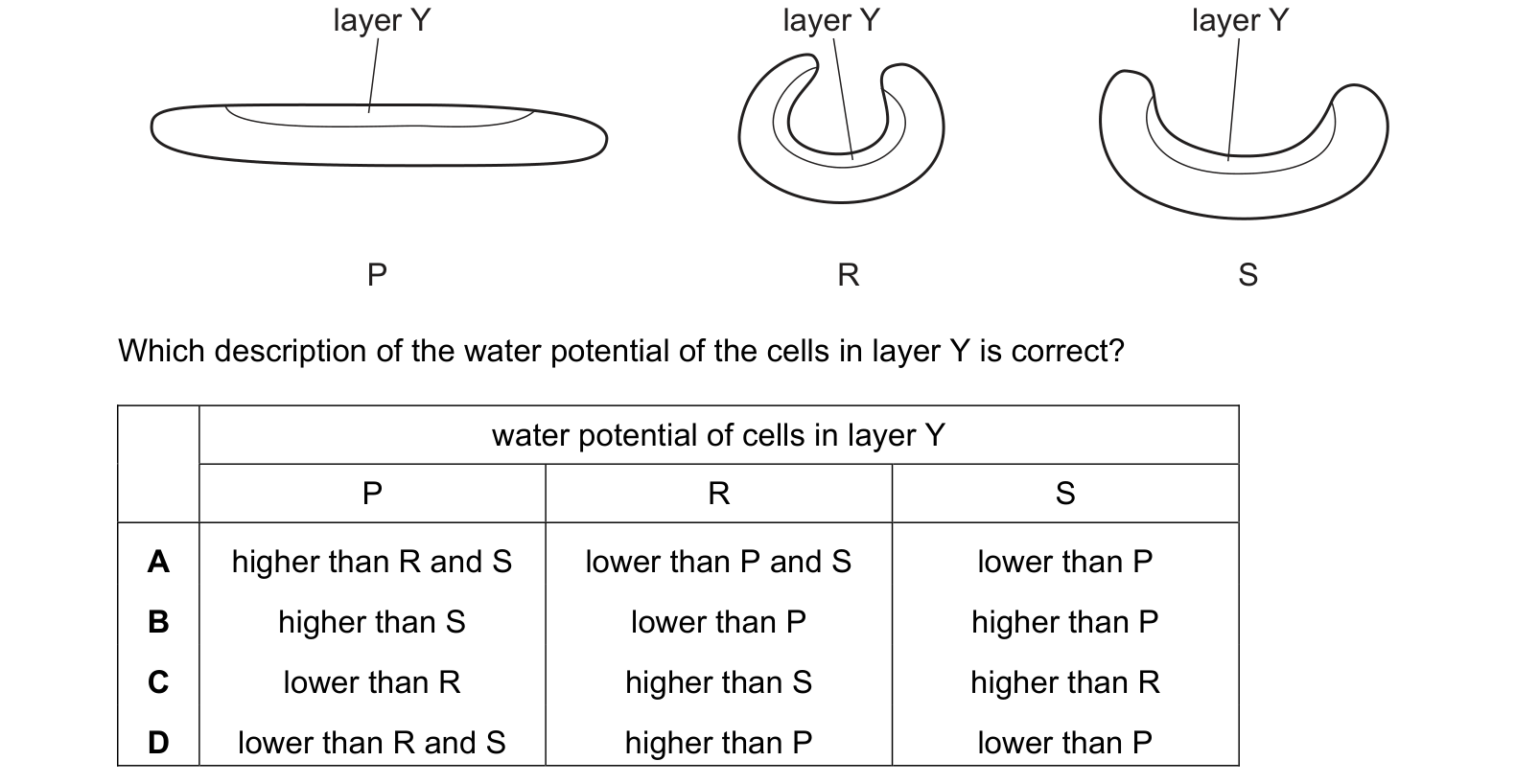
Answer: A.
Water potential follows directly: more water means a less negative, and so higher, water potential. The order is P highest, then S, then R lowest.
Check A against that. P higher than R and S ✓. R lower than P and S ✓. S lower than P ✓. Every claim in the row holds, so A.
The other three each contain at least one statement that inverts the order. B says S is higher than P. C says P is lower than R, which puts the open leaf below the rolled one. D says P is lower than both.
Rolling is the point of the question. A xerophyte rolls its leaf so the stomata end up enclosed in a pocket of still, humid air, which cuts the water potential gradient to the atmosphere and slows transpiration. The tighter the roll, the more water has already been lost.
Question 3
When animal cells are cultured, salt solution is added to keep the cells alive.
What is the purpose of the salt solution?
Answer: C.
It matters because an animal cell has no cell wall. In pure water it would take water in by osmosis and burst; in a concentrated solution it would lose water and shrivel. Neither leaves a usable culture.
A and B misread what the solution does. It is not there to be transported into the cells, and it does not stop other ions moving.
D confuses solute with fuel. Salt is not an energy source; ATP for active transport comes from respiration of glucose.
What the syllabus asks for on this topicSyllabus points
Syllabus points
- Describe and explain diffusion, facilitated diffusion, osmosis, active transport, endocytosis and exocytosis.
- Explain water potential and its components, and predict the direction of water movement.
- Describe the effects of solutions of different water potential on plant and animal cells.
- Investigate the effect of surface area to volume ratio on diffusion.
Related CIE 9700 Biology topics
Not the topic you were looking for? Describe what you are stuck on in your own words and we will take you to the notes that answer it.