Structure of nucleic acids and replication of DNA
Contents: 8 sections
The nucleotide
A nucleotide has three parts:
- a pentose sugar, deoxyribose in DNA and ribose in RNA
- a phosphate group
- a nitrogenous base
The bases fall into two classes, and the difference matters for the geometry of the molecule:
- Purines have two rings: adenine and guanine.
- Pyrimidines have one ring: thymine, cytosine and, in RNA, uracil.
A purine always pairs with a pyrimidine, so every rung of the ladder is two rings plus one ring, and the double helix is a constant width along its length. Two purines would be too wide and two pyrimidines too narrow.
The sugar-phosphate backbone
Nucleotides join by condensation. The phosphate on carbon 5 of one sugar bonds to the hydroxyl on carbon 3 of the next, forming a phosphodiester bond and releasing water.
The result is a strand with a phosphate at one end and a sugar hydroxyl at the other, which is why strands have direction and are described as running from 5′ to 3′.
The double helix
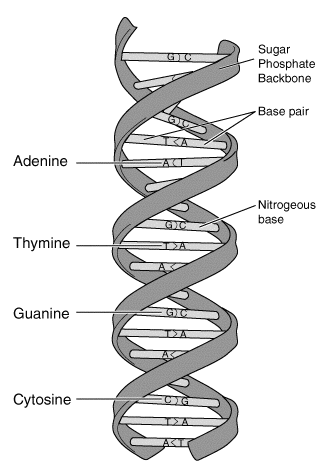
Two strands wind around each other into a double helix, held together by hydrogen bonds between complementary base pairs:
- A pairs with T by two hydrogen bonds
- C pairs with G by three hydrogen bonds
Three bonds are stronger than two, so DNA with a higher proportion of C and G needs more energy to separate. That is the reason behind questions about which sample melts at a higher temperature.
The two strands run in opposite directions, which is what antiparallel means: one runs 5′ to 3′ and the other 3′ to 5′.
Chargaff's rule
Because A always pairs with T and C with G, in double-stranded DNA:
- the amount of A equals the amount of T
- the amount of C equals the amount of G
- purines equal pyrimidines
If a sample contains 30 per cent adenine, then thymine is also 30 per cent, leaving 40 per cent to be shared equally between cytosine and guanine, so 20 per cent each.
These rules apply to double-stranded DNA only. A single strand, or RNA, need not obey them, and a question giving unequal A and T is telling you the molecule is single-stranded.
Why the structure suits its job
- Stable, because the sugar-phosphate backbone is covalent and the bases are protected on the inside of the helix.
- Two hydrogen bonds per A-T pair are individually weak, so the strands can be separated for replication without breaking the backbone, while the sheer number of them holds the molecule together.
- Complementary base pairing means each strand carries the information to rebuild the other, which is the basis of accurate replication.
- The base sequence is the code, and it can be any order, so an enormous amount of information fits into a small space.
DNA and RNA compared
| DNA | RNA | |
|---|---|---|
| Sugar | deoxyribose | ribose |
| Bases | A, T, C, G | A, U, C, G |
| Strands | double | single |
| Length | very long | short |
| Stability | stable | less stable, broken down after use |
| Role | stores genetic information | transfers it and builds protein |
Semi-conservative replication
Each new molecule has one original strand and one newly made strand. That is what semi-conservative means, and the phrase is worth stating in exactly those words.
The steps:
- DNA helicase moves along the molecule and breaks the hydrogen bonds between the base pairs, unwinding the helix and separating the two strands. It does not touch the phosphodiester bonds.
- Each strand acts as a template.
- Free DNA nucleotides in the nucleus pair with their complementary bases on the template: A with T, C with G.
- DNA polymerase joins the new nucleotides together by forming phosphodiester bonds along the new strand.
- Two identical molecules result, each rewinding into a double helix.
Helicase breaks hydrogen bonds; polymerase makes phosphodiester bonds. Swapping those is one of the most frequently penalised errors in this topic.
DNA polymerase can only work in one direction, adding nucleotides to the 3′ end of the growing strand. On one template that is straightforward and continuous; on the other, the strand is built in short sections that are then joined. At AS level the requirement is to know that the two strands are antiparallel and that this is why the process differs between them.
The Meselson and Stahl evidence
Bacteria were grown in a medium containing only heavy nitrogen, ¹⁵N, so all their DNA was heavy. They were then transferred to normal ¹⁴N medium and sampled after each generation.
- After one generation, all the DNA was of intermediate density: one heavy strand, one light. This rules out conservative replication, which would have given one heavy molecule and one light one.
- After two generations, half was intermediate and half was light. This rules out dispersive replication, which would have given a single band of uniform intermediate density getting lighter each time.
Only semi-conservative replication predicts both results.
A question may ask for the percentage containing the original heavy nitrogen. There are only ever two original heavy strands, so after n generations there are 2ⁿ molecules and two of them contain a heavy strand:
| Generation | Molecules | Containing ¹⁵N | Percentage |
|---|---|---|---|
| 1 | 2 | 2 | 100 |
| 2 | 4 | 2 | 50 |
| 3 | 8 | 2 | 25 |
Mutation
A gene mutation is a change in the base sequence of DNA. It happens spontaneously during replication and its rate is raised by mutagens.
- Substitution: one base is replaced by another. Only one triplet is affected. Because the genetic code is degenerate, the new triplet may still code for the same amino acid, in which case there is no effect at all. If it codes for a different amino acid, one amino acid in the protein changes.
- Deletion or insertion: a base is lost or added. Every triplet from that point on is read in the wrong groupings, which is a frameshift, and the protein is usually completely non-functional.
A frameshift is far more damaging than a substitution, because a substitution changes at most one amino acid and a frameshift changes all of them downstream.
Sickle cell anaemia is the standard example of a substitution: one base change in the gene for the β-globin chain replaces glutamic acid with valine. Valine is non-polar where glutamic acid was charged, so the haemoglobin molecules stick together at low oxygen concentrations and distort the red cell into a sickle shape.
That example is worth holding on to, because it shows the whole chain from a single base to a clinical condition: base sequence, to amino acid sequence, to tertiary structure, to function.
Common mistakes
- Saying helicase "unzips the DNA" without naming the hydrogen bonds it breaks.
- Saying DNA polymerase joins bases. It forms phosphodiester bonds between the sugar and phosphate.
- Applying Chargaff's rule to RNA or to a single strand.
- Saying replication is semi-conservative "because half the DNA is conserved". Each molecule keeps one whole original strand.
- Saying every mutation changes the protein. A substitution in a degenerate position changes nothing.
Check you have it
Question 1
Which statement about the role of DNA polymerase in the process of semi-conservative replication of DNA is correct?
Answer: D.
That is exactly why the lagging strand exists. Because the two template strands are antiparallel, moving 5′ to 3′ on both means moving towards the replication fork on one and away from it on the other, so the second has to be built in short pieces that are joined afterwards by ligase.
A gives it the wrong job: hydrogen bonds between base pairs form spontaneously as the nucleotide lines up.
B has it running 3′ to 5′. C limits it to the leading strand, which would leave the other half of the molecule uncopied.
Question 2
Which statements are correct for all nucleotides?
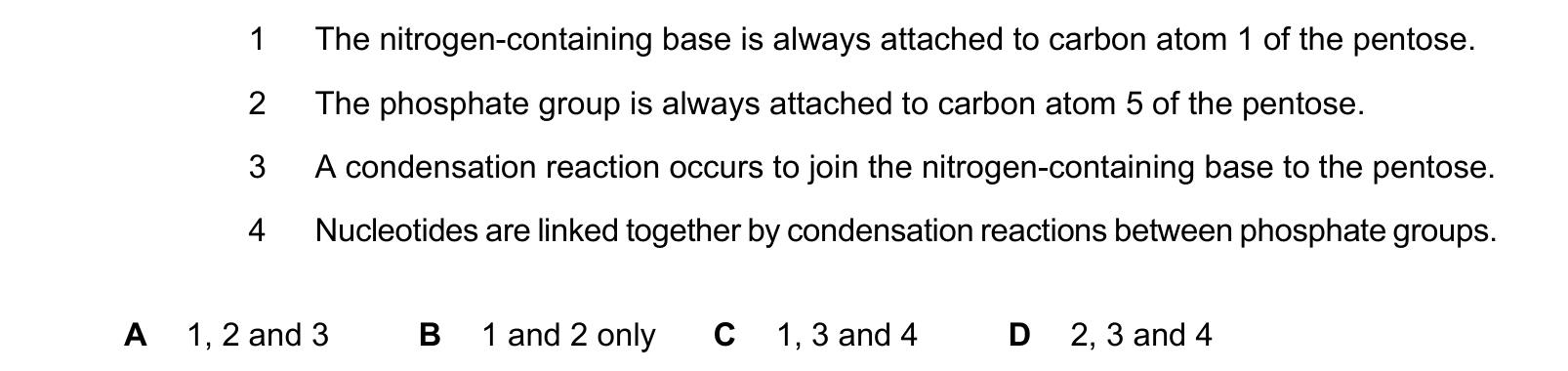
Answer: A.
1 is correct. The nitrogen-containing base is joined to carbon 1 of the pentose. That numbering is why the ends of a DNA strand are called 3′ and 5′.
2 is correct. The phosphate group is attached to carbon 5.
3 is correct. Joining the base to the sugar releases a molecule of water, so it is a condensation reaction, like every other bond-forming step in biological molecules.
4 is wrong, and it is the one being tested. Nucleotides are joined by a phosphodiester bond, and it forms between the phosphate of one nucleotide and the carbon 3 hydroxyl of the sugar of the next. Phosphate to sugar, not phosphate to phosphate. That alternation is what gives the strand its sugar-phosphate backbone; if phosphates joined to each other there would be no backbone at all.
1, 2 and 3, which is A.
Question 3
Which statement correctly describes a feature of a DNA molecule?
Answer: C.
A says the strands are parallel. They are antiparallel, running in opposite directions, which is what allows the bases to pair.
B says all base pairs have three hydrogen bonds. C-G has three, A-T has two, and that difference is why C-G-rich DNA is harder to separate.
D describes the backbone as phosphate and nucleotides. It is sugar and phosphate alternating; the whole nucleotide includes the base, which hangs off the backbone rather than forming part of it.
What the syllabus asks for on this topicSyllabus points
Syllabus points
- Describe the structure of nucleotides and the formation of phosphodiester bonds.
- Describe the structure of DNA and RNA and compare them.
- Explain semi-conservative replication and the roles of DNA polymerase and DNA helicase.
- Explain the consequences of a gene mutation.
Related CIE 9700 Biology topics
Not the topic you were looking for? Describe what you are stuck on in your own words and we will take you to the notes that answer it.