Structure of nucleic acids and replication of DNA: five questions to try now
Real past-paper questions, the answer key from the mark scheme, and the explanation that goes with it. No account needed to answer them.
Question 1
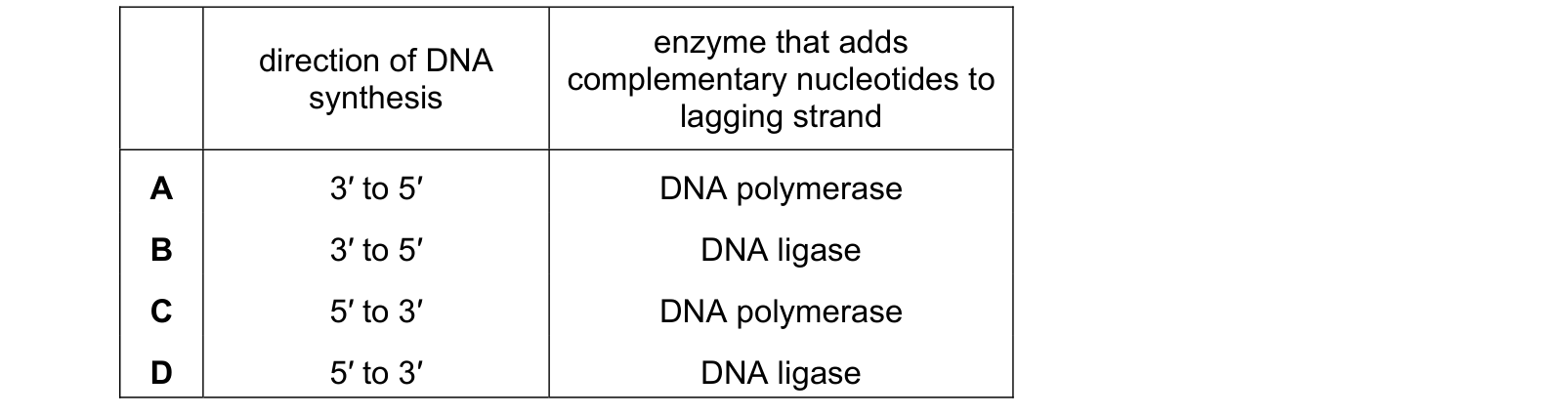
Which row is correct for the replication of a DNA molecule? Each answer gives, in order: direction of DNA synthesis; enzyme that adds complementary nucleotides to lagging strand.
Answer: C.
DNA polymerase can only add nucleotides to the 3′ end of a growing strand, so synthesis always runs 5′ to 3′. There are no exceptions, which removes A and B.
The enzyme that adds complementary nucleotides is DNA polymerase, on the lagging strand as on the leading one. So C.
DNA ligase has a different job. Because the lagging strand runs the wrong way, it is built in short sections, and ligase joins those sections together afterwards. Adding nucleotides and joining finished fragments are two different steps, and the question asks about the first.
The 5′ to 3′ rule is what makes a lagging strand necessary in the first place.
Question 2
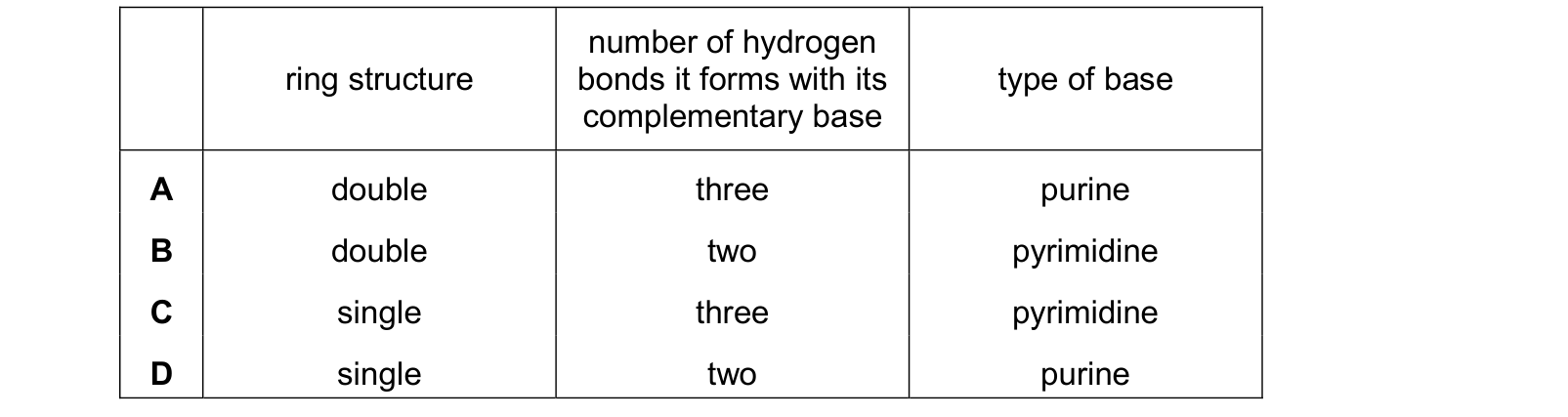
Which row correctly describes cytosine? Each answer gives, in order: ring structure; number of hydrogen bonds it forms with its complementary base; type of base.
Answer: C.
Cytosine is a pyrimidine, which means a single ring. That settles two columns at once and leaves only B and C.
It pairs with guanine, and the C-G pair is held by three hydrogen bonds, while A-T has two. So C.
The fact worth carrying is that the three-bond pair is C-G. It is why DNA rich in C and G takes more energy to separate, which is what a question about difficult sequencing or high melting temperature is usually testing.
B has the right ring count and the wrong bond count; A and D both call it a purine.
Question 3
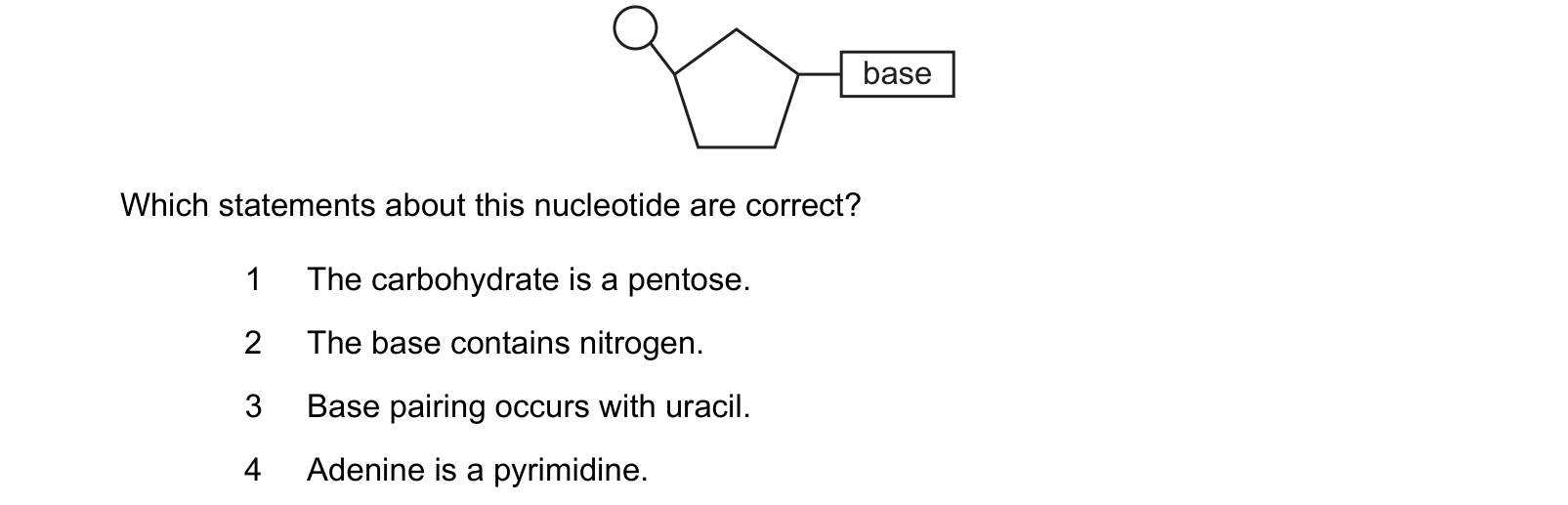
The diagram represents a nucleotide containing adenine. Which statements about this nucleotide are correct?
1 The carbohydrate is a pentose.
2 The base contains nitrogen.
3 Base pairing occurs with uracil.
4 Adenine is a pyrimidine.
Answer: B.
4 is the false one. Adenine is a purine, not a pyrimidine. Purines have two fused rings and there are two of them, adenine and guanine. Pyrimidines have one ring: cytosine, thymine and uracil. The size difference is what makes base pairing work, because a two-ring base always pairs with a one-ring base and the two strands stay a constant distance apart. Every option containing 4 is gone, which leaves B and C.
3 decides between them. Adenine does pair with uracil, in RNA. In DNA it pairs with thymine, but uracil replaces thymine in RNA, so a statement that adenine pairs with uracil is correct. Both are two hydrogen bonds.
1 and 2 are both correct, and worth confirming. The sugar in any nucleotide is a pentose, five carbons: deoxyribose in DNA, ribose in RNA. And every base contains nitrogen, which is why they are called nitrogenous bases and why nitrogen is one of the elements a cell needs to make nucleic acid at all.
1, 2 and 3 only, which is B.
Question 4
DNA polymerase catalyses condensation reactions between molecules during semi-conservative replication of DNA.
What is joined by DNA polymerase?
Answer: C.
A and B involve bases. Bases pair with each other, but they are held by hydrogen bonds, which form spontaneously as the complementary nucleotide lines up, not by an enzyme.
D names phosphate and ribose. The sugar in DNA is deoxyribose, and in any case the bond joins two whole nucleotides rather than two loose components.
The division of labour is the point: base pairing positions the nucleotide, and the polymerase then locks it into the backbone.
Question 5
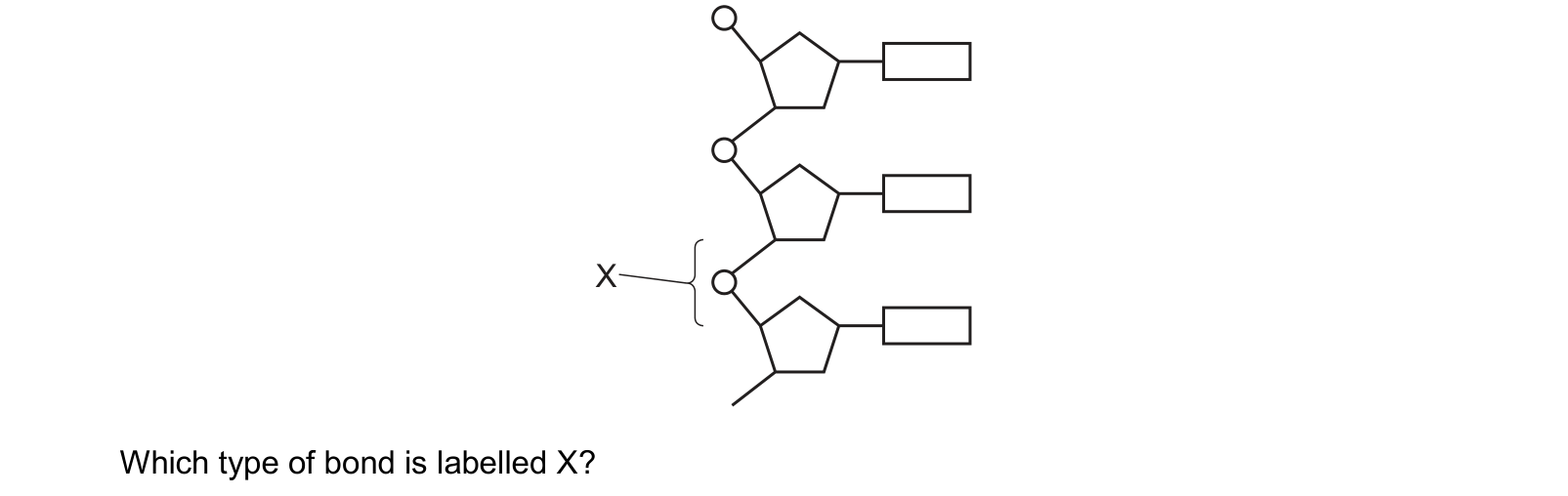
The diagram shows a section of a strand of DNA. Which type of bond is labelled X?
Answer: D.
The name says what it is: the phosphate group forms two ester bonds, one to the 3′ carbon of the sugar above it and one to the 5′ carbon of the sugar below. Building that bond is what DNA polymerase does, and breaking it is what happens when DNA is hydrolysed.
A, glycosidic, is the wrong bond in the right molecule. That is the bond from each sugar to its own base, drawn here as the horizontal line out to the rectangle. Glycosidic bonds also join the monosaccharides in a disaccharide or a polysaccharide.
B, hydrogen, is the wrong place entirely. Hydrogen bonds hold the two strands together, base to base. This diagram shows a single strand, so there are none in it, and that is the point of drawing only one.
C, peptide, belongs to proteins, joining the amino group of one amino acid to the carboxyl group of the next.
The distinction matters when DNA is heated or unwound. Hydrogen bonds between the strands are weak and break easily, which is what lets the double helix open for replication. The phosphodiester bonds along each backbone are covalent and stay intact.
What this practice covers
These questions are drawn from past CIE 9700 Biology papers and filtered to structure of nucleic acids and replication of dna. You answer, you find out immediately whether you were right, and you get the reasoning for the correct option and for each distractor. Wrong answers go to a mistakes locker so you can come back to exactly those.
Practice is free. You need an account only so your progress and your mistakes are still there next time.
What examiners see students get wrong here
These are the errors that cost marks on structure of nucleic acids and replication of dna, taken from our own topic notes. Read them before you practise and you will recognise the traps in the questions.
- Saying helicase "unzips the DNA" without naming the hydrogen bonds it breaks.
- Saying DNA polymerase joins bases. It forms phosphodiester bonds between the sugar and phosphate.
- Applying Chargaff's rule to RNA or to a single strand.
- Saying replication is semi-conservative "because half the DNA is conserved". Each molecule keeps one whole original strand.
- Saying every mutation changes the protein. A substitution in a degenerate position changes nothing.
Revise it first
If any of the above is unfamiliar, work through the notes before practising: Structure of nucleic acids and replication of DNA revision notes.