Energy and respiration
Contents: 12 sections
Cambridge International AS & A Level Biology 9700 · A Level
Every objective in this topic is printed under the heading "A Level subject content" in the 9700 syllabus, so all of it is A Level and none of it is AS. It is examined on Paper 4, and the practical objectives feed Paper 5. Paper 1 is the 40-question AS multiple-choice paper, so this topic never appears there, which is why the multiple-choice practice on this site has nothing tagged to it.
Why a cell needs energy at all
A cell is a system that is constantly being pushed away from equilibrium, and every push costs energy. Three examples carry the whole objective:
- Active transport. Moving ions against a concentration gradient. Sodium-potassium pumps in a neurone, or the uptake of nitrate by a root hair from soil water that contains far less nitrate than the cell already holds.
- Movement. Muscle contraction, the beating of cilia and flagella, and the movement of chromosomes on the spindle.
- Anabolic reactions. Building large molecules from small ones. DNA replication joins nucleotides; protein synthesis joins amino acids into a polypeptide.
Energy is also spent on maintaining body temperature in a mammal and on bioluminescence in a few organisms, but the three above are the ones the syllabus names.
Why ATP is the universal energy currency
ATP is adenine plus ribose plus three phosphate groups. Hydrolysis of the terminal phosphate gives ADP, inorganic phosphate, and about 30.5 kJ per mole.
The word to hold on to is currency, not store. ATP is not where a cell keeps its energy; glycogen and lipid are. ATP is what a cell trades in, and the features that suit it to that job are these:
- It releases a useful, moderate amount of energy in one step. Enough to drive a reaction, small enough that little is wasted as heat. Hydrolysing glucose directly would release far more than any single reaction could use.
- It is soluble and moves easily within the cell.
- Its hydrolysis is a single reaction requiring one enzyme, so energy is available almost instantly.
- It is easily re-formed from ADP and phosphate, so the same molecules cycle round again and again. A resting human turns over roughly their own body mass in ATP each day, from a standing pool of only about 50 g.
- It can phosphorylate other compounds, raising their energy level and making them more reactive. Glycolysis begins by doing exactly that to glucose.
ATP is made in two distinct ways, and the syllabus wants both named:
- Substrate-linked phosphorylation, in which a phosphate group is transferred directly from a donor molecule to ADP. This happens in glycolysis and in the Krebs cycle.
- Chemiosmosis, in which a proton gradient across a membrane drives ATP synthase. This happens in the inner mitochondrial membrane and in the thylakoid membranes of chloroplasts.
Respiratory substrates and their energy values
| Substrate | Energy value / kJ g⁻¹ | Why |
|---|---|---|
| Lipid | 39 | Long hydrocarbon chains, so many carbon-hydrogen bonds and very little oxygen already in the molecule |
| Protein | 17 | Similar to carbohydrate once the amino group is removed |
| Carbohydrate | 16 | Already partly oxidised, so fewer hydrogens to hand to the carriers |
The reason is worth stating properly, because "lipids have more energy" earns nothing. What is actually being oxidised is hydrogen. Each pair of hydrogen atoms handed to NAD ends up driving proton pumping and therefore ATP synthesis. A lipid molecule is almost entirely carbon and hydrogen, so per gram it supplies far more hydrogen than a carbohydrate, which already carries an oxygen for every carbon.
Respiratory quotient
RQ is the ratio of carbon dioxide molecules given out to oxygen molecules taken in:
RQ = molecules of CO₂ produced / molecules of O₂ used
Worked example, carbohydrate. For the complete oxidation of glucose:
C₆H₁₂O₆ + 6O₂ → 6CO₂ + 6H₂O
RQ = 6 / 6 = 1.0
Worked example, lipid. Oleic acid burns as:
C₁₈H₃₄O₂ + 25.5O₂ → 18CO₂ + 17H₂O
RQ = 18 / 25.5 = 0.71
Protein works out at roughly 0.9. Proteins are only used as a respiratory substrate when carbohydrate and lipid are short, because the amino group has to be removed first by deamination in the liver and converted to urea, which itself costs energy.
So the RQ tells you what is being respired:
| RQ | Interpretation |
|---|---|
| 1.0 | Carbohydrate |
| about 0.9 | Protein |
| about 0.7 | Lipid |
| above 1.0 | Some anaerobic respiration is happening as well, so carbon dioxide is being released without oxygen being taken in |
An RQ above 1.0 is the case worth understanding rather than memorising. In ethanol fermentation, pyruvate is decarboxylated and carbon dioxide comes off with no oxygen consumed at all, so the numerator rises while the denominator does not.
Measuring RQ with a respirometer
A simple respirometer is a sealed tube holding the organism, a manometer to read a volume change, and a control tube identical in every way except that it holds glass beads of the same mass instead of a living organism. Both sit in the same water bath so that a change in room temperature or atmospheric pressure moves both arms equally and cancels out.
The trick is to run the experiment twice:
- With potassium hydroxide in the tube. KOH absorbs all the carbon dioxide produced, so the only volume change is the oxygen taken in. The manometer fluid moves towards the organism, and the distance gives the oxygen uptake.
- Without potassium hydroxide. Now oxygen is being removed and carbon dioxide added, so the reading is the difference between them.
Worked example. Germinating seeds take up oxygen at 0.60 cm³ min⁻¹ when KOH is present. With the KOH removed, the fluid still moves towards the seeds, at 0.15 cm³ min⁻¹.
The second reading is oxygen used minus carbon dioxide released, so:
carbon dioxide released = 0.60 - 0.15 = 0.45 cm³ min⁻¹
RQ = 0.45 / 0.60 = 0.75
which points at lipid as the main substrate, exactly what you would expect of a seed living on a stored oil reserve.
The four stages of aerobic respiration
| Stage | Where | Main products |
|---|---|---|
| Glycolysis | Cytoplasm | 2 pyruvate, net 2 ATP, 2 reduced NAD |
| Link reaction | Mitochondrial matrix | Acetyl coenzyme A, CO₂, reduced NAD |
| Krebs cycle | Mitochondrial matrix | CO₂, reduced NAD, reduced FAD, ATP |
| Oxidative phosphorylation | Inner mitochondrial membrane | ATP, water |
Learn the locations as carefully as the chemistry. Questions ask them directly, and the commonest error is to place glycolysis inside the mitochondrion. Glycolysis is in the cytoplasm, which is why a red blood cell, which has no mitochondria at all, can still respire glucose anaerobically.
Glycolysis
Glucose is phosphorylated twice, using two ATP, to give hexose bisphosphate. That seems perverse when the point of the pathway is to make ATP, but phosphorylation is what makes the glucose reactive enough to be split, and it traps it inside the cell.
Fructose 1,6-bisphosphate (6C) is then split into two triose phosphate molecules (3C). Each is oxidised to pyruvate (3C). The oxidation is a dehydrogenation: the hydrogen removed is taken up by NAD, giving reduced NAD, and four ATP are made by substrate-linked phosphorylation.
Net per glucose: 2 ATP, 2 reduced NAD, 2 pyruvate. Four made minus two invested.
The link reaction
When oxygen is available, pyruvate is actively transported into the mitochondrial matrix. Two things then happen to it.
- It is decarboxylated, losing a carbon as CO₂.
- It is dehydrogenated, the hydrogen going to NAD to form reduced NAD.
What remains is a 2C acetyl group, and coenzyme A picks it up to form acetyl coenzyme A. Coenzyme A is a carrier: it delivers the acetyl group to the Krebs cycle and is released unchanged.
This happens twice per glucose, because glycolysis produced two pyruvate.
The Krebs cycle
Acetyl coenzyme A hands its 2C fragment to oxaloacetate (4C) to form citrate (6C). Citrate is then converted back to oxaloacetate in a series of small steps, each catalysed by its own enzyme. Across those steps:
- two decarboxylations release two CO₂,
- four dehydrogenations reduce three NAD and one FAD, and
- one substrate-linked phosphorylation makes one ATP.
Per glucose the cycle turns twice, so double all of that.
Oxaloacetate is regenerated, which is what makes this a cycle. It is not consumed, so a small amount keeps working indefinitely.
Oxidative phosphorylation
All that reduced NAD and reduced FAD is the point of the first three stages. It now delivers hydrogen to carriers in the inner mitochondrial membrane, and the sequence runs:
- Hydrogen atoms split into protons and electrons.
- The energetic electrons pass along the electron transport chain, releasing energy at each transfer.
- That energy is used to transfer protons from the matrix into the intermembrane space, building a proton gradient and therefore a difference in both concentration and charge across the inner membrane.
- Protons flow back into the matrix by facilitated diffusion through ATP synthase, and the energy of that flow drives the synthesis of ATP from ADP and phosphate. This is chemiosmosis.
- Oxygen is the final electron acceptor. It combines with the electrons and the protons to form water.
Reduced NAD delivers its electrons earlier in the chain than reduced FAD does, so each reduced NAD drives more proton pumping and yields more ATP than each reduced FAD. The syllabus does not want a total ATP figure, so do not spend revision time on whether the answer is 36 or 38; it wants the mechanism.
The reason a lack of oxygen stops everything is worth thinking through. Without a final acceptor, electrons back up along the chain, the carriers stay reduced, no protons are pumped, and, most importantly, NAD is never regenerated. The link reaction and the Krebs cycle then halt for want of oxidised NAD, not for want of oxygen directly.
Mitochondrial structure and function
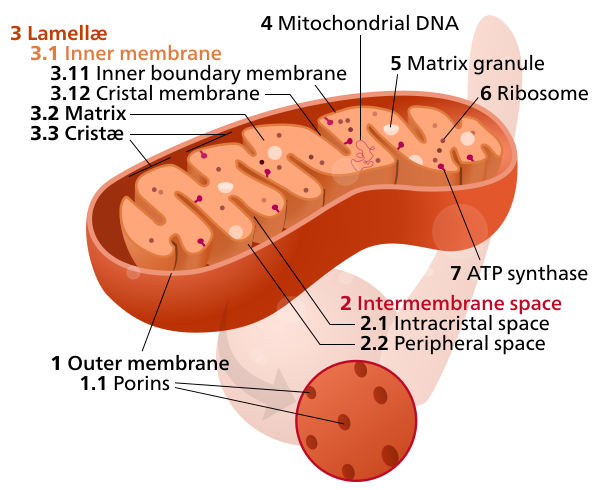
- Double membrane. The inner one is folded into cristae, giving a large surface area for the electron transport chain and ATP synthase.
- Small intermembrane space. A small volume means the protons pumped into it build a steep gradient quickly.
- Matrix. Contains the enzymes of the link reaction and Krebs cycle, plus mitochondrial DNA and 70S ribosomes.
- Inner membrane is largely impermeable to protons, which is what allows a gradient to exist at all. If protons leaked freely, the pumping would achieve nothing.
Cells with high energy demands, such as muscle fibres, liver cells and the cells of the proximal convoluted tubule, have many mitochondria with densely packed cristae. That is a favourite question: relate a number of mitochondria in a micrograph to the function of the tissue.
Anaerobic respiration
Without oxygen, only glycolysis can run, and it can only keep running if NAD is regenerated. Both fermentation pathways exist to do exactly that.
In mammals, lactate fermentation:
pyruvate + reduced NAD → lactate + NAD
In yeast, ethanol fermentation:
pyruvate → ethanal + CO₂, then ethanal + reduced NAD → ethanol + NAD
The yield is 2 ATP per glucose, against a great deal more in aerobic conditions. The reason is simple once stated: in anaerobic conditions the link reaction, the Krebs cycle and oxidative phosphorylation do not run, so the hydrogen carried by reduced NAD is never used to pump protons. Instead of being oxidised, it is dumped onto pyruvate. All that energy stays locked in the lactate or the ethanol, which is why ethanol still burns.
Note the difference between the two products. Lactate can be carried in the blood to the liver and oxidised later, so a mammal repays an oxygen debt. Ethanol cannot be recovered, and it is toxic, which is why yeast fermentation stops at around 15 per cent ethanol.
Rice as an adaptation to flooding
Rice grows with its roots submerged, where oxygen diffuses roughly ten thousand times more slowly than in air. Three adaptations are named:
- Aerenchyma: air spaces running down through the stem and roots, so oxygen diffuses from the shoots above water down to the root tissue.
- Ethanol fermentation in the roots, with an unusual tolerance of the ethanol produced.
- Faster stem growth when water rises, so the leaves stay above the surface and keep photosynthesising.
Investigating rate of respiration
Redox indicators. DCPIP and methylene blue are blue when oxidised and colourless when reduced. Add one to a yeast suspension with a substrate, and the dehydrogenations of respiration reduce the dye. The time taken for the colour to disappear is the measure: a shorter time means a faster rate, so 1/t is proportional to rate. Vary temperature, or vary substrate concentration, and keep everything else the same.
Respirometers with temperature. Place the respirometer in water baths at a range of temperatures, allow time to equilibrate at each, and measure the oxygen uptake per unit time per gram of organism. Rate rises with temperature to an optimum and then falls sharply as the respiratory enzymes denature.
Common mistakes
- Calling ATP an energy store rather than a currency, or saying it "contains" energy, when the energy is released by the hydrolysis of a bond.
- Placing glycolysis in the mitochondrion. It is in the cytoplasm, in every eukaryote and every prokaryote.
- Forgetting that glycolysis invests two ATP, and quoting a gross yield of four rather than a net yield of two.
- Saying oxygen is used in the Krebs cycle. Oxygen is used only at the end of the electron transport chain.
- Writing that oxygen "accepts hydrogen" without saying it is the final electron acceptor forming water.
- Explaining anaerobic respiration as producing less ATP "because there is no oxygen", without saying that the reduced NAD is never oxidised by the chain and so no protons are pumped.
- Saying fermentation makes ATP. Neither fermentation pathway makes any ATP; both exist only to regenerate NAD so that glycolysis can continue.
- Reading an RQ above 1.0 as an error. It is the signature of anaerobic respiration alongside aerobic.
- Inverting the RQ ratio. Carbon dioxide produced is on the top.
- Saying lipids release more energy because they are larger molecules, rather than because they carry far more hydrogen per gram.
- Running a respirometer without a control tube of glass beads, then attributing a pressure change caused by the room warming up to the organism.
What the syllabus asks for on this topicSyllabus points
Syllabus points
12.1 Energy
- Outline the need for energy in living organisms, as illustrated by active transport, movement and anabolic reactions, such as those occurring in DNA replication and protein synthesis.
- Describe the features of ATP that make it suitable as the universal energy currency.
- State that ATP is synthesised by: transfer of phosphate in substrate-linked reactions; chemiosmosis in membranes of mitochondria and chloroplasts.
- Explain the relative energy values of carbohydrates, lipids and proteins as respiratory substrates.
- State that the respiratory quotient (RQ) is the ratio of the number of molecules of carbon dioxide produced to the number of molecules of oxygen taken in, as a result of respiration.
- Calculate RQ values of different respiratory substrates from equations for respiration.
- Describe and carry out investigations, using simple respirometers, to determine the RQ of germinating seeds or small invertebrates (for example blowfly larvae).
12.2 Respiration
- State where each of the four stages in aerobic respiration occurs in eukaryotic cells: glycolysis in the cytoplasm; link reaction in the mitochondrial matrix; Krebs cycle in the mitochondrial matrix; oxidative phosphorylation on the inner membrane of mitochondria.
- Outline glycolysis as phosphorylation of glucose and the subsequent splitting of fructose 1,6-bisphosphate (6C) into two triose phosphate molecules (3C), which are then further oxidised to pyruvate (3C), with the production of ATP and reduced NAD.
- Explain that, when oxygen is available, pyruvate enters mitochondria to take part in the link reaction.
- Describe the link reaction, including the role of coenzyme A in the transfer of acetyl (2C) groups.
- Outline the Krebs cycle, explaining that oxaloacetate (4C) acts as an acceptor of the 2C fragment from acetyl coenzyme A to form citrate (6C), which is converted back to oxaloacetate in a series of small steps.
- Explain that reactions in the Krebs cycle involve decarboxylation and dehydrogenation and the reduction of the coenzymes NAD and FAD.
- Describe the role of NAD and FAD in transferring hydrogen to carriers in the inner mitochondrial membrane.
- Explain that during oxidative phosphorylation: hydrogen atoms split into protons and energetic electrons; energetic electrons release energy as they pass through the electron transport chain (details of carriers are not expected); the released energy is used to transfer protons across the inner mitochondrial membrane; protons return to the mitochondrial matrix by facilitated diffusion through ATP synthase, providing energy for ATP synthesis (details of ATP synthase are not expected); oxygen acts as the final electron acceptor to form water.
- Describe the relationship between the structure and function of mitochondria using diagrams and electron micrographs.
- Outline respiration in anaerobic conditions in mammals (lactate fermentation) and in yeast cells (ethanol fermentation).
- Explain why the energy yield from respiration in aerobic conditions is much greater than the energy yield from respiration in anaerobic conditions (a detailed account of the total yield of ATP from the aerobic respiration of glucose is not expected).
- Explain how rice is adapted to grow with its roots submerged in water, limited to the development of aerenchyma in roots, ethanol fermentation in roots and faster growth of stems.
- Describe and carry out investigations using redox indicators, including DCPIP and methylene blue, to determine the effects of temperature and substrate concentration on the rate of respiration of yeast.
- Describe and carry out investigations using simple respirometers to determine the effect of temperature on the rate of respiration.
Related CIE 9700 Biology topics
Not the topic you were looking for? Describe what you are stuck on in your own words and we will take you to the notes that answer it.