Structure of transport tissues
Contents: 9 sections
Why plants need transport tissue
A plant faces two problems at once. Water and mineral ions enter at the roots but are needed in the leaves, and sugars are made in the leaves but are needed everywhere else. The two flows go in opposite directions, so the plant has two tissues, one for each.
Xylem carries water and dissolved mineral ions upward only, from root to leaf.
Phloem carries dissolved organic solutes, mainly sucrose, in either direction, from a source to a sink.
That difference in directionality is worth holding on to, because it follows directly from the mechanism of each, which is topic 7.2.
Where the tissues sit
The arrangement differs between organs, and diagram questions test it.
In the root, xylem and phloem are at the centre, in a central vascular cylinder. The xylem often forms a star or X shape with phloem between its arms. A central position resists the pulling forces on a root and puts the xylem where water arriving from the root hairs converges.
In the stem, the vascular bundles are arranged in a ring near the outside, with xylem on the inside of each bundle and phloem on the outside. A ring near the periphery resists bending, in the same way a hollow tube is stiffer than a solid rod of the same mass.
In the leaf, the vascular bundles form the veins, with xylem on the upper side and phloem on the lower side. That orientation is consistent with the stem, since a leaf vein is a continuation of a stem bundle.
The rule that makes all three easy to remember: xylem is always on the side nearer the centre of the axis.
Xylem vessel elements
A xylem vessel is a long hollow tube formed from many cells stacked end to end.
The cells are dead. During development the contents die and break down, the end walls between adjacent cells are lost completely, and what remains is a continuous open tube.
That is the whole design, and each feature follows from it:
- No cytoplasm, nucleus or organelles, so there is nothing to obstruct the flow of water.
- No end walls, so water moves in an uninterrupted column rather than crossing membrane after membrane.
- Lignified walls. Lignin is deposited in the cellulose wall in rings, spirals or as a continuous layer. It is very strong and impermeable to water, so it stops the vessel collapsing under the tension of water being pulled up, and it stops water leaking out sideways.
- Pits, small unlignified gaps in the wall, allow water to move sideways out of one vessel and into an adjacent one or into surrounding cells. Without pits a blocked vessel would be useless and no water could reach the leaf tissue.
- A narrow lumen, which helps the water column stay continuous and supports capillary action.
The lignin is laid down in patterns rather than as an unbroken sheet in young vessels because a completely lignified wall cannot stretch, and a young stem is still growing.
Xylem also gives the plant mechanical support, which is a second function worth stating.
Phloem sieve tube elements
Phloem faces a different problem. It carries an organic solution that must be loaded and unloaded actively, so the cells cannot simply die.
A sieve tube element is a living cell, but heavily modified:
- No nucleus, and very little cytoplasm, ribosomes or other organelles, so there is a clear path through the tube.
- Sieve plates at each end: the end walls are perforated with pores, so the cytoplasm of adjacent elements is continuous and solution can flow through.
- A thin layer of cytoplasm around the edge, holding the cell surface membrane, which is needed for loading and unloading.
Because it has no nucleus, a sieve tube element cannot make its own proteins or maintain itself, and this is where the companion cell comes in.
Companion cells
Each sieve tube element sits beside a companion cell, which is a normal living cell with:
- a nucleus
- dense cytoplasm
- many mitochondria
- many ribosomes
The two are connected by numerous plasmodesmata, which are strands of cytoplasm passing through the walls.
The companion cell does the metabolic work for both. It makes the proteins the sieve tube element needs, and its many mitochondria supply the ATP for active loading of sucrose into the sieve tube. A cell with unusually many mitochondria is almost always a cell doing active transport, and the companion cell is the standard example.
Companion cells and sieve tube elements develop from the same parent cell, which is why they are always paired.
The two tissues compared
| Xylem vessel | Phloem sieve tube | |
|---|---|---|
| Living? | dead at maturity | living, but no nucleus |
| Contents | empty lumen | thin cytoplasm |
| End walls | absent | perforated sieve plates |
| Wall | lignified, impermeable | cellulose, thin |
| Carries | water, mineral ions | sucrose, amino acids |
| Direction | upward only | source to sink, either way |
| Needs ATP? | no | yes, at loading |
| Support role | yes | no |
Reading a transverse section
Diagram questions ask you to identify the tissue in a photomicrograph. The reliable tells:
- Xylem vessels are the largest openings in the section, roughly circular, with thick walls that stain strongly because lignin takes up the stain, and nothing inside them.
- Phloem cells are smaller, thin-walled, and stain more weakly. Sieve plates may be visible as perforated end walls in a longitudinal section.
- Sclerenchyma fibres are also lignified and thick-walled, but have a very small lumen and are for support only. They are the usual wrong answer when a question shows a thick-walled cell.
If the question gives an organ, use the position rule first: centre means root, ring means stem, and a vein in a flat blade means leaf.
Common mistakes
- Saying xylem cells are alive. They are dead at maturity, and this is why they work.
- Saying lignin makes the wall permeable. It makes it impermeable, and pits are the exception that lets water pass.
- Saying sieve tube elements have no cytoplasm. They have a thin layer; what they lack is a nucleus.
- Attributing the ATP for phloem loading to the sieve tube element. It comes from the companion cell.
- Putting phloem on the inside of a stem vascular bundle. Xylem is the inner tissue.
Check you have it
Question 1
The diagram shows a phloem sieve tube element and a companion cell that are involved in translocation of sucrose. Which process correctly describes the translocation of sucrose through these cells?
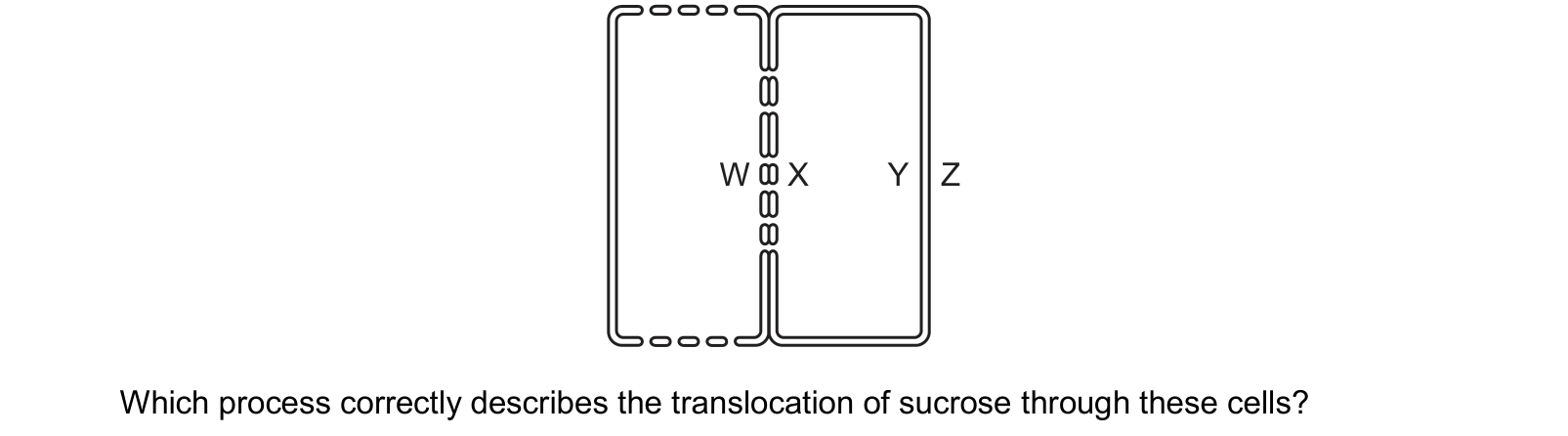
Answer: B.
B is the loading step. A proton pump in the companion cell's outer membrane moves H⁺ ions out, from Y to Z, using ATP. That is active transport, and it builds up a proton gradient in the wall outside the cell. Everything else in phloem loading runs on that gradient.
C describes the protons coming back, Z to Y, which they do. It is wrong because of how: they return through a cotransporter protein, bringing sucrose in with them. That is facilitated diffusion coupled to cotransport, not plain diffusion, and calling it diffusion loses the only part that matters, which is the sucrose being dragged in alongside.
A moves sucrose the wrong way. Y to Z is out of the companion cell, and sucrose is being loaded in.
D has protons crossing from the companion cell into the sieve tube. What passes through the plasmodesmata in that shared wall is the sucrose, moving down its concentration gradient into the sieve tube, and no proton gradient exists there to drive anything.
Question 2
Which row correctly matches the structure and function of phloem sieve tube elements? Each answer gives, in order: structure; function.
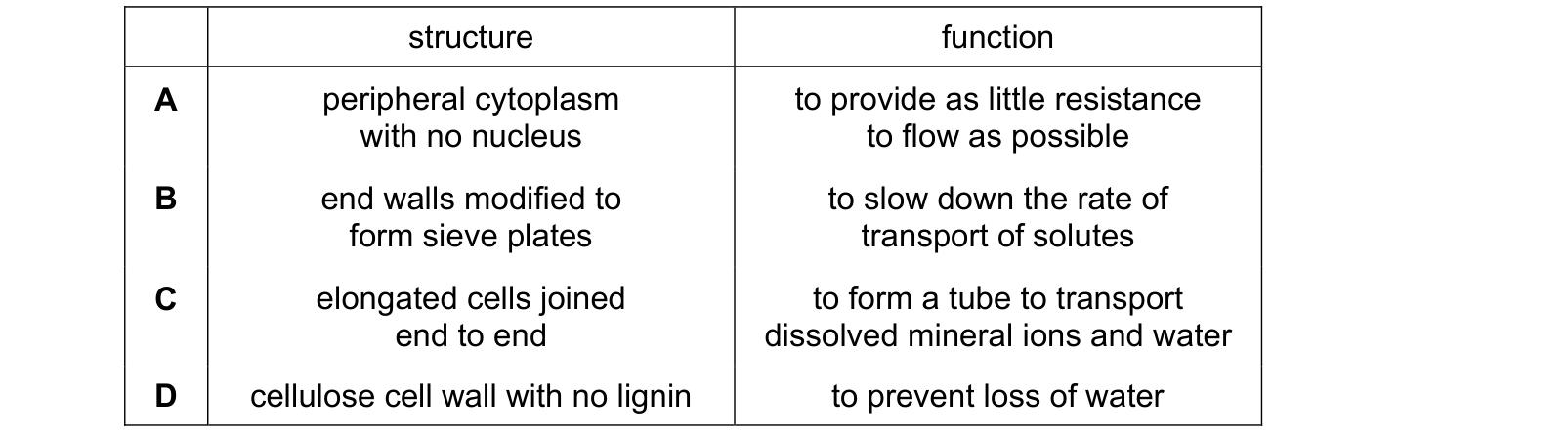
Answer: A.
A sieve tube element has only a thin peripheral layer of cytoplasm and no nucleus, which leaves the centre of the tube clear. That gives the least possible resistance to flow, which matters because translocation is mass flow and anything in the way slows it.
B pairs a correct structure with a nonsensical purpose: sieve plates are perforated to allow flow through, not to slow it.
C describes phloem but gives it xylem's job. Mineral ions and water are carried in the xylem.
D pairs a correct structure with the wrong reason. The absence of lignin keeps the wall permeable, which is needed for loading, not for preventing water loss.
Question 3
The electron micrograph shows a longitudinal section of part of the stem of a plant. What is the name of the structure labelled X?
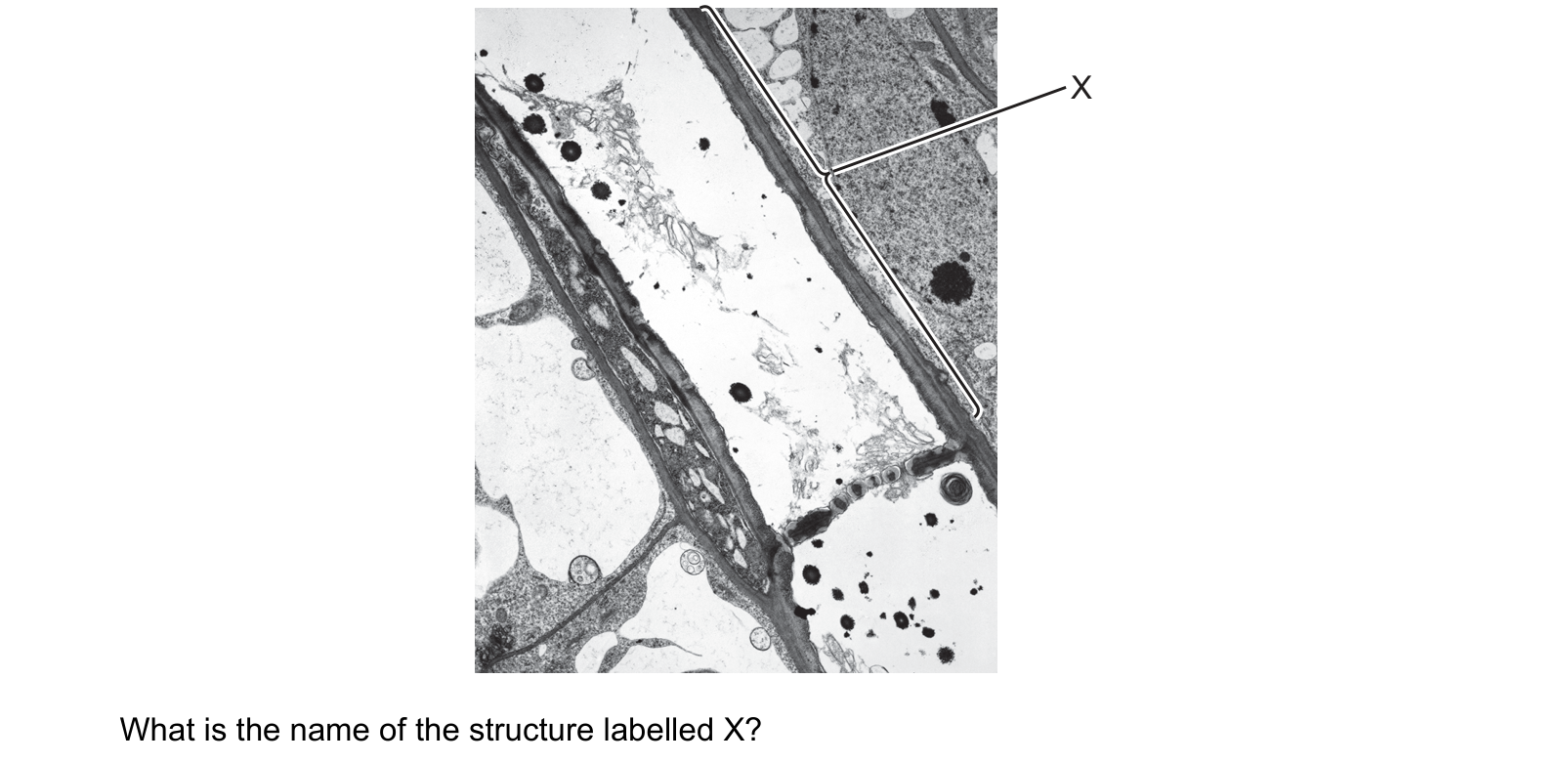
Answer: C.
It is almost empty. There is no nucleus, and only a few wisps of material against the walls where a thin layer of cytoplasm remains. A living plant cell that has given up its nucleus and most of its organelles, while keeping its cell surface membrane and a little cytoplasm, is a phloem sieve tube element. That is C.
It gives all that up for a reason: an empty tube offers almost no resistance to the sap being pushed through it by mass flow. The cost is that it can no longer maintain itself, which is why it is never alone.
A, the companion cell, is the cell next to it, and in this micrograph it is the narrow strip packed with dense cytoplasm and dark organelles. It keeps its nucleus and has many mitochondria, because it does the metabolic work for the sieve tube element and runs the proton pumps that load sucrose.
D, a xylem vessel element, would be empty too, but completely so: it is dead, with no membrane and no cytoplasm at all, and a thick lignified wall. B, the Casparian strip, is a band in the wall of an endodermal cell in a root, and this is a stem.
What the syllabus asks for on this topicSyllabus points
Syllabus points
- Draw and label the distribution of xylem and phloem in root, stem and leaf.
- Relate the structure of xylem vessel elements to their function.
- Relate the structure of sieve tube elements and companion cells to their function.
Related CIE 9700 Biology topics
Not the topic you were looking for? Describe what you are stuck on in your own words and we will take you to the notes that answer it.