Carbohydrates and lipids
Contents: 6 sections
Monosaccharides
The general formula is (CH₂O)ₙ. Glucose is a hexose, so n is 6 and the formula is C₆H₁₂O₆.
Glucose exists as two ring isomers that differ at carbon 1 only:
- α-glucose: the hydroxyl group on carbon 1 points down, on the same side as the one on carbon 4.
- β-glucose: the hydroxyl group on carbon 1 points up.
That single difference is responsible for the entire gulf between starch and cellulose, so it is worth being able to draw. Everything else about the two molecules is identical, which is why they are isomers and not different sugars.
Fructose and galactose are also hexoses with the formula C₆H₁₂O₆, arranged differently. Ribose and deoxyribose are pentoses, with five carbons, and belong to nucleic acids rather than to energy storage.
The glycosidic bond
Two monosaccharides join by condensation: a hydroxyl group on each reacts, a molecule of water is released, and a glycosidic bond forms between them.
The bond is named for the carbons it joins. A bond between carbon 1 of one α-glucose and carbon 4 of the next is a 1,4-glycosidic bond. A bond to carbon 6 instead is a 1,6-glycosidic bond, and that is what produces a branch.
Hydrolysis is the reverse. A molecule of water is added and the bond breaks. This is what digestive enzymes do, and what dilute acid does in the non-reducing sugar test.
The disaccharides worth knowing
| Disaccharide | Made from | Reducing? |
|---|---|---|
| Maltose | glucose + glucose | yes |
| Lactose | glucose + galactose | yes |
| Sucrose | glucose + fructose | no |
Polysaccharides
Starch
Starch is the plant storage carbohydrate and is a mixture of two molecules, both built from α-glucose.
- Amylose is joined by 1,4 bonds only. The bond angles make the chain coil into a helix, which is compact and holds the iodine that gives the blue-black test colour.
- Amylopectin has 1,4 bonds along the chain and 1,6 bonds at branch points every twenty-five residues or so.
Starch suits storage because it is:
- insoluble, so it has no effect on the water potential of the cell and will not draw water in by osmosis
- compact, so a large amount of glucose is held in a small space
- easily hydrolysed back to glucose when it is needed
- too large to leave the cell, so it stays where it is put
Glycogen
Glycogen is the animal equivalent, also from α-glucose, also with 1,4 and 1,6 bonds, but more highly branched than amylopectin.
Branching matters for a specific reason. Hydrolysis happens at the ends of chains, so a molecule with many branches has many ends, and glucose can be released quickly. Animals need glucose released faster than plants do, which is the whole argument for the extra branching.
Cellulose
Cellulose is built from β-glucose, and this is where the isomer difference pays off.
Because the hydroxyl on carbon 1 points up in β-glucose, every second molecule must be flipped through 180° for a 1,4 bond to form at all. The result is a straight chain rather than a helix.
Straight chains lie alongside one another, and hydrogen bonds form between the chains. Around sixty to seventy chains bond together into a microfibril, and microfibrils bundle into fibres. The whole arrangement has enormous tensile strength, which is what a plant cell wall needs to resist the pressure of a turgid cell pushing outward.
Cellulose also resists digestion by most animals, because the enzymes that hydrolyse 1,4 bonds between α-glucose units do not fit bonds between β-glucose units.
The three compared
| Starch (amylose) | Glycogen | Cellulose | |
|---|---|---|---|
| Monomer | α-glucose | α-glucose | β-glucose |
| Bonds | 1,4 | 1,4 and 1,6 | 1,4, alternate units flipped |
| Shape | helix | branched | straight chains |
| Branching | none in amylose | very high | none |
| Role | plant storage | animal storage | plant cell wall |
Lipids
Lipids are not polymers. They are not built from repeating identical subunits, so calling a triglyceride a polymer of fatty acids loses a mark.
Triglycerides
A triglyceride is one glycerol joined to three fatty acids. Each bond is an ester bond, formed by condensation, so three molecules of water are released in making one triglyceride.
A fatty acid is a hydrocarbon chain ending in a carboxyl group.
- Saturated: no carbon-to-carbon double bonds. The chains are straight, pack closely, and the fat is solid at room temperature.
- Unsaturated: one or more double bonds. Each double bond puts a kink in the chain, the chains cannot pack closely, and the lipid is liquid at room temperature, which is what an oil is.
Triglycerides suit energy storage because:
- they release more than twice the energy per gram that carbohydrate does, being more reduced and so having more hydrogen to oxidise
- they are insoluble in water, so they do not affect water potential
- their oxidation releases metabolic water, which matters to desert animals
- stored under the skin they also insulate, and around organs they protect
Phospholipids
A phospholipid is a triglyceride with one fatty acid replaced by a phosphate group.
This produces a molecule with two incompatible ends:
- the phosphate head is charged, so it is hydrophilic
- the two fatty acid tails are uncharged hydrocarbon, so they are hydrophobic
A molecule with both properties is amphipathic, and in water it arranges itself so the heads face the water and the tails are shielded from it. In a thin layer that gives a bilayer, which is the basis of every membrane in the cell and the subject of topic 4.1.
Common mistakes
- Saying starch is made of glucose without specifying α-glucose. The isomer is the point.
- Explaining cellulose strength as coming from the glycosidic bonds. It comes from hydrogen bonds between adjacent chains.
- Saying glycogen is branched "so it is compact". Branching is about the rate of glucose release.
- Calling a triglyceride bond a glycosidic bond. It is an ester bond.
- Saying lipids contain more energy "because they are bigger". Per gram, it is the higher proportion of hydrogen that matters.
Check you have it
Question 1
Which row correctly matches the example with the type of molecule? Each answer gives, in order: disaccharide; macromolecule; monomer; polymer.
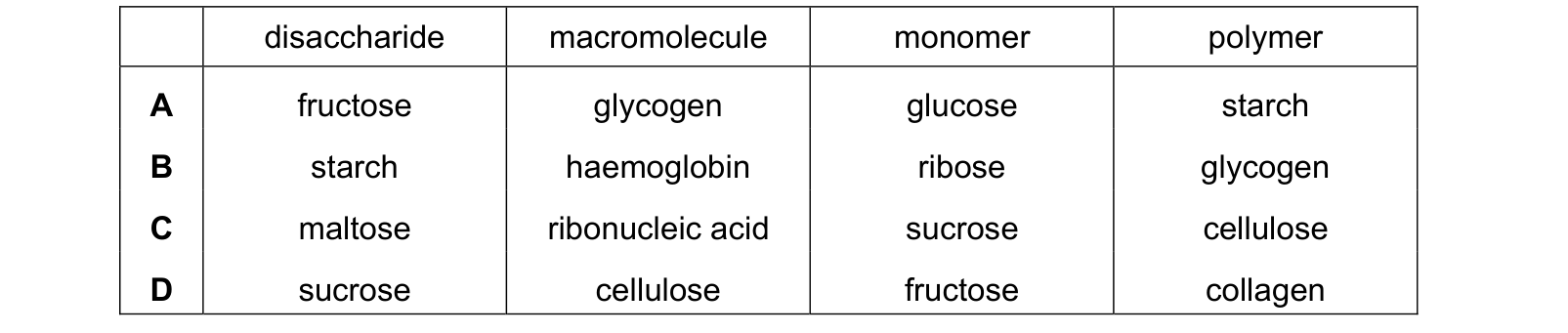
Answer: D.
Disaccharide: sucrose, two monosaccharides joined.
Macromolecule: cellulose, a very large molecule.
Monomer: fructose, a single unit.
Polymer: collagen, many amino acids joined.
A fails on the first column, since fructose is a monosaccharide, not a disaccharide.
B fails on the first too, since starch is a polysaccharide.
C fails on the third, since sucrose is a disaccharide rather than a monomer.
The distinction to hold on to is that a polymer is defined by repeating units while a macromolecule just means very large. Collagen is both, and a triglyceride is a large molecule that is not a polymer at all.
Question 2
The diagram shows three hexose sugars. CH2OH CH2OH CH2OH Which row correctly shows examples of carbohydrates in which these three hexose sugars occur? Each answer gives, in order: sucrose; cellulose; amylopectin.
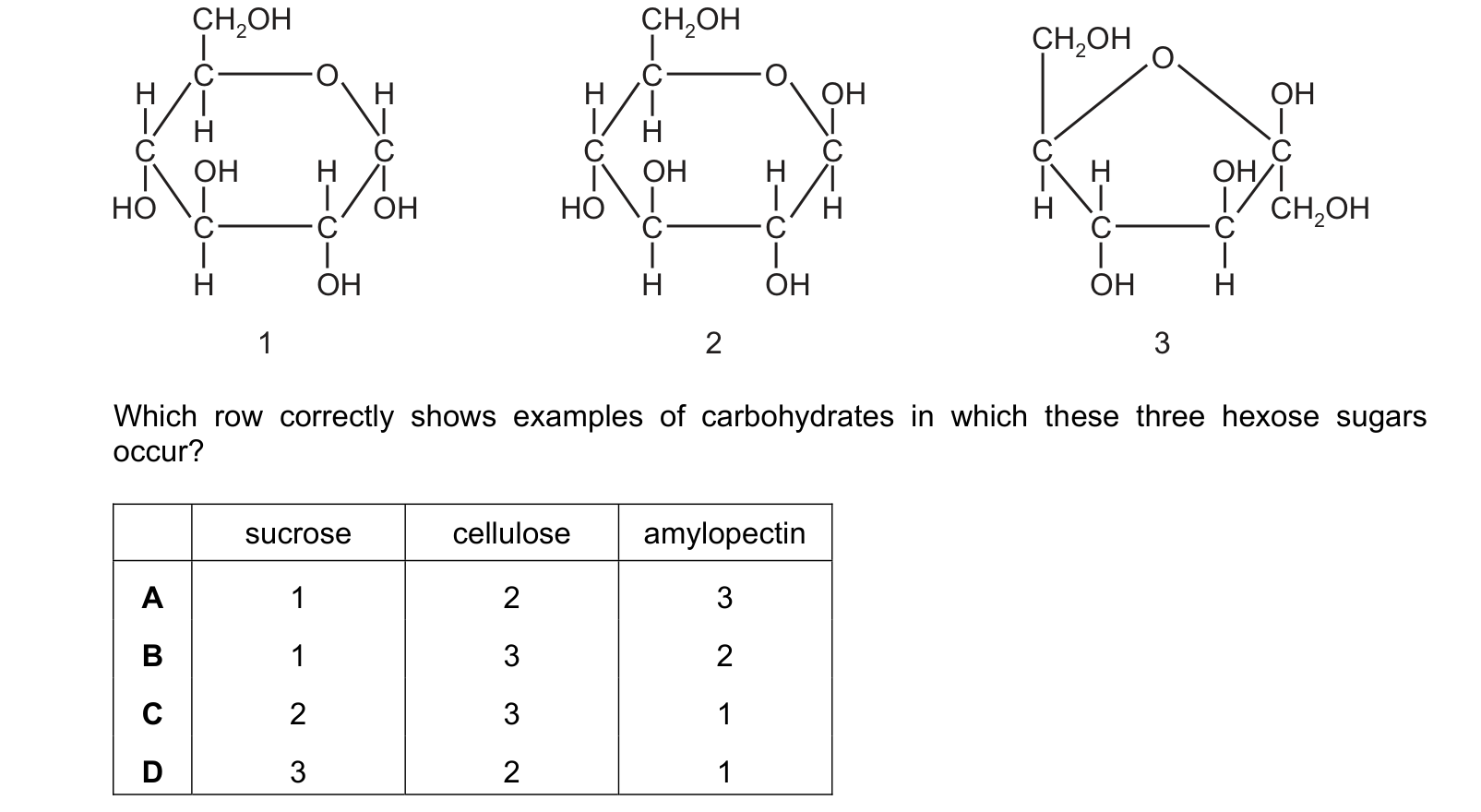
Answer: D.
3 is drawn as a five-membered ring while the other two are six-membered. That is fructose, and fructose appears in only one of the three carbohydrates listed: sucrose, which is glucose joined to fructose. That fixes the first column and removes A and B at once.
1 and 2 are both glucose, and the difference is the OH on carbon 1, the right-hand corner of the ring. In 1 it points down, which is α-glucose. In 2 it points up, which is β-glucose.
Cellulose is built from β-glucose, so cellulose is 2. Amylopectin is built from α-glucose, so amylopectin is 1.
3, 2, 1, which is D.
That single OH is one of the most consequential details in the whole subject. β-glucose has to be flipped over to join to the next monomer, so cellulose chains are straight and lie side by side in bundles held by hydrogen bonds, which is what gives a plant cell wall its strength. α-glucose chains curl into a helix instead, which is what makes starch compact and easy to store.
Question 3
Which statement is a correct comparison between saturated triglyceride molecules and unsaturated triglyceride molecules of approximately the same molecular masses?
Answer: A.
The two go together by definition. A double bond between two carbons uses electrons that would otherwise hold hydrogens, so each double bond introduced removes two hydrogens. Unsaturated means having double bonds, so it also means having fewer hydrogens.
That makes B, C and D self-contradictory in one way or another: C pairs more double bonds with more hydrogens, and D pairs fewer double bonds with more hydrogens while calling the molecule unsaturated.
The consequence worth remembering is physical. Each double bond puts a kink in the chain, so unsaturated chains cannot pack closely, and the lipid is liquid at room temperature: an oil rather than a fat.
What the syllabus asks for on this topicSyllabus points
Syllabus points
- Describe the ring forms of α-glucose and β-glucose and state that they are isomers.
- Describe the formation and breakage of glycosidic bonds by condensation and hydrolysis.
- Relate the structures of starch, glycogen and cellulose to their functions.
- Describe the structure of triglycerides and phospholipids and relate them to their functions.
Related CIE 9700 Biology topics
Not the topic you were looking for? Describe what you are stuck on in your own words and we will take you to the notes that answer it.