Carbohydrates and lipids: five questions to try now
Real past-paper questions, the answer key from the mark scheme, and the explanation that goes with it. No account needed to answer them.
Question 1
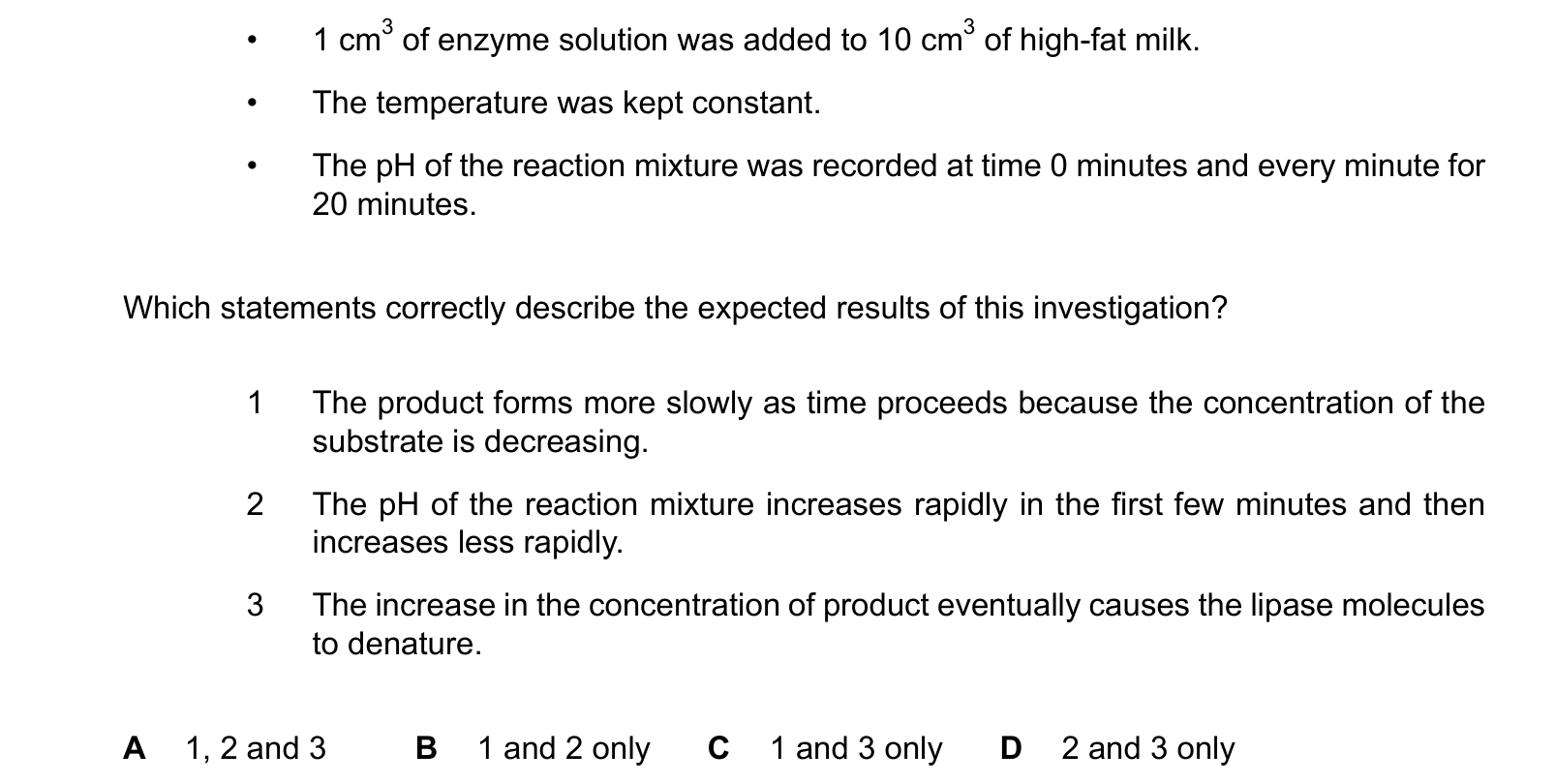
A student investigated the hydrolysis of lipid in high-fat milk, using the enzyme lipase. Which statements correctly describe the expected results of this investigation?
Answer: C.
1 is correct. As the reaction proceeds the lipid is used up, so there is less substrate, fewer enzyme-substrate complexes form per second, and the product accumulates more slowly. Any progress curve for an enzyme flattens for this reason.
2 is wrong, and it is the wrong way round. Releasing fatty acids makes the mixture more acidic, so the pH falls. It falls quickly at first, while the substrate is plentiful, then more slowly. The shape described is right; the direction is not.
3 is correct, and it follows from 2. As fatty acids build up the pH moves further and further from the enzyme's optimum. Extremes of pH break the ionic and hydrogen bonds holding the tertiary structure, the active site loses its shape, and the lipase denatures. So the product really does bring the reaction to a halt.
1 and 3 only, which is C.
That is why measuring pH works as a way of following this reaction at all: the enzyme changes the pH as a side effect of doing its job.
Question 2
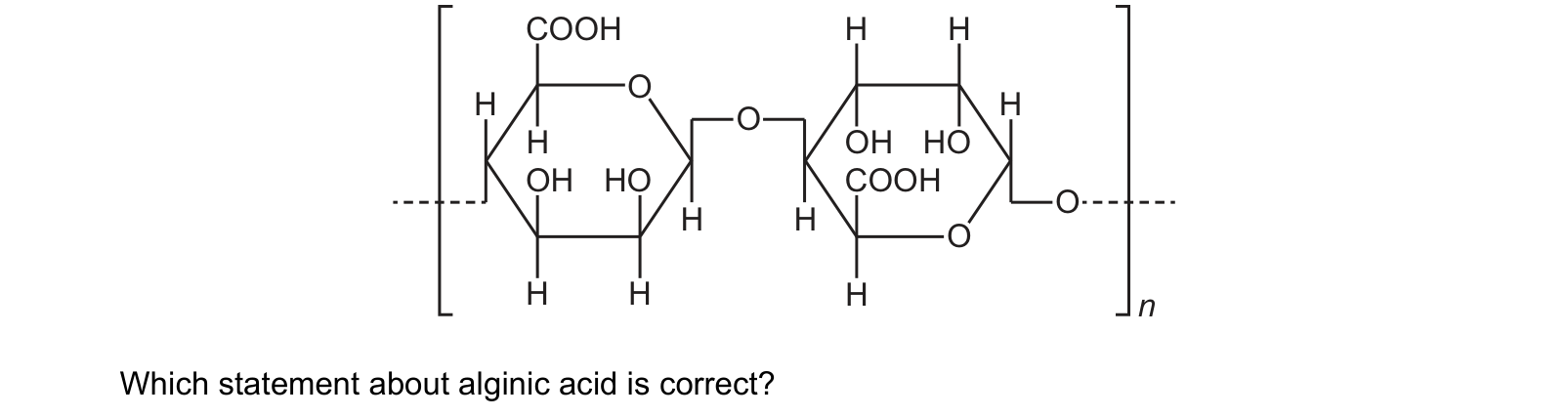
The diagram represents part of an alginic acid molecule. Alginic acid is a polymer found in the cell walls of brown seaweeds. Which statement about alginic acid is correct?
Answer: B.
A says 1,6, and the bonds drawn are plainly between carbons 1 and 4.
C starts correctly and then picks the wrong polysaccharide. The alternate monomers really are flipped, which you can see from the second ring having its oxygen at the bottom, but the molecule that does the same thing is cellulose, not glycogen. Glycogen is built from α-glucose with every monomer the same way up.
D has condensation backwards. Hexose sugars are joined to each other by condensation, and each bond releases a molecule of water. Water is a product, never a reactant, in building a polymer.
The flip is the useful thing to take away. Any polysaccharide whose monomers alternate in direction has its OH groups pointing outwards on both sides of the chain, which lets neighbouring chains hydrogen bond into strong parallel bundles. That is why alginic acid, like cellulose, is a structural molecule in a cell wall.
Question 3
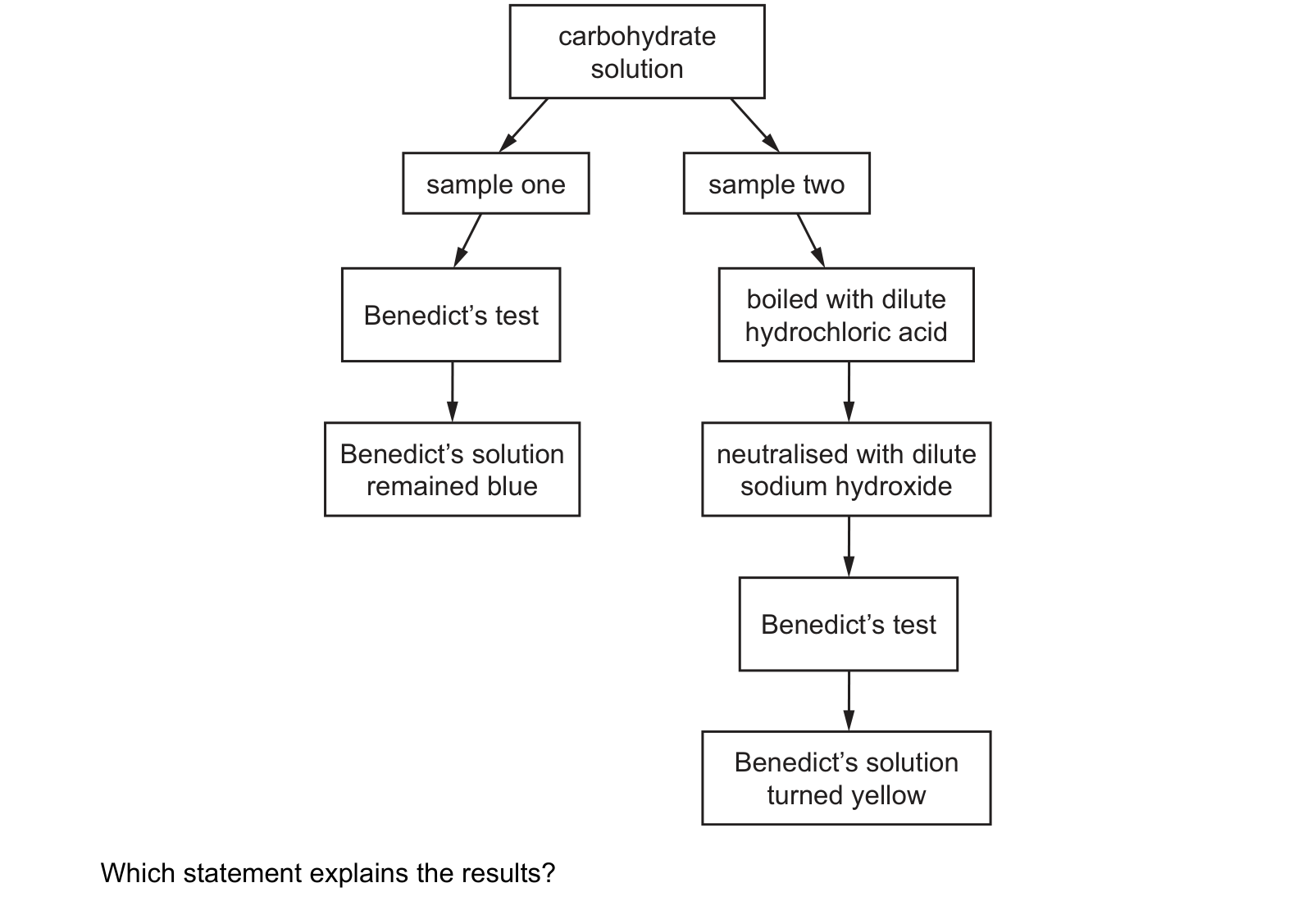
A student was provided with a solution of carbohydrate. They removed two samples from the solution and performed tests on each sample, as shown. Which statement explains the results?
Answer: B.
Sample one, tested directly, stayed blue: no reducing sugar present.
Sample two, boiled with acid and then neutralised, turned yellow: reducing sugar now present.
So the carbohydrate was not a reducing sugar to begin with, and boiling with acid released one. Boiling with acid hydrolyses glycosidic bonds, which is B.
A calls it a condensation reaction, which builds bonds rather than breaking them and could not liberate anything.
C over-reads sample one. A blue Benedict's result says only that no reducing sugar is present. Sucrose would give that, but so would starch or glycogen, so the test cannot name sucrose.
D over-reads sample two. Benedict's detects any reducing sugar, so a yellow result shows a reducing sugar is present, not specifically glucose. It could be maltose or fructose.
The neutralisation step is worth noticing rather than skipping over. Benedict's solution needs alkaline conditions to work, so the acid has to be neutralised first or the second test would fail whatever the sugar.
Question 4
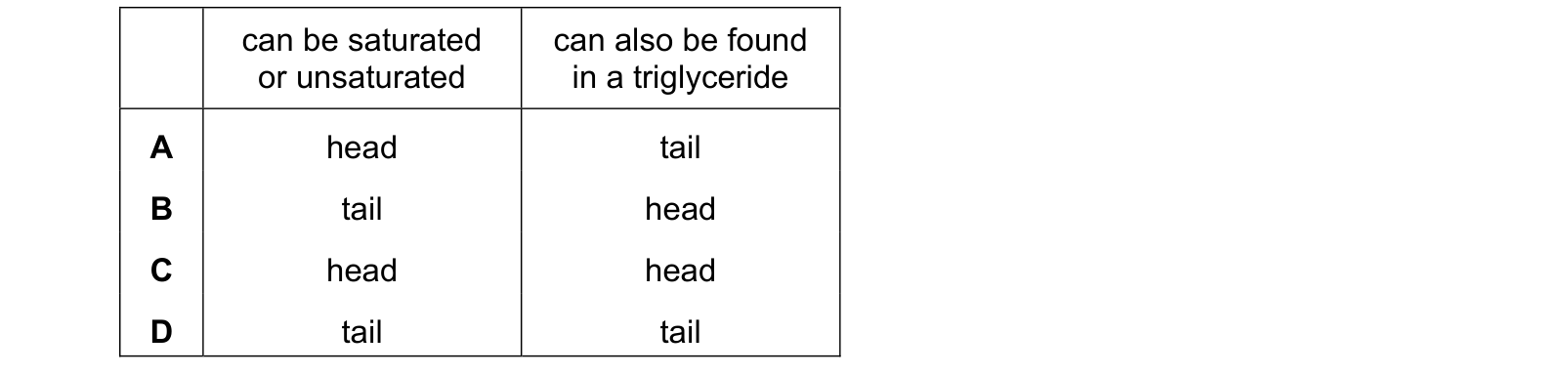
Which row is correct for parts of a phospholipid molecule? Each answer gives, in order: can be saturated or unsaturated; can also be found in a triglyceride.
Answer: D.
Can be saturated or unsaturated: that describes a fatty acid chain, so the tail. The phosphate head has no hydrocarbon chain to have double bonds in.
Can also be found in a triglyceride: a triglyceride is glycerol with three fatty acids, so the tails are the shared part. The phosphate head is exactly what a triglyceride does not have, since it is the replacement for the third fatty acid.
The relationship is worth stating plainly: a phospholipid is a triglyceride with one tail swapped for a phosphate group. Everything the two molecules share is in the tails, and everything that makes a phospholipid behave differently is in the head.
Question 5
Molecule X is a lipid. Which row is correct for molecule X and a triglyceride? Each answer gives, in order: molecule X contains; triglyceride contains.
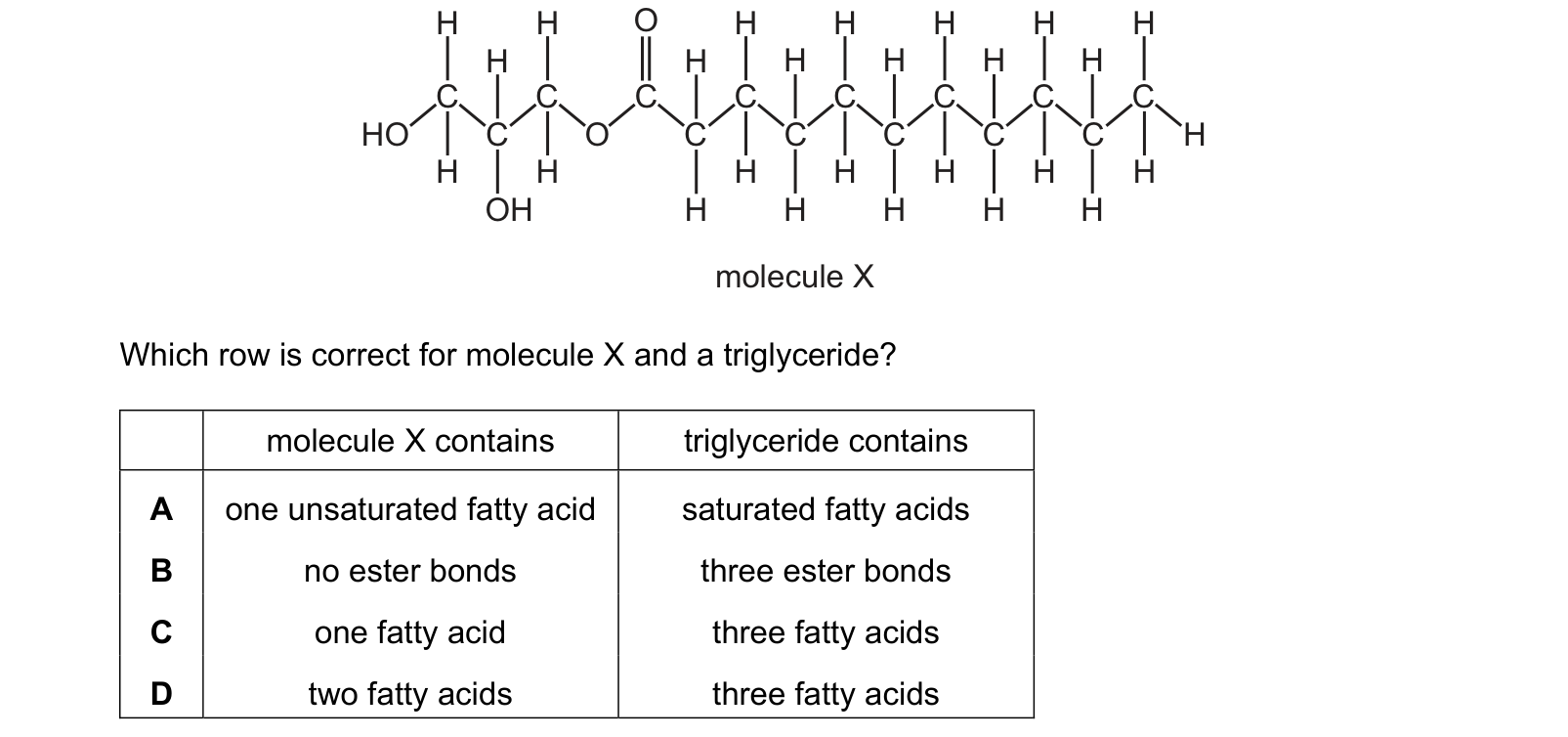
Answer: C.
So molecule X has one fatty acid, and a triglyceride, as the name says, has three. That is C.
D is the closest trap. Two fatty acids on a glycerol with a phosphate group in the third position would be a phospholipid, which is the molecule most people expect to see beside a triglyceride. This is not that: there are two free hydroxyls and no phosphate.
B is contradicted by the drawing. There is an ester bond, the C(=O)-O- linkage joining the chain to the glycerol. It is the only one, whereas a triglyceride has three.
A misreads the chain. Every carbon in it is joined to the next by a single bond and carries two hydrogens, so it is saturated. An unsaturated fatty acid would show at least one C=C, which is exactly the feature to look for.
What this practice covers
These questions are drawn from past CIE 9700 Biology papers and filtered to carbohydrates and lipids. You answer, you find out immediately whether you were right, and you get the reasoning for the correct option and for each distractor. Wrong answers go to a mistakes locker so you can come back to exactly those.
Practice is free. You need an account only so your progress and your mistakes are still there next time.
What examiners see students get wrong here
These are the errors that cost marks on carbohydrates and lipids, taken from our own topic notes. Read them before you practise and you will recognise the traps in the questions.
- Saying starch is made of glucose without specifying α-glucose. The isomer is the point.
- Explaining cellulose strength as coming from the glycosidic bonds. It comes from hydrogen bonds between adjacent chains.
- Saying glycogen is branched "so it is compact". Branching is about the rate of glucose release.
- Calling a triglyceride bond a glycosidic bond. It is an ester bond.
- Saying lipids contain more energy "because they are bigger". Per gram, it is the higher proportion of hydrogen that matters.
Revise it first
If any of the above is unfamiliar, work through the notes before practising: Carbohydrates and lipids revision notes.