Proteins and water
Contents: 7 sections
The amino acid
Every amino acid has the same backbone:
- a central carbon
- an amino group, NH₂
- a carboxyl group, COOH
- a hydrogen
- an R group, which is the only part that differs
There are twenty R groups in biological proteins. They may be charged, polar, or non-polar and hydrophobic, and the chemistry of the R groups is what makes one protein different from another.
The peptide bond
Two amino acids join by condensation: the carboxyl group of one reacts with the amino group of the next, water is released, and a peptide bond forms. Many joined together make a polypeptide.
Hydrolysis reverses it, adding water and breaking the bond. This is what protease enzymes do.
The four levels of structure
Primary structure
The sequence of amino acids in the chain, held by peptide bonds.
This is the level that everything else follows from. The R groups sit in a particular order, so the interactions available further up are determined here. A single change in the primary structure can change the whole molecule, which is exactly what happens in sickle cell anaemia: one glutamic acid replaced by one valine in the β-globin chain.
Secondary structure
Hydrogen bonds between the backbone, not between R groups. The slightly negative oxygen of one carboxyl group attracts the slightly positive hydrogen of an amino group further along the chain.
Two shapes result:
- the α-helix, a right-handed coil with hydrogen bonds running along it
- the β-pleated sheet, chains lying alongside one another with hydrogen bonds between them
An individual hydrogen bond is weak. There are so many of them that the structure holds, which is also why moderate heat undoes it.
Tertiary structure
The way the whole chain folds into a three-dimensional shape, held by interactions between R groups:
| Bond | Between | Strength |
|---|---|---|
| Hydrogen bond | polar R groups | weak, many |
| Ionic bond | oppositely charged R groups | stronger, pH sensitive |
| Hydrophobic interaction | non-polar R groups clustering inside | weak individually |
| Disulfide bond | two cysteine R groups | strong, covalent |
The disulfide bond is the only covalent one, so it is the one that survives conditions that break the others. Proteins that work in harsh environments, such as keratin, carry many of them.
Hydrophobic interactions deserve a note. Non-polar R groups are pushed to the inside of the molecule, away from the surrounding water, and polar ones end up on the outside. That is why most globular proteins are soluble: their outer surface is hydrophilic.
Quaternary structure
Present only in proteins made of more than one polypeptide chain, and held by the same bonds as tertiary structure.
Haemoglobin has four chains and a prosthetic group, so it has quaternary structure. Myoglobin has one chain and therefore does not.
Globular and fibrous proteins
Haemoglobin, a globular protein
Four polypeptide chains, two α and two β, each holding a haem prosthetic group containing an iron ion. Each haem group binds one oxygen molecule, so one haemoglobin molecule carries four.
The chains fold so that hydrophobic R groups face inward and hydrophilic ones face out, which makes it soluble and able to travel in blood plasma inside the red cell.
A protein with a non-protein component like haem is a conjugated protein.
Collagen, a fibrous protein
Three polypeptide chains, each a left-handed helix, wound around one another into a triple helix. Every third amino acid is glycine, which has the smallest R group, a single hydrogen. Only glycine is small enough to sit at the crowded centre where the three chains touch.
The chains are held by hydrogen bonds between them, and adjacent collagen molecules are joined by covalent cross-links that are staggered rather than aligned, so there is no line of weakness across the fibre.
Collagen is insoluble, has huge tensile strength, and is structural. It is found in tendons, skin, bone and artery walls.
The comparison
| Haemoglobin (globular) | Collagen (fibrous) | |
|---|---|---|
| Shape | roughly spherical | long and thin |
| Solubility | soluble | insoluble |
| Sequence | irregular | repeating, glycine every third |
| Role | transport, metabolic | structural |
| Prosthetic group | haem | none |
Water
Water is a polar molecule. Oxygen attracts the shared electrons more strongly than hydrogen does, so oxygen carries a slight negative charge and each hydrogen a slight positive one. Hydrogen bonds form between the slightly positive hydrogen of one molecule and the slightly negative oxygen of another.
A single hydrogen bond is weak, but each water molecule can form up to four, and that is where the properties come from.
A solvent. Polar and charged substances dissolve, because water molecules surround them and separate them. Most metabolic reactions happen in solution, and dissolved substances can be transported, which is what blood plasma and xylem sap depend on.
High specific heat capacity. A lot of energy goes into breaking hydrogen bonds before the temperature rises, so water warms and cools slowly. Cells and aquatic habitats are buffered against sudden temperature change, and enzymes are protected from denaturing.
High latent heat of vaporisation. A great deal of energy is needed to turn liquid water into vapour, so evaporation removes a lot of heat for a small loss of water. This is what makes sweating and transpiration effective as cooling.
Cohesion and surface tension. Water molecules stick to one another, so a column of water in a xylem vessel can be pulled up from above without breaking. At a surface, cohesion produces surface tension strong enough to support small organisms.
Density and ice. Ice is less dense than liquid water, because the hydrogen bonds hold the molecules in a fixed open lattice. Ice floats, insulating the water beneath, so ponds do not freeze solid and aquatic life survives the winter.
A reactant. Water is a reagent in its own right, in hydrolysis and in photosynthesis.
Common mistakes
- Saying secondary structure involves R groups. It is backbone hydrogen bonding.
- Saying every protein has quaternary structure. Only multi-chain proteins do.
- Describing the disulfide bond as strong "because there are many of them". It is strong because it is covalent.
- Saying water molecules are held together by ionic bonds. They are hydrogen bonds between polar molecules.
- Explaining ice floating as "ice is lighter". The hydrogen bonds hold the molecules further apart than in liquid water.
Check you have it
Question 1
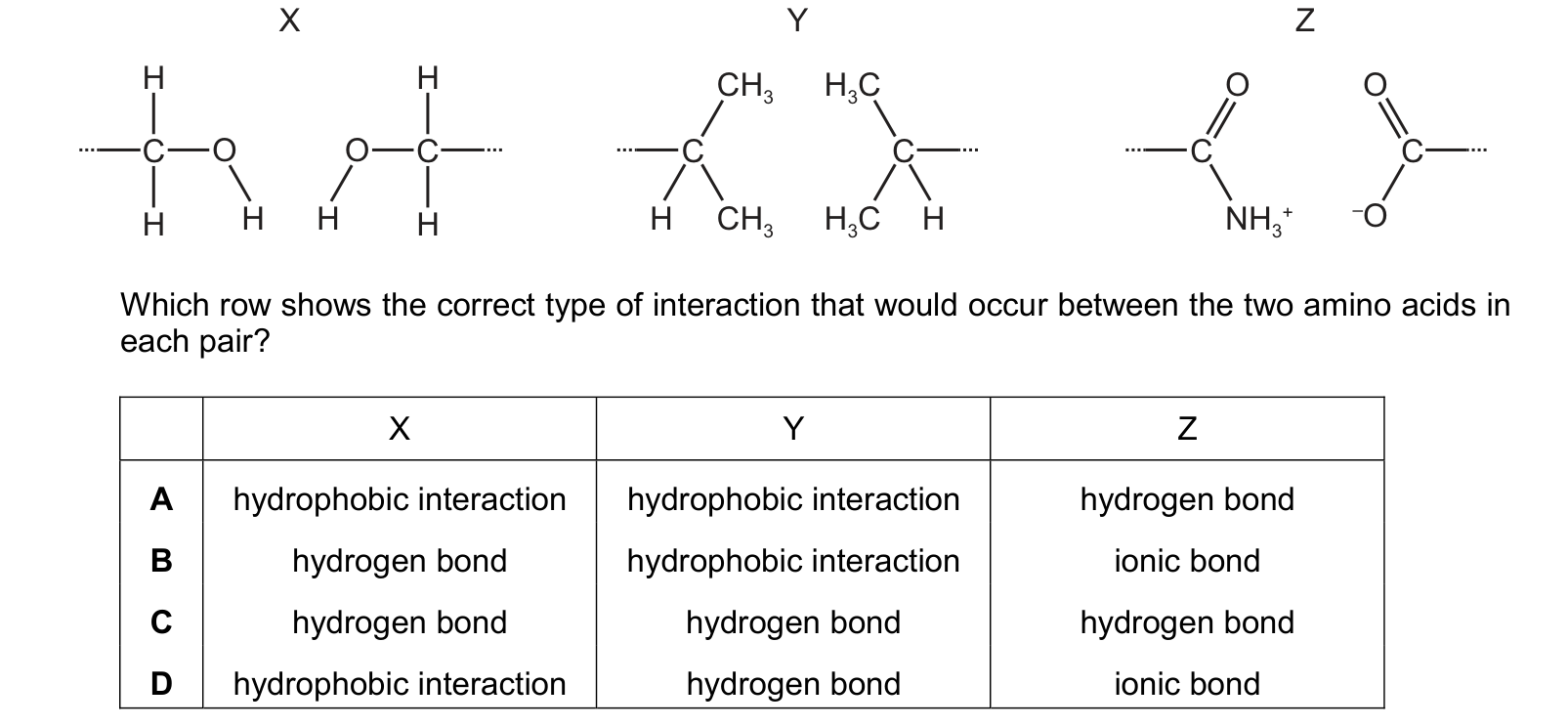
The diagrams show parts of three pairs of amino acids within a protein.
The pairs are labelled X, Y and Z.
X Y Z
H H CH3 H3C CH3 H3C H NH3 + –O Which row shows the correct type of interaction that would occur between the two amino acids in each pair? Each answer gives, in order: X; Y; Z.
Answer: B.
X: two -CH₂-OH groups. An -OH is polar, with a slightly positive hydrogen and a slightly negative oxygen, so two of them attract. That is a hydrogen bond.
Y: two -CH(CH₃)₂ groups. Only carbon and hydrogen, so completely non-polar. Non-polar side chains are pushed together as the surrounding water molecules hydrogen bond to each other instead, which is a hydrophobic interaction. It is why non-polar R groups end up buried in the middle of a folded protein.
Z: an NH₃⁺ facing a COO⁻. Two full, opposite charges attracting each other is an ionic bond.
Hydrogen bond, hydrophobic interaction, ionic bond, which is B.
The way to tell them apart is to look for charge. Full charges, written with a + or a −, mean ionic. Partial charges, from an O or an N pulling on a hydrogen, mean hydrogen bonding. No charge at all, just carbon and hydrogen, means hydrophobic. All three hold tertiary structure, and all three are broken by heat, which is what denaturing a protein does.
Question 2
Which statements about phospholipids in cell surface membranes are correct?
1 Fatty acid tails allow most ions to pass through the membrane.
2 Hydrophobic tails point inwards facing each other.
3 All polar heads face the cytoplasm.
4 The phospholipids help with the flexibility of the membrane.
Answer: D.
The hydrophobic tails point inwards, meeting in the middle of the bilayer away from the water on both sides: statement 2. And the phospholipids are not fixed in place: they move within their own layer, which is what gives the membrane its flexibility and the fluid in fluid mosaic: statement 4.
Statement 1 is the opposite of the truth. The hydrophobic core is what stops ions crossing, because a charged particle cannot enter it. Ions need channel or carrier proteins.
Statement 3 has all polar heads facing the cytoplasm. Half of them do; the other half face outward, which is what makes it a bilayer.
Question 3
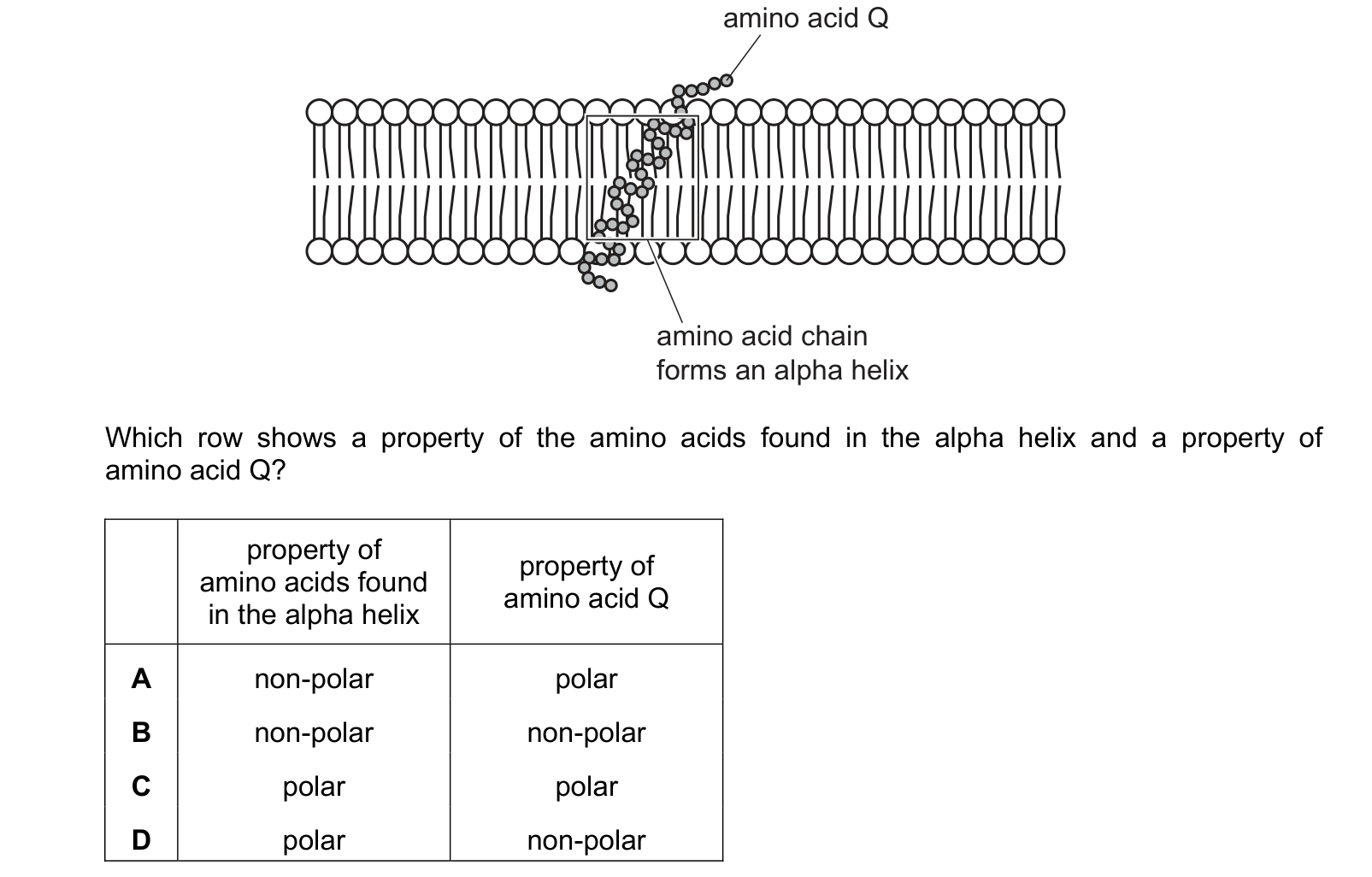
The diagram shows a section of a glycoprotein molecule found embedded in a cell surface membrane. Each of the amino acids is represented by a small shaded circle. Which row shows a property of the amino acids found in the alpha helix and a property of amino acid Q? Each answer gives, in order: property of amino acids found in the alpha helix; property of amino acid Q.
Answer: A.
The alpha helix is the part boxed inside the membrane, threading through the fatty acid tails. That region is hydrophobic, so the amino acid R groups facing it have to be non-polar. A polar side chain there would be trying to hydrogen bond with a hydrocarbon tail, and the protein would not sit stably in the membrane at all.
Amino acid Q is outside the membrane, sticking up into the watery environment on that side. Water is polar, so Q's R group is polar and hydrogen bonds happily with it.
Non-polar in the helix, polar at Q, which is A.
That pattern is what makes a protein an intrinsic membrane protein rather than a surface one, and it is why membrane proteins are held in place without being anchored to anything: the hydrophobic stretch will not leave the hydrophobic core, and the polar ends will not enter it.
What the syllabus asks for on this topicSyllabus points
Syllabus points
- Describe the structure of an amino acid and the formation of a peptide bond.
- Explain the four levels of protein structure and the bonds that hold each together.
- Compare a globular protein with a fibrous protein, using haemoglobin and collagen.
- Explain how hydrogen bonding between water molecules gives water its properties.
Related CIE 9700 Biology topics
Not the topic you were looking for? Describe what you are stuck on in your own words and we will take you to the notes that answer it.