Proteins and water: five questions to try now
Real past-paper questions, the answer key from the mark scheme, and the explanation that goes with it. No account needed to answer them.
Question 1
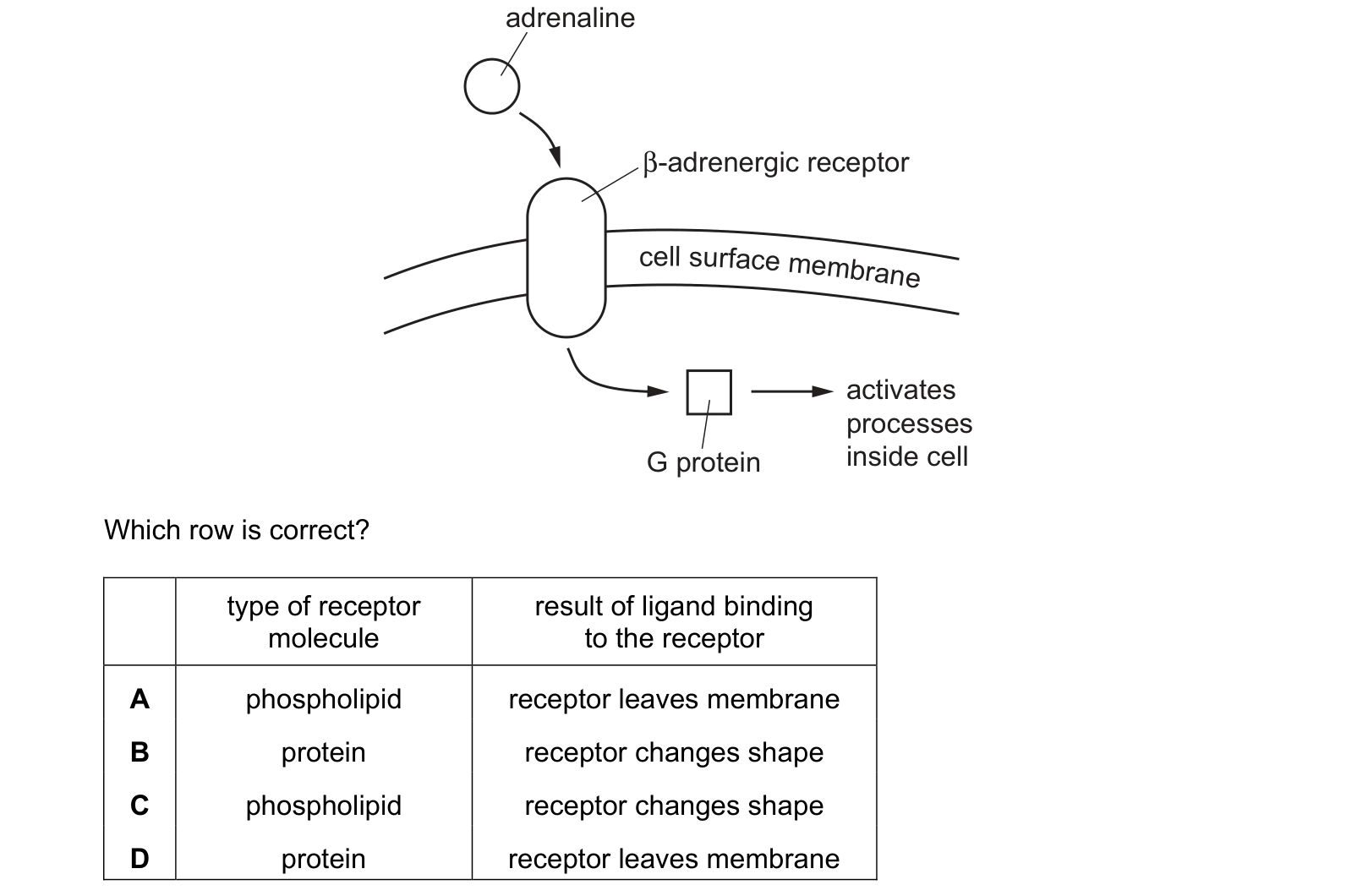
The diagram shows how adrenaline activates processes inside a cell. Which row is correct? Each answer gives, in order: type of receptor molecule; result of ligand binding to the receptor.
Answer: B.
What is the receptor made of? It is drawn spanning the cell surface membrane, with part of it sticking out into the fluid outside. Only a protein can do that. A phospholipid is a structural component of the bilayer itself, not something embedded in it, and it has no shape specific enough to recognise one particular signalling molecule. That removes A and C.
What happens when the ligand binds? The receptor changes shape. Adrenaline binds to the part outside the cell, and that conformational change is transmitted through the membrane to the part inside, which is then able to activate the G protein. That is B.
A and D both say the receptor leaves the membrane, and it does not. If it did, the signal would have nowhere to go and the receptor could not be used again. The whole point of the arrangement is that a molecule that never enters the cell can still change what happens inside it.
Adrenaline is water-soluble, so it cannot cross the hydrophobic core of the membrane, which is exactly why this mechanism has to exist. The message is passed on rather than carried in.
Question 2
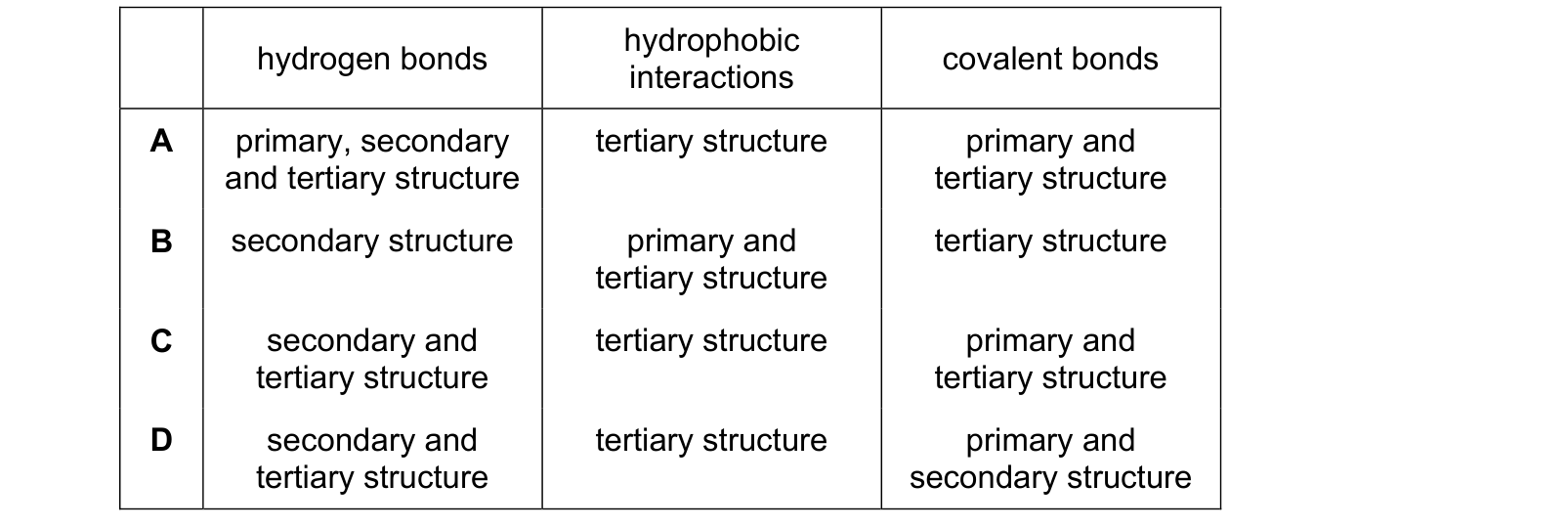
Which row correctly shows levels of protein structure that can be held together by each type of interaction? Each answer gives, in order: hydrogen bonds; hydrophobic interactions; covalent bonds.
Answer: C.
Hydrogen bonds appear in secondary structure, between backbone groups, and again in tertiary structure, between polar R groups.
Hydrophobic interactions occur only in tertiary structure, as non-polar R groups cluster away from the surrounding water.
Covalent bonds appear in primary structure, as the peptide bonds themselves, and in tertiary structure, as disulfide bonds between cysteines.
That gives C.
The two easily missed entries are hydrogen bonds appearing at two levels for two different reasons, and covalent bonds appearing in the tertiary level as well as the primary, because the disulfide bond is covalent.
Question 3
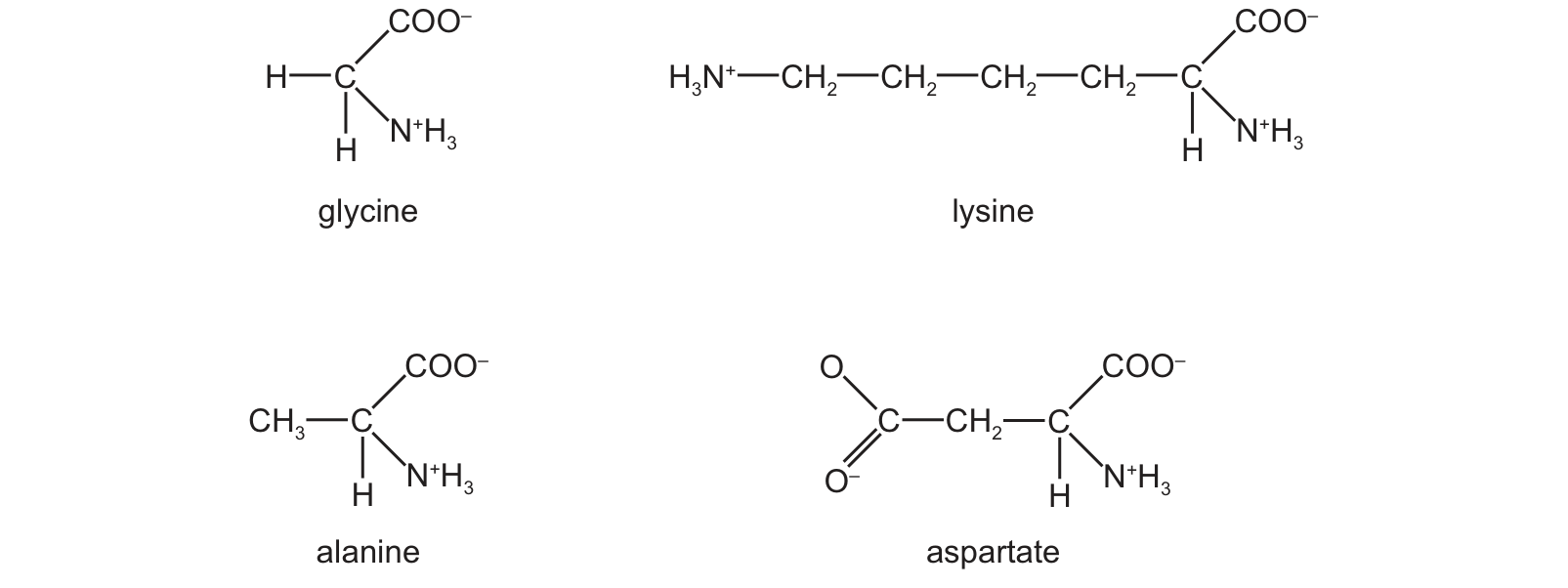
The diagrams show the structure of four amino acids in aqueous solution. Which two structures have an overall charge?
Answer: C.
So the overall charge can only come from the R group, and only two of the four have a charged one.
Lysine has an extra H₃N⁺ at the end of its side chain, giving it an overall charge of +1.
Aspartate has an extra COO⁻ on its side chain, giving it −1.
Glycine's R group is just H and alanine's is CH₃. Neither carries a charge, so both molecules are overall neutral.
Aspartate and lysine, which is C.
The reason this matters is what those side chains do in a folded protein. A positive lysine and a negative aspartate can attract each other and form an ionic bond, which is one of the interactions holding tertiary structure. Charged R groups are also hydrophilic, so they tend to end up on the outside of the molecule facing the water, while alanine's non-polar CH₃ ends up buried inside.
Question 4
Bread contains a mixture of polypeptides known as gluten.
Two of the polypeptides found in gluten are glutenin and gliadin.
Which statement describes the tertiary structure of a protein?
Answer: D.
A describes bonds between glutenin and gliadin, which are two different polypeptides, so that is quaternary structure.
B describes the proportion of a particular amino acid, which is a fact about the primary structure, the sequence.
C names α-helical sections, which are secondary structure, held by hydrogen bonds along the backbone.
So each option describes a real level and only one describes the level asked for, which is why identifying what each statement is about is the whole task.
Question 5
Which component of cell surface membranes helps to reduce fluidity of the phospholipids at high temperatures?
Answer: C.
The part usually got half right is that cholesterol works in both directions. At low temperatures it stops the tails packing tightly together, keeping the membrane more fluid. It is a buffer against change, not a one-way stiffener.
B, unsaturated fatty acids, do the opposite: their kinks prevent close packing and increase fluidity.
A, phosphate groups, form the hydrophilic heads and anchor the layer to the surrounding water.
D, proteins, are embedded in the bilayer but are not what regulates its fluidity.
What this practice covers
These questions are drawn from past CIE 9700 Biology papers. You answer, you find out immediately whether you were right, and you get the reasoning for the correct option and for each distractor. Wrong answers go to a mistakes locker so you can come back to exactly those.
Practice is free. You need an account only so your progress and your mistakes are still there next time.
What examiners see students get wrong here
These are the errors that cost marks on proteins and water, taken from our own topic notes. Read them before you practise and you will recognise the traps in the questions.
- Saying secondary structure involves R groups. It is backbone hydrogen bonding.
- Saying every protein has quaternary structure. Only multi-chain proteins do.
- Describing the disulfide bond as strong "because there are many of them". It is strong because it is covalent.
- Saying water molecules are held together by ionic bonds. They are hydrogen bonds between polar molecules.
- Explaining ice floating as "ice is lighter". The hydrogen bonds hold the molecules further apart than in liquid water.
Revise it first
If any of the above is unfamiliar, work through the notes before practising: Proteins and water revision notes.