Fluid mosaic membranes
Contents: 8 sections
Why the model is called what it is
Fluid because the phospholipid molecules are not fixed. They move sideways within their own layer, and the membrane behaves like a two-dimensional liquid rather than a solid sheet.
Mosaic because the proteins are scattered through the phospholipid bilayer in a pattern, of different sizes and at different depths, like tiles set in a floor.
Both halves of the name are worth quoting when a question asks you to describe the model, because each carries a mark.
The phospholipid bilayer
From topic 2.2: a phospholipid has a hydrophilic phosphate head and two hydrophobic hydrocarbon tails.
Put in water, phospholipids arrange themselves so the heads face the water and the tails are shielded from it. In a membrane that gives two layers back to back: heads facing the watery cytoplasm on the inside, heads facing the watery surroundings on the outside, tails meeting in the middle.
No energy is needed to hold this arrangement. It forms because it is the lowest-energy arrangement available, which is also why a small tear in a membrane seals itself.
The bilayer is about 7 nm thick, which is why it is invisible under a light microscope and needs an electron microscope to see.
What the bilayer will and will not let through
The hydrophobic core is the barrier. It is permeable to:
- small non-polar molecules: oxygen, carbon dioxide
- lipid-soluble molecules: steroid hormones, some vitamins
- water, slowly, because the molecules are small enough to slip between the phospholipids
It is effectively impermeable to:
- ions, because they are charged and cannot enter a hydrophobic region
- large polar molecules: glucose, amino acids
Everything on the second list needs a protein to get through, which is the whole reason membranes have transport proteins.
The proteins
Proteins are classified by how deeply they sit.
Intrinsic (or integral) proteins are embedded in the bilayer, and many span it completely. A protein that spans the membrane has hydrophobic R groups on the part inside the bilayer and hydrophilic R groups at the two ends, which is what holds it in position.
Extrinsic (or peripheral) proteins sit on one surface only, not spanning the membrane, held by interactions with the phospholipid heads or with intrinsic proteins.
Their roles:
- Channel proteins are intrinsic and form a water-filled pore lined with hydrophilic R groups. Ions and small polar molecules pass through by facilitated diffusion. Many are gated, opening and closing in response to a signal.
- Carrier proteins are intrinsic and bind a specific molecule, then change shape to move it across. They work both in facilitated diffusion, moving substances down a gradient with no energy, and in active transport, moving them against a gradient using ATP.
- Receptor proteins have a binding site complementary to a specific signalling molecule such as a hormone. Binding triggers a response inside the cell. Specificity here comes from shape, exactly as it does in an enzyme active site.
- Enzymes are held in membranes so that the reactions they catalyse happen in the right place, for example the enzymes on the inner mitochondrial membrane.
- Glycoproteins, proteins with a carbohydrate chain attached, act in cell recognition and adhesion. They are the antigens that an immune system reads.
Cholesterol
Cholesterol is a small lipid molecule that sits between the phospholipid tails, in both layers.
Its role is to regulate fluidity, and it does so in both directions, which is the part students usually get half right:
- At higher temperatures it restricts the movement of the phospholipids, making the membrane less fluid and more stable, and reducing its permeability to water and ions.
- At lower temperatures it prevents the phospholipid tails packing tightly together, so the membrane does not become rigid and stays more fluid.
Saying only that cholesterol "makes the membrane less fluid" gets half the answer. It is a buffer against change, not a one-way stiffener.
Cholesterol also adds mechanical strength, which matters most in animal cells, since they have no cell wall.
Glycolipids and glycoproteins
A glycolipid is a phospholipid with a carbohydrate chain attached; a glycoprotein is a protein with one. In both cases the carbohydrate sticks out from the outer surface of the membrane only, never into the cytoplasm.
Together they form the outer coating and do three jobs:
- Cell recognition. The carbohydrate chains are unique to a cell type and act as antigens, letting the immune system tell self from non-self. Blood group antigens are of this kind.
- Receptor sites for hormones and for signalling molecules.
- Cell adhesion, sticking cells together to form tissues, and helping cells stabilise the membrane by hydrogen bonding to surrounding water.
Because the carbohydrate faces outward only, the membrane is asymmetric. The two halves of the bilayer are not interchangeable, and a question that asks which side is which is asking about this.
What the cell surface membrane does
- A partially permeable barrier, controlling what enters and leaves and so keeping the cytoplasm different from the surroundings.
- Cell signalling, through receptors that recognise specific molecules.
- Cell recognition, through glycoproteins and glycolipids.
- A site for reactions, holding enzymes in place.
- Compartmentalisation inside the cell, where the same structure forms the membranes around organelles and separates incompatible reactions from one another.
Common mistakes
- Saying the membrane is "made of phospholipids and proteins" without saying the phospholipids form a bilayer with heads outward.
- Putting hydrophilic tails and hydrophobic heads the wrong way round. The phosphate head is hydrophilic.
- Saying cholesterol only makes the membrane less fluid. It works in both directions.
- Saying carbohydrate chains are found on both surfaces. They face outward only.
- Saying water cannot cross the bilayer at all. It crosses slowly, and faster through aquaporin channels.
Check you have it
Question 1
Which statement correctly describes facilitated diffusion?
Answer: B.
Channel proteins form a water-filled pore lined with hydrophilic R groups; many are gated, so they do change shape. Carrier proteins bind the molecule and change shape to release it on the other side. So proteins that may or may not change shape is exactly right.
A and C both have the cell providing energy. Facilitated diffusion is passive: the molecule moves down its own gradient using its own kinetic energy.
D describes a co-transporter moving things in opposite directions and creating a gradient, which is active transport's job, not this one's.
Question 2
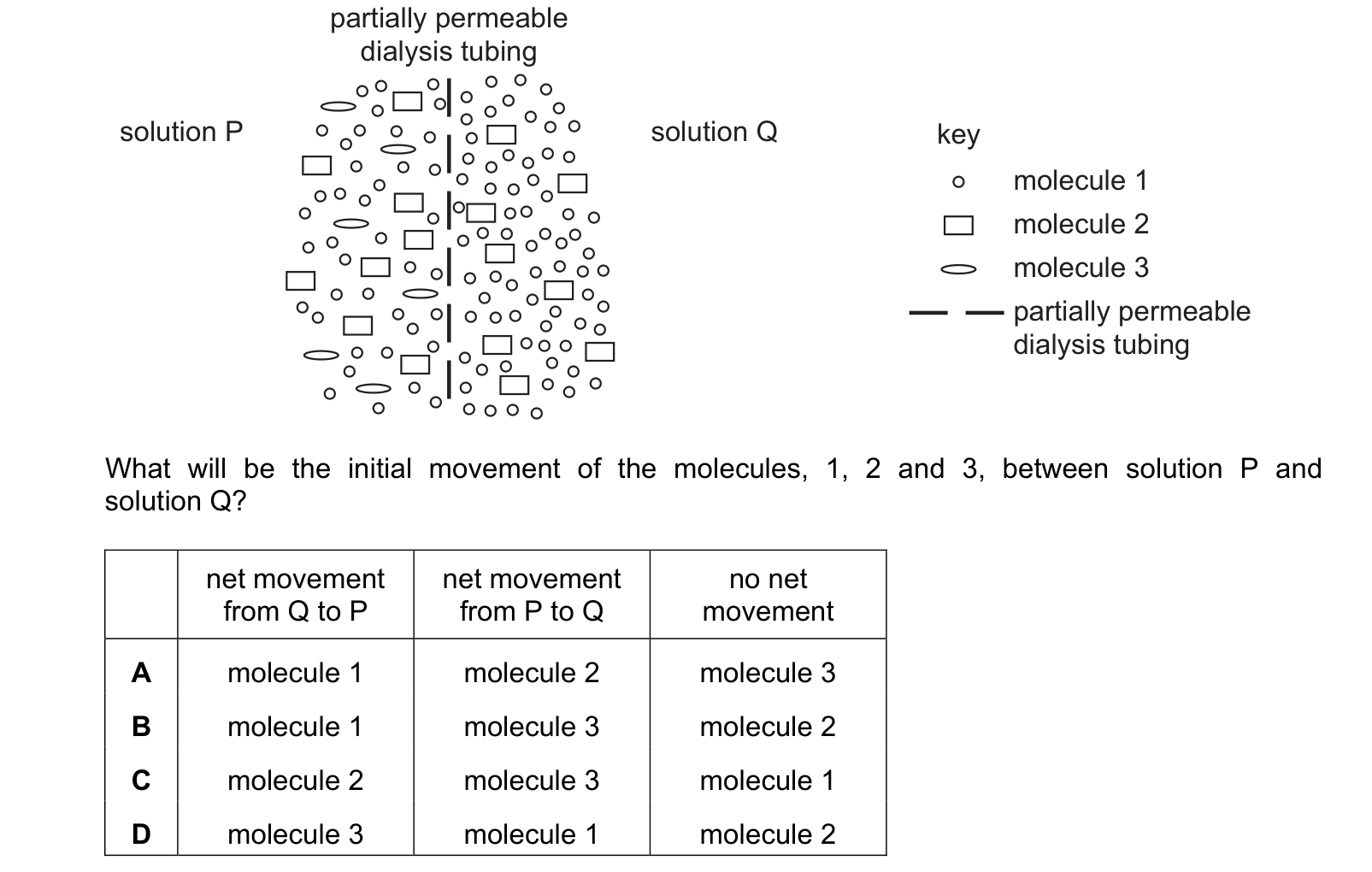
The diagram represents two solutions, P and Q, that were separated by a partially permeable dialysis tubing. partially permeable solution P solution Q key What will be the initial movement of the molecules, 1, 2 and 3, between solution P and solution Q? Each answer gives, in order: net movement from Q to P; net movement from P to Q; no net movement.
Answer: B.
Molecule 1, the small circles, is clearly more crowded in Q than in P. It will diffuse down its gradient, so the net movement is Q to P.
Molecule 3, the ellipses, appears only in P. There is none at all on the Q side, so the gradient is as steep as it can be and the net movement is P to Q.
Molecule 2, the rectangles, is present on both sides in about the same numbers. Molecules still cross in both directions, but the two flows cancel, so there is no net movement. This is the one that catches people out, because "nothing is happening" and "nothing is happening on balance" look the same from outside and are not the same thing.
Q to P for 1, P to Q for 3, no net movement for 2, which is B.
Notice that the direction never depends on how much of anything else is present. Each solute diffuses down its own gradient, independently of the others.
What the syllabus asks for on this topicSyllabus points
Syllabus points
- Describe the fluid mosaic model of membrane structure.
- Describe the roles of phospholipids, cholesterol, glycolipids, glycoproteins and proteins in membranes.
- Outline the roles of cell surface membranes.
Related CIE 9700 Biology topics
Not the topic you were looking for? Describe what you are stuck on in your own words and we will take you to the notes that answer it.