Fluid mosaic membranes: two questions to try now
Real past-paper questions, the answer key from the mark scheme, and the explanation that goes with it. No account needed to answer them.
Question 1
Which statement correctly describes facilitated diffusion?
Answer: B.
Channel proteins form a water-filled pore lined with hydrophilic R groups; many are gated, so they do change shape. Carrier proteins bind the molecule and change shape to release it on the other side. So proteins that may or may not change shape is exactly right.
A and C both have the cell providing energy. Facilitated diffusion is passive: the molecule moves down its own gradient using its own kinetic energy.
D describes a co-transporter moving things in opposite directions and creating a gradient, which is active transport's job, not this one's.
Question 2
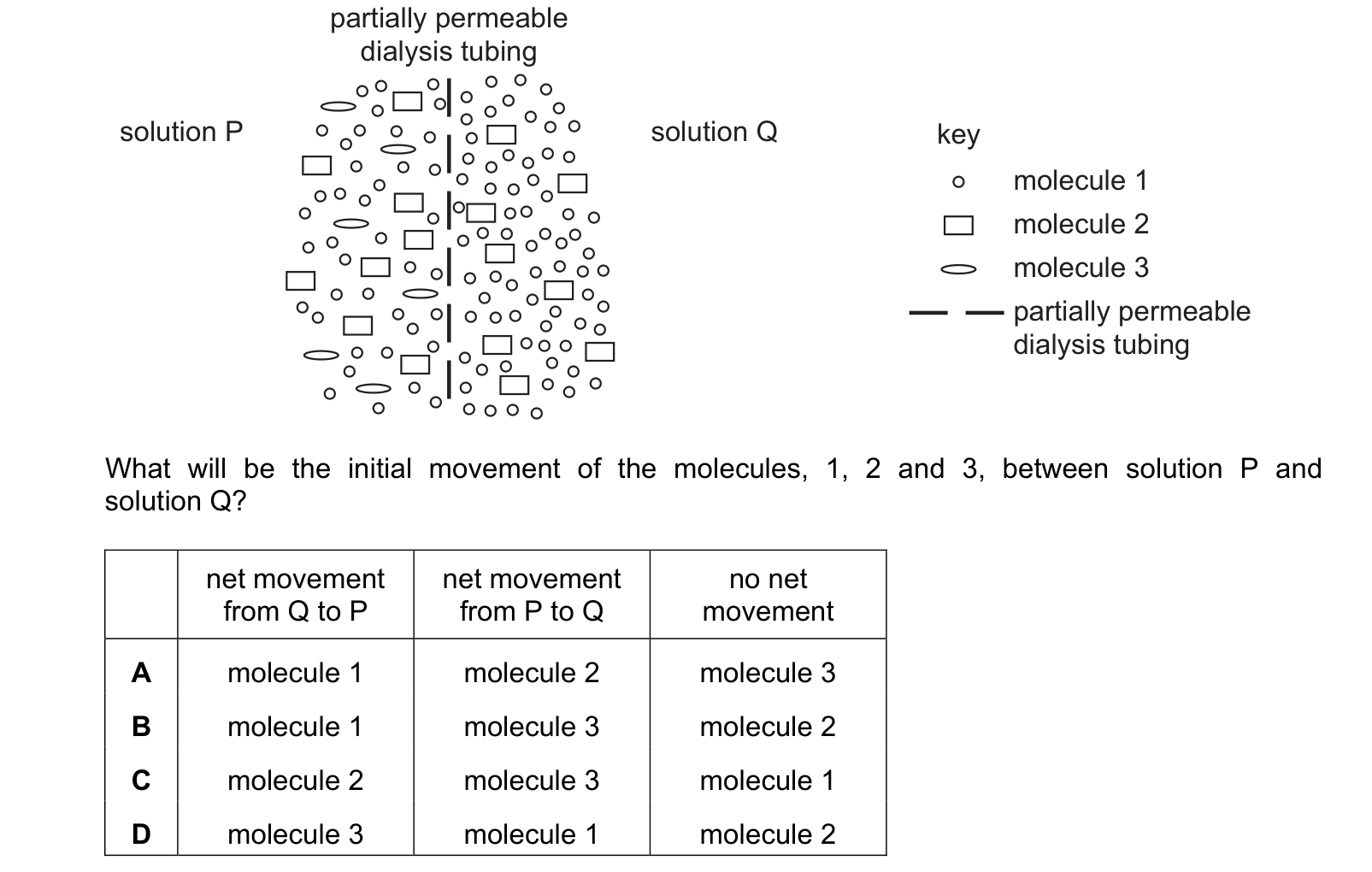
The diagram represents two solutions, P and Q, that were separated by a partially permeable dialysis tubing. partially permeable solution P solution Q key What will be the initial movement of the molecules, 1, 2 and 3, between solution P and solution Q? Each answer gives, in order: net movement from Q to P; net movement from P to Q; no net movement.
Answer: B.
Molecule 1, the small circles, is clearly more crowded in Q than in P. It will diffuse down its gradient, so the net movement is Q to P.
Molecule 3, the ellipses, appears only in P. There is none at all on the Q side, so the gradient is as steep as it can be and the net movement is P to Q.
Molecule 2, the rectangles, is present on both sides in about the same numbers. Molecules still cross in both directions, but the two flows cancel, so there is no net movement. This is the one that catches people out, because "nothing is happening" and "nothing is happening on balance" look the same from outside and are not the same thing.
Q to P for 1, P to Q for 3, no net movement for 2, which is B.
Notice that the direction never depends on how much of anything else is present. Each solute diffuses down its own gradient, independently of the others.
What this practice covers
These questions are drawn from past CIE 9700 Biology papers and filtered to fluid mosaic membranes. You answer, you find out immediately whether you were right, and you get the reasoning for the correct option and for each distractor. Wrong answers go to a mistakes locker so you can come back to exactly those.
Practice is free. You need an account only so your progress and your mistakes are still there next time.
What examiners see students get wrong here
These are the errors that cost marks on fluid mosaic membranes, taken from our own topic notes. Read them before you practise and you will recognise the traps in the questions.
- Saying the membrane is "made of phospholipids and proteins" without saying the phospholipids form a bilayer with heads outward.
- Putting hydrophilic tails and hydrophobic heads the wrong way round. The phosphate head is hydrophilic.
- Saying cholesterol only makes the membrane less fluid. It works in both directions.
- Saying carbohydrate chains are found on both surfaces. They face outward only.
- Saying water cannot cross the bilayer at all. It crosses slowly, and faster through aquaporin channels.
Revise it first
If any of the above is unfamiliar, work through the notes before practising: Fluid mosaic membranes revision notes.