Structure of transport tissues: five questions to try now
Real past-paper questions, the answer key from the mark scheme, and the explanation that goes with it. No account needed to answer them.
Question 1
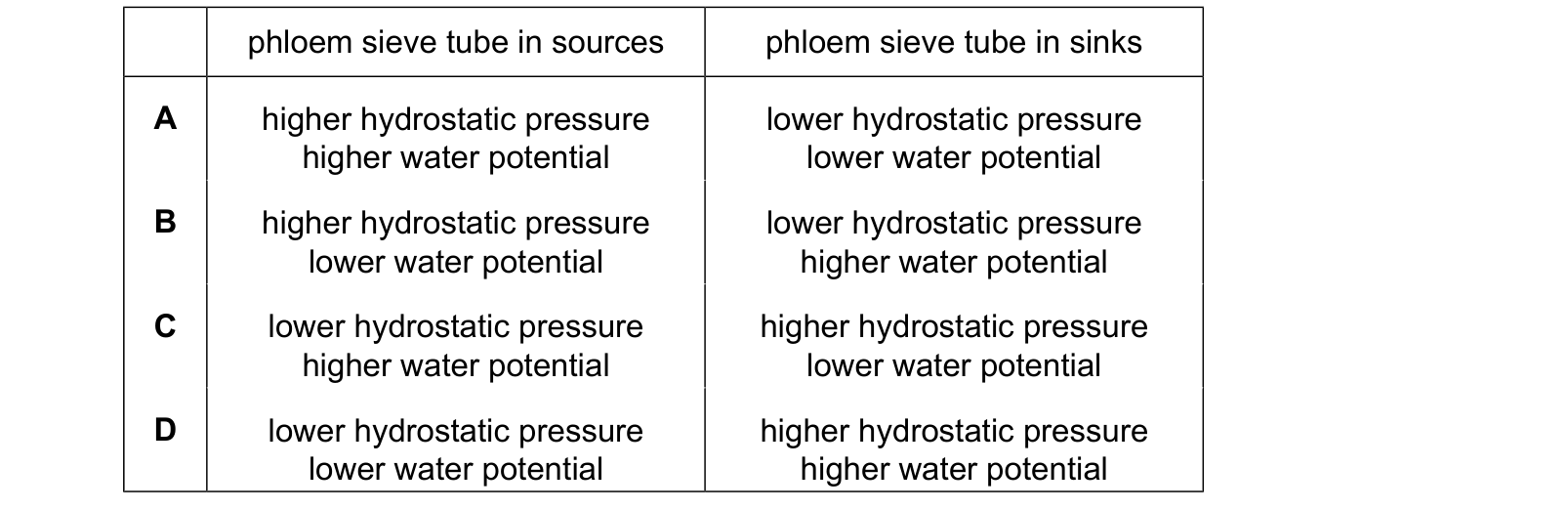
Which conditions are needed to allow the mass flow of sucrose in phloem sieve tubes? Each answer gives, in order: phloem sieve tube in sources; phloem sieve tube in sinks.
Answer: B.
At the source, sucrose is actively loaded in. That makes the sieve tube contents concentrated, so the water potential is lower, water enters from the xylem by osmosis, and the hydrostatic pressure is higher.
At the sink, sucrose is unloaded and used. The contents are dilute, so the water potential is higher, water leaves, and the hydrostatic pressure is lower.
Higher pressure and lower water potential at the source, the reverse at the sink, which is B.
Solution then flows from high pressure to low, which is source to sink, and that is the whole mechanism.
Question 2
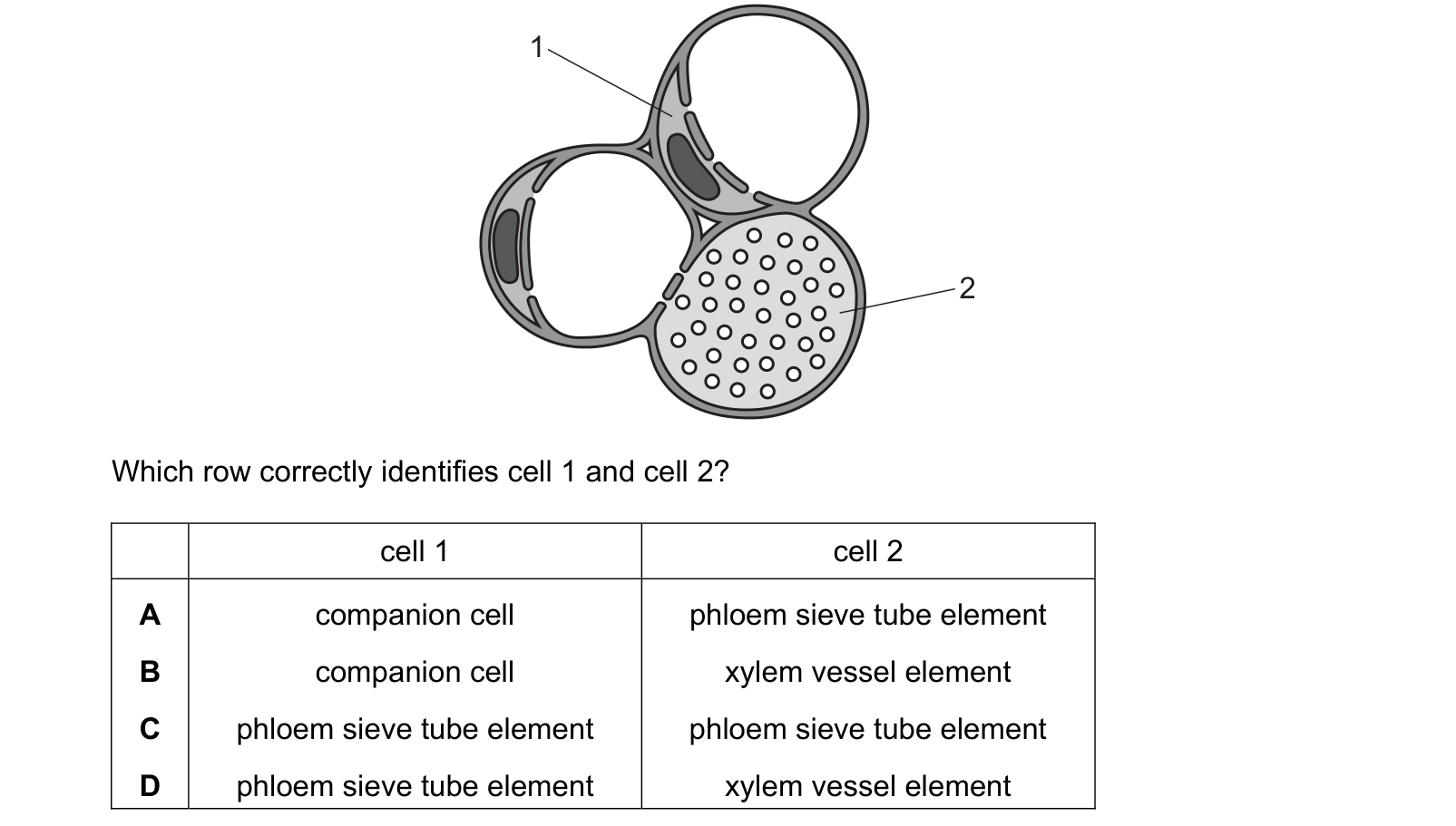
The diagram shows a transverse section through a transport tissue in a plant. Which row correctly identifies cell 1 and cell 2? Each answer gives, in order: cell 1; cell 2.
Answer: A.
Cell 2 is the large one whose whole face is covered in small pores. That is a sieve plate seen from above, and a sieve plate is the end wall of a phloem sieve tube element, perforated so that sap can flow straight from one element into the next.
Companion cell, then sieve tube element, which is A.
B and D can be eliminated without looking closely at cell 2 at all. A xylem vessel element is dead: no cytoplasm, no nucleus, and a thick lignified wall with pits. It would never be drawn attached to a companion cell, because companion cells only ever accompany sieve tube elements. Seeing a companion cell in the section tells you the tissue is phloem.
C calls cell 1 a sieve tube element, but a mature sieve tube element loses its nucleus, and cell 1 clearly has one.
Question 3
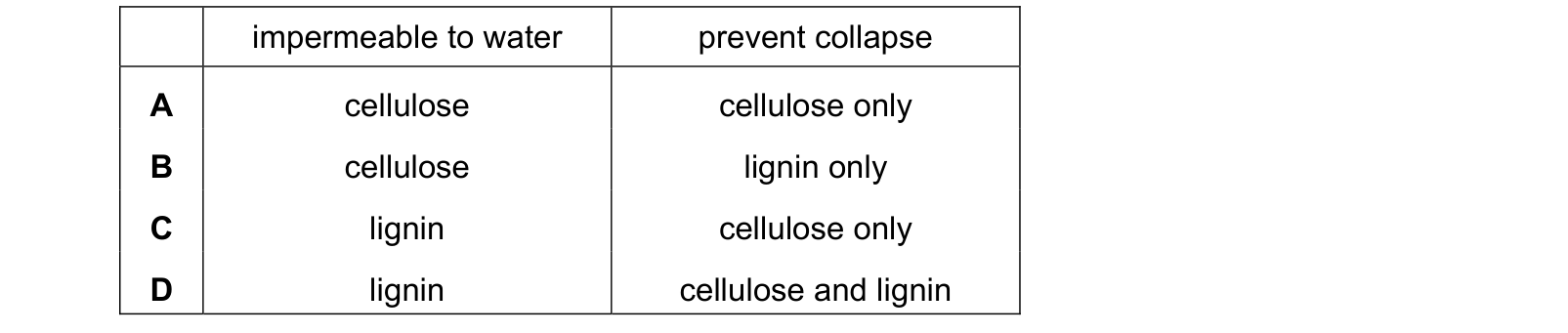
Which substances in xylem tissue are impermeable to water and prevent the collapse of the vessels? Each answer gives, in order: impermeable to water; prevent collapse.
Answer: D.
Impermeable to water is lignin. Cellulose walls are freely permeable, which is exactly what makes the apoplast pathway possible, so cellulose cannot be the waterproofing material.
Preventing collapse is cellulose and lignin together. The cellulose wall provides the underlying structure and the lignin deposited in it provides the rigidity, and the vessel needs both to resist the inward pull of a column under tension.
Lignin, then cellulose and lignin, which is D.
The question is designed so that knowing lignin is the waterproofing gets you halfway and no further. The second column asks whether you remember that the cellulose wall is still there underneath.
Question 4
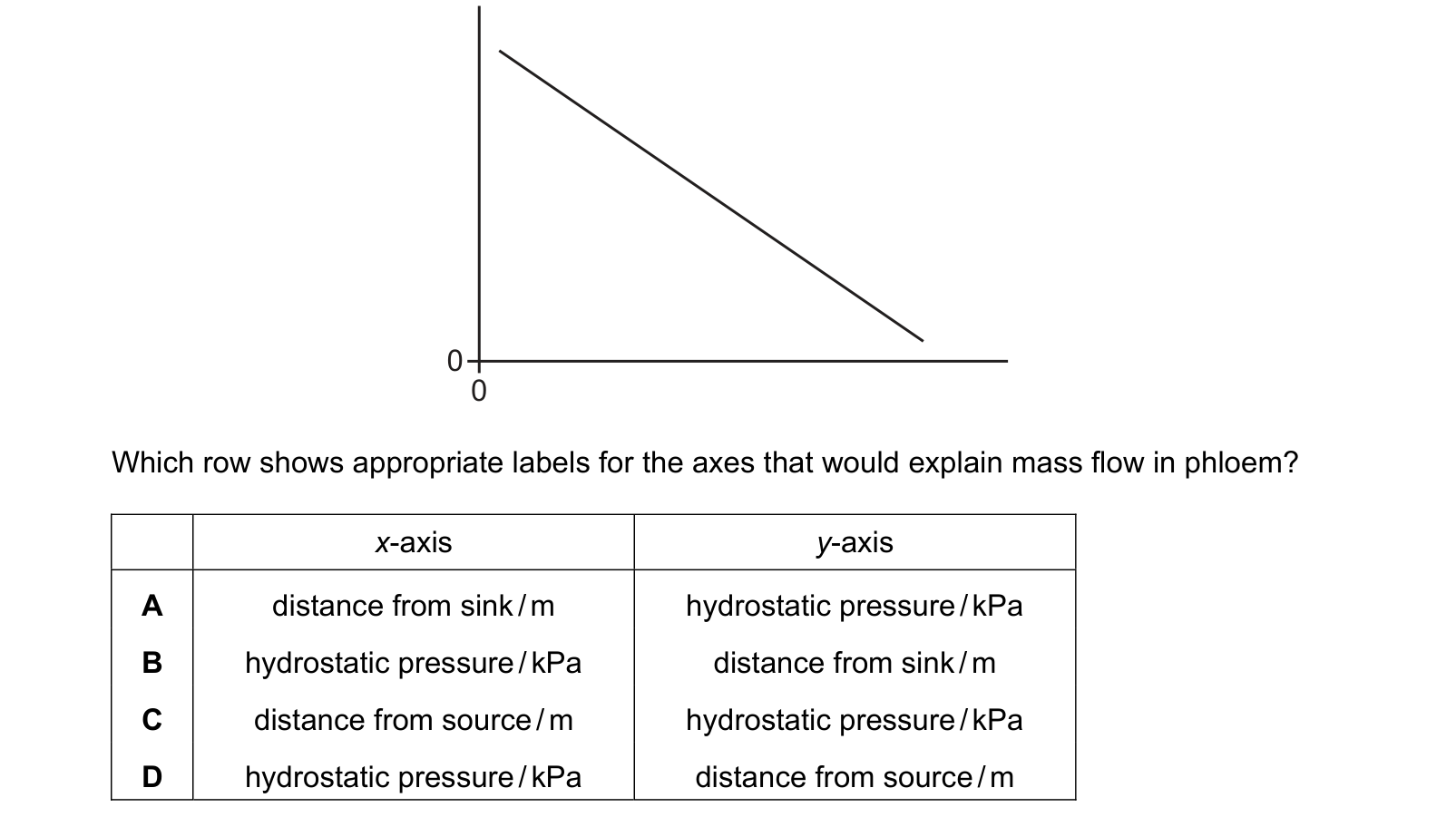
The graph shown does not have any axis labels. Which row shows appropriate labels for the axes that would explain mass flow in phloem? Each answer gives, in order: x-axis; y-axis.
Answer: C.
So pressure is at its highest at the source and falls as you move away from it. On the graph, the line starts high at zero and falls steadily, which matches hydrostatic pressure on the y-axis and distance from the source on the x-axis. That is C.
A has the same axes but measures from the sink, which puts the highest pressure at the sink and reverses the whole mechanism. If that were true the sap would flow the wrong way.
B and D put the axes the wrong way round. Distance is what you choose as you move along the phloem, and the pressure is what you then measure at each point, so distance is the independent variable and belongs on the x-axis. D describes the same relationship as C with the axes swapped, and it is the swap that makes it wrong as an answer.
Notice that the graph is a straight line. That is the point of calling it mass flow: the whole column of sap moves together down a smooth pressure gradient, rather than each molecule diffusing on its own.
Question 5
The diagrams show transverse sections through parts of plants. Which row is correct? Each answer gives, in order: contains lignin; transports organic solutes.
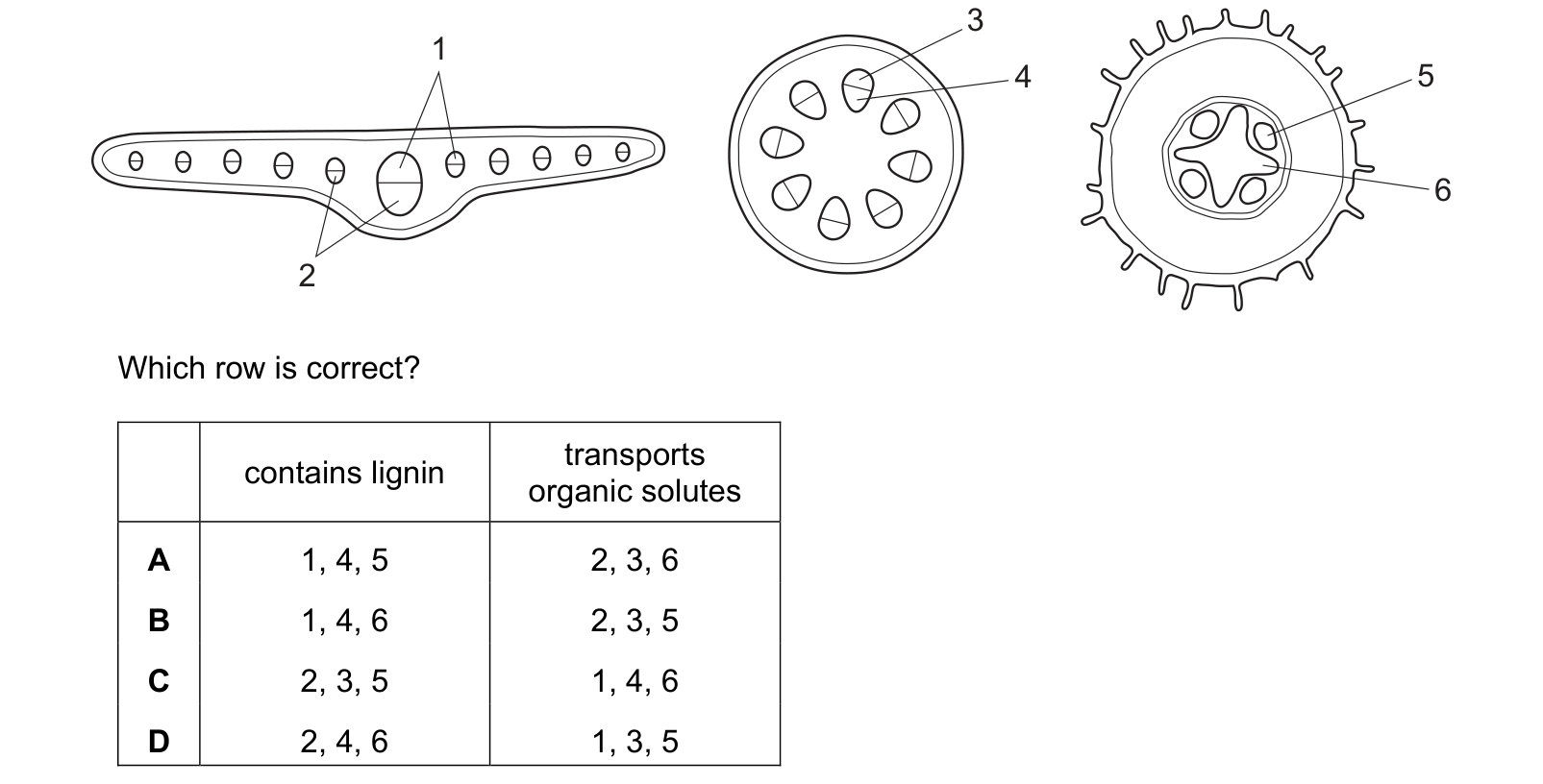
Answer: B.
In the leaf, the bundle sits in the midrib with xylem on top (1) and phloem underneath (2).
In the stem, the bundles form a ring near the outside, each with phloem on the outer side (3) and xylem on the inner side (4).
In the root, the vascular tissue is all in the centre, with the xylem (6) forming a star and the phloem (5) in the patches between its arms.
So the lignified tissue is 1, 4 and 6, and the tissue carrying organic solutes is 2, 3 and 5, which is B.
Two things follow from that list and are worth holding on to. Lignin means xylem, always: it waterproofs and stiffens the vessel walls so they can carry water under tension without collapsing. Organic solutes means phloem, because sucrose and amino acids are the assimilates being translocated. Water and mineral ions travel in the xylem, and they are not organic.
What this practice covers
These questions are drawn from past CIE 9700 Biology papers and filtered to structure of transport tissues. You answer, you find out immediately whether you were right, and you get the reasoning for the correct option and for each distractor. Wrong answers go to a mistakes locker so you can come back to exactly those.
Practice is free. You need an account only so your progress and your mistakes are still there next time.
What examiners see students get wrong here
These are the errors that cost marks on structure of transport tissues, taken from our own topic notes. Read them before you practise and you will recognise the traps in the questions.
- Saying xylem cells are alive. They are dead at maturity, and this is why they work.
- Saying lignin makes the wall permeable. It makes it impermeable, and pits are the exception that lets water pass.
- Saying sieve tube elements have no cytoplasm. They have a thin layer; what they lack is a nucleus.
- Attributing the ATP for phloem loading to the sieve tube element. It comes from the companion cell.
- Putting phloem on the inside of a stem vascular bundle. Xylem is the inner tissue.
Revise it first
If any of the above is unfamiliar, work through the notes before practising: Structure of transport tissues revision notes.