Movement into and out of cells: five questions to try now
Real past-paper questions, the answer key from the mark scheme, and the explanation that goes with it. No account needed to answer them.
Question 1
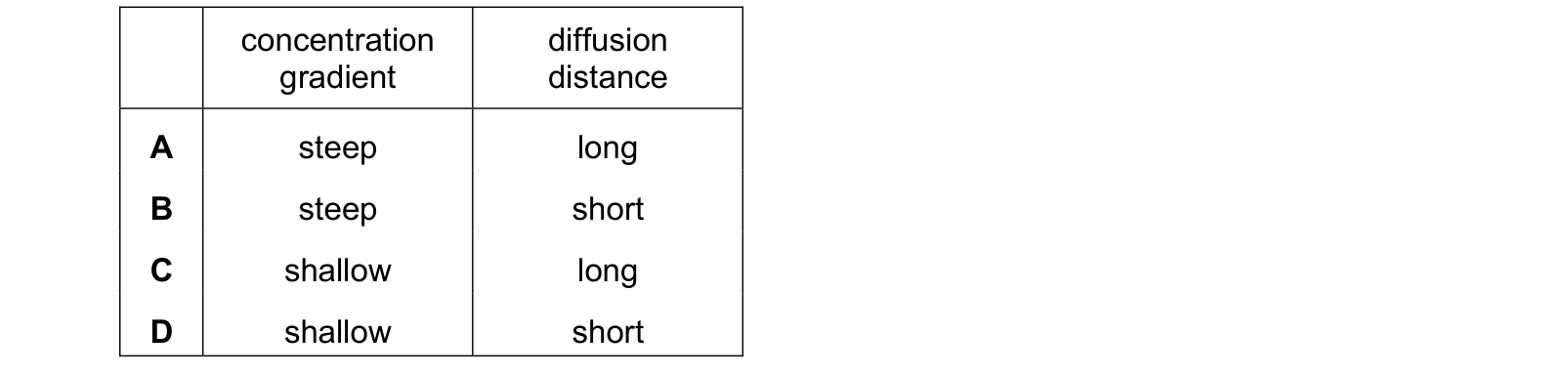
Which row shows the features of the gas exchange surface that increase diffusion of carbon dioxide and oxygen? Each answer gives, in order: concentration gradient; diffusion distance.
Answer: B.
A steep gradient means a large difference driving the movement, and a short distance means less to cross. So the exchange surface wants steep and short, which is B.
In the lungs, the steep gradient is kept up by ventilation replacing the alveolar air and by blood flow removing the oxygenated blood, so neither side is allowed to equalise. The short distance comes from a squamous alveolar wall against a squamous capillary wall, together under a micrometre.
Every other row asks for either a shallow gradient or a long path, and both make diffusion slower.
Question 2
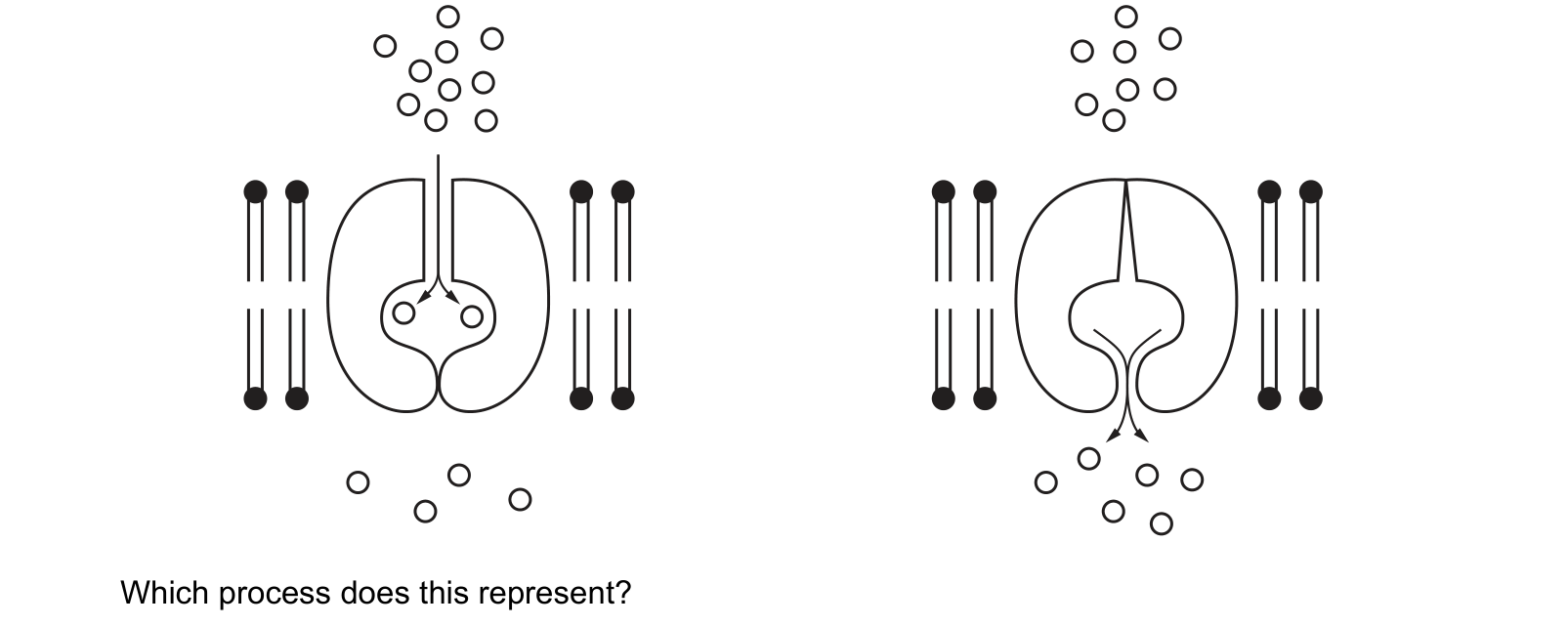
The diagram represents a process by which molecules move out of a cell through a cell surface membrane.
Which process does this represent?
Answer: C.
And they are moving from the side where they are crowded to the side where they are sparse, so they are going down their concentration gradient. Down a gradient means no energy is needed and no ATP is involved.
Through a protein and down a gradient is facilitated diffusion, which is C.
B, plain diffusion, would take the molecules straight through the phospholipid bilayer. The whole point of drawing the protein is that these molecules cannot do that, usually because they are too large or charged.
A, exocytosis, needs a vesicle to travel to the membrane and fuse with it. There is no vesicle here, and exocytosis also costs ATP.
D, osmosis, is the movement of water. The particles drawn are discrete solute molecules being carried by a protein, not water.
Question 3
Sodium ions can enter cells across the cell surface membrane.
Which methods could be used by sodium ions to cross a cell surface membrane and enter a cell?
Answer: B.
That leaves the two protein-mediated routes, and cells use both. Sodium moves down its gradient through channel proteins, which is facilitated diffusion, and against its gradient through pumps using ATP, which is active transport. So B.
A is too narrow. Sodium entering a cell down a steep gradient is exactly what happens in a nerve impulse and in gut co-transport, and neither uses ATP at the moment of entry.
The question says could be used, so any route the ion genuinely takes counts.
Question 4
The following are all processes that allow movement into cells.
1 phagocytosis
2 active transport
3 facilitated diffusion
Which processes require ATP?
Answer: A.
Phagocytosis is bulk transport: the membrane has to be folded around the material and pinched off, and moving membrane costs ATP.
Active transport is defined by using ATP. The carrier protein is phosphorylated, changes shape to carry the molecule across against its gradient, then returns.
Facilitated diffusion is the one that does not. It is passive, it moves substances only down their gradient, and the protein is a route rather than a pump. The energy comes from the kinetic energy the particles already have.
The test that separates them: a metabolic poison such as cyanide stops phagocytosis and active transport and leaves facilitated diffusion running.
Question 5
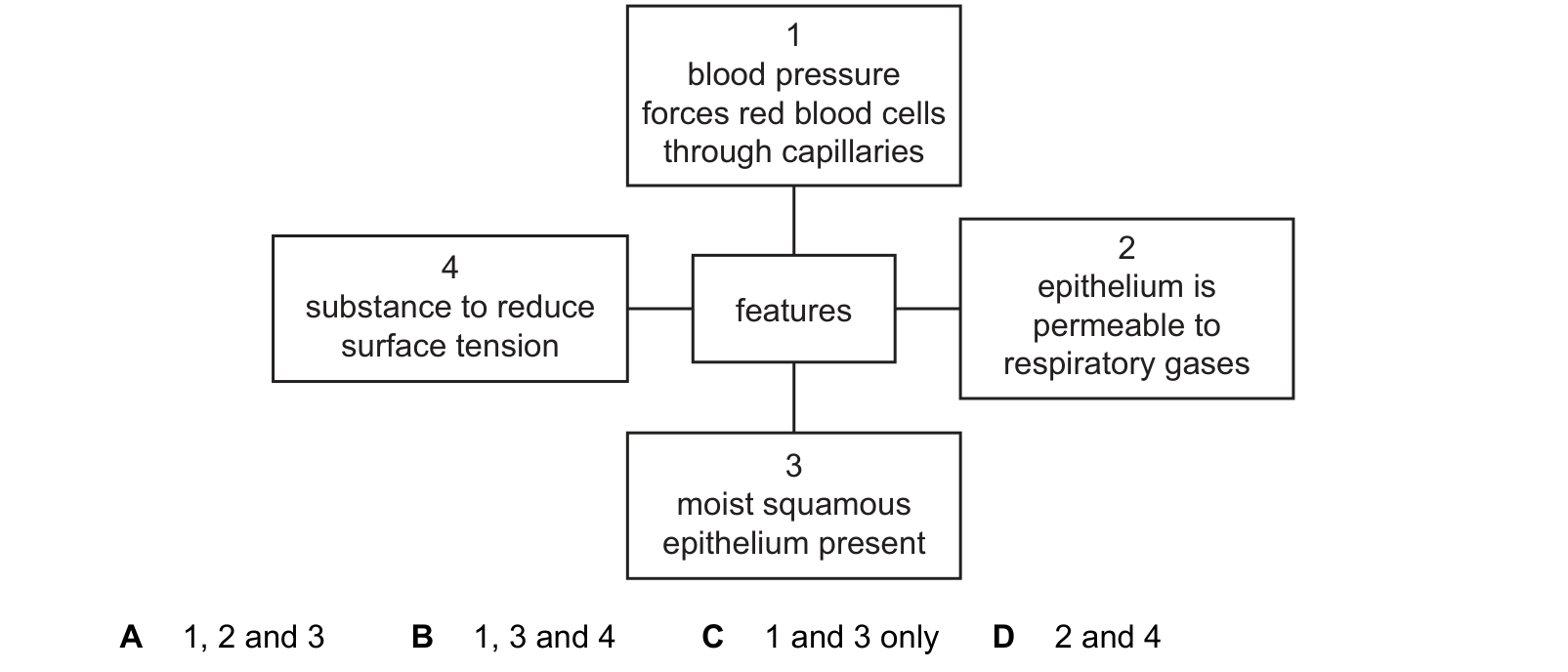
Which features are important for the process of diffusion of oxygen out of an alveolus?
Answer: A.
1 is important. Blood pressure forcing red blood cells through the capillaries keeps the blood moving, which carries oxygenated blood away and brings deoxygenated blood in. That is what maintains the concentration gradient. It also flattens the cells against the capillary wall, shortening the distance.
2 is important, and it is close to a definition. If the epithelium were not permeable to respiratory gases, nothing would cross it at all.
3 is important for two reasons. Squamous means flattened, so the barrier is thin and the diffusion distance short. Moist matters because oxygen has to dissolve in the film of water lining the alveolus before it can cross the membrane.
4 is the odd one out. A substance to reduce surface tension is surfactant, and it is genuinely essential, but for a different job: without it the water lining would pull the alveolus shut as you breathed out. That keeps the alveolus open and inflated, which is ventilation rather than diffusion.
1, 2 and 3, which is A.
Surfactant is a good example of a feature that matters enormously and still fails the question actually asked. Read what the stem is testing before deciding which real facts count.
What this practice covers
These questions are drawn from past CIE 9700 Biology papers and filtered to movement into and out of cells. You answer, you find out immediately whether you were right, and you get the reasoning for the correct option and for each distractor. Wrong answers go to a mistakes locker so you can come back to exactly those.
Practice is free. You need an account only so your progress and your mistakes are still there next time.
What examiners see students get wrong here
These are the errors that cost marks on movement into and out of cells, taken from our own topic notes. Read them before you practise and you will recognise the traps in the questions.
- Defining osmosis as movement "from high to low concentration of water". Use water potential.
- Getting the sign wrong. −200 kPa is higher than −800 kPa.
- Saying a plant cell bursts in pure water. The wall prevents it.
- Saying facilitated diffusion needs ATP. It does not; only active transport does.
- Saying a large organism has a large surface area so diffusion is fine. It is the ratio that matters, and it falls with size.
Revise it first
If any of the above is unfamiliar, work through the notes before practising: Movement into and out of cells revision notes.