Factors that affect enzyme action: five questions to try now
Real past-paper questions, the answer key from the mark scheme, and the explanation that goes with it. No account needed to answer them.
Question 1
Which row describes the expected effect on Vmax and Km when a competitive reversible inhibitor is added to an enzyme-catalysed reaction? Each answer gives, in order: effect on Vmax; substrate concentration at Km.
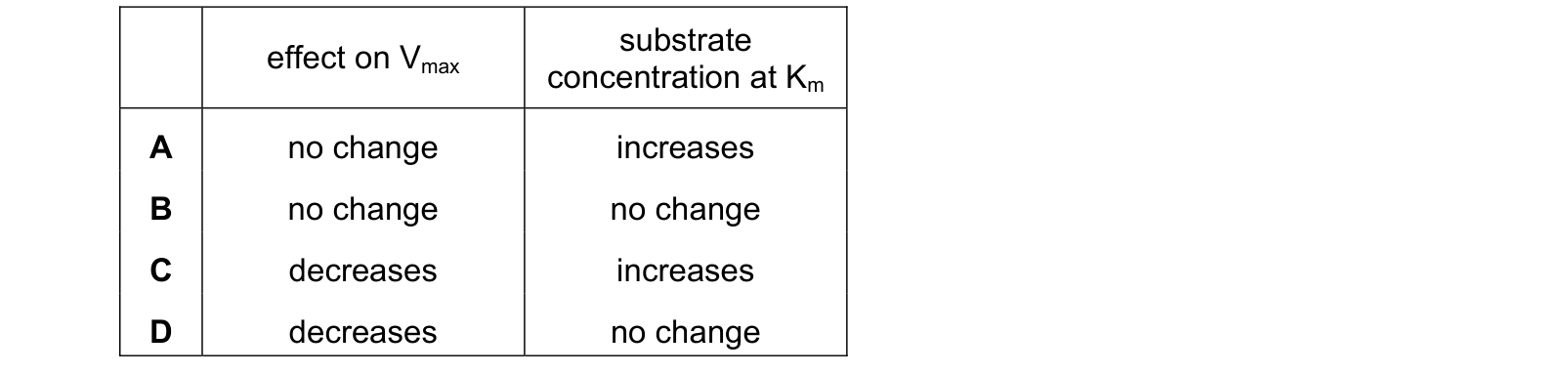
Answer: A.
What does change is how much substrate is needed to get halfway there. With the inhibitor present, more substrate is required to occupy half the active sites, so Km increases.
Rows C and D both lower Vmax, which is what a non-competitive inhibitor does, because no amount of extra substrate can displace an inhibitor that is not on the active site.
Question 2
How will the removal of a reversible non-competitive enzyme inhibitor affect an enzyme-catalysed reaction?
Answer: C.
Removing the inhibitor reverses exactly that: Vmax increases back towards normal and Km still does not change.
Options A and B both move Km, which is the tell that they are describing competitive inhibition. Only a competitor for the active site changes the apparent affinity.
Question 3
Which statement about the Michaelis–Menten constant (Km) is correct for an enzyme with a low affinity for its substrate?
Answer: A.
An enzyme with a low affinity binds its substrate reluctantly, so a lot of substrate is needed before it reaches half speed. That is a high Km, and for the same reason it needs a high substrate concentration to reach Vmax at all. A is the only row with both.
Low Km means high affinity. Reading it the other way round is the single most common error in this topic.
Question 4
Which description identifies a reversible, non-competitive enzyme inhibitor?
Answer: B.
Binding there changes the enzyme's tertiary structure, which changes the shape of the active site, so the substrate no longer fits. Because the inhibitor and the substrate are not competing for the same place, adding more substrate does not help, and Vmax falls while Km is unchanged.
A describes a competitive inhibitor. C and D describe nothing real: an inhibitor binds one kind of site, and a molecule that could use either would not have the specificity that makes inhibition selective in the first place.
Question 5
What is a feature of competitive enzyme inhibition?
Answer: B.
A describes an irreversible inhibitor: a reversible competitive inhibitor binds and leaves. C is wrong because inhibitors that distort the enzyme change its tertiary structure, not its secondary, and that is non-competitive inhibition in any case. D overstates it: the inhibitor is a similar shape to the substrate, close enough to fit the site, not identical to it.
What this practice covers
These questions are drawn from past CIE 9700 Biology papers and filtered to factors that affect enzyme action. You answer, you find out immediately whether you were right, and you get the reasoning for the correct option and for each distractor. Wrong answers go to a mistakes locker so you can come back to exactly those.
Practice is free. You need an account only so your progress and your mistakes are still there next time.
What examiners see students get wrong here
These are the errors that cost marks on factors that affect enzyme action, taken from our own topic notes. Read them before you practise and you will recognise the traps in the questions.
- Explaining the temperature curve with kinetic energy alone, and never mentioning denaturation.
- Saying high temperature "kills" the enzyme. An enzyme is not alive; it is denatured.
- Getting Km backwards. Low Km means high affinity.
- Saying a competitive inhibitor lowers Vmax. It does not, given enough substrate.
- Saying a non-competitive inhibitor "changes the shape of the substrate". It changes the shape of the active site.
Revise it first
If any of the above is unfamiliar, work through the notes before practising: Factors that affect enzyme action revision notes.