Mode of action of enzymes: five questions to try now
Real past-paper questions, the answer key from the mark scheme, and the explanation that goes with it. No account needed to answer them.
Question 1
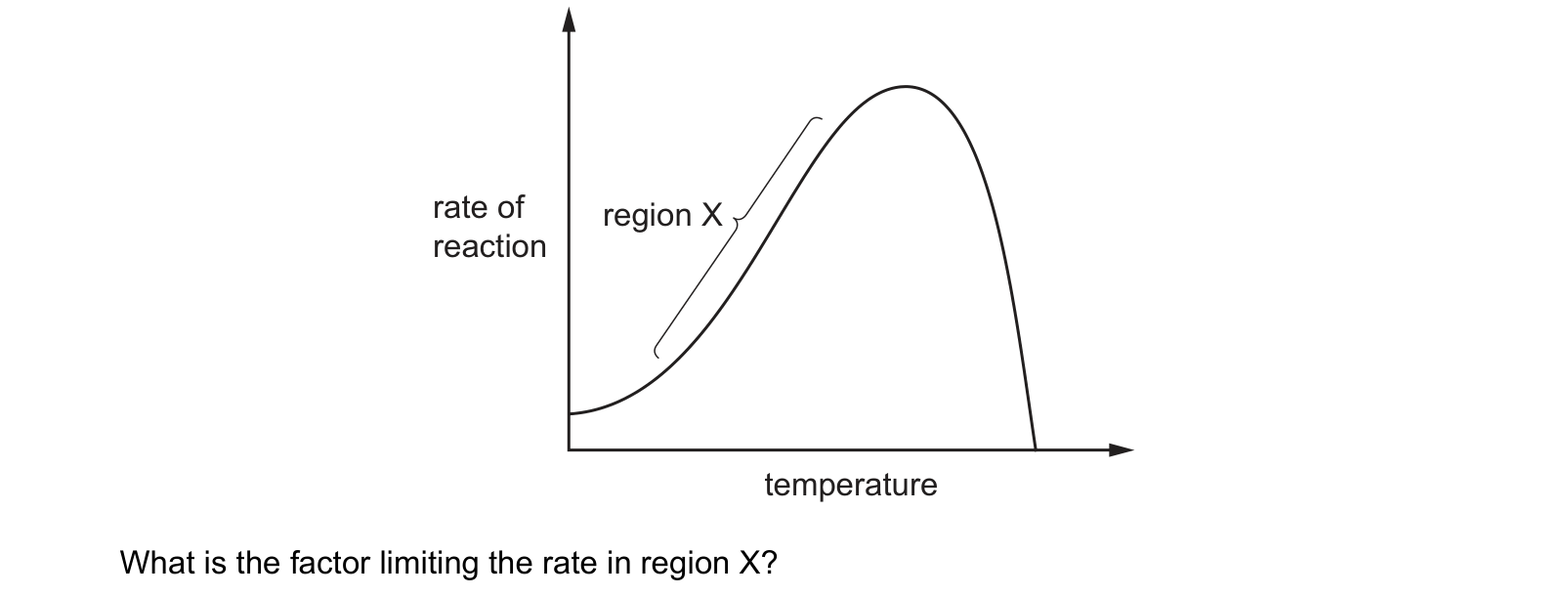
The graph shows how the rate of an enzyme-controlled reaction is affected by the change in temperature. All other variables were standardised. What is the factor limiting the rate in region X?
Answer: C.
The mechanism is kinetic energy. Warmer molecules move faster, so enzyme and substrate collide more often and with more energy, and more of those collisions succeed in forming an enzyme-substrate complex. Every extra degree buys more collisions, right up to the optimum.
A, B and D would each show up differently on this graph. If substrate concentration or enzyme concentration were limiting, raising the temperature would not lift the rate and the line would be flat through region X. Empty active sites describes the same situation from the other side: on the plateau of a substrate-concentration graph the sites are all full, but here the line is still rising, so that is not what is holding the rate back.
Beyond the peak the curve falls steeply, and that is a different mechanism entirely. There the hydrogen and ionic bonds holding the tertiary structure break, the active site loses its shape, and the enzyme is permanently denatured.
Question 2
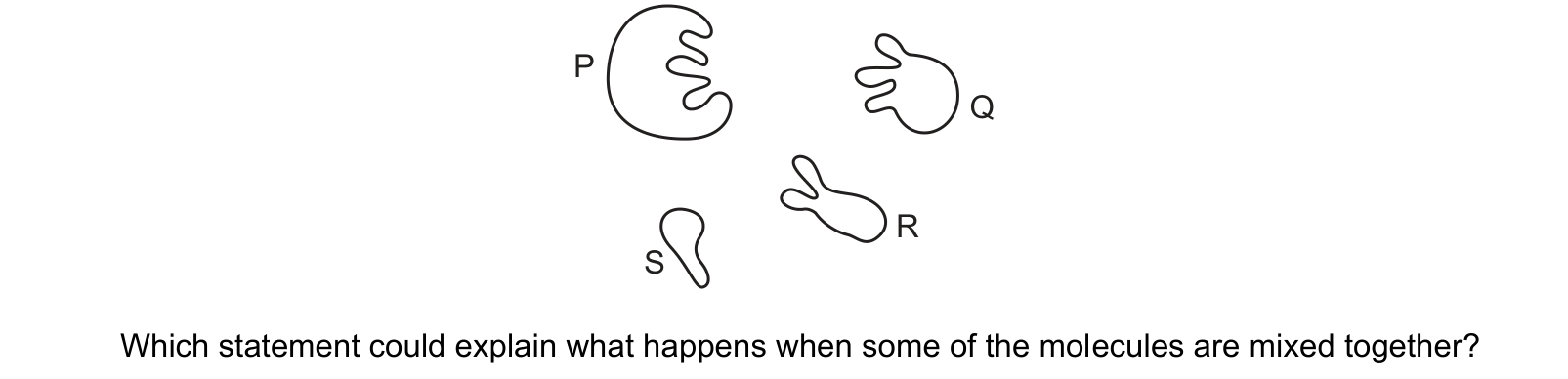
The diagram shows different molecules in a solution. Which statement could explain what happens when some of the molecules are mixed together?
Answer: C.
A contradicts itself. A non-competitive inhibitor by definition does not bind the active site, and an enzyme-substrate complex is by definition the enzyme joined to its substrate. An inhibitor cannot form one.
B gets the mechanism of inhibition wrong. An inhibitor does not raise the activation energy. The uncatalysed activation energy is a property of the reaction itself; what an inhibitor does is take enzyme molecules out of service so fewer substrate molecules are helped over that barrier.
D confuses the enzyme with the substrate. P is the enzyme, the large molecule with the cleft, and enzymes are not consumed or broken down by the reactions they catalyse. That is why a tiny amount of enzyme can process an enormous amount of substrate.
C is left, and the shapes support it. R and S are the two small molecules whose outlines match the two halves of the groove in P, so both can bind to the active site at the same time. That is what an enzyme catalysing a synthesis reaction does: hold two substrates side by side in the right orientation so they can be joined.
Question 3
A student investigated the effect of substrate concentration on the rate of an enzyme-catalysed reaction.
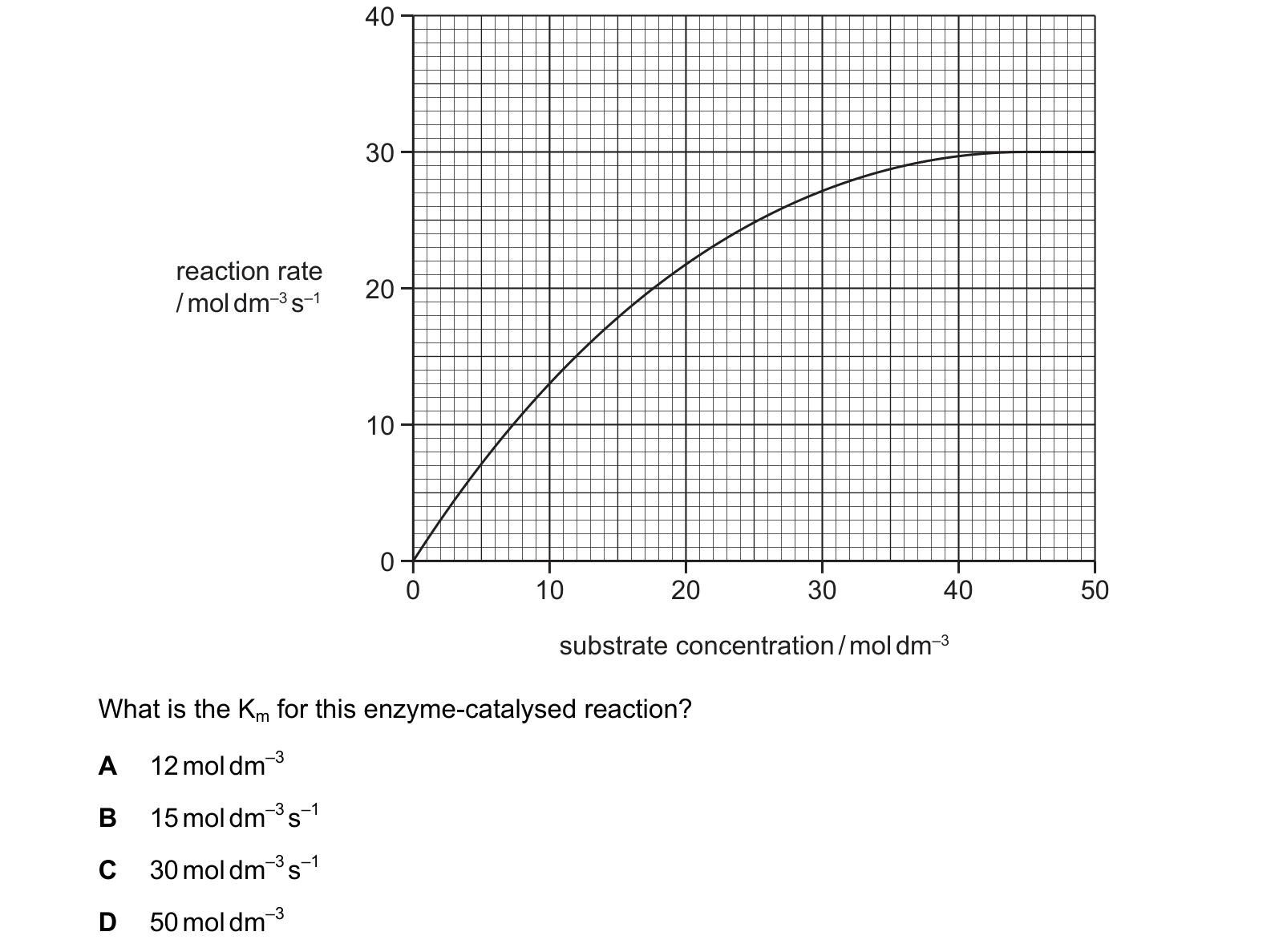
The student plotted the results in a graph. What is the Km for this enzyme-catalysed reaction?
Answer: A.
The curve levels off at 30 mol dm⁻³ s⁻¹, so Vmax is 30 and half of it is 15 mol dm⁻³ s⁻¹. Now go across from 15 on the rate axis to the curve, then straight down: the substrate concentration there is 12 mol dm⁻³, which is A.
The units settle it even faster than the graph does. Kₘ is a concentration, so it must be in mol dm⁻³. B and C are quoted in mol dm⁻³ s⁻¹, which is a rate, so neither can be a Kₘ whatever number is attached. C is in fact just Vmax with the wrong label on it, and B is half of Vmax, the rate you read across from rather than the concentration you read down to.
D, 50 mol dm⁻³, has the right unit but is the far end of the axis, where the curve has already flattened. That is a concentration well past saturation, not the half-way point.
What Kₘ tells you is how tightly the enzyme holds its substrate. A low Kₘ means half speed is reached at a low substrate concentration, so the enzyme has a high affinity for its substrate.
Question 4
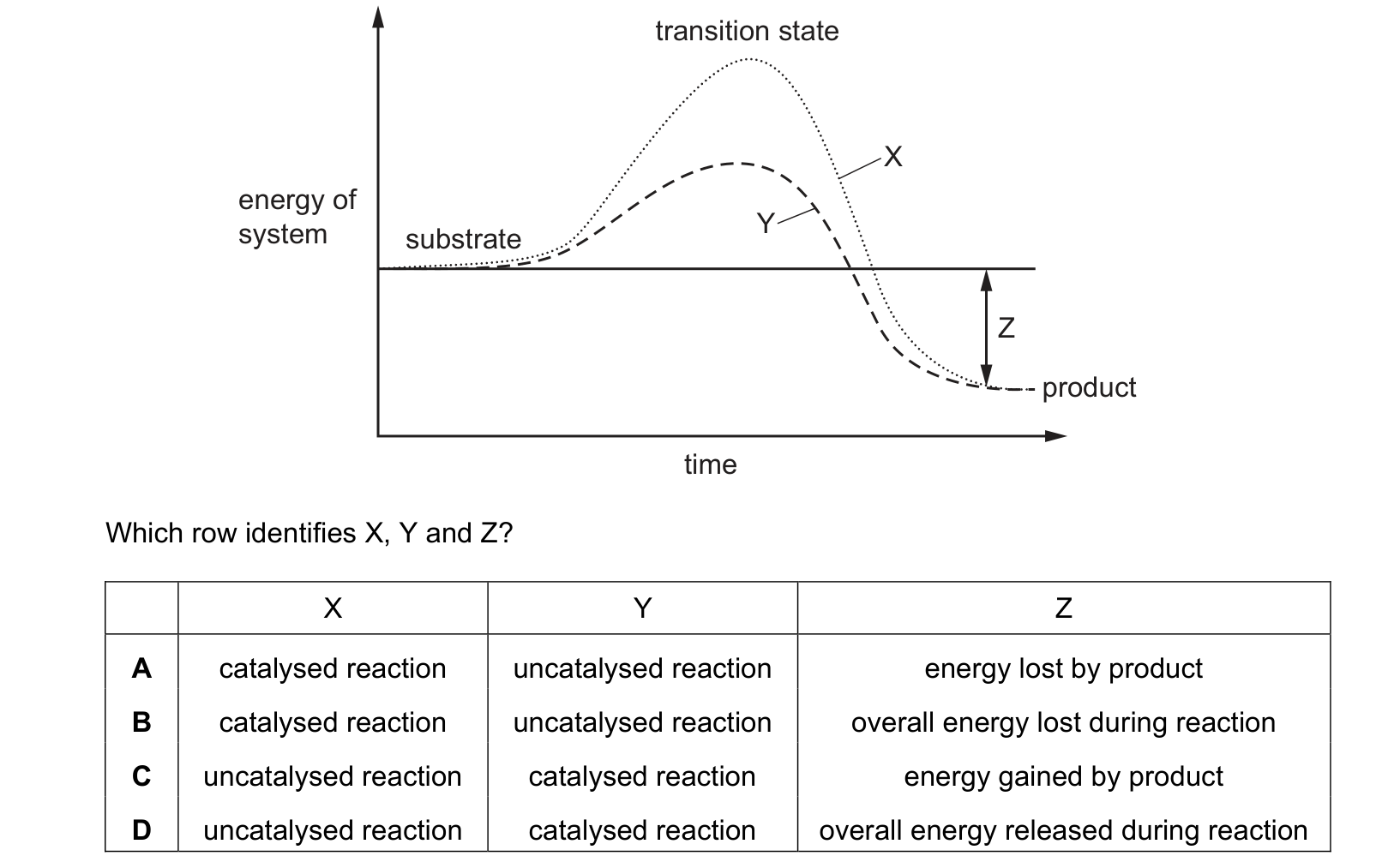
The graph shows the effect of an enzyme on a reaction. Which row identifies X, Y and Z? Each answer gives, in order: X; Y; Z.
Answer: D.
X is the higher peak, so it needs more energy to get started. That is the uncatalysed reaction. Y is the lower peak, and lowering the activation energy is exactly what an enzyme does, so Y is the catalysed reaction. That removes A and B.
Z is the vertical arrow from the substrate level down to the product level. The product finishes below the substrate, so energy has left the system: Z is the overall energy released during the reaction. So D.
C calls Z the energy gained by the product, which has the sign the wrong way round. The product ends up with less energy, not more.
The most important feature of the graph is what does not change: the substrate level and the product level are the same for both curves, so Z is the same either way. An enzyme changes how fast a reaction happens, never how much energy it releases and never which way it goes.
Question 5
Which row is correct for enzymes that catalyse reactions using the lock-and-key hypothesis? Each answer gives, in order: effect of the enzyme on the activation energy of the reaction being catalysed; shape of active site in comparison to the substrate.
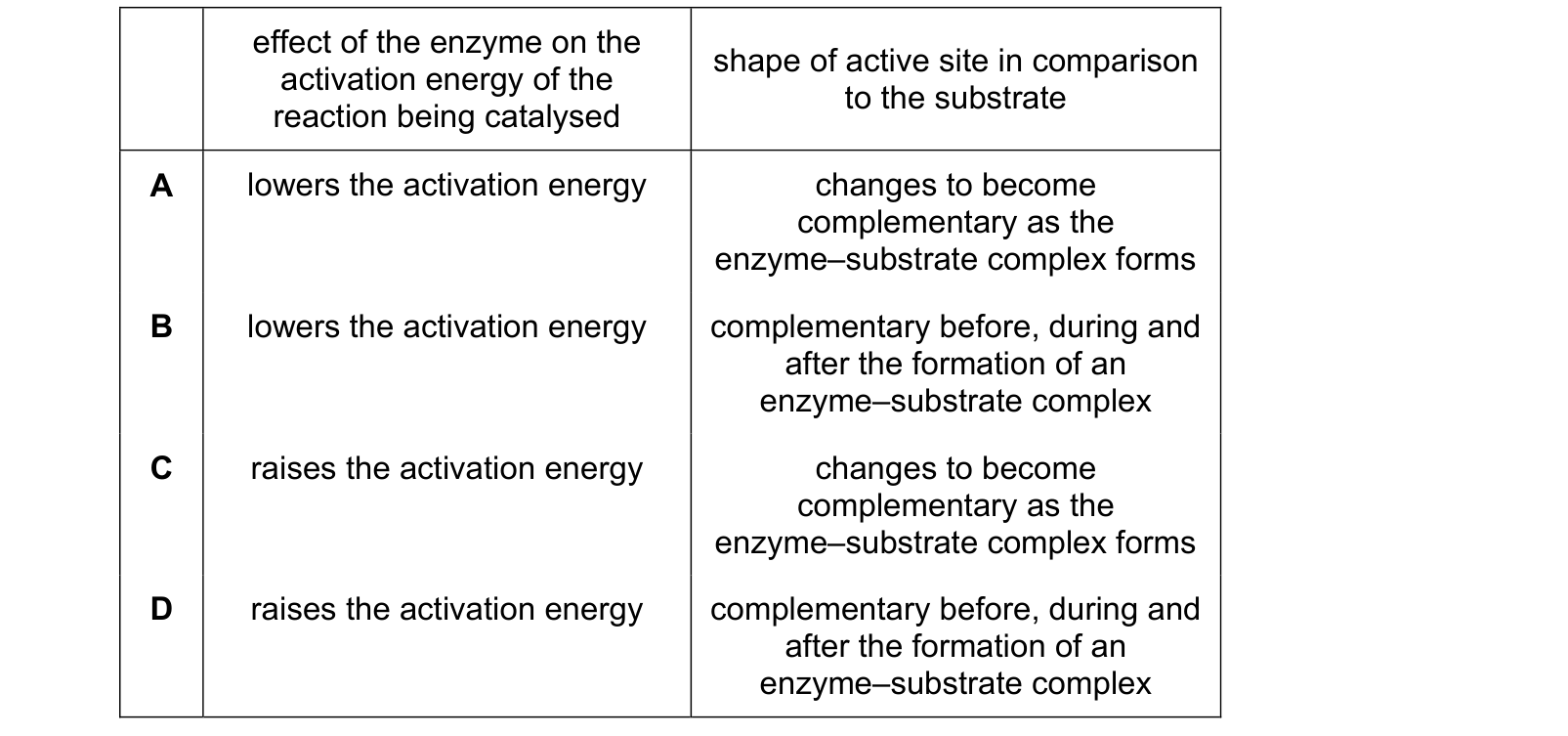
Answer: B.
Activation energy: lowered. That is what a catalyst does, and it is worth being precise about how. The enzyme does not push the reaction along; it holds the substrates in the right orientation and strains the bonds that are about to break, so the transition state is easier to reach. The overall energy change of the reaction is untouched, which is why an enzyme speeds up a reaction without changing how far it goes. C and D are gone.
Shape of the active site: complementary throughout. That is the whole content of the lock-and-key hypothesis, which the question names. The active site is already the right shape before the substrate arrives, like a lock waiting for its key, and it does not change.
So B.
A describes induced fit, the model that replaced lock-and-key: there the active site is not quite complementary at first and moulds itself around the substrate as the complex forms. Both models appear on the syllabus and questions distinguish them exactly here, so read which one is being asked about before answering.
What this practice covers
These questions are drawn from past CIE 9700 Biology papers and filtered to mode of action of enzymes. You answer, you find out immediately whether you were right, and you get the reasoning for the correct option and for each distractor. Wrong answers go to a mistakes locker so you can come back to exactly those.
Practice is free. You need an account only so your progress and your mistakes are still there next time.
What examiners see students get wrong here
These are the errors that cost marks on mode of action of enzymes, taken from our own topic notes. Read them before you practise and you will recognise the traps in the questions.
- Saying the active site is "the same shape as" the substrate. It is complementary to it.
- Saying an enzyme "lowers the energy needed for the reaction". It lowers the activation energy, not the overall energy change.
- Saying denaturation "breaks the enzyme down" or "breaks the peptide bonds". Peptide bonds are unaffected; the bonds holding the tertiary structure break.
- Saying enzymes are used up. They are not, which is why a small quantity catalyses a large amount of reaction.
- Treating lock and key as simply wrong. It is an accurate description of specificity that induced fit refines.
Revise it first
If any of the above is unfamiliar, work through the notes before practising: Mode of action of enzymes revision notes.