Antibiotics: five questions to try now
Real past-paper questions, the answer key from the mark scheme, and the explanation that goes with it. No account needed to answer them.
Question 1
Which row shows how penicillin kills bacteria? Each answer gives, in order: process inhibited by penicillin; effect on bacteria.
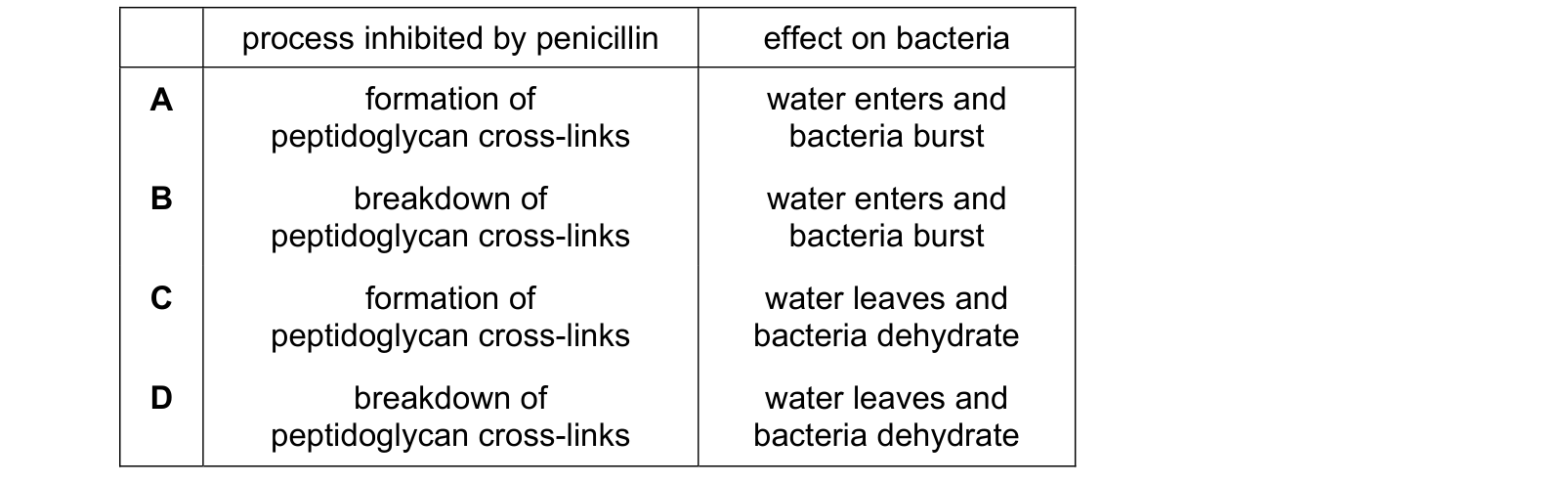
Answer: A.
The second column follows from water potential. Bacterial cytoplasm has a much lower water potential than its surroundings, so water enters constantly by osmosis. The wall is what resists the resulting pressure. Weaken it and the cell bursts, which is A.
C has the water moving the wrong way. Nothing about penicillin changes the water potential gradient; it removes the structure that was holding the pressure back.
Question 2
What will reduce the rate at which bacteria become resistant to antibiotics?
1 prescribing two antibiotics with different modes of action
2 prescribing different antibiotics for the same bacterium
3 finishing a prescribed course of antibiotics
Answer: A.
Using two antibiotics with different modes of action means a bacterium would have to be resistant to both to survive, and the chance of one organism carrying both mutations is very small: statement 1.
Rotating between different antibiotics stops any one of them applying constant selection pressure, so resistant strains are not steadily favoured: statement 2.
Finishing the course matters because stopping early leaves the hardiest survivors alive and free to multiply, and those are the ones closest to being resistant: statement 3.
Every one of these works by reducing selection pressure, which is the thing to say in an answer rather than listing the measures.
Question 3
Bacteria can become resistant to antibiotics.
What can help reduce the development of antibiotic resistance in bacteria?
1 Use specific antibiotics instead of wide spectrum.
2 Use antibiotics to treat viral infections.
3 Develop new antibiotics.
Answer: C.
A narrow-spectrum antibiotic targets the species causing the infection and leaves other bacterial populations unexposed, so far fewer bacteria are under selection pressure: statement 1. Developing new antibiotics gives an alternative when resistance to an existing one has spread: statement 3.
Statement 2 is the reverse of good practice. Antibiotics have no effect on viruses at all, because a virus has no cell wall, no ribosomes of its own and no metabolism for the drug to attack. Prescribing them for a viral infection does nothing for the patient while exposing all their harmless bacteria to the drug, which is one of the largest single drivers of resistance.
Question 4
How does the antibiotic penicillin affect the metabolism of a bacterial cell?
Answer: B.
That means new wall is laid down weak. Water keeps entering by osmosis because the cytoplasm has a much lower water potential than the surroundings, the weakened wall cannot resist the pressure, and the cell bursts.
C and D both have penicillin breaking down existing wall. It does not: it prevents new wall being built properly, which is why penicillin only affects bacteria that are actively growing. A dormant one is untouched, and that is part of why TB is so hard to treat.
A has the mechanism backwards. Nothing prevents water uptake; the problem is that water uptake continues.
Question 5
The graph shows changes in the antibiotic resistance of a species of bacterium between 2000 and 2016 in one country. Samples of bacteria were collected every year from 48 hospitals. The bacteria were tested to see if they showed resistance to five different antibiotics. percentage of antibiotic resistant bacteria What can be concluded from the data in the graph?
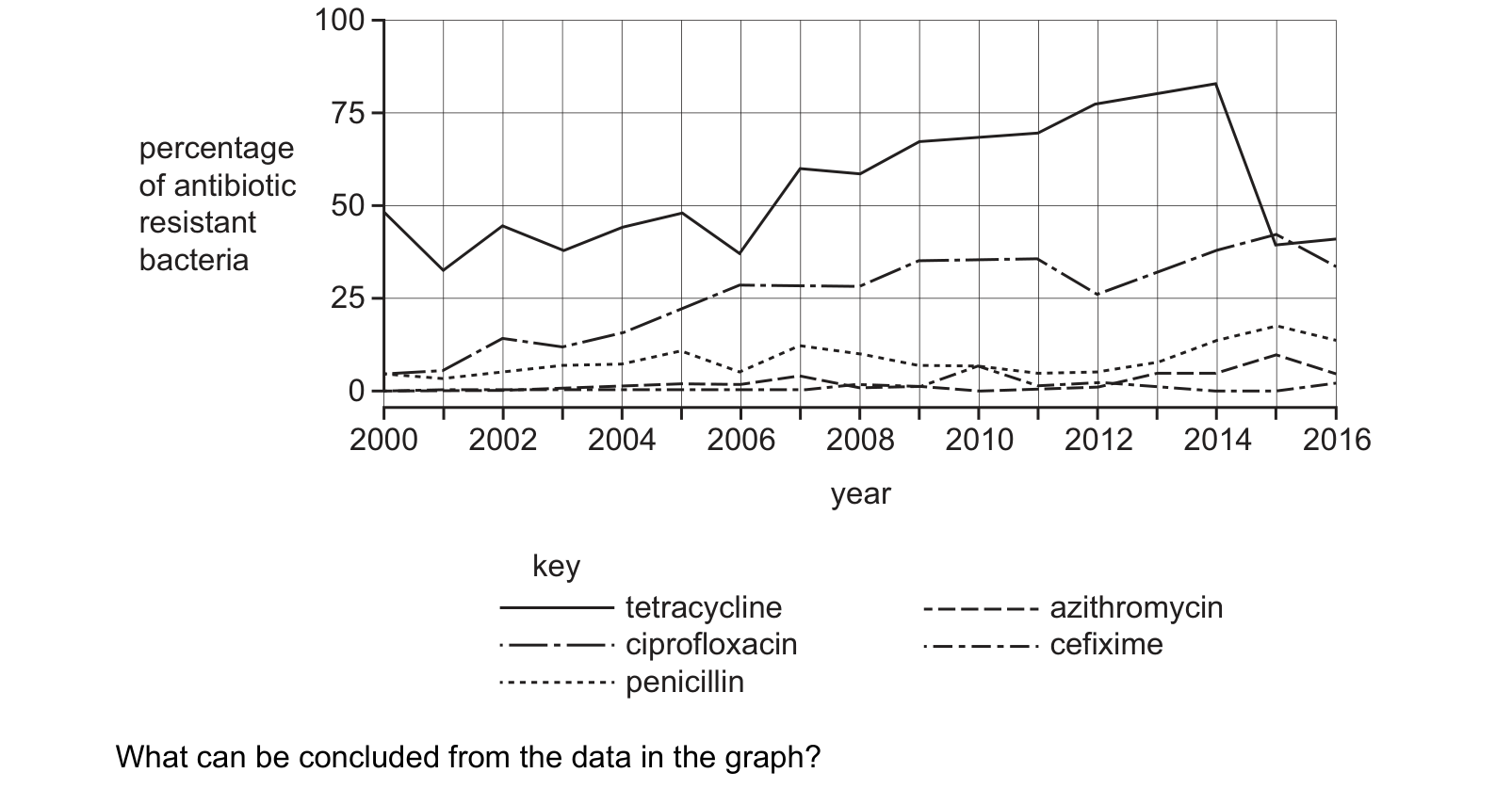
Answer: B.
B is the only statement the graph supports. Look at 2015 and count the lines that turn over there. Ciprofloxacin, penicillin and azithromycin all reach their highest point in 2015 and fall in 2016. That is three of the five, and it is a plain reading of the shape of the lines.
A and C both claim a cause. The graph records how many bacteria were resistant each year and nothing else. It contains no measurement of how much ciprofloxacin was prescribed and no record of when treatment guidelines changed, so neither overuse nor a guideline change can be concluded from it. Overuse is a plausible explanation, and it may well be the real one, but plausible is not the same as shown.
D is a factual claim the graph contradicts. Tetracycline resistance starts at nearly 50% in 2000 and finishes near 40% in 2016, so it is lower at the end, not higher.
A useful habit in data questions: circle the words "caused", "because" and "all" before you look at the graph. They are where most wrong options hide.
What this practice covers
These questions are drawn from past CIE 9700 Biology papers and filtered to antibiotics. You answer, you find out immediately whether you were right, and you get the reasoning for the correct option and for each distractor. Wrong answers go to a mistakes locker so you can come back to exactly those.
Practice is free. You need an account only so your progress and your mistakes are still there next time.
What examiners see students get wrong here
These are the errors that cost marks on antibiotics, taken from our own topic notes. Read them before you practise and you will recognise the traps in the questions.
- Saying the antibiotic causes the mutation. Mutation is random and prior; the antibiotic selects.
- Saying bacteria "become immune". Immunity is something a host has against a pathogen, not something a bacterium has against a drug.
- Saying penicillin dissolves or destroys the cell wall. It prevents new wall being cross-linked, so it only affects growing cells.
- Saying antibiotics do not affect viruses because viruses are too small. It is because they have no cellular machinery of their own to target.
- Explaining "finish the course" as making sure you feel better. It is about not leaving the most resistant survivors behind.
Revise it first
If any of the above is unfamiliar, work through the notes before practising: Antibiotics revision notes.