The immune system: five questions to try now
Real past-paper questions, the answer key from the mark scheme, and the explanation that goes with it. No account needed to answer them.
Question 1
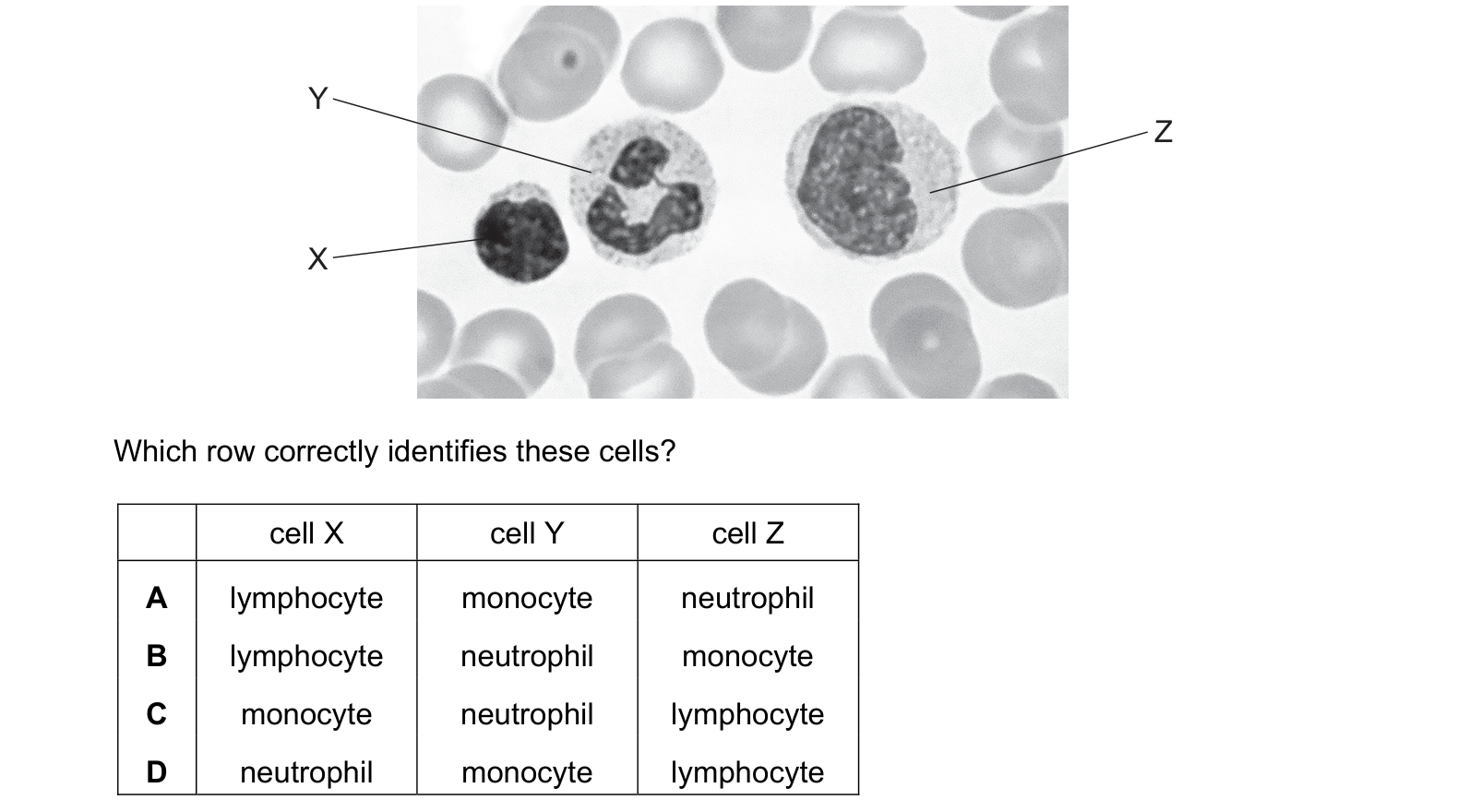
The photomicrograph shows three white blood cells labelled X, Y and Z. Which row correctly identifies these cells? Each answer gives, in order: cell X; cell Y; cell Z.
Answer: B.
X is small, and almost all of it is nucleus: a dense round mass with only the thinnest rim of cytoplasm around it. That is a lymphocyte.
Y has a nucleus divided into several lobes joined by thin strands, sitting in granular cytoplasm. A lobed nucleus like that belongs to a neutrophil, and the lobes are what let it squeeze between capillary endothelial cells to reach an infection.
Z is the largest of the three, with plenty of cytoplasm and a single nucleus curved into a kidney or horseshoe shape. That is a monocyte, the cell that leaves the blood and becomes a macrophage.
Lymphocyte, neutrophil, monocyte, which is B.
The pale discs filling the background are red blood cells, and they are a useful ruler. A lymphocyte is only slightly bigger than one; a monocyte is two to three times the width. If a cell you have called a lymphocyte is much larger than the red cells around it, it is a monocyte.
Question 2
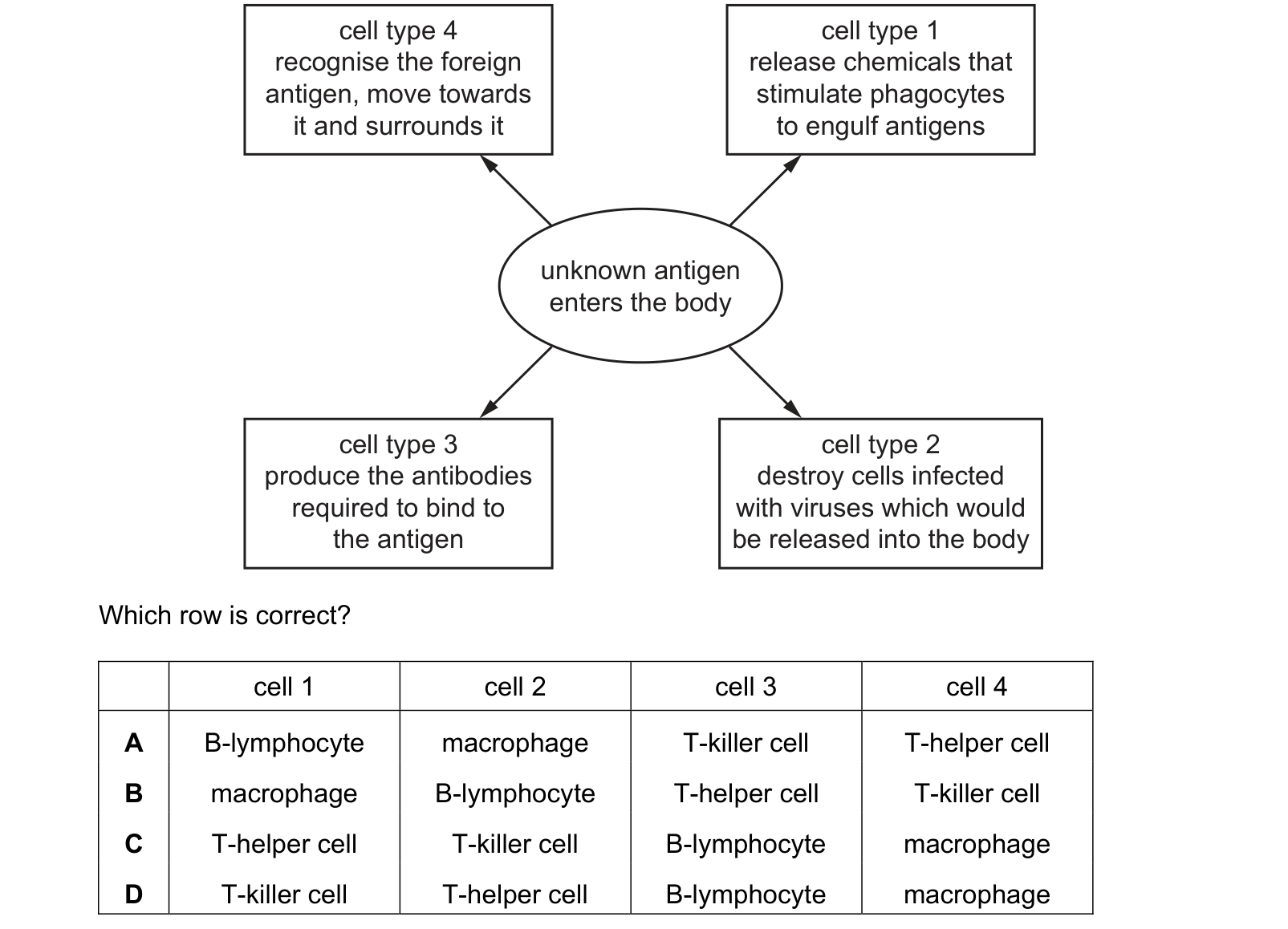
A student used a diagram to show four types of cells involved in the primary immune response. Which row is correct? Each answer gives, in order: cell 1; cell 2; cell 3; cell 4.
Answer: C.
Cell type 4 recognises the antigen, moves towards it and surrounds it. Surrounding and engulfing is phagocytosis, so cell type 4 is the macrophage. Only C and D put the macrophage there, so A and B are gone in one step.
That leaves the difference between C and D, which is only the order of the first two. Cell type 1 releases chemicals that stimulate phagocytes to engulf antigens. Those chemicals are cytokines and the cell that secretes them to coordinate everyone else is the T-helper cell. Cell type 2 destroys the body's own cells once a virus is inside them, before new virus can be released, and that is the T-killer cell.
Cell type 3 produces the antibodies, so it is the B-lymphocyte, or strictly the plasma cells that a B-lymphocyte divides into.
T-helper, T-killer, B-lymphocyte, macrophage, which is C.
Question 3
Some responses made by cells of the immune system to a pathogen are listed.
1 mitosis
2 recognises a pathogen
3 produces memory cells
4 secretes enzymes
Which responses are correct for phagocytes?
Answer: D.
A phagocyte recognises a pathogen, helped by receptors and by antibodies already stuck to it: statement 2. It engulfs it, lysosomes fuse with the vesicle, and hydrolytic enzymes are secreted into it to digest the pathogen: statement 4.
Statements 1 and 3 belong to lymphocytes. Phagocytes do not divide into clones and they produce no memory cells, which is exactly why the non-specific response is the same every time and never gets faster with experience.
That is the whole difference between the two arms of the immune system, and this question and its B lymphocyte twin are the two halves of it.
Question 4
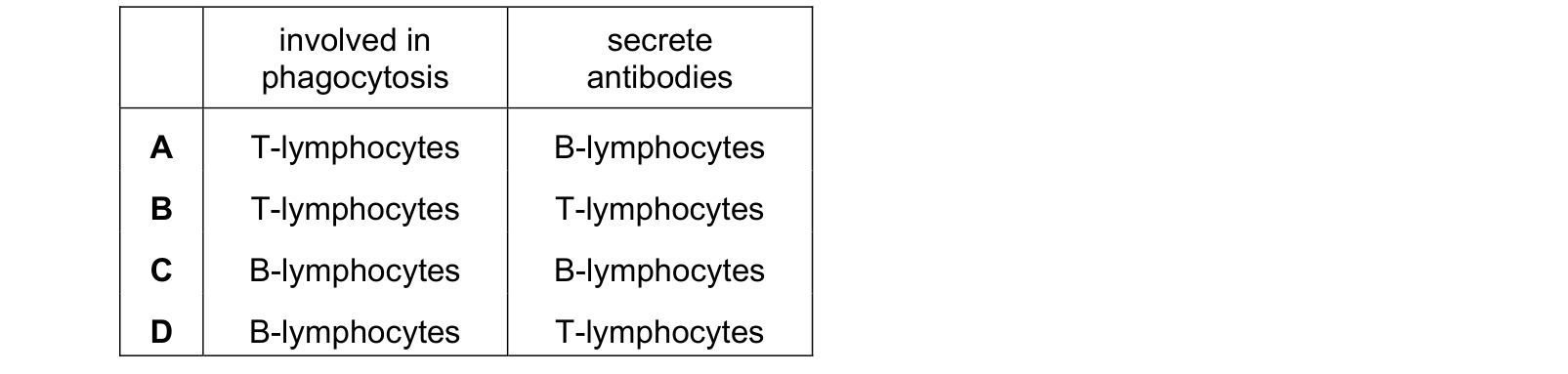
Which row is correct? Each answer gives, in order: involved in phagocytosis; secrete antibodies.
Answer: A.
The second half is straightforward: B lymphocytes differentiate into plasma cells, and plasma cells are the antibody factories. That alone eliminates B and D.
The first half is the one to think about. T helper cells interact with macrophages that have engulfed and digested a pathogen and are displaying its antigens, and the cytokines they release stimulate phagocytes to engulf more. So T lymphocytes are involved in phagocytosis without doing any engulfing themselves.
C fails because it gives B lymphocytes both jobs, and B lymphocytes are not part of the phagocytic response at all.
Question 5
What will be produced by the division of memory cells during a secondary immune response?
Answer: B.
That is exactly why the secondary response is so much faster and larger. The searching and the initial multiplying were done during the primary response, so the memory cells are already present, already specific, and already numerous. They differentiate into plasma cells almost immediately, with very little lag.
A, C and D are all cells of the non-specific response. Macrophages, neutrophils and monocytes come from stem cells in the bone marrow, not from memory cells, and none of them is produced by the specific immune system dividing.
What this practice covers
These questions are drawn from past CIE 9700 Biology papers and filtered to the immune system. You answer, you find out immediately whether you were right, and you get the reasoning for the correct option and for each distractor. Wrong answers go to a mistakes locker so you can come back to exactly those.
Practice is free. You need an account only so your progress and your mistakes are still there next time.
What examiners see students get wrong here
These are the errors that cost marks on the immune system, taken from our own topic notes. Read them before you practise and you will recognise the traps in the questions.
- Saying the immune system "makes an antibody to fit" a new pathogen. The lymphocyte with the right receptor already exists and is selected.
- Saying phagocytes are specific. They are non-specific; lymphocytes are specific.
- Mixing up where the two lymphocytes mature. B in bone marrow, T in thymus.
- Saying plasma cells are memory cells. Plasma cells secrete antibody and die within days; memory cells persist.
- Explaining the secondary response as "the body remembers", without naming memory cells and their rapid division into plasma cells.
Revise it first
If any of the above is unfamiliar, work through the notes before practising: The immune system revision notes.