Antibodies and vaccination: five questions to try now
Real past-paper questions, the answer key from the mark scheme, and the explanation that goes with it. No account needed to answer them.
Question 1
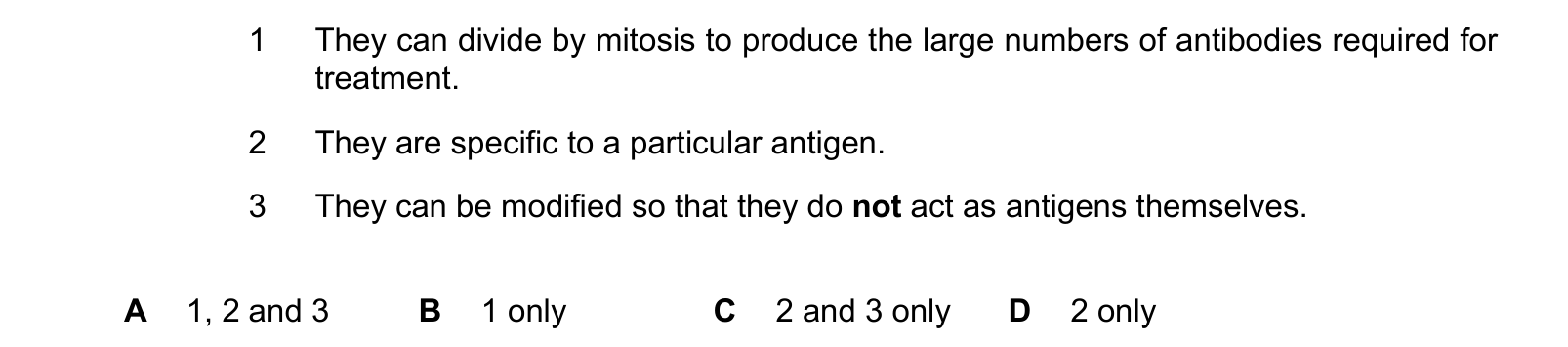
Monoclonal antibodies are now being used to treat some human diseases.
What explains why monoclonal antibodies are suitable for this purpose?
Answer: C.
1 is wrong. Antibodies are molecules, and molecules do not divide by mitosis. What divides is the hybridoma cell that secretes them, which is exactly why hybridomas are made in the first place. As written, the statement has proteins undergoing cell division.
2 is correct, and it is the whole point of a monoclonal antibody. Every molecule comes from one clone of cells, so every one has the same variable region and binds the same antigen. That is what lets a drug find one kind of cell, a tumour marker say, and leave the rest of the body alone.
3 is correct. An antibody from a mouse is a foreign protein, so a human immune system would attack it. The molecule can be humanised, altering the constant region so the patient's own immune system does not treat it as an antigen, which is what makes repeated doses possible.
2 and 3 only, which is C.
Question 2
Monoclonal antibodies are produced using the hybridoma method.
What are removed from the spleen of a mouse to produce monoclonal antibodies?
Answer: C.
A is what was injected to provoke them.
D is the other parent cell, and it comes from a tumour rather than from the spleen. Its contribution is the ability to divide indefinitely.
B is the product. A clone is what grows after the fusion, not what is removed to start it.
The sequence is antigen in, lymphocytes out, fuse with myeloma, culture the clone, harvest the antibody.
Question 3
The diagram shows a stage in monoclonal antibody production. What is represented by X?

Answer: B.
An animal is injected with the antigen, and its B-lymphocytes are the cells that respond by producing antibody against it. That is the only cell type in the list that makes antibodies. The problem is that B-lymphocytes will not keep dividing in culture, so on their own they give you a supply that runs out. Fusing them with cancer cells, which divide indefinitely, produces a hybridoma: a cell that both secretes the one specific antibody and goes on dividing. So X is B-lymphocytes, which is B.
T-lymphocytes do not secrete antibodies, so A would give you a hybridoma that produces nothing useful. Antigens and antibodies are molecules, not cells, and you cannot fuse a molecule with a cell, so C and D fail before you even get to the biology.
Question 4
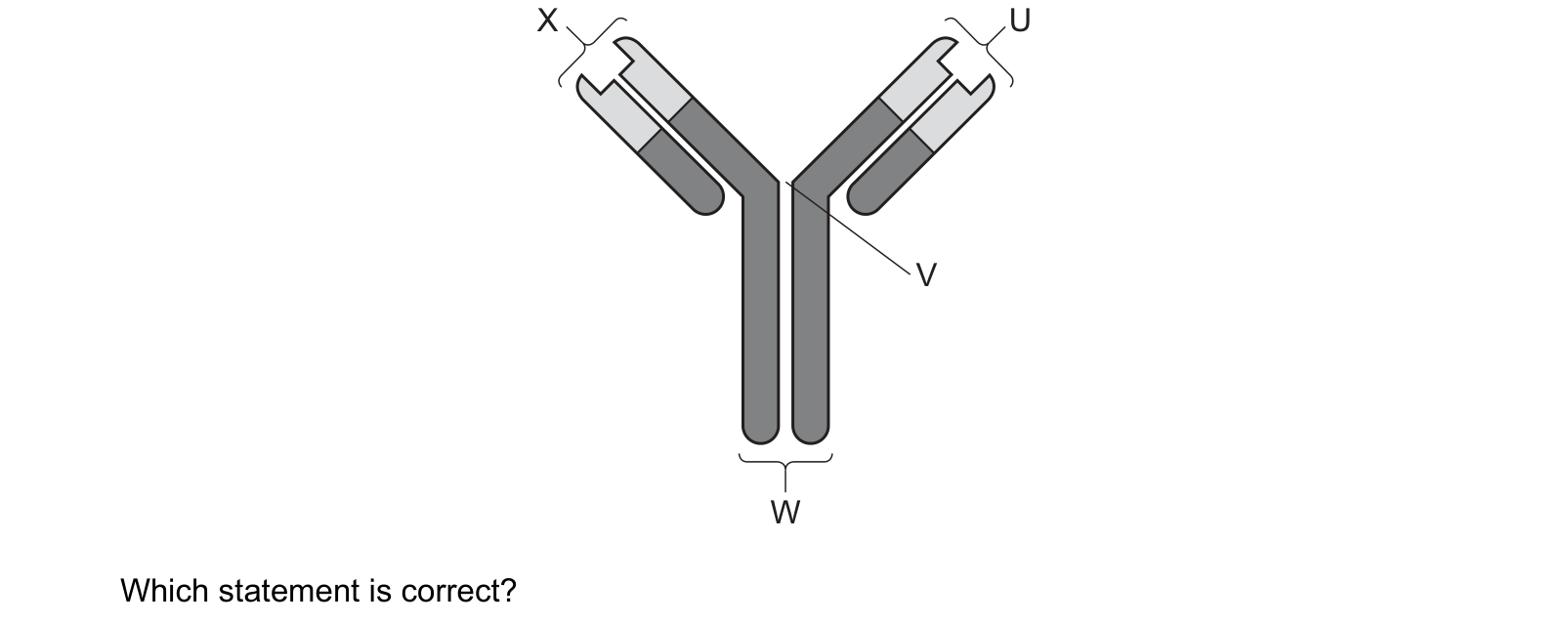
The diagram shows the simplified structure of an antibody. Which statement is correct?
Answer: B.
B is correct. The hinge lets the arms swing, so the antibody can change the angle between its two binding sites and reach two antigen molecules that are not conveniently spaced. That flexibility is what allows antibodies to clump pathogens together.
A is wrong for a reason worth getting straight. An antibody does have two binding sites, but they are identical, because both are built from the same variable sequence. It binds two molecules of the same antigen, never two different ones. Being able to bind only one antigen is the whole point of specificity.
C is wrong because W is the constant region at the stem, and no antigen binds there.
D is wrong in the mirror image of C. It is W, the stem, that a phagocyte's receptor binds to, and that is how an antibody-coated pathogen gets recognised and engulfed. X is at the far end, busy holding the antigen.
Question 5
A student wrote the following statements about the production of monoclonal antibodies.
Which statement is not correct?
Answer: D.
A is correct: a non-self antigen is injected into a mammal, usually a mouse, to provoke the response.
B is correct: plasma cells are the antibody factories, and they are what the spleen is harvested for.
C is correct: the selected hybridoma divides by mitosis to give a clone, which is where the word monoclonal comes from.
The error in D is the single most common one in this topic, because both cell types are lymphocytes and only one of them secretes antibody.
What this practice covers
These questions are drawn from past CIE 9700 Biology papers and filtered to antibodies and vaccination. You answer, you find out immediately whether you were right, and you get the reasoning for the correct option and for each distractor. Wrong answers go to a mistakes locker so you can come back to exactly those.
Practice is free. You need an account only so your progress and your mistakes are still there next time.
What examiners see students get wrong here
These are the errors that cost marks on antibodies and vaccination, taken from our own topic notes. Read them before you practise and you will recognise the traps in the questions.
- Saying antibodies kill pathogens. They agglutinate, neutralise and mark them; phagocytes and other mechanisms do the killing.
- Saying an antibody has one binding site. It has two, which is what makes agglutination possible.
- Calling breast milk antibodies active immunity. Antibodies received ready-made are passive.
- Saying a vaccine gives immediate protection. It takes days, because a primary response has to happen first.
- Saying myeloma cells are cultured to make the antibody. The hybridoma clone is; myeloma cells alone make nothing useful.
Revise it first
If any of the above is unfamiliar, work through the notes before practising: Antibodies and vaccination revision notes.