Replication and division of nuclei and cells: five questions to try now
Real past-paper questions, the answer key from the mark scheme, and the explanation that goes with it. No account needed to answer them.
Question 1
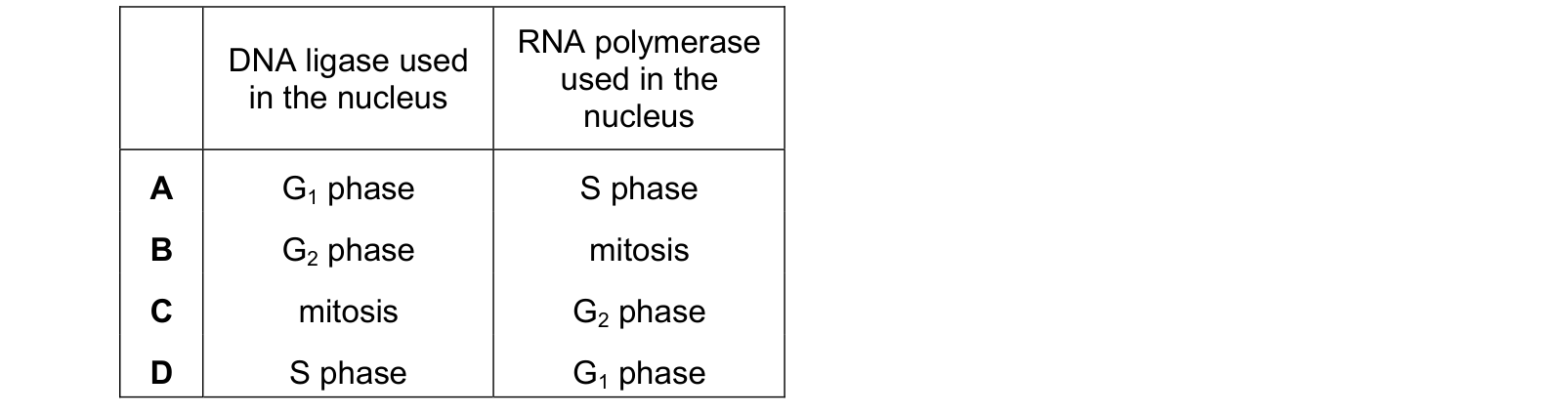
Which row about the stages of the mitotic cell cycle is correct? Each answer gives, in order: DNA ligase used in the nucleus; RNA polymerase used in the nucleus.
Answer: D.
DNA ligase joins fragments of DNA together, which happens during replication. Replication is S phase, so that is the first column.
RNA polymerase builds mRNA from a DNA template, which is transcription. Transcription happens whenever a cell is making proteins, and in the cycle that is the growth phase, G1.
S phase then G1, which is D.
The trap is assuming the two columns must run in cycle order. They do not: the question pairs an enzyme with a phase, and here the phases happen to come out of order.
Question 2
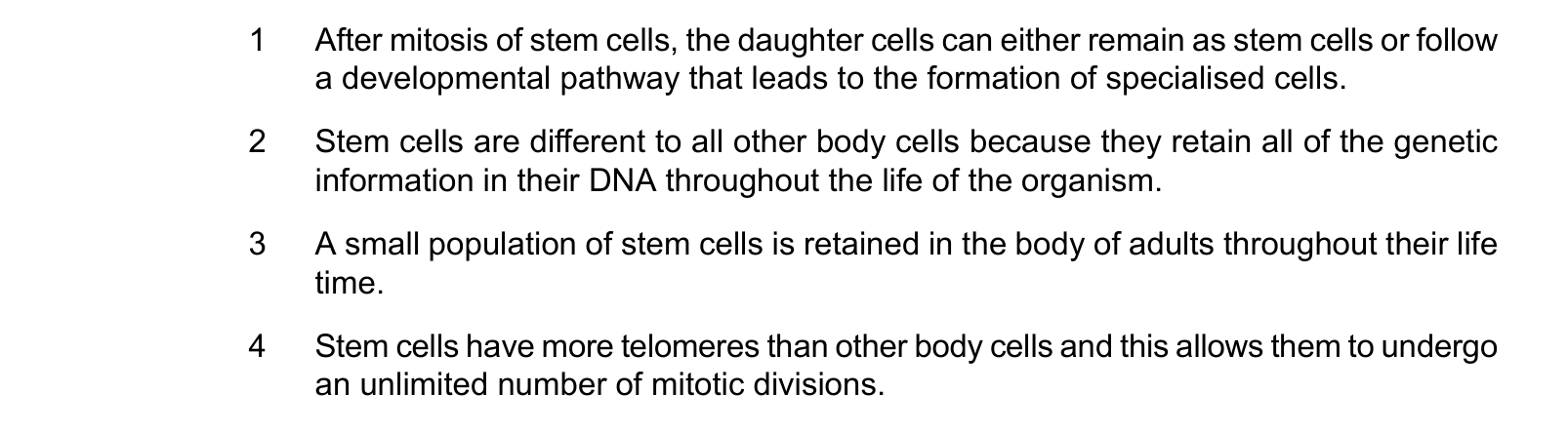
Which statements correctly describe features of stem cells that are essential for their role in cell replacement and tissue repair?
Answer: C.
1 is the definition. After a stem cell divides, one daughter can stay a stem cell while the other goes down a pathway to a specialised cell. That combination, self-renewal plus differentiation, is exactly what tissue repair needs: replace the lost cell and keep the supply going.
3 is correct and it is why repair is possible at all in an adult. Small populations persist for life in bone marrow, in the basal layer of the skin, in the lining of the gut. Without them a graze would never heal.
2 is wrong, and it is the most tempting distractor here. Every body cell keeps its full genome; a liver cell has the same DNA as a stem cell. What differs is which genes are expressed. Retaining the genetic information cannot be what makes stem cells different, because nothing has lost it.
4 is wrong on the biology of telomeres. A stem cell does not have more telomeres. Every chromosome has one at each end, in every cell. What stem cells have is active telomerase, the enzyme that rebuilds telomeres after each replication, so they do not shorten to the point where division stops.
1 and 3 only, which is C.
Question 3
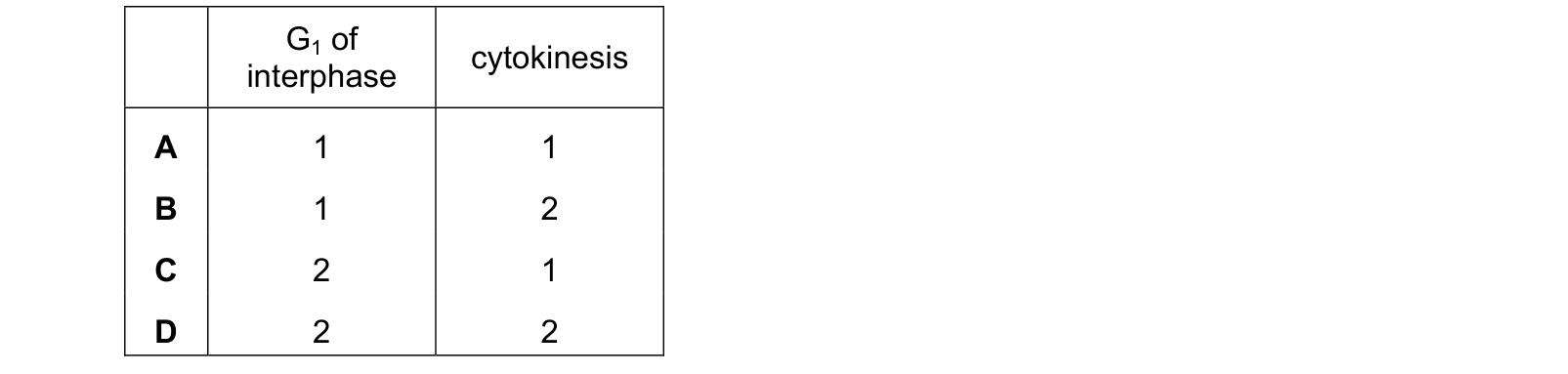
How many copies of each DNA molecule will be found in a cell at the start of the stages of the mitotic cell cycle shown? Each answer gives, in order: G1 of interphase; cytokinesis.
Answer: B.
By cytokinesis the DNA has been replicated in S phase and the chromatids have been separated by mitosis, but the cytoplasm has not yet split. The cell therefore still contains two copies of each molecule, one heading into each daughter cell.
One then two, which is B.
D is the tempting wrong answer, from treating G1 as though replication had already happened. Replication is the definition of S phase, and G1 comes before it.
Question 4
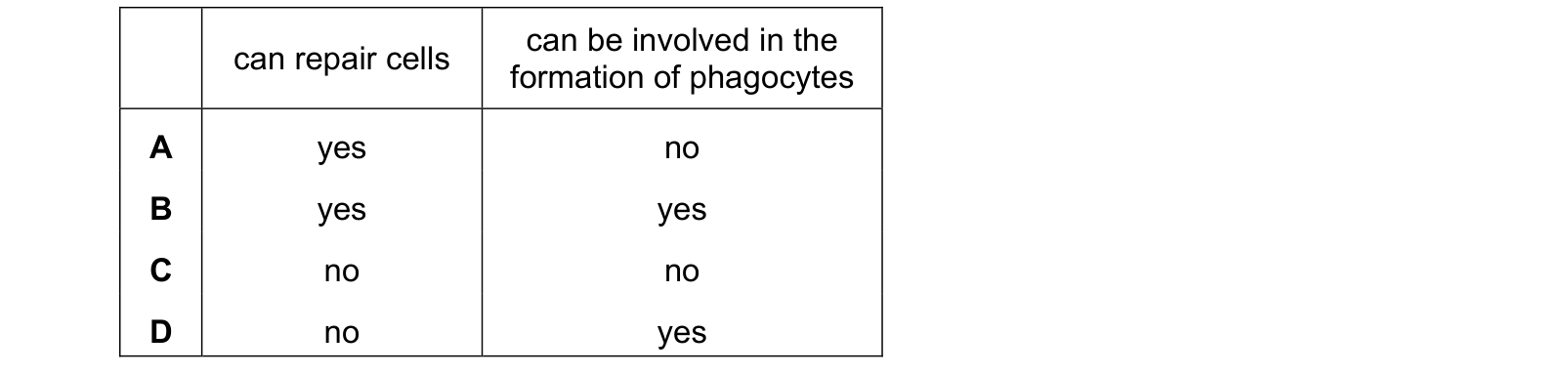
Which row is correct for stem cells? Each answer gives, in order: can repair cells; can be involved in the formation of phagocytes.
Answer: D.
The second is yes. Multipotent stem cells in the bone marrow give rise to all the blood cells, and that includes the phagocytes: neutrophils and the monocytes that become macrophages.
No then yes, which is D.
The distinction the question is testing is repair of a cell against replacement of a cell. Tissues are repaired by replacing their cells, and that is what stem cells contribute to.
Question 5
The diagram shows some of the stages that take place during the cell cycle. Which two stages take place during interphase?
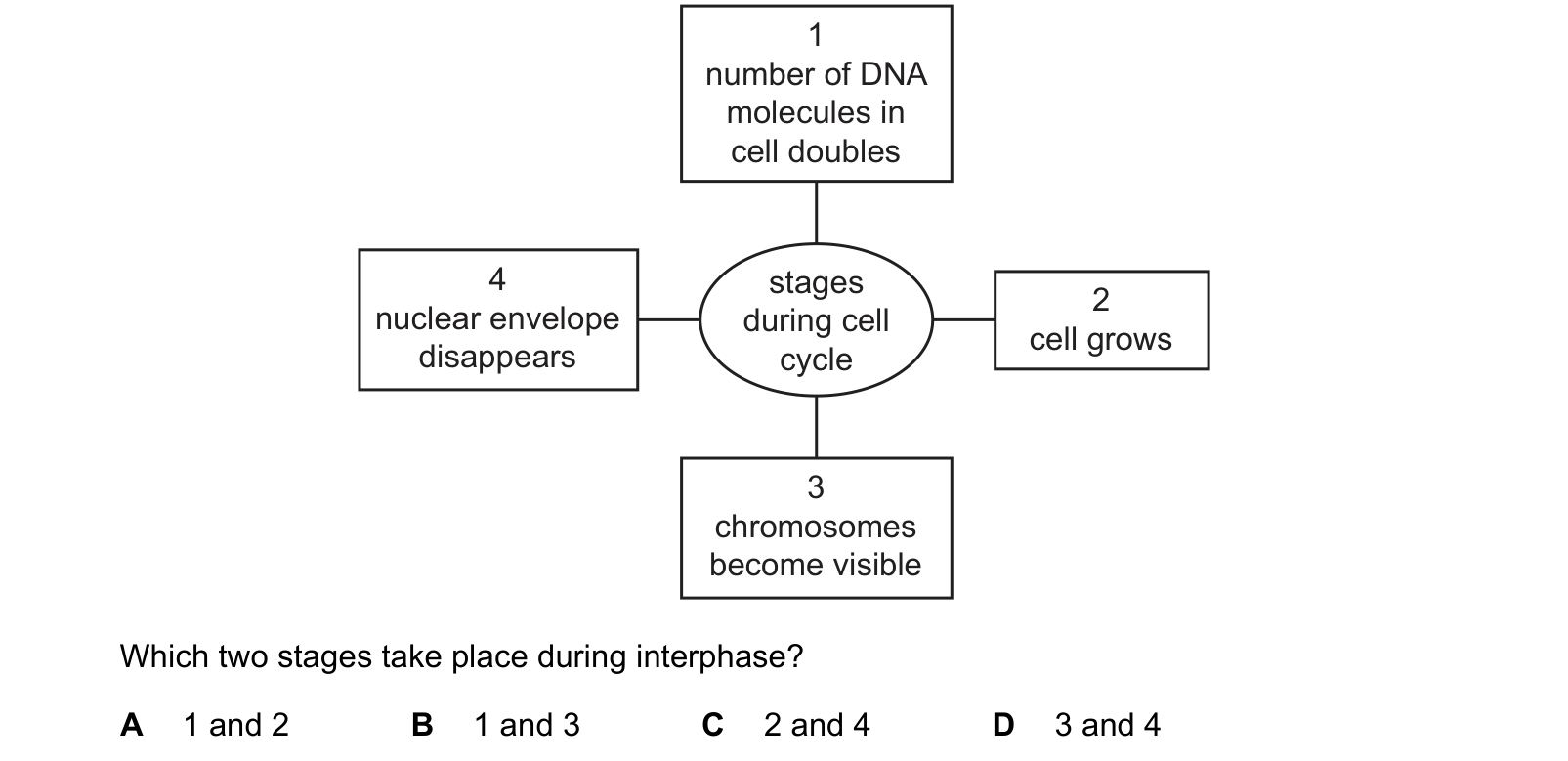
Answer: A.
1, the number of DNA molecules doubling, is S phase, and S phase is part of interphase.
2, the cell growing, happens in G₁ and again in G₂, both of which are interphase. This is the part students forget, because "interphase" gets taught as a resting stage when it is the busiest part of the cycle by far.
1 and 2, which is A.
The other two belong to prophase, and so to mitosis rather than interphase. 3, chromosomes becoming visible, is the chromatin coiling and condensing until it is thick enough to see. During interphase the DNA is uncoiled, which is precisely what allows it to be transcribed and replicated. 4, the nuclear envelope disappearing, has to happen before the spindle can reach the chromosomes at all.
What this practice covers
These questions are drawn from past CIE 9700 Biology papers and filtered to replication and division of nuclei and cells. You answer, you find out immediately whether you were right, and you get the reasoning for the correct option and for each distractor. Wrong answers go to a mistakes locker so you can come back to exactly those.
Practice is free. You need an account only so your progress and your mistakes are still there next time.
What examiners see students get wrong here
These are the errors that cost marks on replication and division of nuclei and cells, taken from our own topic notes. Read them before you practise and you will recognise the traps in the questions.
- Calling interphase a resting stage. It is the longest and most active part of the cycle.
- Saying the chromosome number doubles in S phase. The DNA quantity doubles; the chromosome number does not.
- Saying telomeres stop the chromosome fraying. They exist so that the DNA lost at replication is non-coding.
- Saying high telomerase limits division. It allows more division.
- Saying cancer is caused by one mutation. Usually several are needed in the same cell line.
Revise it first
If any of the above is unfamiliar, work through the notes before practising: Replication and division of nuclei and cells revision notes.