Protein synthesis: five questions to try now
Real past-paper questions, the answer key from the mark scheme, and the explanation that goes with it. No account needed to answer them.
Question 1
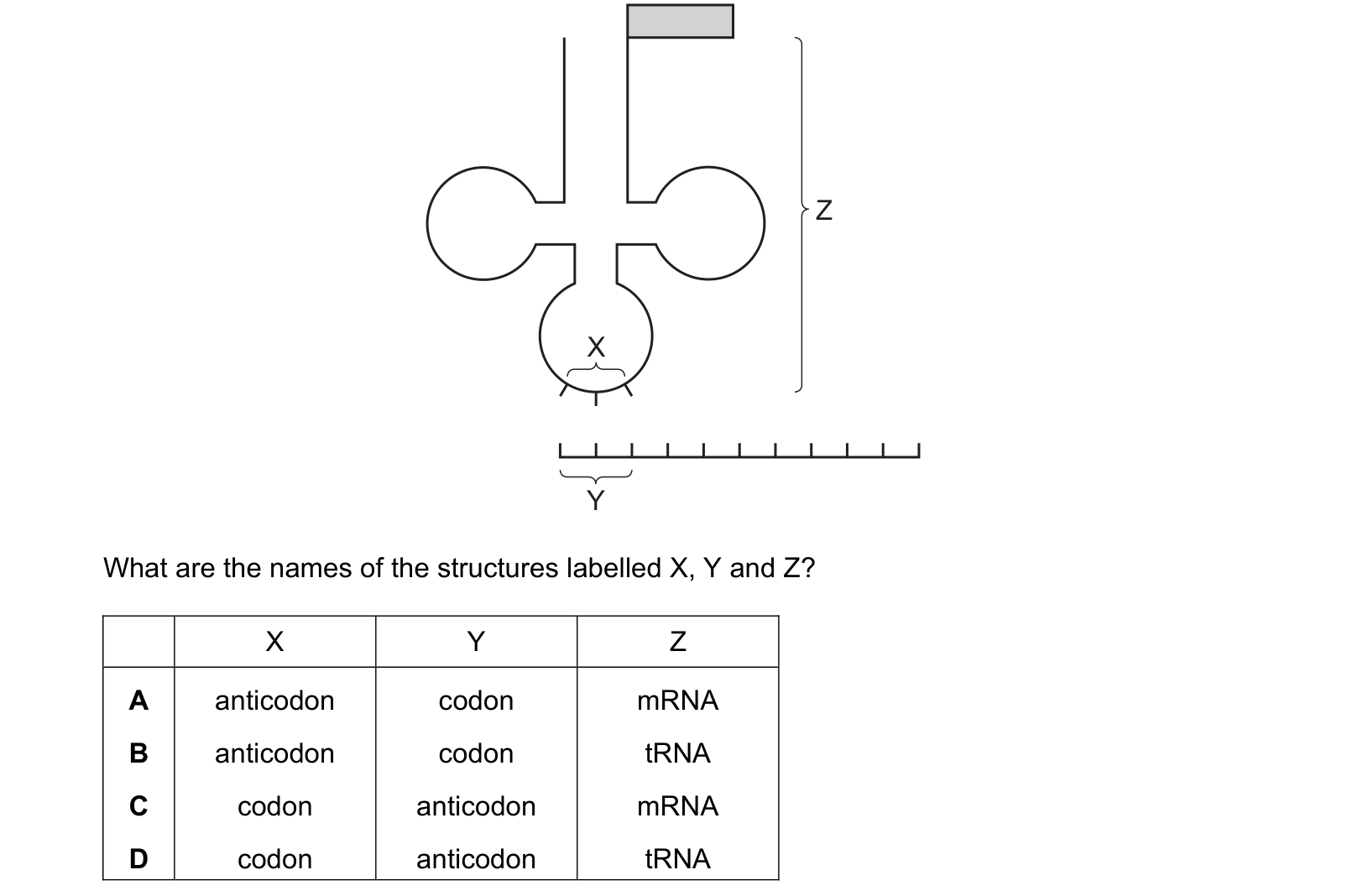
The diagram shows part of the process of translation. What are the names of the structures labelled X, Y and Z? Each answer gives, in order: X; Y; Z.
Answer: B.
X is the three bases at the bottom of the middle loop, on the tRNA itself. Three bases on a tRNA are its anticodon, the part that recognises the message.
Y is the three bases marked out on the long straight strand underneath, which is the mRNA passing through the ribosome. Three bases on mRNA are a codon.
Anticodon, codon, tRNA, which is B.
The naming is worth fixing properly because it is easy to reverse. The codon is on the messenger; it is the instruction. The anticodon is on the transfer molecule; it is what reads the instruction. They are complementary and held together by hydrogen bonds while the amino acid is added to the chain, then the tRNA lets go and leaves to collect another.
Question 2
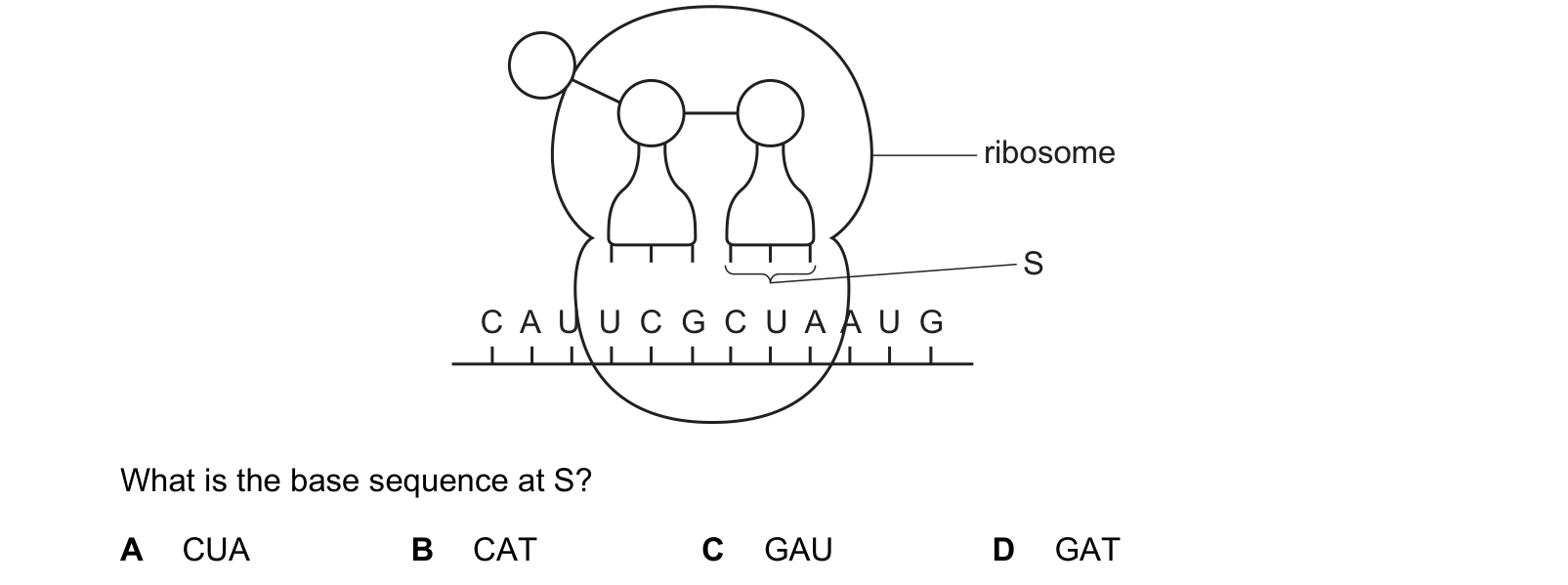
The diagram shows the process of translation occurring at a ribosome. What is the base sequence at S?
Answer: C.
Read the mRNA strand underneath in threes: CAU · UCG · CUA · AUG. The tRNA that S belongs to is sitting over the third codon, CUA.
An anticodon is complementary to its codon, so pair each base: C with G, U with A, A with U. The anticodon is GAU, which is C.
D, GAT, is the same sequence with a T in it, and that is the mistake the question is set to catch. tRNA is RNA, and RNA never contains thymine. Any option with a T can be crossed out on sight in a question about tRNA or mRNA.
A, CUA, is the codon itself, not its complement, so it is what you get by copying the mRNA instead of pairing with it.
B, CAT, is neither, and it also fails the no-thymine test.
Question 3
The anticodon for the amino acid tryptophan is ACC.
What shows a template DNA sequence that includes the DNA triplet for tryptophan?
Answer: D.
The anticodon is ACC. The mRNA codon is its complement: UGG.
The template DNA triplet is complementary to the codon, in DNA, so it is ACC. Notice that the template triplet and the anticodon have the same sequence, which is a useful shortcut: anticodon and template strand match, with T for U.
So look for a DNA sequence containing ACC, and D, CCT ACC CAT, is the one.
A and B contain U, so they are RNA and cannot be a DNA strand at all. C contains TGG, which is the codon written in DNA, so it is the non-transcribed strand rather than the template.
Question 4
Which statements are correct for chloroplasts and also for mitochondria?
1 They contain 80S ribosomes.
2 They can transcribe their circular DNA.
3 They can translate mRNA.
4 They are enclosed by double membranes.
Answer: C.
Both organelles have circular DNA they can transcribe, and their own ribosomes on which they can translate the resulting mRNA, and both are enclosed by a double membrane.
Statement 1 is the one to reject. Their ribosomes are 70S, the smaller prokaryotic type, not the 80S found in the rest of a eukaryotic cell.
That single fact is the strongest piece of evidence for the endosymbiotic theory. Circular DNA, 70S ribosomes and a double membrane are exactly what you would expect if these organelles descend from free-living prokaryotes engulfed by an early cell.
Question 5
A polypeptide molecule contains the amino acid sequence:
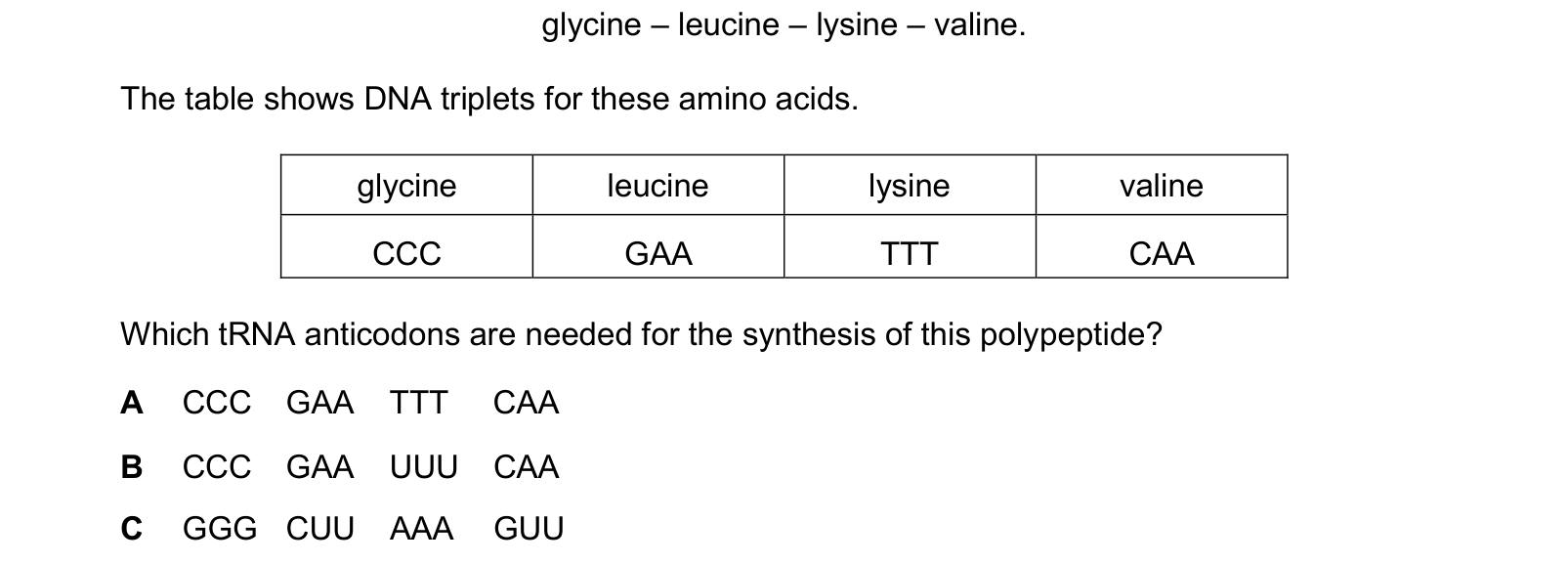
glycine – leucine – lysine – valine.
The table shows DNA triplets for these amino acids.
glycine leucine lysine valine
CCC GAA TTT CAA
Which tRNA anticodons are needed for the synthesis of this polypeptide?
Answer: B.
Start from the DNA triplets: CCC · GAA · TTT · CAA. These are on the template strand, so transcribe them to get the mRNA codons:
CCC → GGG, GAA → CUU, TTT → AAA, CAA → GUU
Now the anticodons, which are complementary to the codons:
GGG → CCC, CUU → GAA, AAA → UUU, GUU → CAA
CCC GAA UUU CAA, which is B.
C is the mRNA codons, one step short. A is the DNA triplets unchanged, and it fails on a rule as well as on the reasoning: tRNA is RNA, so it cannot contain the T in TTT. D is a mixture of the two.
There is a shortcut hiding in the arithmetic. Complementing twice gets you back where you started, so an anticodon is the same as the DNA template triplet with U in place of T. Compare A and B and that is exactly the difference between them. The shortcut is worth knowing, but the two-step working is worth doing at least until it is second nature, because it is the same working the exam asks for elsewhere.
What this practice covers
These questions are drawn from past CIE 9700 Biology papers and filtered to protein synthesis. You answer, you find out immediately whether you were right, and you get the reasoning for the correct option and for each distractor. Wrong answers go to a mistakes locker so you can come back to exactly those.
Practice is free. You need an account only so your progress and your mistakes are still there next time.
What examiners see students get wrong here
These are the errors that cost marks on protein synthesis, taken from our own topic notes. Read them before you practise and you will recognise the traps in the questions.
- Saying mRNA is complementary to the coding strand. It is complementary to the template strand and identical to the coding strand.
- Saying the anticodon is on the mRNA. The codon is on mRNA; the anticodon is on tRNA.
- Saying transcription happens at the ribosome. Transcription is in the nucleus; translation is at the ribosome.
- Saying tRNA "makes" the amino acid. It carries one that already exists in the cytoplasm.
- Saying the code is degenerate "because some codons are unused". Degeneracy means several codons code for the same amino acid.
Revise it first
If any of the above is unfamiliar, work through the notes before practising: Protein synthesis revision notes.