Transport mechanisms: five questions to try now
Real past-paper questions, the answer key from the mark scheme, and the explanation that goes with it. No account needed to answer them.
Question 1
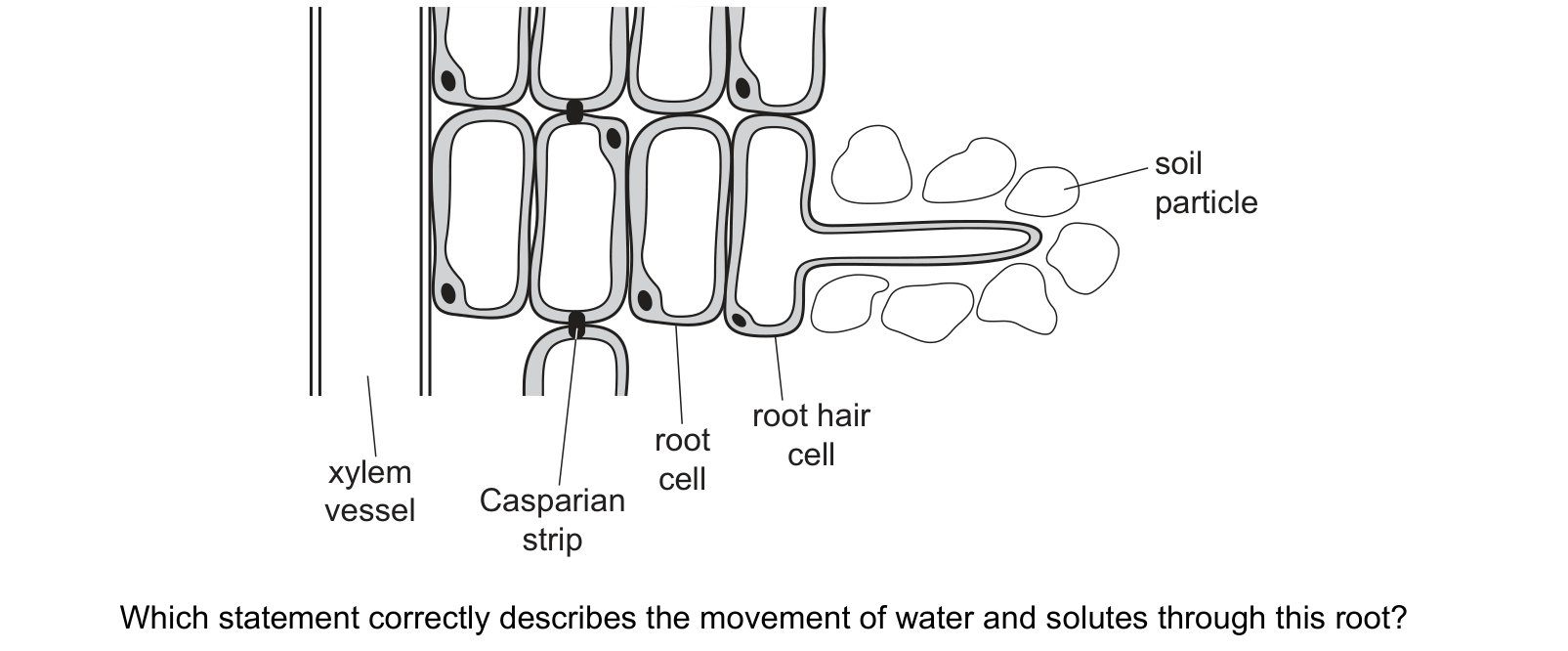
The diagram shows a section through a root of a dicotyledonous plant. Which statement correctly describes the movement of water and solutes through this root?
Answer: A.
Suberin is waterproof. Water and dissolved solutes travelling through the cell walls, which is the apoplast pathway, hit that band and cannot go any further. The only way onwards is to cross the cell surface membrane into the cytoplasm and continue through the cells, which is the symplast pathway. Apoplast into symplast, which is A.
B has the right molecule and the wrong direction. Nothing forces water out of the cytoplasm and back into the walls at the endodermis; the strip is a barrier to the walls, not to the cytoplasm.
C and D name the wrong structure entirely. The tonoplast is the membrane around a plant cell's vacuole. It sits well inside the cell and has no part in getting water across the root.
The reason a plant bothers with any of this: the apoplast is a fast, uncontrolled route, and if it ran all the way to the xylem the plant would have no say over what entered its transport system. Forcing everything through a membrane at the endodermis is what makes uptake selective.
Question 2
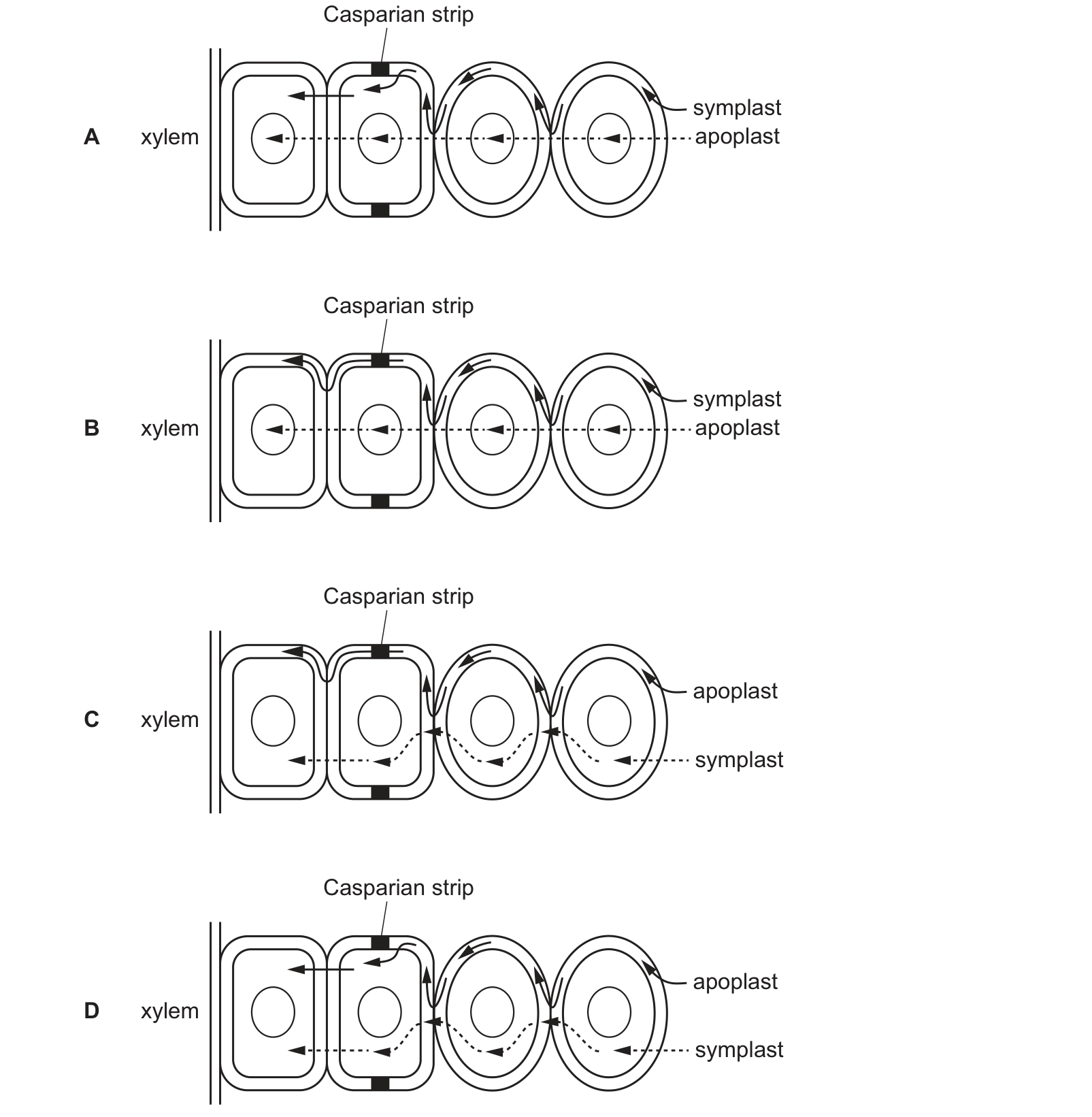
Four students sketched diagrams of the apoplast pathway and the symplast pathway.
Which sketch is the most accurate diagram of the two pathways?
Answer: D.
The labels. The apoplast is the route through the cell walls, so it must be the line running around the outside of each cell. The symplast is the route through the cytoplasm, passing from cell to cell through plasmodesmata, so it must be the line running through the middle. A and B both have these the wrong way round: they draw a line straight through the centres of the cells and label it apoplast.
What happens at the Casparian strip. The strip is a band of suberin in the endodermal cell wall, and suberin is waterproof, so the apoplast route is blocked there. The water has no choice but to cross the cell surface membrane and continue through the cytoplasm. C draws the apoplast carrying straight on past the strip into the xylem, which is exactly what cannot happen. If it could, the strip would serve no purpose.
D is the only sketch that gets both. The apoplast runs in the walls, the symplast runs through the cytoplasm, and at the endodermis the apoplast route turns inwards and joins the symplast before reaching the xylem.
The reason it matters: forcing everything through a living membrane at least once is how the root controls which mineral ions get into the xylem, and how it stops them leaking back out.
Question 3
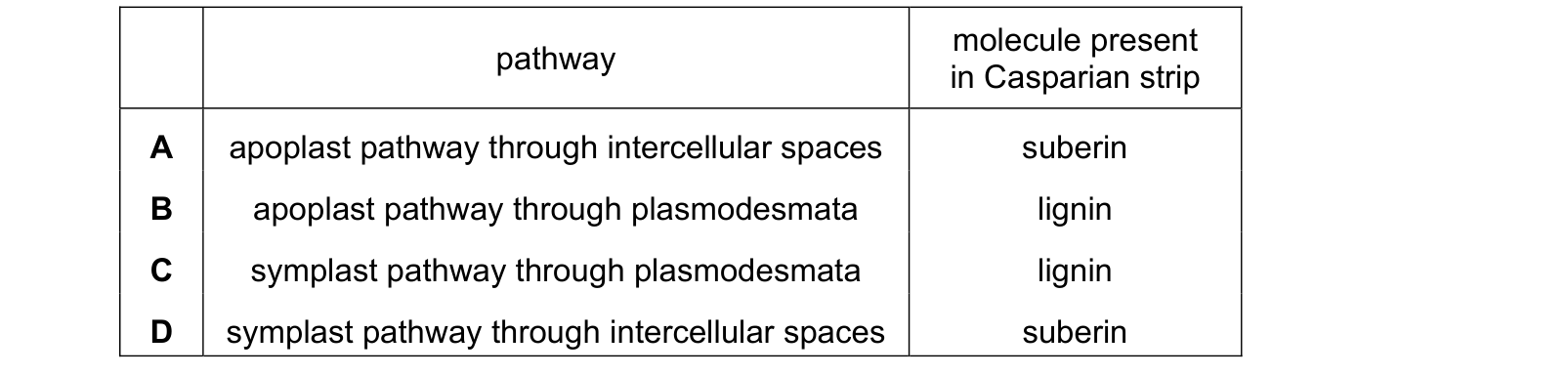
Which row is correct for the movement of water in a root? Each answer gives, in order: pathway; molecule present in Casparian strip.
Answer: A.
The apoplast pathway is the route through the cell walls and the intercellular spaces, never entering a cell. The symplast route is through the cytoplasm, and that is the one that uses plasmodesmata. So A and B are the apoplast rows and only A pairs it with intercellular spaces.
The Casparian strip is made of suberin, a waxy, impermeable substance. Lignin is what stiffens and waterproofs the xylem vessel wall, which is a different structure doing a different job.
Suberin with the Casparian strip and lignin with the xylem is worth memorising as a pair, because swapping them is what makes B and C look reasonable.
Question 4
Which feature of some xerophytic leaves reduces the rate of transpiration by decreasing the water potential gradient between the internal leaf surface and the atmosphere?
Answer: C.
Sunken stomata sit in pits, and water vapour diffusing out collects in the pit. That humid pocket has a higher water potential than the open air, so the difference across the stomatal pore is smaller and evaporation slows.
A, a waxy cuticle, works by making the epidermis impermeable, which blocks a route rather than changing a gradient.
B, spines, work by reducing the surface area available for evaporation.
D, water storage, does not affect evaporation at all; it just gives the plant a reserve.
All four reduce water loss. Only one does it the way the question asks about.
Question 5
A plant leaf seen in transverse section with a microscope shows the features listed. ● a thick waxy cuticle on upper surface ● sunken stomata on lower surface ● rolled leaf so the edges curl
What is this leaf adapted for?
Answer: C.
A thick waxy cuticle blocks evaporation through the epidermis. Sunken stomata sit in pits where humid air collects, reducing the water potential gradient across the pore. A rolled leaf encloses the stomata in a humid chamber, doing the same thing on a larger scale.
So the leaf is adapted to reduce water loss by transpiration, which is the classic xerophyte set.
A and B are about carbon dioxide, and here the relationship is the trade-off rather than the aim. Everything that restricts water leaving also restricts carbon dioxide entering, so a xerophyte pays for its water saving with a lower rate of photosynthesis. That cost is the point a strong answer makes, but it is not what the adaptations are for.
What this practice covers
These questions are drawn from past CIE 9700 Biology papers and filtered to transport mechanisms. You answer, you find out immediately whether you were right, and you get the reasoning for the correct option and for each distractor. Wrong answers go to a mistakes locker so you can come back to exactly those.
Practice is free. You need an account only so your progress and your mistakes are still there next time.
What examiners see students get wrong here
These are the errors that cost marks on transport mechanisms, taken from our own topic notes. Read them before you practise and you will recognise the traps in the questions.
- Saying water is pushed up the xylem by root pressure. It is pulled by transpiration.
- Confusing cohesion with adhesion. Cohesion is water to water; adhesion is water to the vessel wall.
- Putting lignin in the Casparian strip. It is suberin.
- Saying phloem transport is upward. It runs source to sink, in either direction.
- Saying mass flow requires ATP along the whole tube. ATP is used at loading; the flow follows a pressure gradient.
- Saying humidity increases transpiration. High humidity reduces the gradient and slows it.
Revise it first
If any of the above is unfamiliar, work through the notes before practising: Transport mechanisms revision notes.