Atomic structure: five questions to try now
Real past-paper questions, the answer key from the mark scheme, and the explanation that goes with it. No account needed to answer them.
Question 1
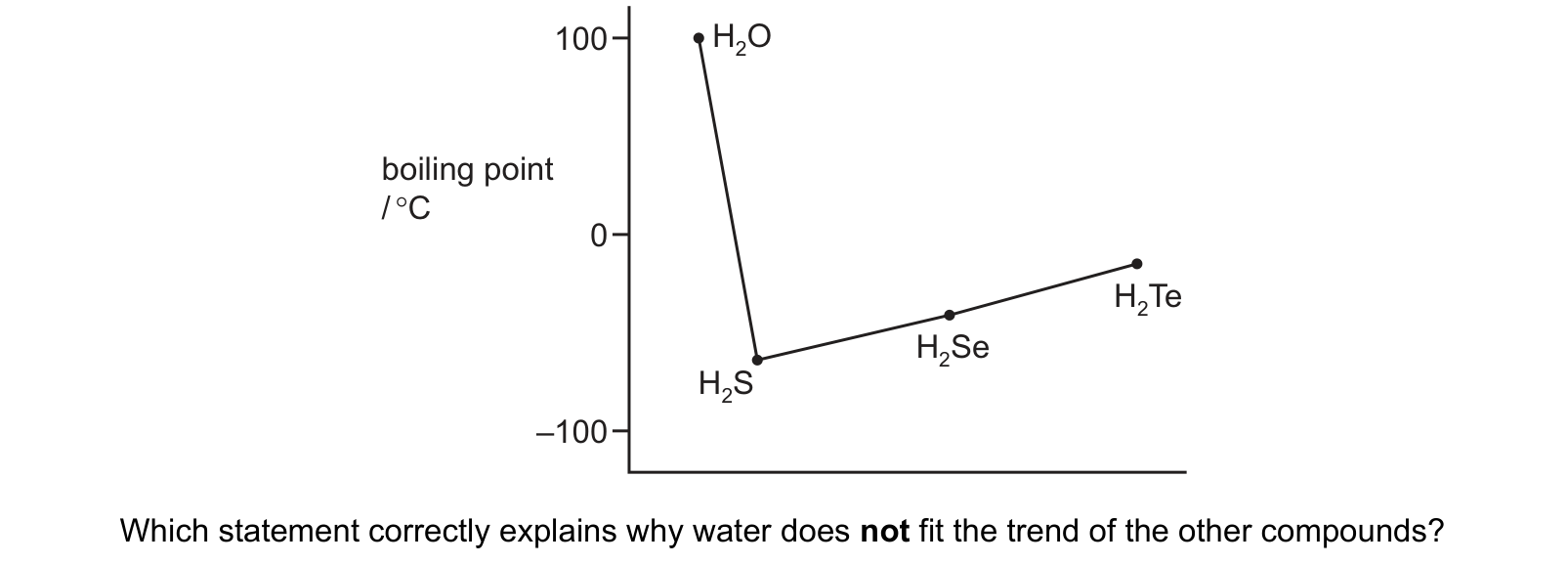
The graph shows the boiling points of the hydrogen compounds of Group 16 elements. Which statement correctly explains why water does not fit the trend of the other compounds?
Answer: B.
A hydrogen bond needs hydrogen attached directly to nitrogen, oxygen or fluorine. Oxygen is small and highly electronegative enough to make the O–H bond strongly polar and to offer a lone pair for the next molecule to bond to. Sulfur, selenium and tellurium are all too large and not electronegative enough, so their hydrides manage only van der Waals' forces and follow the ordinary trend of boiling point rising with molecular size.
C is the classic confusion and worth naming: boiling breaks intermolecular forces, not covalent bonds. The O–H bonds inside each molecule are still intact in the steam. How strong they are has nothing to do with the boiling point.
D has the trend backwards. Van der Waals' forces get stronger with more electrons, so the smallest molecule in the group has the weakest ones. If van der Waals' forces were the whole story, water would boil lowest of the four, which is exactly what the extrapolated line predicts and exactly what does not happen.
A is about ionisation energy and does not explain a boiling point at all.
Question 2
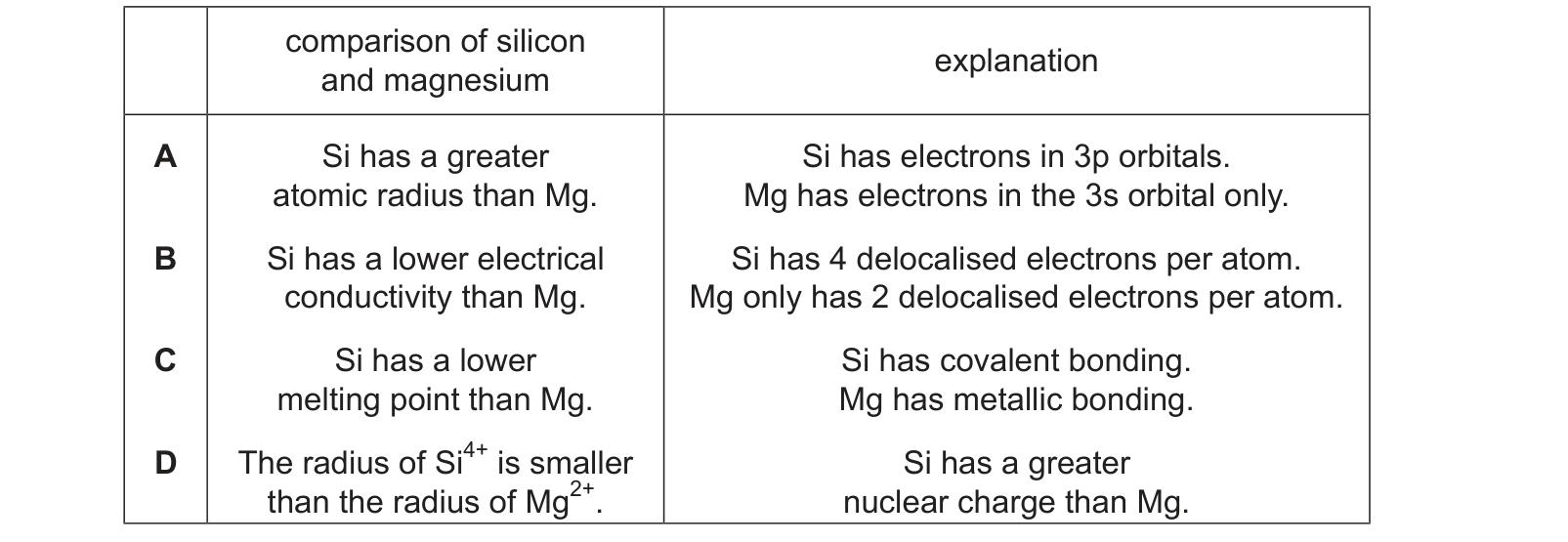
Which row about silicon, Si, and magnesium, Mg, and their ions is correct? Each answer gives, in order: comparison of silicon and magnesium; explanation.
Answer: D.
D is correct. Si⁴⁺ and Mg²⁺ both have 10 electrons, the same as neon. Silicon has 14 protons against magnesium's 12, so its nucleus pulls those ten electrons in more tightly and the ion is smaller. Same electrons, greater nuclear charge, smaller radius.
A is false. Atomic radius decreases across a period, because the nuclear charge rises while the electrons stay in the same shell. Silicon's atoms are smaller than magnesium's.
B has a true comparison and a false explanation. Silicon does conduct less well, but not because it has four delocalised electrons: it has none. Silicon is giant covalent, with every electron localised in a bond, which is precisely why it is a semiconductor rather than a metal.
C is false. Silicon melts at about 1410 °C and magnesium at 650 °C, so silicon's is higher. The explanation offered is even the reason why: melting a giant covalent structure means breaking covalent bonds throughout it, which costs far more than disrupting metallic bonding.
Isoelectronic ions are worth remembering as a set. Across N³⁻, O²⁻, F⁻, Na⁺, Mg²⁺, Al³⁺ and Si⁴⁺ the electron count is 10 throughout and the radius falls steadily as the nuclear charge rises.
Question 3
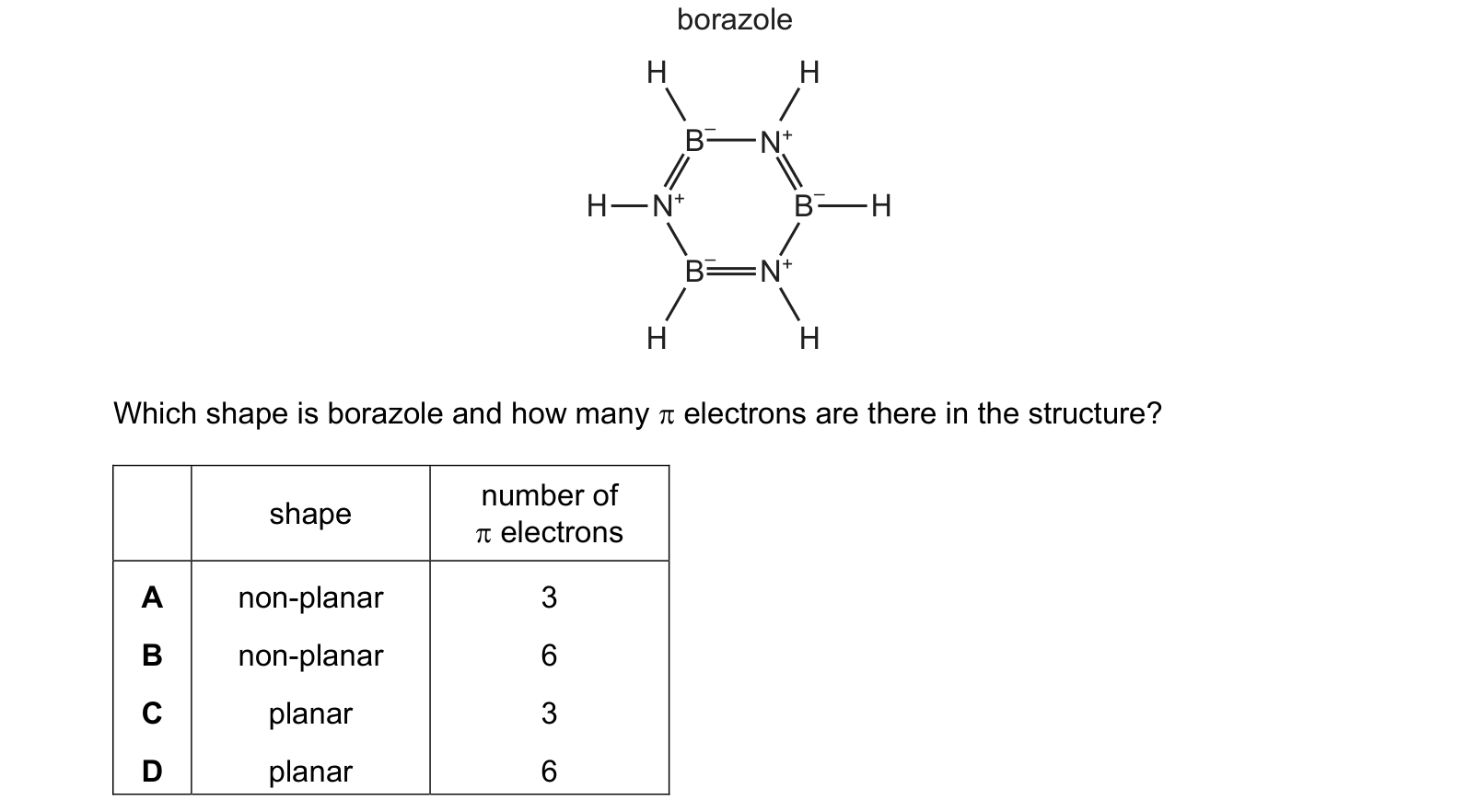
A structure for borazole, N3B3H6, is shown. borazole H H Which shape is borazole and how many π electrons are there in the structure? Each answer gives, in order: shape; number of π electrons.
Answer: D.
Planar. Every atom in the ring uses sp2 hybridisation, three sigma bonds arranged at 120° in a flat hexagon. Each boron and each nitrogen is left with a p orbital perpendicular to that plane, and those orbitals can only overlap sideways if the ring stays flat. Planarity is the condition for the π system to exist at all, which is why non-planar in A and B is not an option a delocalised ring can take.
Six π electrons. Three alternating B=N double bonds contribute the π bonds, and a π bond holds two electrons: 3 × 2 = 6.
The commonest slip is counting three, once per double bond, which is counting bonds where the question asks for electrons. That gives A or C.
The comparison with benzene is worth carrying: the same flat six-membered ring, the same six delocalised π electrons in a ring above and below the plane, and the same reluctance to undergo addition reactions. Borazole is sometimes called inorganic benzene for exactly that reason, though its ring is polar because nitrogen is much more electronegative than boron.
Question 4
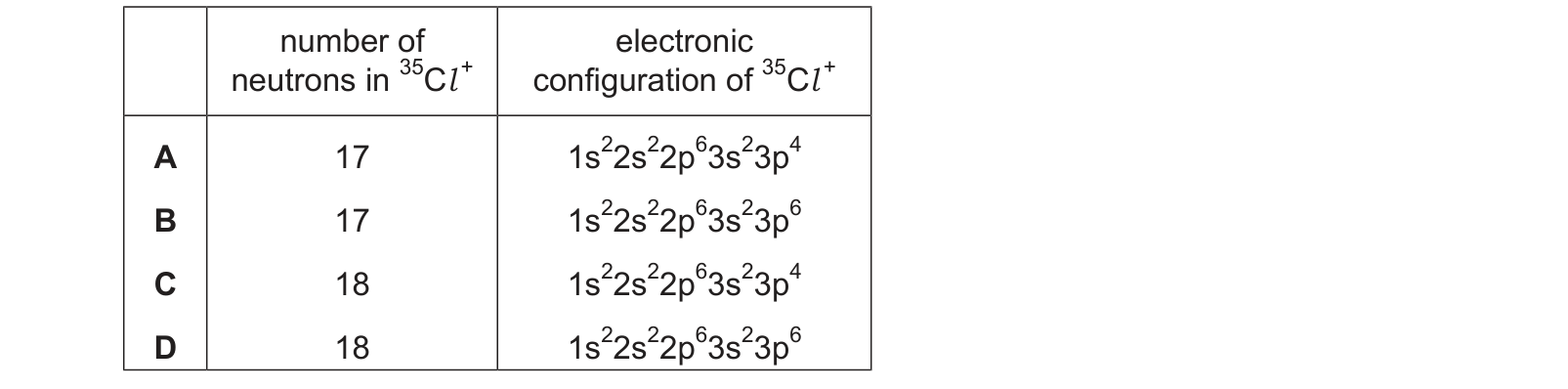
When chlorine gas is analysed in a mass spectrometer 35Cl + ions are detected. Which row is correct? Each answer gives, in order: number of neutrons in 35Cl +; electronic configuration of 35Cl +.
Answer: C.
Neutrons. Chlorine has 17 protons, and the mass number is 35, so
35 − 17 = 18 neutrons
That removes A and B.
Electrons. A neutral chlorine atom has 17 electrons, and the positive charge means one has been lost, leaving 16:
1s² 2s² 2p⁶ 3s² 3p⁴
which is C.
D gives 3p⁶, which would be 18 electrons, the configuration of the chloride ion, Cl⁻, or of argon. That is the natural mistake, because a full outer shell looks like the stable arrangement chlorine usually reaches. In a mass spectrometer, though, ions are made by knocking an electron off, so they are positive, and the species detected is Cl⁺ rather than Cl⁻.
The neutron count is unaffected by the charge, since charge is entirely about electrons. That is why the mass number and the proton number are all that is needed for the first half of the question.
Question 5
Which row is correct? Each answer gives, in order: molecule; shape; total number of pairs of electrons in the valence shell of the central atom.
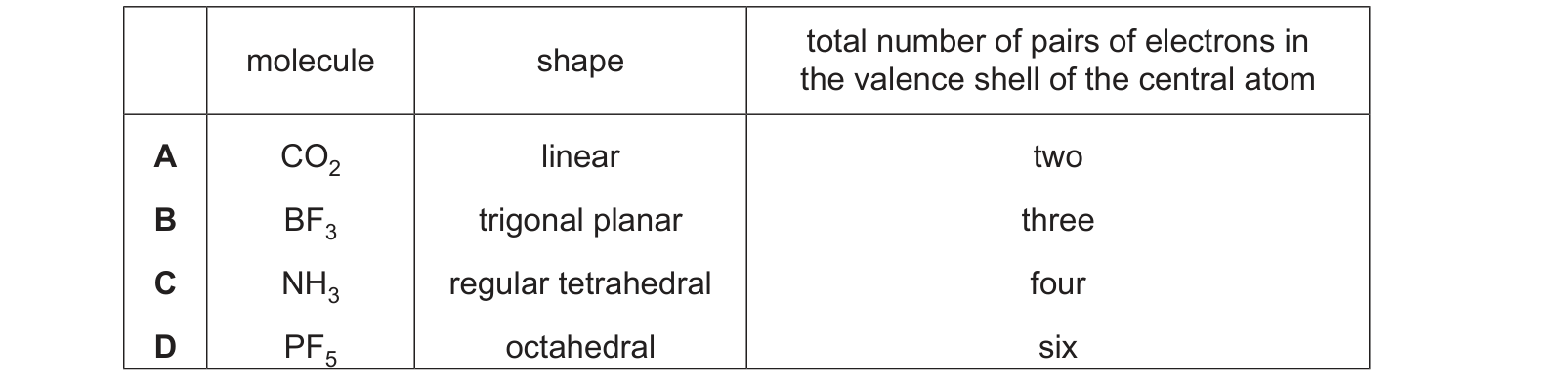
Answer: B.
B is correct. Boron has three outer electrons, all used in bonds to fluorine, so there are three pairs and no lone pair. Three regions give trigonal planar at 120° ✓
A gets the shape right and the count wrong. CO₂ is linear, but the carbon forms two double bonds, which is four bonding pairs, not two. The two double bonds behave as two regions for shape purposes, which is why it is linear, but the question asks for the number of pairs.
C gets the count right and the shape wrong. Nitrogen in ammonia has four pairs, three bonding and one lone, but the lone pair repels more strongly, so the shape is pyramidal at 107°, not a regular tetrahedron. Only the arrangement of the four pairs is tetrahedral.
D is wrong on both. PF₅ has five bonding pairs, not six, and five regions give a trigonal bipyramid, not an octahedron.
The distinction running through the whole question is between the arrangement of the electron pairs and the shape of the molecule, which differ whenever there is a lone pair.
What this practice covers
These questions are drawn from past CIE 9701 Chemistry papers. You answer, you find out immediately whether you were right, and you get the reasoning for the correct option and for each distractor. Wrong answers go to a mistakes locker so you can come back to exactly those.
Practice is free. You need an account only so your progress and your mistakes are still there next time.
What examiners see students get wrong here
These are the errors that cost marks on atomic structure, taken from our own topic notes. Read them before you practise and you will recognise the traps in the questions.
- Changing the number of neutrons when an ion forms. Only electrons are gained or lost.
- Writing Fe²⁺ as 3d⁴ 4s². The 4s electrons go first, so it is 3d⁶.
- Leaving "gaseous" or "one mole" out of the ionisation energy definition.
- Saying the atomic radius increases across a period. It decreases, because the nuclear charge grows while shielding stays about the same.
- Explaining the Mg to Al dip with shielding. The reason is the sub-shell: the electron comes from 3p rather than 3s.
- Explaining the P to S dip with nuclear charge. The reason is paired electron repulsion within one p orbital.
Revise it first
If any of the above is unfamiliar, work through the notes before practising: Atomic structure revision notes.