Atomic structure
Contents: 5 sections
The three particles
Everything in this topic follows from three numbers, so they are worth knowing exactly rather than approximately.
| Particle | Relative mass | Relative charge | Where it is |
|---|---|---|---|
| Proton | 1 | +1 | Nucleus |
| Neutron | 1 | 0 | Nucleus |
| Electron | 1/1836 | -1 | Shells around the nucleus |
The electron's mass is so small that it is usually taken as negligible, which is why the nucleon number (protons + neutrons) is effectively the mass of the atom.
Two definitions that questions rely on:
- Proton number (Z) is the number of protons. It defines the element and never changes in a chemical reaction.
- Nucleon number (A) is protons + neutrons.
Isotopes are atoms of the same element with different numbers of neutrons. They have identical chemical properties, because chemistry is decided by electrons, and different physical properties such as density and rate of diffusion, because those depend on mass.
Working out an ion
For an ion, adjust the electrons and nothing else. In ³⁵Cl⁻, the proton number is 17 and the nucleon number is 35, so:
- protons = 17
- neutrons = 35 - 17 = 18
- electrons = 17 + 1 = 18, because the single negative charge means one electron has been gained
A very common slip is to change the neutron count when forming an ion. Ions form by gaining or losing electrons only.
Shells, sub-shells and orbitals
Electrons occupy shells (numbered 1, 2, 3, ...), each divided into sub-shells (s, p, d, f), each made of orbitals that hold at most two electrons.
| Sub-shell | Orbitals | Maximum electrons |
|---|---|---|
| s | 1 | 2 |
| p | 3 | 6 |
| d | 5 | 10 |
| f | 7 | 14 |
An orbital is a region where there is a high probability of finding an electron. An s orbital is spherical; a p orbital is dumbbell-shaped, and the three p orbitals lie along the x, y and z axes at right angles to one another.
Sub-shells fill in order of increasing energy, and the order is not simply numerical:
1s 2s 2p 3s 3p 4s 3d 4p 5s 4d 5p
The 4s sub-shell is filled before 3d because it is at a lower energy. That single fact is behind several exam favourites.
Writing configurations
Calcium (Z = 20): 1s² 2s² 2p⁶ 3s² 3p⁶ 4s²
Iron (Z = 26): 1s² 2s² 2p⁶ 3s² 3p⁶ 3d⁶ 4s²
For ions of d-block elements, electrons are removed from the 4s sub-shell first, even though 4s was filled first. So Fe²⁺ is 1s² 2s² 2p⁶ 3s² 3p⁶ 3d⁶, not 3d⁴ 4s².
Two elements break the simple pattern because a half-filled or fully filled d sub-shell is more stable:
- Chromium is 3d⁵ 4s¹, not 3d⁴ 4s²
- Copper is 3d¹⁰ 4s¹, not 3d⁹ 4s²
Ionisation energy
First ionisation energy is the energy needed to remove one electron from each atom in one mole of gaseous atoms to form one mole of gaseous 1+ ions.
Every word of that definition earns marks: one mole, gaseous, and 1+ ions. The equation form is
X(g) → X⁺(g) + e⁻
Three factors decide the size of an ionisation energy:
- Nuclear charge. More protons pull the electrons in more strongly, so the energy is higher.
- Distance from the nucleus. An electron in a shell further out is held less strongly.
- Shielding. Inner shells of electrons repel the outer electron and reduce the pull it feels.
Across a period
First ionisation energy generally increases across a period: the nuclear charge rises while the electrons are added to the same shell, so shielding barely changes and the atomic radius falls.
Two dips break the trend, and both are examined constantly:
- Group 2 to Group 13 (for example Mg to Al). The outer electron in Al is in a 3p orbital, which is at a higher energy than the 3s orbital it would otherwise occupy, so it is easier to remove.
- Group 15 to Group 16 (for example P to S). In S the fourth p electron must pair up in an orbital that already holds one electron, and the repulsion between the pair makes it easier to remove.
Down a group
First ionisation energy decreases down a group. The nuclear charge does rise, but the outer electron is in a shell further from the nucleus and there is far more shielding from the extra inner shells, and those two effects win.
Successive ionisation energies
Removing each further electron takes more energy, because the ion is increasingly positive and holds the remaining electrons more tightly.
A large jump shows that an electron has been taken from a shell closer to the nucleus, and the position of that jump gives the group.
Suppose the first five ionisation energies of an element are 590, 1150, 4940, 6480 and 8120 kJ mol⁻¹. The big jump is between the second and third, so the element has two electrons in its outer shell and is in Group 2.
Common mistakes
- Changing the number of neutrons when an ion forms. Only electrons are gained or lost.
- Writing Fe²⁺ as 3d⁴ 4s². The 4s electrons go first, so it is 3d⁶.
- Leaving "gaseous" or "one mole" out of the ionisation energy definition.
- Saying the atomic radius increases across a period. It decreases, because the nuclear charge grows while shielding stays about the same.
- Explaining the Mg to Al dip with shielding. The reason is the sub-shell: the electron comes from 3p rather than 3s.
- Explaining the P to S dip with nuclear charge. The reason is paired electron repulsion within one p orbital.
Check you have it
Question 1
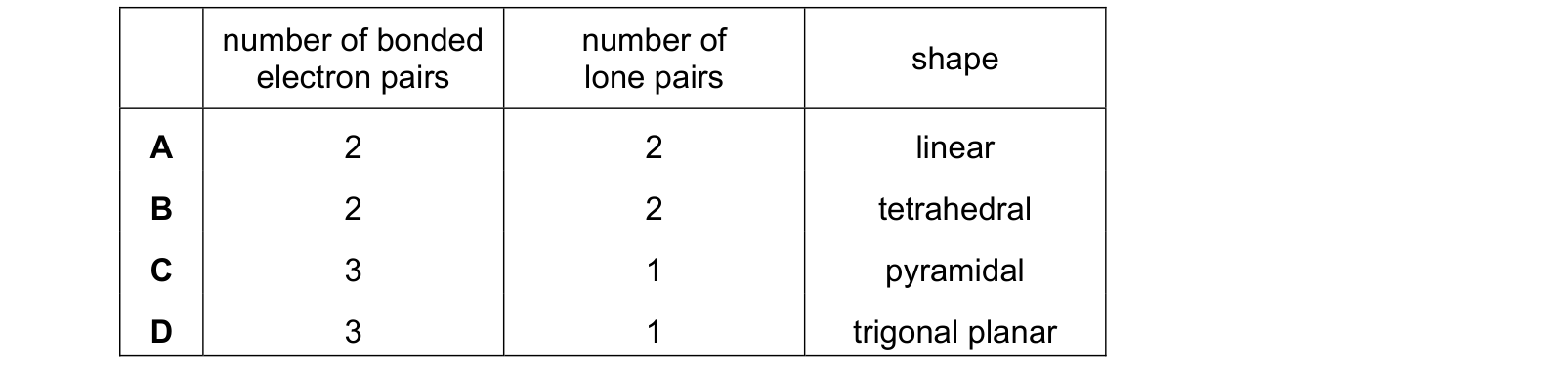
Which shape is correctly predicted by VSEPR theory? Each answer gives, in order: number of bonded electron pairs; number of lone pairs; shape.
Answer: C.
C is correct. Three bonding pairs and one lone pair make four regions, which arrange themselves tetrahedrally. With one of the four being a lone pair that you cannot see, the atoms form a pyramid. Ammonia is the example, with an angle of 107° rather than 109.5°, because the lone pair repels the bonds slightly more strongly.
D describes the same electron count and names the wrong shape. Trigonal planar needs three regions with no lone pair, as in BF₃.
A and B both have two bonding pairs and two lone pairs, which is again four regions, so the shape is bent at about 104.5°, as in water. It is neither linear, which needs two regions, nor tetrahedral, which is the name for the arrangement of the pairs rather than of the atoms.
The rule underneath all four is worth stating: the number of regions fixes the arrangement, and the number of lone pairs decides how much of that arrangement you can see. Four regions give tetrahedral, pyramidal or bent depending on whether none, one or two are lone pairs.
Question 2
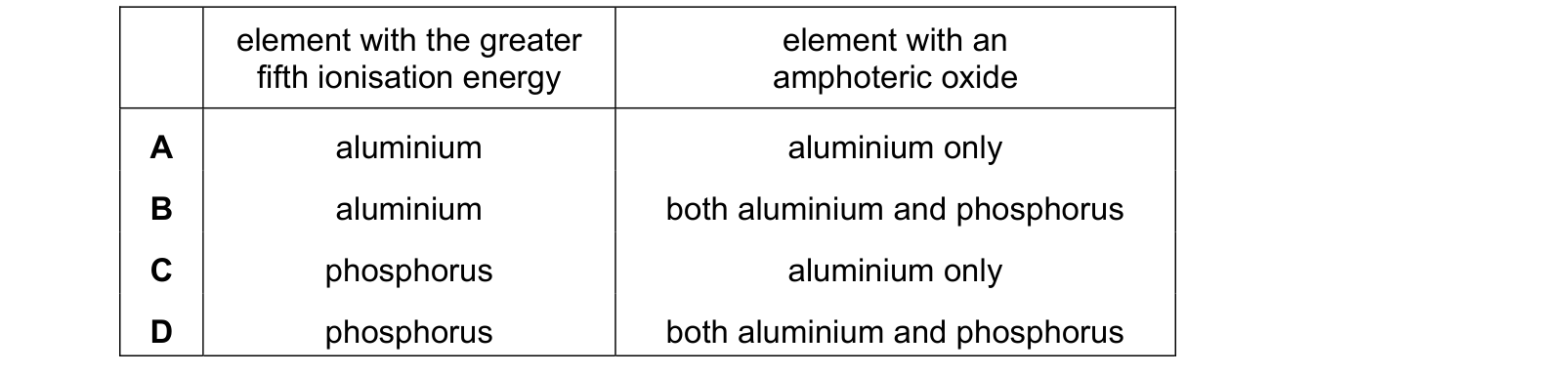
Which row is correct? Each answer gives, in order: element with the greater fifth ionisation energy; element with an amphoteric oxide.
Answer: A.
The fifth ionisation energy. Aluminium has three outer electrons, so its fourth ionisation already reaches into the full n = 2 shell, and its fifth is deeper still. Phosphorus has five outer electrons, so its fifth ionisation is still removing an outer electron. Pulling an electron from a complete inner shell around a highly charged ion takes far more energy, so aluminium has the greater fifth ionisation energy. That removes C and D.
The amphoteric oxide. Al₂O₃ reacts with both acids and alkalis, so it is amphoteric. Phosphorus oxides are acidic: P₄O₁₀ gives phosphoric acid with water. So aluminium only, which makes A the answer.
The ionisation-energy comparison is counter-intuitive at first, because phosphorus is further right and every first ionisation energy rises across the period. What matters here is not the position but which shell the fifth electron comes from, and that is decided by the group number.
The same reasoning identifies an unknown element's group from a table of successive ionisation energies: the big jump comes immediately after the group number has been exhausted.
Question 3
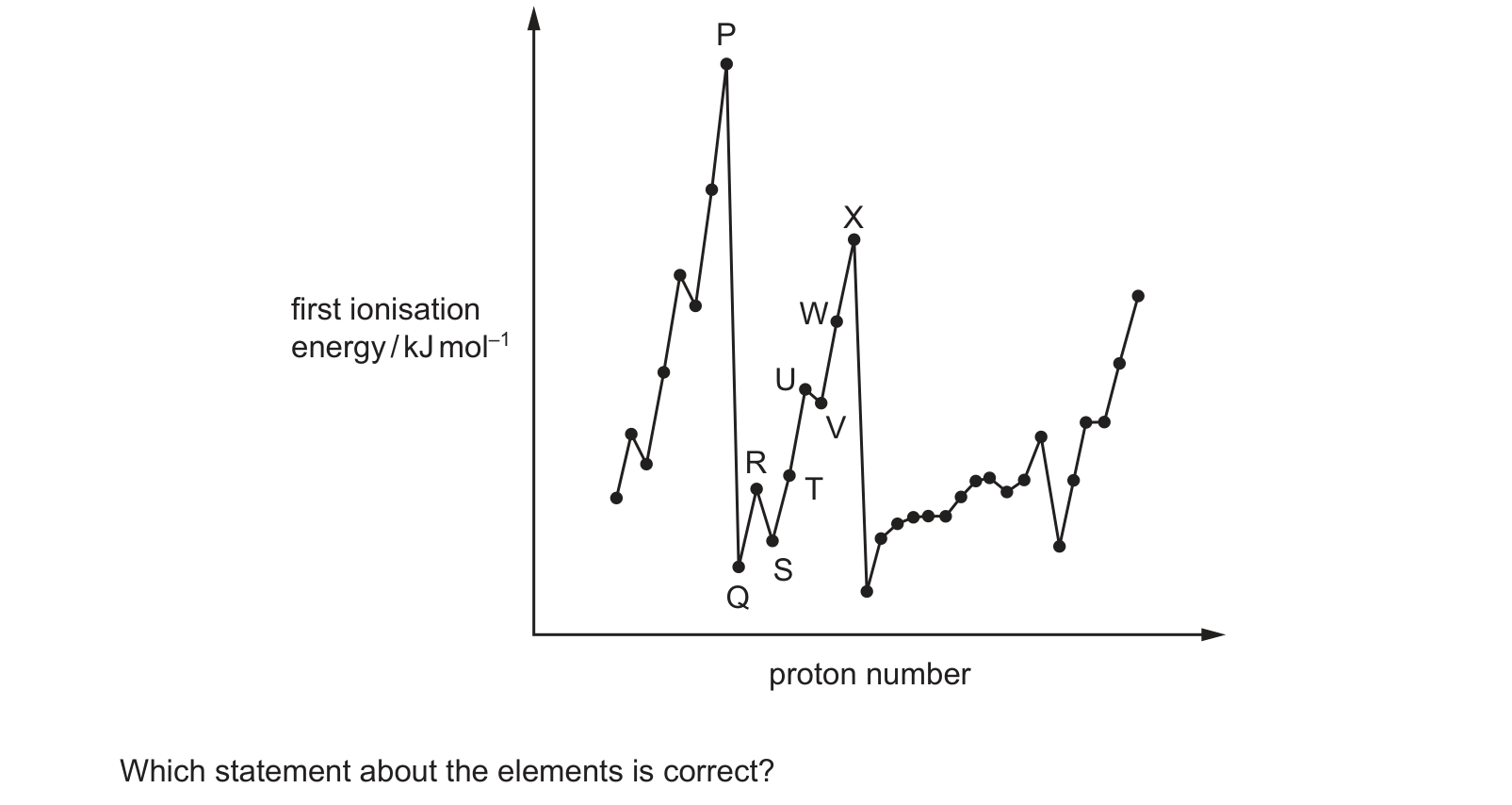
The graph shows the variation of the first ionisation energy with proton number for some elements. The letters used are not the actual symbols for the elements. Which statement about the elements is correct?
Answer: D.
Reading the graph, P is a noble gas ending one period and Q starts the next, so Q to X is a whole period across. U sits at the p³ configuration, where all three p electrons occupy separate orbitals, and V at p⁴, where one orbital now holds a pair. Those two electrons repel each other, so slightly less energy is needed to remove one, and the value falls despite the nuclear charge having risen.
A fails because P ends the previous period and X ends this one. They are both noble gases and both peaks, which is what makes them look alike, but a period boundary lies between them.
B has the reason backwards. Atomic radius decreases across a period, because electrons are added to the same shell while the nuclear charge grows. The rise in ionisation energy is caused by that increasing nuclear charge with shielding almost unchanged.
C gets the shielding the wrong way round too. R to S is the Group 2 to Group 13 drop, and there the outer electron has moved into a p subshell, which is higher in energy and is shielded slightly more by the filled s subshell beneath it.
The two small dips in every period have different causes, and the pattern is worth memorising as a pair: s to p at the first, and paired p electrons at the second.
What the syllabus asks for on this topicSyllabus points
Syllabus points
- Identify the relative charges and relative masses of a proton, a neutron and an electron.
- Deduce the numbers of protons, neutrons and electrons in atoms and ions from proton number and nucleon number.
- Describe the distribution of electrons in shells, sub-shells and orbitals.
- Write electronic configurations, including for ions and for the d-block elements.
- Define and explain first and successive ionisation energies, and the trends across a period and down a group.
Related CIE 9701 Chemistry topics
Not the topic you were looking for? Describe what you are stuck on in your own words and we will take you to the notes that answer it.